“The real voyage of discovery consists not in seeking new landscapes, but in having new eyes.”
— Reflecting on the nature of experience and perception.

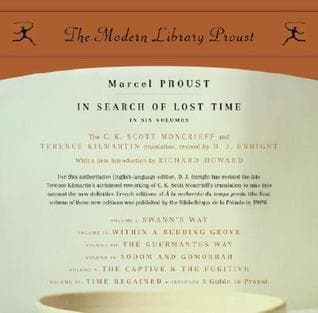
Marcel Proust (2002)
Genre
Literary Fiction / Philosophy
Reading Time
9000 min
Key Themes
See below
Sign in to track this book
A man eats a madeleine, which sends him on a long, inward journey through memory, society, and the nature of time as he puts back together a lost world.
The story begins with the narrator, Marcel, remembering his childhood nights at his family's country house in Combray. He describes his sadness when his mother does not come to kiss him goodnight, a routine broken when Monsieur Swann, a family friend, visits. This early feeling of longing sets a tone for much of the book. Marcel also describes his walks along the Méséglise way and the Guermantes way, two paths that come to stand for different parts of society and experience. A key moment happens when the taste of a madeleine dipped in lime-blossom tea brings back a strong, involuntary memory of his entire childhood in Combray, bringing a rush of forgotten sensations, images, and feelings. This event is the basis for his later artistic search.
Mixed with Marcel's childhood memories is a long section about the difficult love affair between Charles Swann, a cultured and rich man, and Odette de Crécy, a beautiful but mysterious courtesan. Swann, at first not interested in Odette, becomes consumed by a passionate, jealous, and finally unreturned love for her. He suffers greatly from her casual unfaithfulness and the uncertainty of her feelings, even though he knows she is not his equal in mind or social standing. This section details the psychology of jealousy, the false ideas of love, and the social scene of Parisian salons and the demi-monde. Swann's love for Odette, though it eventually fades, leaves him with a deep sense of loss and the understanding that his passion was for someone not worth it, hinting at Marcel's own future disappointments in love.
Marcel, now a young man, travels with his grandmother to the seaside town of Balbec. There, he becomes interested in a group of stylish young women who spend time on the beach. He is especially drawn to Albertine Simonet, a beautiful, mysterious, and seemingly hard-to-reach girl. Marcel's first tries to make friends with them are met with disinterest, but he eventually becomes close with Robert de Saint-Loup, a charming and aristocratic officer, and gets to know the girls. He experiences the difficulties of friendship, social climbing, and the exciting, yet often frustrating, search for love. His strong liking for Albertine begins here, marked by close watching, longing, and the first feelings of the jealousy that will later control their relationship.
Marcel, now wanting to be a writer, becomes more and more interested in the aristocratic Guermantes family, especially the Duchesse de Guermantes, whom he had admired from afar since childhood. Through his friendship with Saint-Loup and his family's connection to the Guermantes, he gets into their exclusive social group. He carefully watches their manners, conversations, and the complex social rules of the Faubourg Saint-Germain. He is at first drawn to the glamour of this world, but slowly becomes disappointed by its shallow nature, snobbery, and moral failures, realizing that the reality is not as good as his childhood fantasies. His rise in society gives him many characters and observations, but it is not satisfying in the end.
This volume looks at the subject of homosexuality, both male and female, as Marcel becomes more aware of the secret lives and desires of several characters. He sees the hidden relationship between Monsieur de Charlus, an eccentric aristocrat, and Jupien, a tailor. This discovery breaks Marcel's innocent views and shows him the complex and often painful realities of forbidden love and social judgment. He also starts to suspect that Albertine might have same-sex relationships, adding to his already strong jealousy. The title refers to biblical cities connected with sexual sin, showing the moral and social judgments around these relationships in the high society Marcel observes.
Marcel, overcome by extreme jealousy and suspicion about Albertine's past and possible unfaithfulness, especially with other women, brings her to live with him in his apartment in Paris. He tries to control her movements, her friends, and her whole life, believing that by keeping her confined, he can fully possess her and ease his suffering. However, this 'captivity' only makes his suffering worse, as his jealousy becomes a cycle of doubt, questioning, and paranoia. Albertine's presence, instead of bringing peace, increases his worries, turning their relationship into a psychological battleground where love and hatred are deeply connected. He constantly tries to find out the truth about her, but the truth remains out of reach.
One morning, Marcel wakes to find that Albertine has secretly left his apartment, leaving only a note. Her sudden leaving throws him into deep sadness, regret, and renewed jealousy. He tries to find her, sending Saint-Loup to ask questions, and even thinks about marrying her if she comes back. However, news of her death in a riding accident brings a different kind of sorrow, at first deep despair, but slowly leading to a long, painful process of forgetting. Marcel's love for Albertine, kept alive by her absence and then her death, slowly changes and lessens, showing how even the strongest passions fade when faced with time and distance. He realizes that forgetting is an unavoidable, though harsh, part of love.
Years later, Marcel goes to an afternoon gathering at the Prince de Guermantes's home. During the event, a series of involuntary memories are brought back by different sensations: the unevenness of paving stones, the sound of a spoon hitting a plate, the starched napkin. These experiences are like the madeleine incident, but now Marcel understands their deep meaning. He realizes that these moments of involuntary memory, which connect past and present, hold the essence of true reality and can only be captured through art. He recognizes his true calling as a writer, whose purpose is to find and change these lost moments into a lasting work of art. This sudden understanding marks the end of his long journey, giving him the meaning and direction he had looked for his whole life.
At the same afternoon gathering, Marcel watches the guests, many of whom he has known for years, and is struck by the great changes time has made. He sees them aged, disfigured, and changed, almost unrecognizable. The social scene has also changed a lot, with old aristocrats fading and new money gaining power. He sees a strange show of time, where people hold onto past identities while their bodies show the steady march of decay. This clear example of death and the temporary nature of human life strengthens his belief that only art can truly go beyond time and keep the essence of experience. The social gathering becomes a sad picture of human weakness and the illusion of permanence.
Having understood the deep meaning of involuntary memory and the destructive power of time, Marcel decides to start his great writing project. He realizes that his entire life, with all its sufferings, loves, social observations, and aesthetic experiences, has been a preparation for this task. The novel he plans to write will not just tell his life but will put it back together, giving meaning to the seemingly unconnected parts of his past through art. He imagines a work that mirrors how memory works, where past moments can be recovered and understood truly. The final pages describe his resolve to begin this major work, which is, in effect, the very book the reader has just finished, bringing the story to a strong, self-referential close.
The Protagonist
From a hypersensitive child obsessed with his mother's goodnight kiss, Marcel evolves into a disillusioned young man seeking love and social acceptance, ultimately discovering his true calling as a writer who can redeem lost time through art.
The Supporting
Initially a sophisticated man of the world, Swann descends into the torment of jealous love for Odette, eventually realizing the futility of his passion, but forever marked by the experience.
The Supporting
From a 'demi-mondaine' who causes Swann immense suffering, Odette rises in social status to become Madame Swann, embodying the changing face of Parisian society.
The Supporting
Introduced as a carefree young woman, Albertine becomes Marcel's captive, then fugitive, and finally a memory that gradually fades, symbolizing the transient nature of love and the pain of loss.
The Supporting
Beginning as a dashing and loyal friend, Saint-Loup navigates complex romantic relationships, eventually succumbing to the ravages of war and time, his youthful idealism giving way to a more melancholic existence.
The Supporting
From an ethereal, almost mythical figure of beauty and aristocracy in Marcel's childhood imagination, she transforms into a human figure, admired for her wit but ultimately a symbol of social superficiality and the passage of time.
The Supporting
Beginning as an intimidating and mysterious aristocrat, Charlus's hidden life as a homosexual is gradually revealed, leading to his social decline and a poignant portrayal of the ravages of time and obsession.
The Supporting
From Marcel's idealized first love in childhood, Gilberte becomes a friend, then a more distant acquaintance, eventually marrying Saint-Loup and representing the social connections that evolve over time.
The Supporting
Françoise remains a steadfast, if sometimes severe, presence throughout Marcel's life, representing the enduring domestic sphere amidst personal and societal changes.
This is the novel's main subject, looking at voluntary and involuntary memory and how they relate to time passing. Proust separates conscious, intellectual memory (voluntary) from spontaneous, sensory memory (involuntary), which he says is the only real way to get back and experience the past purely. The madeleine incident is the main example of involuntary memory. The novel shows how time steadily wears away experiences and identities, but also how art, through memory, can save and immortalize these 'lost times,' creating a world where past and present exist together.
“And suddenly the memory revealed itself. The taste was that of the little piece of madeleine which on Sunday mornings at Combray (because on those mornings I did not go out before mass), when I went to say good morning to her in her bedroom, my aunt Léonie used to give me, dipping it first in her own cup of lime-blossom tea.”
Proust closely examines the psychology of love, often showing it as suffering, false ideas, and finally, disappointment. Both Swann's love for Odette and Marcel's love for Albertine include strong jealousy, suspicion, and a constant wish to own the person loved. Love is shown to be less about the person loved and more about the lover's own thoughts and worries. The pain of jealousy and separation, while terrible, also helps lead to deeper self-reflection and artistic understanding, making the characters face what they and others truly are.
“One is not in love with a woman, one is in love with an ideal, one is in love with a dream.”
The novel gives a detailed and often funny picture of Parisian high society, especially the Faubourg Saint-Germain. Marcel's journey through this world shows its complex social rules, snobbery, moral hypocrisy, and the constant fight for status. At first drawn to the glamour of the aristocracy, Marcel slowly becomes disappointed, seeing the shallow nature and moral emptiness beneath the polished surface. This subject looks at the illusion of social permanence and the changing power, as old aristocratic families fade and new money rises.
“For society, the most important thing is not what you do, but how you do it.”
In the end, 'In Search of Lost Time' is a novel about its own creation. Marcel's lifelong search for meaning ends with the understanding that true reality and the essence of 'lost time' can only be brought back through art. The suffering, disappointments, and observations of his life are not ends themselves but material for his art. The novel suggests that art is the only way to overcome time's destructive effects, to make sense of broken experiences, and to show the deep truths hidden beneath everyday life. It shows the artist's unique ability to see and express these truths.
“A book is a vast cemetery in which for the most part the names upon the tombs are effaced.”
Marcel's journey is mainly about discovering himself, as he deals with his own desires, fears, and perceptions. His identity constantly changes, shaped by his relationships, his social interactions, and his inner thoughts. The novel explores how memory builds and rebuilds the self, and how past experiences shape present understanding. Through watching others and his own inner struggles, Marcel slowly comes to understand who he is and what his purpose in life is, ending with his acceptance of his artistic calling. This subject highlights how personal identity is not fixed and can be hard to grasp.
“We are not provided with wisdom, we must discover it for ourselves, after a journey through the wilderness which no one else can take for us, which no one else can spare us, for our wisdom is the point of view from which we come at last to regard the world.”
Sensory triggers that spontaneously unleash vivid, forgotten past experiences.
This is the most crucial plot device. Unlike voluntary memory, which is conscious and intellectual, involuntary memory is triggered by an accidental sensory experience (e.g., the taste of the madeleine, the uneven paving stones). These moments transport Marcel directly back to the past, allowing him to re-experience emotions and sensations with an intensity that provides profound insight into the true nature of time and self. It is through these moments that Marcel understands the possibility of redeeming 'lost time' through art, forming the philosophical backbone of the entire work and justifying its structure.
The entire story is filtered through Marcel's highly subjective and evolving consciousness.
The novel is told entirely from Marcel's first-person perspective, making his subjective perceptions, memories, and reflections the primary lens through which the reader experiences the world. This allows for deep psychological introspection and a detailed exploration of his inner life, but also means that events and characters are often presented with bias, idealization, or misinterpretation, reflecting the fallibility of human perception. This device emphasizes the personal and psychological nature of reality, making the reader complicit in Marcel's journey of understanding and misunderstanding.
Two distinct paths representing different social worlds and aesthetic ideals.
From his childhood in Combray, Marcel's walks along the Méséglise way (Swann's way) and the Guermantes way become powerful metaphors. The Méséglise way, associated with the common, the natural, and Swann's love, initially seems less grand. The Guermantes way, associated with aristocracy and the Duchesse de Guermantes, represents a distant, idealized world. As the narrative progresses, Marcel realizes that neither path holds the ultimate truth or satisfaction he seeks. This device symbolizes the narrator's evolving understanding of social classes, beauty, and the disillusionment that comes with confronting reality versus fantasy.
Transitions between states of consciousness that frame the narrative and trigger memory.
The novel frequently begins and ends chapters, or even entire volumes, with Marcel describing his state of falling asleep, waking up, or being in a liminal state between the two. These transitions are not merely descriptive; they serve as a metaphor for the shifting nature of consciousness and memory. It is often in these semi-conscious states that memories surface, or that Marcel reflects most deeply on his past, blurring the lines between dream, memory, and reality. This device highlights the novel's exploration of subjective experience and the subconscious mind.
The novel itself becomes the subject of its own creation.
In the final volume, 'Finding Time Again,' the narrator, Marcel, realizes his artistic vocation and resolves to write the very book the reader has just finished reading. This self-referential loop, or mise en abyme, elevates the novel beyond a mere autobiography; it becomes a meditation on the act of writing and the purpose of art. It suggests that the entire preceding narrative has been a preparation for this ultimate act of creation, making the novel's form and content inextricably linked and providing a profound, circular closure to the monumental work.
“The real voyage of discovery consists not in seeking new landscapes, but in having new eyes.”
— Reflecting on the nature of experience and perception.
“Happiness is beneficial for the body, but it is grief that develops the powers of the mind.”
— Contemplating the role of suffering in intellectual growth.
“The only paradise is paradise lost.”
— Nostalgic reflection on memory and the past.
“We are healed of a suffering only by experiencing it to the full.”
— Discussing emotional processing and recovery.
“The time which we have at our disposal every day is elastic; the passions that we feel expand it, those that we inspire contract it; and habit fills up what remains.”
— Analyzing how subjective experience distorts time.
“Love is space and time measured by the heart.”
— Poetic definition of love's subjective nature.
“The memory of a particular image is but regret for a particular moment.”
— Connecting memory to longing and the passage of time.
“A change in the weather is sufficient to recreate the world and ourselves.”
— Observing how small external changes alter perception.
“The true paradises are the paradises that we have lost.”
— Echoing the theme of idealized past experiences.
“We don't receive wisdom; we must discover it for ourselves after a journey that no one can take for us or spare us.”
— Emphasizing personal experience in gaining insight.
“The time at our disposal each day is elastic; the passions we feel expand it, those we inspire contract it, and habit fills the rest.”
— Reiterating the subjective elasticity of time perception.
“The only true voyage of discovery... would be not to visit strange lands but to possess other eyes.”
— Reinforcing the idea that perception trumps external travel.
“Habit is a second nature which prevents us from knowing the first, of which it has neither the cruelties nor the enchantments.”
— Critiquing habit's dulling effect on raw experience.
“The places we have known do not belong only to the world of space on which we map them for our own convenience. None of them was ever more than a thin slice, held between the contiguous impressions that composed our life at that time.”
— Describing how memory contextualizes physical places.
Ready to see how well you understood this book? Take our interactive quiz with 10 questions.
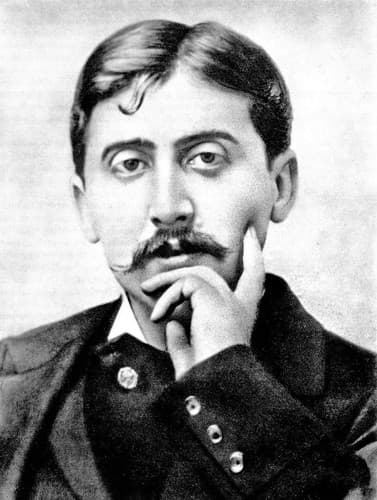
Valentin Louis Georges Eugène Marcel Proust was a French novelist, literary critic, and essayist who wrote the monumental novel In Search of Lost Time, originally in French and published in seven volumes between 1913 and 1927. He is considered by critics and writers to be one of the most influential authors of the 20th century.







