“If you give a mouse a cookie, he's going to ask for a glass of milk.”
— The opening line that sets off the chain of events.

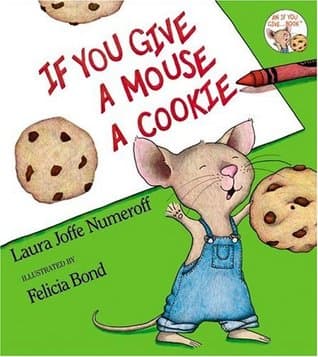
Laura Joffe Numeroff (1985)
Genre
Fantasy / Children's
Reading Time
5 min
Key Themes
See below
Sign in to track this book
A single cookie plunges a boy into a spiraling, hilariously demanding odyssey as he caters to the insatiable whims of a tiny, take-charge mouse.
The story begins with a young boy offering a small, brown mouse a cookie. Immediately, the mouse asks for a glass of milk to go with it. After finishing the milk, he requests a straw. Once he's had his fill, he wants to look in a mirror to check for a milk mustache, prompting him to ask for a pair of nail scissors to trim his hair. This initial series of requests quickly establishes the pattern for the rest of the narrative, where each fulfilled desire leads to a new, related demand from the energetic mouse, keeping the boy involved.
After trimming his hair with the boy's scissors, the mouse decides he needs a broom to sweep up the hair trimmings. The boy provides the broom, and the mouse sweeps the entire house. This act of cleaning then makes him feel warm and prompts him to ask for a nap. The boy prepares a cozy bed for the mouse, with a blanket and a pillow. The mouse, however, is not quite ready for sleep.
The mouse, now in bed, finds it difficult to fall asleep. He requests a story from the boy. The boy reads him a story, and the mouse enjoys it so much that he asks to see the pictures. Looking at the pictures in the book reminds him of his own drawings. This shift from napping to creative expression shows the mouse's unpredictable desires, keeping the boy constantly fulfilling his whims.
Inspired by the book's illustrations, the mouse asks for paper and crayons to draw a picture. He draws a picture, and then, wanting to display his artwork, asks for tape to hang it on the refrigerator. Once his picture is displayed, he stands back to admire it. This moment of artistic satisfaction, however, is short-lived as a new thought immediately sparks in his mind, ready to continue the cycle of requests.
Standing in front of the refrigerator, admiring his drawing, the mouse suddenly notices the refrigerator door. This visual cue reminds him that he is thirsty again. He then asks for a glass of milk. This request brings the narrative full circle, as the mouse's thirst for milk was the very first demand he made after receiving the initial cookie. The boy, having gone through many tasks, prepares another glass of milk.
As the boy hands the mouse the glass of milk, the mouse, now with his thirst quenched, looks at the boy. The sight of the boy, with the milk, reminds him of the very first thing he was offered. With a contented look, the mouse then asks for a cookie to go with his milk, bringing the story back to its starting point and implying an endless loop of requests for the patient young host.
The Protagonist
The boy remains consistently obliging throughout the story, demonstrating unwavering patience and hospitality without a significant personal transformation, though he experiences the full cycle of the mouse's demands.
The Antagonist/Supporting
The mouse's arc is circular; he begins and ends with the desire for a cookie, representing an endless loop of needs and the charming persistence of a small creature.
This theme is central to the book, showing how a single action—giving a mouse a cookie—can lead to a long, interconnected chain of consequences. Each request from the mouse directly stems from the previous one, showing a cause-and-effect relationship that builds throughout the story. For example, the milk leads to a mirror, the trim leads to a broom, and the drawing leads to the refrigerator, eventually bringing the story full circle. This highlights how one decision can have far-reaching and often unexpected implications.
“If you give a mouse a cookie, he's going to ask for a glass of milk.”
The boy's character shows hospitality and generosity. Despite the mouse's many demands, the boy consistently and patiently fulfills each request, from providing food and drink to grooming tools, cleaning supplies, and entertainment. His willingness to go to great lengths for his tiny guest shows a spirit of giving without expectation. This theme emphasizes the kindness and accommodating nature that can be found in simple acts of welcome and care.
“He'll want to look in a mirror to make sure he doesn't have a milk mustache.”
The story playfully explores the continuous nature of wants and desires. The mouse's every action is driven by a new need or whim that arises directly from the satisfaction of the previous one. This shows how satisfying one desire can immediately trigger another, creating an endless cycle. The mouse's journey from a cookie to milk, a haircut, cleaning, napping, drawing, and back to milk and a cookie, humorously portrays the human (or mouse) tendency for desires to snowball and never be fully satisfied.
“And chances are, if he asks for a glass of milk, he's going to want a cookie to go with it.”
A series of events where each outcome triggers the next.
The entire narrative structure of 'If You Give a Mouse a Cookie' is built upon a chain reaction. Each action taken by the boy to fulfill a mouse's request immediately leads to the mouse making another, related request. For instance, giving milk leads to a straw, then a mirror, then scissors. This device creates a fast-paced, cumulative plot where the reader anticipates the next logical (or sometimes illogical) step in the sequence, making the story engaging and predictable in its pattern but surprising in its specific demands.
The story begins and ends in the same place, creating a loop.
The story employs a circular narrative, starting with the mouse asking for a cookie and concluding with the mouse, after a long sequence of activities, once again asking for a cookie to go with his milk. This device provides a sense of completion while also implying an endless, ongoing cycle. It suggests that the boy's generosity could lead to this entire sequence repeating, reinforcing the idea of continuous wants and the ripple effect of small actions.
A consistent 'if-then' structure with varied outcomes.
The book establishes a clear 'if you give X, then Y will happen' pattern. This predictable structure helps young readers follow the cause-and-effect logic. However, the specific content of the mouse's requests is often unexpected and humorous (e.g., sweeping the whole house after a haircut). This combination of a reliable narrative framework with surprising plot points keeps the story fresh and entertaining, allowing for both anticipation and delight.
“If you give a mouse a cookie, he's going to ask for a glass of milk.”
— The opening line that sets off the chain of events.
“When you give him the milk, he'll probably ask you for a straw.”
— The mouse's second request after getting milk.
“He'll want to look in a mirror to make sure he doesn't have a milk mustache.”
— After drinking the milk, the mouse checks his appearance.
“Then he'll want to trim his hair.”
— Noticing his hair in the mirror leads to grooming.
“When he's finished, he'll want a broom to sweep up.”
— After trimming his hair, he cleans up the mess.
“He'll start sweeping. He might get carried away and sweep every room in the house.”
— The mouse's sweeping becomes overly enthusiastic.
“He might even end up washing the floors.”
— Sweeping leads to more cleaning tasks.
“Then he'll probably want to take a nap.”
— After all the work, the mouse gets tired.
“You'll have to fix a little box for him with a blanket and a pillow.”
— Preparing a cozy nap spot for the mouse.
“When he wakes up, he'll want to read a book.”
— After napping, the mouse seeks entertainment.
“He'll ask for paper and crayons to draw a picture.”
— Inspired by the book, the mouse wants to create art.
“He'll want to hang his drawing on the refrigerator.”
— After drawing, the mouse displays his artwork.
“Looking at the refrigerator will remind him that he's thirsty.”
— Seeing the refrigerator triggers thirst.
“So he'll ask for a glass of milk.”
— The cycle begins again with a request for milk.
“And chances are if he asks for a glass of milk, he's going to want a cookie to go with it.”
— The final line that completes the circular story.
Ready to see how well you understood this book? Take our interactive quiz with 10 questions.







