“For someone who loved words as much as I did, I was often at a loss to explain how I felt.”
— Reflecting on emotional inarticulacy despite a love for language.

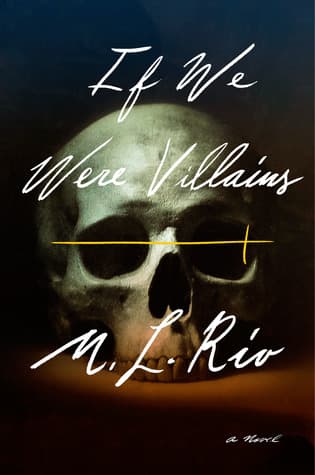
M.L. Rio (2017)
Genre
Thriller / Mystery
Reading Time
7-8 hours
Key Themes
See below
Sign in to track this book
Seven young actors, immersed in Shakespearean ambition and betrayal, find their real-life roles dangerously blurred when a death on campus forces them into their most challenging performance yet: feigning innocence.
Oliver Marks is released from prison after serving ten years for the murder of Richard Stirling. Waiting for him is Detective Colborne, the man who investigated the original case and secured Oliver's conviction. Colborne, on the verge of retirement, tells Oliver he has never been entirely satisfied with the official story and wants to know the real truth. Oliver, hesitant at first, agrees to recount the events of his final year at Dellecher Classical Conservatory, a prestigious arts college where he and six other students studied Shakespeare, leading to a tragic incident that changed their lives forever.
Oliver begins his narrative, introducing the insular world of Dellecher Classical Conservatory. He describes the seven fourth-year students in the acting program: himself, the quiet observer; Richard, the charismatic and volatile 'tyrant'; James, the principled 'hero'; Alexander, the flamboyant 'villain'; Meredith, the beautiful 'temptress'; Wren, the delicate 'ingenue'; and Filippa, the pragmatic 'extra'. They live in a secluded building, the Wardrobe, and are bound by intense friendships, rivalries, and a shared passion for Shakespeare, often blurring the lines between their stage roles and their real-life personas.
The group's seemingly stable dynamic begins to unravel during casting for their final play, 'Julius Caesar'. Richard, who typically played the lead 'tyrant' roles, is cast as Brutus, a more conflicted character, while James, the usual 'hero', is cast as Caesar. This unexpected switch, orchestrated by Professor Geller, ignites simmering tensions and resentments, particularly from Richard, who feels his dominance is threatened. The other students are forced to adapt to these new interpretations, and the lines between their stage personas and their personal lives become increasingly blurred, leading to heightened emotional stakes.
During a Halloween party, fueled by alcohol and underlying resentments, the group's tensions boil over. Richard, increasingly erratic and abusive, provokes James. The confrontation escalates into a brutal fight between them, witnessed by the others. This violent outburst precedes the tragedy that will soon unfold. The incident leaves the group shaken, and the bond between them, once thought unbreakable, shows significant cracks. The others are forced to confront Richard's escalating aggression and its dangerous impact on their tightly knit community.
Following the Halloween party, a night of heavy drinking and a particularly vicious fight involving Richard, the group disperses. The next morning, Richard's body is found in the lake near Dellecher. The police are called, and a murder investigation begins. The remaining six students are immediately suspects, and their carefully constructed world is shattered. They must perform their greatest act yet: convincing the authorities, and themselves, that they are innocent, while grappling with the reality of Richard's death and their own complicity.
The police, led by Detective Colborne, begin their interrogations. Each of the six remaining students is questioned separately, and their conflicting accounts raise suspicion. Fearing exposure and desperate to protect their futures, the group convenes and makes a pact: they will all corroborate a fabricated story, claiming they were all together in the Wardrobe when Richard disappeared. This collective lie, born of fear and misguided loyalty, binds them together in a dangerous conspiracy, deepening their individual guilt and complicity in the cover-up.
As the investigation continues, the police close in. Despite their shared alibi, the pressure mounts. Ultimately, Oliver, believing he is protecting the others and driven by a desperate need to end the ordeal, confesses to Richard's murder. He provides a detailed, albeit false, account of the events, taking full responsibility. His friends, though distraught, do not contradict his confession, and Oliver is subsequently arrested, tried, and convicted. This act of self-sacrifice marks a turning point, sealing his fate and forever altering the lives of the remaining students.
From prison, Oliver recounts what he knows of his friends' lives after Dellecher. James, burdened by guilt, becomes a reclusive stage actor. Wren and Alexander pursue successful but troubled careers, often performing together. Meredith finds some success but remains haunted. Filippa, the most pragmatic, distances herself from the group, seemingly moving on. The shared trauma and the secret they carry have fractured their once-intense bonds, leaving them isolated and marked by the past. Their lives show the lasting consequences of their actions and the secrets they kept.
Back in the present, Colborne reveals he always suspected Oliver's confession was incomplete or false. He presses Oliver, explaining that his retirement makes this his last chance for closure. Faced with Colborne's unwavering conviction and the passage of time, Oliver finally breaks. He confesses the true sequence of events leading to Richard's death, revealing that while he was present, the actual perpetrator was not who everyone believed, and the circumstances were far more complex and tragic than his initial confession suggested.
Oliver reveals the truth: during the struggle at the lake, James, in a moment of self-defense and rage, pushed Richard, causing him to hit his head and drown. Oliver, arriving shortly after, witnessed the immediate aftermath. Out of a deep, unspoken love and loyalty for James, Oliver chose to take the blame, fabricating a story that would protect his friend. He orchestrated the scene to appear as if he was the killer, believing it was the only way to save James from a life in prison and to preserve the group's fragile unity, even if it meant sacrificing himself.
Oliver explains that his decision to confess was an act of profound love and a desperate attempt to save James, whom he considered his closest friend and soulmate. He believed that James, with his inherent goodness, would not survive prison, whereas Oliver felt he could endure it. He meticulously constructed his false confession, ensuring it was convincing. Colborne, though disturbed by the revelation, recognizes the depth of Oliver's sacrifice. Oliver accepts the consequences of his choice, acknowledging the years he lost but finding a strange peace in having protected James, even if it meant his own suffering.
With the truth finally laid bare to Colborne, Oliver reflects on his ten years in prison and the life he has ahead. He has gained a measure of freedom by telling his story, but the weight of his past and the impact of his sacrifice remain. The novel concludes with Oliver stepping out of the car, having finished his confession, facing an uncertain future. The 'play' is over, but the consequences of his actions and the secrets he kept will undoubtedly continue to shape his life and the lives of those he protected. He is left to navigate a world that has moved on, while he has been suspended in time.
The Protagonist
Oliver transforms from an overlooked student into a tragic hero, sacrificing his freedom out of love and loyalty, and ultimately finding a form of peace through confessing the truth.
The Supporting (catalyst for the murder)
James begins as the group's moral center but is shattered by his accidental act of violence, leading to a life of quiet suffering and artistic retreat.
The Antagonist/Victim
Richard's character arc is one of escalating tyranny, leading to his demise, which ultimately serves as the central mystery and turning point for the other characters.
The Supporting
Meredith navigates the complexities of her relationships, particularly with Richard, and is left to cope with the trauma and secrets of Dellecher.
The Supporting
Wren struggles to maintain her innocence amidst the group's darkness and finds solace in her relationship with James, though still haunted by the past.
The Supporting
Alexander continues his theatrical life, often performing with Wren, but remains tied to the Dellecher tragedy.
The Supporting
Filippa, the most grounded, eventually distances herself from the group's trauma, seeking a more conventional life after Dellecher.
The Supporting
Colborne starts as Oliver's interrogator and ultimately becomes his confessor, finding closure in the truth before his retirement.
The novel constantly explores how the characters' immersion in Shakespearean roles influences and mirrors their real-life relationships and conflicts. The Dellecher students, particularly Richard, often treat life as a stage, playing archetypal roles like 'tyrant,' 'hero,' or 'temptress.' This theatrical mindset leads to dramatic confrontations and a distorted sense of reality, where the heightened emotions of the stage bleed into their personal interactions, contributing to the tragic events. The casting changes for 'Julius Caesar' directly provoke the fatal shift in their dynamic.
“For us, in our youth, the boundaries between the stage and life were often blurred. We lived for the theatre, and sometimes, we died for it.”
A central theme is the extreme lengths to which the characters, particularly Oliver, will go to protect those they love. Oliver's confession and ten-year imprisonment are the ultimate acts of loyalty and self-sacrifice, motivated by his deep, unspoken love for James. The collective pact to lie to the police, while flawed, also stems from a misguided sense of group loyalty. This theme explores the moral ambiguities of such sacrifices and their long-term, often devastating, consequences on the individuals involved.
“What is more theatrical than to die for someone else's sins?”
The novel examines the profound and lasting impact of guilt, both for the act of murder and for the subsequent cover-up. Oliver carries the weight of a crime he did not commit, while James lives with the secret of his accidental involvement. The other characters, complicit in the lie, are also haunted by their past, leading to fractured lives and emotional isolation. The story shows that secrets, even those kept for noble reasons, inevitably take a heavy toll on the human psyche, shaping destinies and preventing true freedom.
“We were so young, so arrogant, we thought we could outrun the consequences. We were wrong.”
Given the characters are actors, the theme of performance and deception is pervasive. They are constantly performing, not just on stage, but in their daily lives, presenting carefully crafted personas to each other and to the outside world. The initial pact to lie to the police is their greatest collective performance, a desperate attempt to deceive. Oliver's confession is a meticulously rehearsed act of deception designed to protect James. The novel questions the nature of truth when everyone is an actor, and how difficult it is to discern genuine emotion from practiced performance.
“We were all good at playing parts. The problem was, we'd forgotten how to stop.”
The story challenges conventional notions of justice. Oliver, an innocent man, serves ten years for murder, while the actual perpetrator lives free, albeit burdened by guilt. Detective Colborne's relentless pursuit of the truth, even after Oliver's conviction, highlights the idea that legal justice does not always align with moral truth. The novel suggests that true justice might be found not in retribution, but in the painful process of confession and self-reckoning, allowing for a different kind of closure.
“Justice, I'd learned, was a malleable thing. It bent to fit the circumstances, the evidence, the will of men.”
Oliver's present-day confession to Detective Colborne frames the retelling of past events.
The entire story is presented as Oliver Marks recounting the events of his final year at Dellecher to Detective Colborne, ten years after the murder and his subsequent imprisonment. This structure allows for a dual timeline, building suspense as the reader, along with Colborne, pieces together the true sequence of events. It also provides Oliver with the emotional distance and perspective to reflect on his past actions and motivations, revealing the layers of truth gradually.
The audience knows Oliver is in prison for murder, but the details of the crime and its true perpetrator are withheld.
From the outset, the reader knows Oliver has served ten years for Richard's murder, creating immediate tension. However, the specific circumstances, Oliver's true role (or lack thereof), and the identities of all involved are gradually revealed. This dramatic irony fuels the narrative, as the reader anticipates the unfolding truth, constantly questioning Oliver's reliability as a narrator and the validity of his initial confession. It highlights the gap between public perception and private reality.
The characters and plot are deeply interwoven with references to Shakespeare's plays and character archetypes.
The novel uses Shakespearean allusions extensively, not just in dialogue and chapter titles, but in the very fabric of the characters' identities and the plot's progression. The seven students consciously embody archetypes like 'hero,' 'villain,' 'tyrant,' 'ingenue,' which profoundly influence their interactions. The casting of 'Julius Caesar' directly precipitates the conflict. This device enriches the themes of performance, fate, and tragedy, drawing parallels between the heightened drama of Shakespeare and the characters' real-life struggles.
Oliver Marks withholds crucial information and actively deceives in his initial confession.
Oliver Marks functions as an unreliable narrator, particularly concerning his initial confession to Detective Colborne. He presents a version of events that is deliberately incomplete and misleading, designed to protect James. The reader is privy to his internal thoughts and justifications, but the full truth is only revealed in the story's climax. This unreliability forces the reader to actively interpret events and question the narratives presented, adding layers of complexity to the mystery.
“For someone who loved words as much as I did, I was often at a loss to explain how I felt.”
— Reflecting on emotional inarticulacy despite a love for language.
“That's the thing about a tragedy. It's never about the villain.”
— Julian discussing the nature of tragedy and the focus on the hero.
“We were a family, in the way that all ensembles are a family: bound by love and rivalry and a terrible, exhilarating intimacy.”
— Oliver describing the complex relationships within the acting troupe.
“You can play a role so many times, but it never really becomes you. Not truly. Not the part, only the performance.”
— Thoughts on the distinction between character and actor.
“We were so young. We were so stupid. We were so in love with ourselves.”
— A retrospective look at the hubris and naiveté of youth.
“But that’s the trick, isn’t it? To make the audience forget that what they’re seeing isn’t real.”
— Reflecting on the art of theatrical illusion.
“We were not actors then, but ourselves. And that was the most terrifying role of all.”
— The characters confronting their true selves outside of their roles.
“We were all villains in our own stories. Or at least, we all had the capacity to be.”
— A realization about the inherent darkness in human nature.
“It was a kind of madness, I think, to live so intensely, so entirely for art.”
— Considering the all-consuming nature of their artistic lives.
“How many times could you lose someone before you stopped noticing the empty space?”
— Mulling over repeated loss and its impact.
“We were always performing, even when there was no audience.”
— Realizing the constant theatricality of their lives, even in private.
“The worst part of a lie is not the telling of it, but the living with it.”
— Reflecting on the enduring burden of deception.
“There are nine circles of hell, but the tenth, I think, is reserved for those who know the truth and choose to look away.”
— A stark statement about complicity and willful ignorance.
“We were all trying to be something we weren't, and in doing so, we became exactly what we were meant to be.”
— A paradoxical observation about fate and self-discovery through artifice.
Ready to see how well you understood this book? Take our interactive quiz with 10 questions.

Biography coming soon.







