“Captain, I'm detecting something large moving at high speed directly towards us.”
— Initial contact with the 'object' underwater near Wilkes Station.

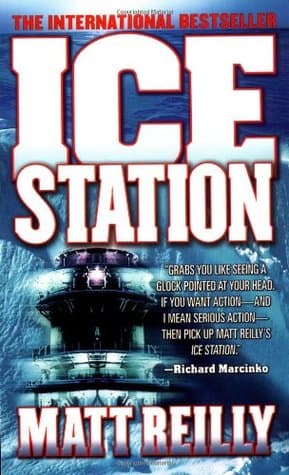
Matthew Reilly (1999)
Genre
Thriller / Mystery / Science Fiction
Reading Time
510 min
Key Themes
See below
Sign in to track this book
Beneath Antarctica's ice, a US Marine team finds a chilling secret and fights for survival against elite assassins and the continent's deadly environment.
The story begins with Lieutenant Shane Schofield, callsign 'Scarecrow', and his US Marine team quickly deploying to Wilkes Ice Station in Antarctica after an SOS signal. The station, a joint US-UK research facility, reported a major incident. Upon arrival, the Marines find the station in disarray, with many dead bodies, including British and American personnel, and signs of a violent fight. They quickly realize they have entered a massacre, and the remaining survivors face an immediate threat from an unknown enemy. Schofield's initial assessment points to a highly trained, well-equipped opposing force, far beyond any typical scientific station incident. He starts to piece together the grim events, understanding that their mission is now survival and investigation, not just rescue.
Schofield's team, including the capable Corporal G.W. 'Wizard' Lin and Sergeant 'Mother' Miriam Webster, goes into the station's underwater research area. There, they make a shocking discovery: a large, ancient alien spacecraft buried deep under the ice. The craft's presence is the true reason for the station's distress. Before they can fully understand the find, a highly trained unit of French paratroopers, led by Captain Pierre Fouché, ambushes them. A brutal underwater firefight follows, causing many casualties on both sides. Schofield manages to disable some of the French forces, but the fight confirms that multiple international players want control of the alien technology, turning Wilkes into a battleground.
During the underwater battle, the French, in desperation, release a pod of killer whales into the flooded research area, making the already deadly environment even more terrifying. Schofield and his remaining Marines, including Wizard and Mother, must fight their way through the whales while also fending off the French. The experience is chaotic and bloody, with several Marines lost to the marine predators or enemy fire. Schofield, using his quick thinking and combat skills, eventually leads his damaged team to the surface, but with significant losses. The immediate threat from the French and the whales is gone, but they are now stranded on the ice, exposed and vulnerable, with the alien secret still contested.
Just as Schofield and his team reach the surface, Chinese forces, led by Colonel Lee, arrive in stealth helicopters, further complicating the already bad situation. An intense aerial dogfight breaks out between the Chinese and the remaining French forces, showing the global interest in the alien spacecraft. Schofield realizes they are caught in a multi-national conflict. With their own transport destroyed and enemies closing in, Schofield and his dwindling team must find a way to escape Wilkes Station and prevent the alien technology from falling into the wrong hands. They must scavenge for resources and plan a dangerous journey across the treacherous Antarctic landscape.
Schofield, showing strong leadership, plans an escape from Wilkes Station through a series of dangerous ice tunnels beneath the surface. His team, including the now-wounded Wizard and Mother, navigates the treacherous, unstable passages, always aware of the pursuing French and Chinese forces. They encounter more of the station's original personnel, some of whom are revealed to be British Special Air Service (SAS) operatives. However, this apparent rescue becomes another betrayal as the SAS, led by the ruthless Colonel George 'Blood' Davies, try to seize the alien technology for themselves. This confirms the complex web of deceit and self-interest among the world powers.
The race for the alien spacecraft's secrets grows more intense. Schofield, seeing the great danger the technology poses if weaponized, aims to secure or destroy it. Colonel Davies, however, is determined to claim it for Britain, viewing it as a strategic advantage. Both leaders, with their teams, meet at the alien ship's central chamber. The spacecraft's interior is as dangerous as the outside, with alien mechanisms and traps. Schofield, through sheer willpower and tactical skill, navigates the ship's defenses, constantly clashing with Davies's forces in a desperate effort to reach the core first.
Upon reaching the alien spacecraft's heart, Schofield makes an important discovery. The supposed 'weapon' or power source all nations are fighting over is, in fact, an advanced terraforming device. It is designed not for destruction, but for large-scale environmental manipulation, able to change a planet's climate and geography. This revelation changes Schofield's understanding of the conflict, making the greedy, nationalistic ambitions of the other forces seem even more shortsighted and dangerous. He sees the device's potential for both great good and catastrophic misuse, strengthening his resolve to prevent it from falling into the wrong hands.
The climax shows Schofield in a brutal hand-to-hand fight with Colonel Davies inside the alien spacecraft's control chamber. The fight is fierce and personal, with both men pushing their limits. Meanwhile, amid the chaos of the battle and various factions trying to gain control, the terraforming device is accidentally activated. Its immense power begins to show, causing dramatic and localized climate shifts within the station and potentially across Antarctica. Schofield must not only defeat Davies but also find a way to stabilize or deactivate the alien technology before its effects become irreversible and catastrophic for the planet.
In a final act of self-sacrifice, Schofield subdues Davies and, with his remaining team members, plans a desperate way to contain the terraforming device's destructive activation. Understanding the immense power and global threat it poses, he decides to stay behind within the alien spacecraft, ensuring its complete deactivation or stabilization, while ordering Wizard and Mother to escape the collapsing station. His actions are driven by duty and a desire to protect humanity from the very technology they were so desperate to acquire. The station begins to implode around him as his team makes their dangerous exit.
Wizard and Mother, along with a few other survivors, escape the collapsing Wilkes Station and the alien spacecraft. US forces rescue them, believing Schofield died in the destruction, a hero who saved the world. The incident is covered up, and the alien craft's existence is suppressed. However, in a twist, Schofield is later revealed to have survived the explosion and the device's containment. Severely injured but alive, a clandestine US agency recovers him, setting the stage for future missions and confirming his legendary status as an unstoppable operative. The alien device remains a secret, its potential still present.
The Protagonist
Scarecrow evolves from a focused operative to a global protector, willing to sacrifice himself for the greater good, solidifying his legend.
The Supporting
Wizard grows in confidence and resourcefulness under Schofield's mentorship, proving his worth as a crucial member of the team.
The Supporting
Mother's unwavering loyalty and combat expertise are tested to their limits, solidifying her role as a steadfast protector.
The Antagonist
Davies descends further into ruthless ambition and betrayal, ultimately consumed by his pursuit of power.
The Antagonist
Fouché remains a determined adversary, showcasing the fierce international competition for the alien discovery.
The Antagonist
Lee serves as a representation of China's global ambition, adding to the multi-factional conflict.
The Mentioned
Wilkes's legacy drives the plot, his initial discovery leading to global conflict and a deeper understanding of the alien object.
The novel shows how discovering advanced alien technology immediately causes a ruthless, multi-national struggle for power. This overrides any sense of shared human interest or ethics. French, British, and Chinese forces are willing to commit murder, betrayal, and environmental damage to get the alien device for their countries. Colonel Davies, in particular, shows this theme, willing to sacrifice many lives for perceived national gain. This theme appears in the constant firefights and betrayals, such as when the British SAS turn on the Americans after seemingly offering help, showing how nationalistic greed can lead to self-destruction.
““They weren't fighting for survival, Scarecrow realized. They were fighting for ownership.””
This theme explores the qualities of true leadership, comparing Schofield's selfless, protective approach with the ruthless, power-hungry methods of his enemies. Schofield consistently puts his team's lives and the greater good first, making tough moral choices and personal sacrifices to prevent global disaster. His leadership inspires loyalty and courage, even against overwhelming odds. This is clear in his decision to stay behind in the collapsing alien ship to contain the device, allowing his team to escape. His actions show that true leadership is about responsibility and protection, not just command.
““A leader's job wasn't to be popular. It was to make the hard calls, to save his people, no matter the cost to himself.””
The alien spacecraft's discovery forces humanity to face the unknown, and the novel explores the immediate, often violent, reactions to such a major revelation. Instead of wonder or scientific cooperation, the first response is fear, greed, and a desperate desire for weaponization. The alien technology, first seen as a weapon, is later revealed to be a terraforming device. This highlights humanity's shortsightedness and tendency to project its own destructive impulses onto the unknown. This theme is central to the mystery surrounding the alien ship and the resulting international conflict.
““Man's first instinct, upon discovering something new, was always to weaponize it.””
A main theme of 'Ice Station' is the constant struggle for survival in a harsh environment against multiple, skilled enemies. Schofield and his team are always outnumbered and outgunned. They face not only enemy soldiers but also the extreme dangers of Antarctica itself — killer whales, collapsing ice, sub-zero temperatures. Every step is a fight for life, forcing the characters to push their physical and mental limits. This theme appears in the constant action sequences, the dwindling numbers of Schofield's team, and their desperate journey across the frozen continent.
““In Antarctica, the environment itself was an enemy, more deadly than any bullet.””
The central object of desire and conflict, driving the entire plot.
The alien spacecraft discovered beneath Wilkes Station serves as the primary MacGuffin. Its existence and the potential power it represents are the sole drivers of the international conflict. All factions – American, French, British, Chinese – are willing to kill and die to gain control of it. Its true nature as a terraforming device, rather than a weapon, is revealed later, adding a twist to the initial perception and highlighting the folly of human greed. The MacGuffin dictates every character's motivation and every plot turn.
Antarctica as a character and a relentless antagonist.
The remote and extreme environment of Antarctica acts as a powerful plot device, intensifying the stakes and challenges. The sub-zero temperatures, killer whales, treacherous ice formations, and blizzards are not just backdrops but active threats that thin the ranks of all combatants. This isolation also ensures that no external help can easily reach Schofield's team, heightening their reliance on their own skills and resources. The hostile setting prevents easy escapes and amplifies the sense of desperation and urgency.
Scarecrow's photographic memory, a key to his tactical brilliance.
Schofield's eidetic memory is a crucial plot device that explains his extraordinary tactical abilities and problem-solving skills. It allows him to recall minute details of maps, blueprints, enemy movements, and scientific data with perfect clarity, enabling him to formulate complex strategies on the fly and exploit weaknesses. This ability often gives him an edge over his equally trained, but less mentally gifted, adversaries. It also serves to quickly disseminate crucial information to the reader through Schofield's internal monologues and observations.
The initial misdirection about the alien device's true purpose.
The alien spacecraft is initially believed by all human factions to contain powerful alien weaponry or a devastating energy source. This perception acts as a major red herring, fueling the desperate and violent international conflict. The true nature of the device as a terraforming machine is only revealed late in the story, after immense bloodshed. This misdirection highlights humanity's propensity to assume the worst and weaponize any unknown discovery, while also providing a dramatic twist that recontextualizes the entire conflict.
“Captain, I'm detecting something large moving at high speed directly towards us.”
— Initial contact with the 'object' underwater near Wilkes Station.
“The first rule of any battle is to know your enemy. The second is to make sure your enemy doesn't know you.”
— Shane Schofield reflecting on strategy during a tense situation.
“They say the coldest place on Earth is the human heart when it's devoid of compassion. I think they're wrong. It's Antarctica.”
— A character's cynical observation about the environment and human nature.
“There are no atheists in foxholes, and there are even fewer in a collapsing ice station.”
— Amidst the chaos and destruction of the collapsing station.
“You never truly appreciate the warmth until you've been cold for so long you can't remember what it feels like.”
— A character longing for escape from the frigid environment.
“Sometimes the only way out is through, and sometimes 'through' means blowing a very big hole in whatever's in your way.”
— Schofield contemplating a destructive solution to a problem.
“In a world of unknowns, the only thing you can truly rely on is your training and your instincts.”
— Schofield's internal monologue during a critical decision.
“The ice doesn't care who you are, what you've done, or what you plan to do. It just is.”
— A stark reminder of the unforgiving nature of the Antarctic environment.
“Every mission has a point of no return. The trick is knowing when you've passed it.”
— A moment of reflection on the irreversible nature of their current situation.
“Fear is a weapon. Use it against your enemies, but never let it control you.”
— Schofield advising another character on managing fear in combat.
“Some secrets are buried so deep, they were never meant to be found.”
— Hinting at the ancient and dangerous secrets hidden beneath the ice.
“The greatest weapon isn't a gun or a bomb, it's information. And the greatest defense is to deny it to your enemy.”
— Discussing the importance of intelligence in espionage.
“There's a fine line between bravery and stupidity. Sometimes, in Antarctica, that line is just a crack in the ice.”
— A grim observation about the risks taken in the extreme environment.
“When you're fighting for your life, there are no rules, only outcomes.”
— Schofield's brutal pragmatism in a life-or-death scenario.
Ready to see how well you understood this book? Take our interactive quiz with 10 questions.

Biography coming soon.







