“I have a little brother called Charlie. He is a very fussy eater.”
— The opening line, introducing the narrator and Charlie's eating habits.

Lauren Child (2000)
Genre
Children's / Health
Reading Time
5 min
Key Themes
See below
Sign in to track this book
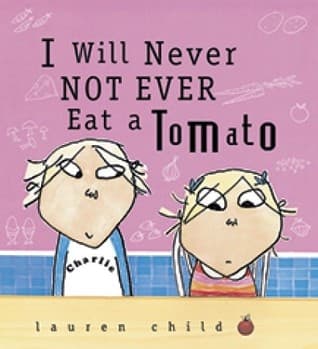
Charlie helps his picky sister, Lola, try new foods by renaming them, turning carrots into 'orange twiglets from Jupiter' and mashed potatoes into 'cloud fluff from Mount Fuji,' until she even eats a dreaded tomato.
The story begins with Charlie describing his younger sister, Lola. He says Lola is a very picky eater, listing many foods she will not eat. These include carrots, peas, potatoes, mushrooms, eggs, sausages, cauliflower, and cabbage. Charlie often has to make sure Lola eats dinner, a difficult job because she is stubborn and always has excuses for disliking food. Lola's firm stance sets the stage for Charlie's imaginative attempts to get her to eat.
Charlie gives Lola her dinner, which includes carrots. Lola immediately says she dislikes carrots and will not eat them. Charlie, calm, starts to use his imagination. He tells Lola the carrots are not carrots, but 'orange twiglets from Jupiter.' Intrigued by this description, Lola carefully tries one of the 'twiglets' and finds she likes them. This is Charlie's first successful try at overcoming Lola's dislike for a food through creative storytelling.
Next on Lola's plate are peas, which she also says she hates. After his last success, Charlie quickly gives them a new identity. He tells Lola the peas are 'green drops from the South Pole,' and if she is careful, they might roll on her tongue. Lola, drawn in by the image, tries the 'green drops' and, to her surprise, enjoys them. Charlie's imaginative descriptions prove effective in getting Lola to eat her vegetables.
Lola then sees her mashed potatoes, another food she usually avoids. Charlie meets the challenge by describing them as 'cloud fluff from the pointiest peak of Mount Fuji.' He says they are light and fluffy and asks Lola to imagine eating clouds. This vivid description again sparks Lola's curiosity. She takes a bite of the 'cloud fluff' and, like with the other foods, discovers she actually likes the taste, despite her initial protests.
The next food on Lola's plate is fish fingers. As expected, Lola says she dislikes them. Charlie, now fully engaged in his imaginative game, tells her they are 'ocean twigs from the bottom of the sea.' He might add details about mermaids or small fish gathering them. Lola, completely lost in the fantasy world Charlie creates, tries the 'ocean twigs' and finds them tasty, continuing her unexpected journey of trying and enjoying foods she once disliked.
Charlie then gives Lola a tomato. This is where Lola draws her firmest line. She states, 'I will never, not ever, eat a tomato.' She repeats her dislike with complete certainty, making it clear that tomatoes are the one food she finds completely unacceptable, no matter Charlie's imaginative efforts. This statement sets up the main conflict and Charlie's biggest test in convincing Lola to try something she so strongly rejects.
Despite Lola's strong refusal, Charlie does not give up. He uses his most fantastical description yet for the tomato. He tells Lola it is not a tomato, but a 'moon squirter.' He explains that these 'moon squirters' are very rare, come from outer space, and burst with juice. He stresses their uniqueness and exotic origin, hoping to bypass Lola's ideas about tomatoes and appeal to her sense of wonder.
Lola, at first doubtful, is eventually won over by Charlie's detailed description of the 'moon squirter.' The idea of something rare from outer space is too exciting to resist. She carefully picks up a piece of the 'moon squirter' and takes a small bite. This is the moment of truth as she tastes the food she previously hated, her face showing both worry and curiosity. This is the peak of Charlie's efforts, as Lola finally faces her biggest food aversion.
To Charlie's delight and Lola's own surprise, she finds she actually likes the taste of the 'moon squirter.' Her initial dislike disappears as she experiences the flavor without calling it a 'tomato.' She not only finishes the piece she tried but asks Charlie for more. This successful moment shows how imagination can overcome deep dislikes and how enjoyable it is to discover new things, even simple ones like food.
Charlie watches Lola happily eat her 'moon squirters.' He then tells the reader, with quiet satisfaction, that Lola ate all her carrots (orange twiglets), all her peas (green drops), all her mashed potatoes (cloud fluff), all her fish fingers (ocean twigs), and especially all her tomatoes (moon squirters). He ends by saying he knew Lola would like them, showing his understanding of his sister and his imaginative approach.
The Protagonist
Lola transforms from a rigid, fussy eater to one who is open to trying new foods, guided by her brother's imagination.
The Supporting
Charlie consistently demonstrates his imaginative problem-solving skills, affirming his role as a patient and effective older brother.
Imagination is the main theme, shown through Charlie's clever ways of renaming food. By changing carrots into 'orange twiglets from Jupiter' or tomatoes into 'moon squirters,' Charlie makes eating fun and helps Lola get past her strong dislikes. The story shows how imagination can change how we see things, turning something undesirable into an exciting adventure. This theme is clear in every scene where Charlie renames a food, leading to Lola trying and enjoying it.
“They are not carrots. These are orange twiglets from Jupiter.”
The book addresses the common problem of picky eating in children. It offers a gentle and effective method for parents and caregivers, focusing on persuasion and creativity instead of conflict. Lola's journey from refusing foods to eagerly trying and liking them shows that with the right approach, even the most stubborn eaters can try new things. The story gives a hopeful and playful view of a potentially frustrating situation, showing that understanding and imaginative involvement can lead to good changes.
“I will never, not ever, eat a tomato.”
The kind and patient relationship between Charlie and Lola is a core theme. Charlie's endless patience and creative problem-solving show how an older sibling can be supportive. He does not scold or force Lola; instead, he connects with her on her own terms, using her imaginative nature to his advantage. Their interaction shows a healthy and positive sibling bond where understanding and gentle guidance help both of them, reinforcing that empathy and playfulness can solve problems.
“I have a little sister, Lola. She is small and very funny.”
The story subtly explores how our view of something can be more powerful than its actual reality. Lola's dislike for certain foods is mostly based on her ideas and labels. Once Charlie renames and redefines the food, her perception changes, allowing her to taste it without prejudice. This theme suggests that often, our dislike for things is psychological. By changing how we see them, we can change how we experience them. The tomato, once just a 'tomato,' becomes a 'moon squirter' and is suddenly delicious.
“They are not peas. These are green drops from the South Pole.”
Charlie renames foods with fantastical descriptions to make them appealing to Lola.
This is the primary plot device. Charlie consistently renames each food item Lola dislikes, transforming 'carrots' into 'orange twiglets from Jupiter,' 'peas' into 'green drops from the South Pole,' and 'tomatoes' into 'moon squirters.' This device bypasses Lola's initial aversion to the food's actual name and appearance, allowing her to approach it with curiosity and an open mind. It's a creative form of persuasion that leverages Lola's imaginative nature, making eating a game rather than a chore.
The story is told from Charlie's perspective, offering insight into his thoughts and strategies.
The story is narrated by Charlie, Lola's older brother. This narrative choice allows the reader to understand Charlie's patience, his creative thinking, and his genuine desire to help his sister. It also frames Lola's fussiness from an external, yet sympathetic, viewpoint. Charlie's narration provides a sense of warmth and humor, making his imaginative solutions feel like a natural extension of his personality and his loving relationship with Lola.
A recurring pattern of Lola refusing food, Charlie renaming it, and Lola trying it, but with increasing imaginative variations.
The plot follows a clear, repetitive structure: Lola dislikes a food, Charlie renames it imaginatively, and Lola tries it and likes it. However, each instance introduces a new, more elaborate description and a different food, building towards the ultimate challenge of the tomato. This repetition creates a comforting rhythm for young readers while allowing for escalating creativity, culminating in the most fantastical renaming for the most disliked food, keeping the narrative engaging and predictable in a positive way.
“I have a little brother called Charlie. He is a very fussy eater.”
— The opening line, introducing the narrator and Charlie's eating habits.
“He will not eat carrots, and he will not eat peas, and he will not eat cabbage, or apples, or rice, or fish fingers. And he will NOT eat tomatoes.”
— Listing Charlie's extensive list of disliked foods.
“Now, Charlie, I said, you HAVE to eat your carrots.”
— Lola trying to convince Charlie to eat his vegetables.
“They're not carrots, Charlie, I said. They're orange twiglets from Jupiter.”
— Lola's first imaginative re-framing of a disliked food.
“He ate all his orange twiglets from Jupiter.”
— Charlie's positive reaction to Lola's imaginative description.
“Then I said, would you like some green garden dots?”
— Lola re-framing peas for Charlie.
“He ate all his green garden dots.”
— Charlie eating the peas after they were re-named.
“Would you like some mashed-up cloud?”
— Lola re-framing mashed potatoes.
“He ate all his mashed-up cloud.”
— Charlie eating the mashed potatoes.
“And then I said, how about some moon squirters?”
— Lola re-framing grapes.
“He ate all his moon squirters.”
— Charlie enjoying the grapes.
“But Charlie said, I will NOT eat tomatoes.”
— Charlie's unwavering stance against tomatoes, despite Lola's success with other foods.
“Oh, they're not tomatoes, Charlie. They are red, round, warm, and shiny. They are called 'Splat' from Planet Floopy.”
— Lola's ultimate imaginative re-framing for tomatoes.
“He ate all the Splat from Planet Floopy.”
— Charlie finally eating the tomatoes due to Lola's imaginative description.
“I will never not ever eat a tomato.”
— The book's title, spoken by Charlie after eating the 'Splat'.
Ready to see how well you understood this book? Take our interactive quiz with 10 questions.

Biography coming soon.
Dan Gemeinhart
4.5
Kate O'Hearn
4.4

Jeanne Birdsall
4.4

Jen Wang
4.4
Wendelin Van Draanen
4.3

John Marsden
4.3

Chris Van Allsburg
4.3
Jennifer A. Nielsen
4.2