“I rode a horse of milk white jade, and in my heart I carried a secret.”
— Opening line of the novel, introducing Oyuna's journey and inner world.

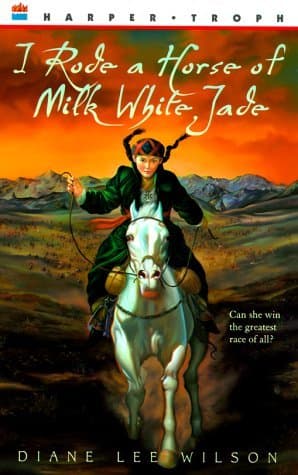
Diane Lee Wilson (1998)
Genre
Fantasy / Children's / Historical Fiction / Young Adult
Reading Time
360 min
Key Themes
See below
Sign in to track this book
Crippled and confined, a determined Mongolian girl disguises herself as a boy and embarks on a perilous journey with her loyal mare and heroic cat to defy a perceived curse and bring honor to her family.
Oyuna is born into a nomadic Mongolian clan during the time of Kublai Khan. As an infant, a tragic accident occurs when a horse crushes her foot, leaving her with a permanent limp. This incident is interpreted by her superstitious clan, especially her grandmother, as a sign of bad luck, a curse that will forever cling to her and harm the family. Oyuna is relegated to the women's sphere within the family's yurt, expected to spend her life cooking, sewing, and caring for younger siblings. She is never to ride or participate in the outdoor life of hunting and herding that defines her people. Despite her physical limitation and the societal expectations, Oyuna wants to prove her worth and bring honor and good fortune to her family, a yearning that sparks her rebellious spirit.
As Oyuna grows, she overhears tales and prophecies from the elders, particularly one about a legendary Horse of Milk White Jade, a magnificent steed said to possess magical qualities and bring immense good fortune to its owner. This legend ignites hope within her, believing that finding such a horse could lift the curse from her family and allow her to earn respect. Driven by this hope, Oyuna approaches her father, Boldo, a kind but traditional man, and pleads with him to allow her to go on a quest to find this fabled horse. Her father, bound by custom and concern for her safety and perceived bad luck, firmly refuses, reiterating her place within the yurt and the dangers of the outside world for a lame girl.
Undeterred by her father's refusal, Oyuna makes a decision. She secretly cuts her long hair, puts on her brother's clothes to disguise herself as a boy named 'Oyuni,' and prepares for her journey. Her only companions are her loyal, aging mare, Khutu, a gentle and wise horse who has been her solace, and her protective cat, Shurka. Under the cover of darkness, she slips away from her sleeping family, leaving behind a note explaining her intentions to seek the Horse of Milk White Jade and restore her family's honor. Her departure is full of fear and determination, as she ventures into the vast, unknown Mongolian steppes.
Oyuna's journey quickly exposes her to the realities of nomadic life outside her clan. She faces hunger, thirst, and extreme weather. Her disguise as a boy provides a fragile shield, but she must constantly be wary. Along the way, she encounters various people: some are kind, offering food or shelter, such as an old woman who recognizes her determination; others are suspicious or dangerous. She narrowly escapes a group of bandits, relying on Khutu's speed and her own quick thinking. These encounters force Oyuna to grow quickly, honing her survival skills and strengthening her resolve, even as loneliness and doubt begin to creep in.
Deep into her journey, Oyuna finds a solitary encampment belonging to a reclusive, older horse herder named Batu. He is a gruff but observant man, initially wary of the young 'boy.' Oyuna, still maintaining her disguise, tries to get information about the fabled Horse of Milk White Jade. Batu, with his knowledge of horses and the land, seems to understand the legend, but speaks in riddles and tests Oyuna's patience and horsemanship. He allows her to stay for a time, putting her to work, assessing her character and her genuine desire. Oyuna senses a hidden sadness and wisdom in Batu, and a connection to her quest.
As Oyuna spends more time with Batu, her perseverance and love for horses slowly break through his hardened exterior. Eventually, Batu reveals his own tragic past: he once owned a magnificent white horse, a descendant of the legendary Milk White Jade, which was stolen from him by a cruel Mongol lord, leading to his self-imposed exile and sorrow. He explains that the Horse of Milk White Jade is not just one horse, but a lineage, and that its true power comes not just from its beauty, but from the bond with its rider. Recognizing Oyuna's intentions and spirit, despite her physical challenge, Batu agrees to guide her further, sharing his knowledge and experience to help her find the fabled steed and reclaim his own lost honor.
Their joint journey takes them into more treacherous territories, including the Altai Mountains. They navigate narrow passes, endure harsh weather, and face wild animals. More ominously, they learn that the powerful Lord Kharlik, the same lord who stole Batu's horse years ago, is also seeking a horse of the Milk White Jade lineage, believing it will bring him ultimate power. Kharlik's men patrol the region, making their quest more dangerous. Oyuna and Batu must use all their cunning and knowledge of the land to evade capture, all while continuing to search for clues about the fabled horse's whereabouts, which are often guarded by ancient tales and hidden paths.
After weeks of searching, following faint clues and ancient markers, Oyuna and Batu finally discover a hidden, lush valley nestled deep within the mountains. To their astonishment, the valley is home to a herd of wild horses, many of them pure white, their coats shimmering like polished jade. Among them is a stallion, a direct descendant of the legendary Horse of Milk White Jade, radiating an aura of power and grace. Oyuna feels an immediate connection to the stallion. However, capturing or approaching such a wild, powerful creature proves to be a challenge, requiring patience, respect, and an understanding of horse behavior.
Oyuna, guided by Batu's wisdom, begins the process of earning the white stallion's trust. She spends days quietly observing the herd, learning their patterns, and slowly, gently approaching the magnificent creature. Her heart and love for horses resonate with the wild stallion, and a unique bond begins to form between them. She realizes that true 'taming' is not about force, but about mutual respect and understanding. Just as Oyuna feels she is on the verge of success, a new danger emerges: scouts from Lord Kharlik's army are spotted nearby. Kharlik's men, having tracked them or stumbled upon clues, are closing in, threatening to seize the valuable herd and the legendary stallion.
Lord Kharlik's men storm the hidden valley, intent on capturing the white horses. A battle ensues, with Batu fighting to protect the herd. In the chaos, Oyuna, having finally earned the white stallion's trust, leaps onto its back. The stallion, sensing her courage and the danger, responds with speed and agility. Oyuna, despite her limp, rides with a natural grace, her bond with the horse allowing them to move as one. They lead the herd in a daring escape, outmaneuvering Kharlik's soldiers through the mountain terrain. This climactic ride shows Oyuna's courage and the power of her connection with the Horse of Milk White Jade.
Having evaded Lord Kharlik's forces and secured the safety of the white stallion, Oyuna, accompanied by Batu, makes her way back to her clan. Her return is triumphant, as she arrives not as the 'unlucky' lame girl, but as a courageous rider, astride the magnificent Horse of Milk White Jade. Her family, initially stunned, quickly realizes the honor and good fortune she has brought upon them. The clan celebrates her bravery and success, finally seeing her not for her physical limitation, but for her strength of spirit and the feat she accomplished. Oyuna's journey has not only found the legendary horse but also transformed her identity within her community.
Oyuna's return with the Horse of Milk White Jade brings prosperity and respect to her clan. The legend, once a distant dream, is now a living reality, and Oyuna is a hero. Her family, especially her grandmother, sheds their superstitions, recognizing that true luck comes from courage and determination, not from birthright or physical perfection. Oyuna, no longer confined to the yurt, is free to ride and participate fully in the life of her people. Her bond with the white stallion symbolizes her own strength and independence. She has not only fulfilled her quest but has also redefined what it means to be strong and honorable, leaving a lasting legacy for herself and her clan.
The Protagonist
Oyuna transforms from a confined, underestimated girl into a heroic, respected rider who brings honor to her family and redefines her own identity.
The Supporting
Khutu remains a loyal and constant companion, symbolizing the enduring power of unconditional love and partnership.
The Supporting
Shurka remains a loyal and protective companion throughout the journey, providing comfort and small acts of bravery.
The Supporting
Boldo shifts from a traditional, cautious father to one who embraces his daughter's unique strength and redefines his understanding of luck and honor.
The Supporting
The Grandmother eventually relinquishes her superstitious beliefs, recognizing Oyuna's true worth and the honor she brings to the family.
The Supporting
Batu, initially reclusive and burdened by his past, finds redemption and renewed purpose by helping Oyuna achieve her quest.
The Antagonist
Lord Kharlik remains a villain, driven by greed and a desire for power, ultimately failing to capture the white jade horse.
The Supporting
The stallion, initially wild and elusive, forms a profound bond with Oyuna, becoming her loyal partner and a symbol of her achievement.
Oyuna's journey is about forging her own identity beyond the limitations imposed by her physical condition and societal expectations. Labeled 'unlucky' and confined, she rebels against these definitions by going on a quest to prove her worth. Her disguise as a boy, 'Oyuni,' allows her to experience a different self, free from the gendered constraints of her clan. Through her trials, she discovers her inner strength, courage, and connection to horses, ultimately defining herself by her actions and spirit rather than her limp. Her return, riding the legendary horse, is a declaration of her true self, earned through self-reliance and determination.
“"The limp was part of her, but it did not define her heart, nor the spirit that longed to ride free."”
The central conflict of the story is Oyuna overcoming both physical adversity (her crushed foot) and the societal prejudice stemming from it. Her clan's superstition casts her as 'bad luck,' leading to her exclusion and confinement. Oyuna's quest is a direct challenge to these prejudices, as she seeks to prove that luck is made, not given, and that her 'disability' does not equate to inability. She faces external dangers and internal doubts, but her perseverance shows that true strength is in spirit and courage, not physical perfection. Her ultimate success shatters the beliefs of her community, showing them the folly of their prejudice.
“"Luck was not a thing that clung to you like dust; it was a thing you made with your own hands and heart."”
The bond between humans and animals, particularly horses, is a significant theme. Oyuna's closest companions are her mare, Khutu, and her cat, Shurka, who offer loyalty and support. Her ability to connect with and understand horses is central to her character and her success. The quest for the Horse of Milk White Jade is not about conquering a beast, but about earning its trust and forming a partnership based on mutual respect. This theme shows the connection that can exist between species, where animals are not just tools but companions, teachers, and reflections of the human spirit.
“"A horse was not just a beast of burden; it was a part of your soul, a mirror to your heart."”
The story explores the tension between the traditions and superstitions of Oyuna's nomadic clan and her individual desire for self-determination and innovation. The clan's customs dictate her fate due to her perceived bad luck and gender, confining her to a specific role. Oyuna's decision to cut her hair, don a disguise, and go on a dangerous quest is an act of individualism that challenges these traditions. Her success ultimately forces her clan to re-evaluate their beliefs, showing that progress and honor can come from breaking with tradition and embracing new ways of thinking, particularly regarding the potential of individuals previously marginalized.
“"Sometimes, to find your place, you had to leave the one that was given to you."”
Oyuna's transformation into 'Oyuni' to navigate the outside world.
Oyuna's disguise as a boy, 'Oyuni,' is a crucial plot device. It allows her to escape the gendered limitations and perceived 'bad luck' assigned to her by her clan, granting her the freedom to travel, interact with strangers, and pursue her quest in a way that would be impossible as a girl with a limp. The disguise enables her to enter male-dominated spaces and engage in activities like riding and herding without immediate suspicion. It also serves as a metaphor for her journey of self-discovery, as she sheds her old identity to embrace a new, more empowered one, even if temporarily. The constant threat of exposure adds tension to her travels.
The mythical horse as the driving force of Oyuna's quest.
The legend of the Horse of Milk White Jade is the central motivating plot device. It provides Oyuna with a specific, tangible goal that she believes will redeem her and her family. The horse is not just an animal but a symbol of good fortune, honor, and almost magical power. The prophecy gives her hope and direction in her desperate situation. The ambiguity of whether the horse is a single entity or a lineage, and the challenges of finding it, create the core narrative structure and drive the plot forward. It represents the ultimate prize that can overcome her family's perceived curse and bring respect.
Oyuna's physical disability as the catalyst for her social exclusion and quest.
Oyuna's crushed foot and resulting limp are not just a physical characteristic but a powerful plot device that initiates the entire story. It is the direct cause of her clan's superstition, her social exclusion, and her confinement to the yurt. This adversity acts as the primary catalyst for her desire to prove herself and embark on her quest. It provides an immediate, tangible obstacle she must overcome, both physically and psychologically. The limp also makes her achievements even more remarkable, highlighting her inner strength and challenging societal perceptions of disability, making her a more sympathetic and inspiring protagonist.
The classic structure of a hero's journey across the Mongolian steppes.
The novel employs a classic journey or quest narrative structure. Oyuna leaves her familiar home (the call to adventure), faces numerous trials and tribulations (road of trials), meets mentors (Batu) and adversaries (Lord Kharlik), and ultimately achieves her goal, returning transformed. This structure allows for a broad exploration of the Mongolian landscape, diverse characters, and the development of Oyuna's skills and character. The physical journey across the vast steppes mirrors Oyuna's internal journey of self-discovery, with each challenge contributing to her growth and resilience, culminating in her triumphant return and integration into her community on her own terms.
“I rode a horse of milk white jade, and in my heart I carried a secret.”
— Opening line of the novel, introducing Oyuna's journey and inner world.
“A horse is not just a beast of burden; it is a companion of the soul.”
— Oyuna reflects on her deep bond with horses, especially her mare.
“In the eyes of a horse, I saw my own reflection—not as a girl, but as a person.”
— Oyuna finds self-acceptance and identity through her connection with horses.
“The wind does not ask permission to blow; it simply is.”
— Oyuna contemplates freedom and natural forces during her travels.
“Sometimes the hardest journeys are the ones we take within ourselves.”
— Oyuna muses on her internal struggles while navigating external challenges.
“A name is a story waiting to be told.”
— Oyuna considers the significance of names and identities in Mongolian culture.
“The steppe teaches patience, for it gives nothing quickly.”
— Oyuna learns from the harsh yet beautiful Mongolian landscape.
“To ride is to speak without words.”
— Oyuna describes the nonverbal communication between rider and horse.
“Courage is not the absence of fear, but the decision to move forward despite it.”
— Oyuna reflects on facing dangers during her journey.
“The stars are the campfires of our ancestors, guiding us home.”
— Oyuna finds comfort in the night sky while far from home.
“A secret shared is a burden lifted, but a secret kept is a power gained.”
— Oyuna weighs the consequences of revealing her hidden truths.
“In the rhythm of hooves, I found the music of my own heart.”
— Oyuna connects the motion of riding to her emotional state.
“The past is a horse that cannot be unridden; we can only steer it toward a better future.”
— Oyuna reflects on her history and its impact on her path forward.
Ready to see how well you understood this book? Take our interactive quiz with 10 questions.







