“I'm not afraid of giants. I kill them.”
— Barbara's defining mantra, expressing her self-appointed role.

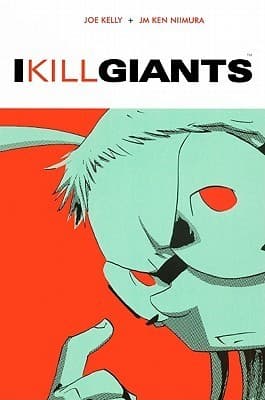
Joe Kelly (2009)
Genre
Fantasy / Young Adult
Reading Time
90 min
Key Themes
See below
Sign in to track this book
Barbara Thorson, a sharp-tongued outcast, uses a hammer, a fierce wit, and an even fiercer imagination to battle colossal, otherworldly giants while dealing with the very real, and far more terrifying, monster of grief.
Barbara Thorson is an eccentric fifth-grader who thinks she is a giant slayer. She lives in a world with hidden giants, fairies, and other mythical creatures. She carries a war hammer named Coveleski, which she believes is magical. She spends her days building traps and looking for giants in the woods and around her Long Island town. Her older sister, Karen, struggles to manage the house and Barbara's behavior. Her younger brother, Kevin, mostly ignores her. At school, Barbara is an outcast. She often gets in trouble for her obsessions and skips class for her 'work.' Her fantasy world is her only comfort. She writes about it in her notebooks, which frustrates her teachers and confuses her new school counselor, Mrs. Mollé.
A new student named Sophia moves to Barbara's school from Leeds, England, and tries to befriend the reclusive giant slayer. Sophia is at first interested in Barbara's stories and views. Soon, she worries about Barbara's intense belief in giants and her isolation. Meanwhile, Mrs. Mollé, the school psychologist, tries to connect with Barbara, sensing a deeper issue. Barbara sees Mrs. Mollé as a nuisance and a threat to her secret mission. She avoids questions and refuses therapy. Karen, overwhelmed by her responsibilities, struggles to manage Barbara's school attendance and her behavior, which includes violent outbursts and more withdrawal into her fantasy world.
Barbara focuses on the coming of a powerful, ancient giant called a Titan. She thinks this Titan will destroy things and only she can stop it. Her preparations become more frantic and dangerous. She spends nights on the beach, sets traps, and even confronts a group of bullies, led by Taylor, who torment her at school. Barbara interprets everyday events, like a storm or a power outage, as signs of the Titan's approach. Sophia tries to understand Barbara's world, even joining her on some of her 'hunts.' But the line between reality and fantasy becomes more blurred for both of them, especially for Barbara, who seems to be losing her grip on the real world.
Sophia's patience runs out as Barbara's behavior gets more extreme. During one of their 'hunts,' Sophia sees Barbara's desperate and self-destructive actions. This makes Sophia openly question if Barbara is mentally unwell. This causes a rift between them. In a vulnerable moment, Barbara tells Sophia that Coveleski, her war hammer, isn't magical in the way Sophia might think. Instead, she says it's a symbolic weapon, given to her by her father before his death. It represents her duty to protect the town. This hints at the deeper, personal meaning of her giant-slaying mission, connecting it to her family and past trauma.
Mrs. Mollé, after many failed attempts to talk to Barbara, learns more about her home situation and her mother's illness. She confronts Barbara directly, trying to get her to acknowledge her mother's deteriorating health. Barbara, however, lashes out, protecting her fantasy world as a shield against the painful truth. Karen, exhausted and overwhelmed, also pleads with Barbara. She asks her to stop her giant-hunting act and face the serious situation at home. The sisters' relationship is strained, with Karen feeling neglected and Barbara feeling misunderstood and burdened by her perceived duty.
Barbara's giant hunting becomes dangerous when she tries to set a trap on the beach. This causes an accident where she is injured, further alarming Karen and Mrs. Mollé. During this time, the school bully, Taylor, unexpectedly approaches Barbara. Instead of tormenting her, Taylor says she has also experienced loss. She understands Barbara's need for a coping mechanism. Taylor shares a story about her grandmother, hinting at her own struggles and offering empathy. This briefly bridges the social gap between the two girls.
Sophia, worried about Barbara, visits her home and finally learns the truth: Barbara's mother is dying from a severe, unnamed illness, likely cancer, and is confined to her bed. The 'giants' Barbara has been fighting are metaphors for her fear, grief, and the helplessness she feels about her mother's coming death. The 'Titan' she fears is death itself. Sophia sees the mother in her bed, weak and frail, and the reality of Barbara's situation becomes clear. This shatters Sophia's initial idea of Barbara's 'fantasy' as just imaginative play.
As her mother's condition quickly worsens, Barbara thinks the 'Titan' giant is arriving. She goes to the woods, preparing for what she believes will be her final battle. She wants to face this giant alone, believing it is her job to protect her family and town from its destructive power. Her actions become frantic and desperate, fueled by grief and a need for control in a situation where she has none. She puts on her 'armor' and brandishes Coveleski, ready to confront the ultimate monster that threatens to take her mother away.
Barbara confronts the 'Titan' in a hallucinatory sequence in the woods. The giant is not a monster but a manifestation of her fears and grief. It speaks to her, saying its purpose is not to destroy but to end suffering. The giant tells her she cannot fight death, but she can fight for life and love. It explains that the real fight is not with external monsters, but with internal pain and the inability to accept loss. This encounter is a turning point, making Barbara face her mother's illness and her own deep emotions.
After her encounter with the 'Titan,' Barbara returns home, no longer burdened by the literal fight against giants. She finds her family around her mother, who is nearing her end. Barbara finally sits by her mother's bedside, holding her hand, and shares a quiet, loving farewell. She accepts that her mother is dying and that she cannot fight this battle. She finds peace in being present and sharing a final moment of connection. Her journey from denial to acceptance ends in this tender, heartbreaking scene, showing her first steps toward processing her grief in a healthy way.
The Protagonist
Barbara evolves from a defiant, isolated girl lost in fantasy to a brave individual capable of confronting her deepest fears and accepting the reality of loss.
The Supporting
Karen endures significant stress as she attempts to hold her family together, ultimately finding a moment of shared grief and understanding with Barbara.
The Supporting
Sophia moves from curious observer to concerned friend, eventually becoming an empathetic confidant who helps Barbara face her truth.
The Supporting
Mrs. Mollé consistently tries to reach Barbara, acting as an external force pushing her towards confronting her reality.
The Mentioned
Her declining health serves as the primary conflict, culminating in her death which forces Barbara to confront reality.
The Supporting
Taylor transforms from a tormentor to someone who briefly connects with Barbara through shared understanding of loss.
The Supporting
Kevin remains a mostly static character, a quiet witness to his family's struggles.
The main theme is Barbara's inability to cope with her mother's terminal illness and coming death. Her giant-slaying fantasy shows her grief, fear, and desperate attempt to control an uncontrollable situation. The 'giants' she fights are metaphors for death, helplessness, and the pain of losing a loved one. The story shows her journey through the stages of grief, from denial and anger to acceptance. It highlights how loss affects a child and how people cope.
““I kill giants. It’s what I do.””
Barbara creates a fantasy world to protect herself from her life's harsh realities. Her belief in giants and her role as a giant slayer lets her turn her inner struggles into monsters she can fight. The story blurs the lines between her imagination and reality, making the reader question what is real. This theme explores how fantasy can protect, but also how it can isolate and stop people from facing truths. It shows the importance of facing reality to heal.
““It's okay to be scared. Everyone is. But you have to fight. You have to fight for what you believe in. And you have to fight for the people you love.””
The story looks at different coping methods, mainly Barbara's fantasy world, as a response to trauma and stress. Her behavior, including social isolation, aggression, and obsessive tendencies, can be seen as symptoms of a child dealing with great psychological pressure. Mrs. Mollé's role as a school psychologist shows the importance of mental health support for grieving children. The story suggests that while fantasy can be a temporary refuge, healthy coping means acknowledging reality and seeking connection, instead of withdrawing.
““You can’t run from the things that scare you, Barbara. Not forever.””
The Thorson family is under great strain because of the mother's illness. Karen, as the eldest, takes on much responsibility. She struggles to care for her siblings and manage the household while dealing with her own grief. This theme explores family dynamics in crisis, unspoken burdens, and the challenges of communicating and supporting each other during hard times. Despite friction and misunderstandings, there is an underlying current of love and loyalty that brings the family together in their shared moment of loss and acceptance.
““Sometimes, you just gotta let go.””
A symbolic weapon representing Barbara's duty and connection to her father.
Coveleski is Barbara's prized war hammer, which she believes is magical and essential for giant slaying. Initially, it appears to be a literal weapon in her fantasy world. However, it is revealed to be a sentimental object given to her by her deceased father, symbolizing his strength, her perceived duty to protect, and her connection to him. It acts as a transitional object, allowing her to channel her grief and fear into a tangible mission. Its significance shifts from a magical tool to a powerful symbol of her internal struggle and inherited strength, evolving as her understanding of her 'mission' changes.
Personifications of fear, grief, and the uncontrollable aspects of life.
The giants Barbara hunts are not literal monsters but powerful metaphors. They represent her deepest fears: the illness consuming her mother, the overwhelming nature of grief, the helplessness she feels, and ultimately, death itself. Each 'giant' she encounters or prepares for corresponds to a stage of her emotional struggle. The ultimate 'Titan' giant is the personification of death, which she must confront and, in doing so, accept. This device allows the story to explore complex psychological states through a fantastical lens, making internal battles external and tangible for Barbara and the reader.
A visual and narrative device for Barbara's inner world and coping mechanism.
Barbara's notebooks are filled with her meticulous drawings, maps, and lore about giants and their weaknesses. These notebooks serve multiple functions: they are a visual representation of her rich inner fantasy world, a detailed record of her coping mechanism, and a narrative device that provides insight into her mental state. They show the extent of her dedication to her fantasy and her need for control through documentation. As her grip on reality loosens, the notebooks become a testament to her desperation, eventually reflecting her journey towards understanding the true nature of her 'giants'.
A climactic moment of direct thematic revelation and emotional catharsis.
In the story's climax, Barbara confronts the 'Titan' giant, which speaks to her directly. This dialogue is a pivotal plot device, as the giant articulates the core themes of the book. It tells Barbara that she cannot fight death, but she can fight for life, love, and for herself. This is not a literal conversation with a monster, but a powerful internal monologue externalized, representing Barbara's subconscious confronting her conscious denial. It serves as the turning point for her acceptance of grief, providing the emotional and thematic resolution to her long-standing internal conflict.
“I'm not afraid of giants. I kill them.”
— Barbara's defining mantra, expressing her self-appointed role.
“Sometimes you have to pretend to be a lot braver than you are.”
— Barbara reflecting on the facade she maintains.
“It's not about being a hero, it's about being strong enough to face what scares you.”
— A deeper understanding of true strength, often from Mrs. Mollé.
“Monsters are real. And ghosts are real too. They live inside us, and sometimes, they win.”
— Barbara acknowledging internal struggles.
“You can't just fight the monsters you can see. Sometimes the hardest ones are the ones you can't.”
— Hinting at the metaphorical nature of her battles.
“Even if you can't see them, that doesn't mean they aren't there.”
— Referring to both giants and unseen emotional burdens.
“It's okay to be scared. Everyone gets scared. But you can't let it stop you.”
— A message about overcoming fear, often from a supportive character.
“Sometimes the biggest giants are the ones we build for ourselves.”
— A profound realization about self-imposed limitations or fears.
“The world is full of terrible things, Barbara. But it's also full of wonderful things. You have to decide which ones you're going to fight for.”
— A crucial life lesson about choice and focus.
“I carry a hammer. For giants. And a purse. For, you know, stuff.”
— Barbara's quirky and iconic self-description.
“It's not about winning every fight. It's about getting back up every time you fall.”
— A lesson in resilience and persistence.
“You don't have to face everything alone, Barbara.”
— A recurring theme about accepting help and connection.
“Because if I don't, who will?”
— Barbara's justification for her solitary mission.
“Grief is a giant. A big, ugly giant. And it's coming for you.”
— The ultimate revelation of the true giant Barbara is fighting.
Ready to see how well you understood this book? Take our interactive quiz with 10 questions.







