“The I Hotel stood at the corner of Kearny and Jackson, a five-story building of brick and wood, one of the last vestiges of Manilatown.”
— Describing the physical presence and historical significance of the I Hotel.

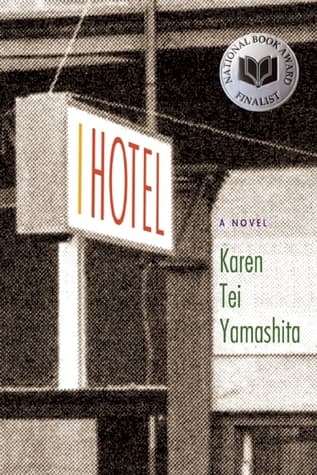
Karen Tei Yamashita (2010)
Genre
Literary Fiction / Historical Fiction
Reading Time
15-20 hours
Key Themes
See below
Sign in to track this book
Through diverse voices and forms, "I Hotel" explores the Yellow Power Movement in San Francisco's Chinatown, tracing a decade of student unrest, revolutionary spirit, and the fight to save a historic hotel that became central to Asian American identity in the late 1960s and early 70s.
The story opens in 1968, a year of assassinations and protests. In San Francisco, an Asian American political awareness begins to grow. We meet characters, including young students and community organizers like Paul and Cynthia, who are dealing with their identities and the wider political situation. The Black Panthers' influence inspires solidarity among some Asian American youth. The Yellow Power Movement begins, driven by a desire for self-determination and a rejection of assimilation. Early discussions and gatherings set the stage for future activism and show the different views within the community, from those wanting revolutionary change to those focused on cultural preservation.
The International Hotel (I-Hotel) in San Francisco's Manilatown becomes a central symbol of the growing movement. Its mostly elderly Filipino tenants face eviction by developers wanting to gentrify the area. This threat mobilizes students and activists, including characters like Alab and the I-Hotel Tenants Association, who see the struggle as a small example of larger injustices. The I-Hotel becomes a meeting place, a print shop, and a communal living space for many young organizers. The fight to save the I-Hotel provides a specific cause for the different parts of the Yellow Power Movement to unite, bridging generational and ethnic divides.
As the movement grows, internal disagreements intensify. Various revolutionary theories, from Maoism to Marxism, create divisions among activists. Some advocate for armed struggle, while others prioritize community organizing and cultural empowerment. Characters like the radical group 'The Bomb' represent the more militant side, while groups focused on tenant rights and social services try to navigate these tensions. Paul and Cynthia, among others, deal with the complexities of these different approaches, questioning the most effective path to liberation and often feeling the strain of personal commitments against political demands. The early enthusiasm is tempered by the realities of sustained activism.
Art, literature, and performance become more important in the movement. Asian American artists, poets, and playwrights use their work to express experiences, challenge stereotypes, and build a sense of collective identity. We see revolutionary theater groups, independent presses, and community art projects appear. Characters involved in these artistic efforts, such as the playwright Cynthia, use their creativity to explore themes of race, class, and colonialism, connecting personal to political. These cultural expressions communicate messages and provide emotional support and a sense of shared heritage for activists facing constant struggle.
The legal fight to save the I-Hotel grows. The tenants and their supporters face more pressure from the landlord, Milton Marks, and the city. Court orders and eviction notices become common, leading to mass protests and civil disobedience. The fight gets media attention and support from other civil rights groups, turning the I-Hotel from a local issue into a national symbol of resistance against gentrification and corporate power. Activists like Alab fully commit to the cause, organizing rallies, sit-ins, and legal defense funds. Daily life within the I-Hotel shows communal living and collective action against great odds, with residents and activists sharing resources and solidarity.
Despite the passionate activism, the movement faces setbacks. Legal battles are often lost, and constant pressure wears on activists. Disillusionment begins for some, as initial excitement gives way to exhaustion and the difficulties of sustained struggle. Characters deal with burnout, personal sacrifices, and the effectiveness of their actions. Some activists leave the movement, pursuing different paths or withdrawing from public life. External pressures from police surveillance and political repression also create a sense of vulnerability and isolation, making it harder to maintain unity and momentum amid ongoing challenges.
As the I-Hotel eviction deadline nears, the community prepares for a final stand. The I-Hotel becomes a fortress of resistance, with hundreds of supporters gathering to protect the elderly tenants. The story builds to a dramatic confrontation between activists, residents, and a heavily armed police force. This period involves intense organization, with watch schedules, food preparation, and media outreach coordinated from inside the hotel. The sense of camaraderie and shared purpose is clear, even as a violent clash seems inevitable. The I-Hotel's fate becomes a symbol of the larger fight for justice and dignity.
In the early hours of August 4, 1977, police violently evict the remaining tenants and activists from the International Hotel. Despite large human chains and brave resistance, the police overcome the defenders. The eviction is a brutal and heartbreaking moment, a significant defeat for the Yellow Power Movement and the tenants. The scene is described in detail, showing the physical and emotional toll on those involved. The loss of the I-Hotel leaves a deep scar on the community, symbolizing both the movement's resilience and the power of capitalist forces.
After the I-Hotel eviction, many activists grapple with a deep sense of loss and disillusionment. The movement, once united by the I-Hotel struggle, begins to break apart. Some characters continue their activism in different ways, focusing on social services, cultural work, or labor organizing. Others withdraw from direct political engagement, pursuing personal lives or academic careers, forever changed by their experiences. The story explores the long-term impact of the struggle on individuals, showing how the fight for the I-Hotel shaped their identities and future paths, even in defeat. The memory of the I-Hotel, however, continues to inspire future generations.
The final sections reflect on the lasting impact of the Yellow Power Movement and the I-Hotel struggle. While the I-Hotel was lost, the movement built a distinct Asian American identity, created solidarity across diverse Asian ethnic groups, and set the stage for future political and cultural organizing. The story shows how the experiences of the 1960s and 70s continued to affect later decades, influencing community development, academic discussion, and artistic expression. The characters' stories, though varied, together provide a complex understanding of what it means to be Asian American and to fight for justice in a changing society.
The Protagonist/Supporting
Paul evolves from an idealistic student to a more seasoned, yet often conflicted, activist, trying to find his place and purpose amidst the movement's triumphs and defeats.
The Protagonist/Supporting
Cynthia develops from a student activist to a committed cultural worker, using her artistic talents to articulate the movement's message and sustain its spirit.
The Supporting
Alab remains a steadfast and practical force throughout the I-Hotel struggle, embodying the consistent effort required for community organizing.
The Antagonist
Milton Marks remains a consistent antagonist, unwavering in his pursuit of profit and the eviction of the I-Hotel, ultimately succeeding.
The Supporting/Collective Protagonist
The tenants collectively fight for their homes, becoming symbols of resistance, ultimately being displaced but leaving an indelible mark on the community's consciousness.
The Supporting
The Bomb's influence ebbs and flows, reflecting the rise and fall of militant revolutionary fervor within the broader movement.
The Mentioned/Implied
The narrative voice evolves by incorporating different forms and perspectives, reflecting the complex, multi-layered history being presented.
The novel explores the complex process of creating a collective 'Asian American' identity from diverse ethnic groups (Filipino, Chinese, Japanese, etc.). It shows how this identity was shaped by shared experiences of racism, colonialism, and the fight for civil rights, especially during the Yellow Power Movement. Characters deal with stereotypes, historical erasure, and the tension between assimilation and revolutionary self-determination. The struggle to save the I-Hotel becomes central to this new identity, showing how shared political action can create solidarity across ethnic lines, as when Chinese and Japanese American students rally to protect Filipino elders.
““We were inventing ourselves, year by year, protest by protest, poem by poem.””
The fight to save the International Hotel is the main story, representing the larger struggle against gentrification and the displacement of marginalized communities. The novel shows how economic forces, driven by developers like Milton Marks, threaten the culture and homes of working-class and immigrant populations. This theme highlights the human cost of urban development and the importance of preserving historical communities. The sustained effort by activists and tenants to defend the I-Hotel, ending in a violent eviction, shows the power imbalance between community activism and corporate interests.
““The I-Hotel was not just a building; it was a home, a history, a heart.””
The novel examines activism, its successes, failures, and the personal cost to individuals. It shows the idealism of the Yellow Power Movement, but also its internal conflicts, disagreements, and setbacks. Characters like Paul and Cynthia experience burnout, disillusionment, and the challenge of maintaining revolutionary spirit over time. The loss of the I-Hotel despite organizing raises questions about the long-term impact of direct action versus systemic change, but also celebrates the enduring spirit of resistance and the legacies of those who fought. It highlights the sacrifices made for collective liberation.
““We measured our victories not in acres won, but in hearts awakened.””
Art, literature, and performance are shown as important tools for expressing and driving the movement. Cynthia's involvement in revolutionary theater, the growth of independent presses, and the use of poetry and visual art throughout the novel show how cultural production can challenge dominant narratives, build collective awareness, and provide emotional support. The novel itself, with its experimental form including plays, poems, and graphic elements, embodies this theme. It suggests that storytelling and creative expression are not just reflections of history but active forces in shaping it and preserving the memory of struggles like the I-Hotel.
““To write was to fight, to sing was to resist, to create was to exist.””
A fragmented structure incorporating prose, playwriting, poetry, and graphic elements.
Yamashita employs a highly experimental and multi-faceted narrative structure. Each year (1968-1977) is presented as a distinct novella, often shifting in style and form. The text integrates traditional prose with dramatic scripts, poems, lists, historical documents, and even visual art. This device mirrors the fragmented, diverse, and often contradictory nature of historical memory and the Asian American experience. It allows for multiple perspectives and prevents a single, authoritative voice from dominating, reflecting the collective and often chaotic nature of social movements and the difficulty of encapsulating a complex historical period in one linear narrative.
The narrative often comments on its own construction and the challenges of writing history.
The novel frequently breaks the fourth wall, with the narrator(s) directly addressing the reader, questioning the reliability of memory, the biases inherent in historical accounts, and the very act of storytelling. This metafictional approach invites the reader to critically engage with the text and its historical subject matter, rather than passively consume a linear narrative. It highlights the subjective nature of history and the ongoing process of interpreting the past. By acknowledging its own constructedness, the novel reinforces the idea that history is not a fixed truth but a contested space of narratives and interpretations, especially for marginalized communities whose stories are often erased.
The I-Hotel acts as a microcosm and a potent symbol for broader struggles.
The International Hotel is not merely a setting but a powerful symbol throughout the novel. It represents the historical presence of the Filipino community in San Francisco, the vulnerability of immigrant populations to gentrification, and the resilience of collective resistance. As a physical space, it becomes a hub for activism, a home for elders, and a battleground for justice. Its eventual loss symbolizes the painful setbacks faced by social movements, but its memory and the fight to save it endure as a symbol of the Yellow Power Movement's spirit and legacy, inspiring future generations of activists and artists.
Integration of real historical figures, events, and archival materials.
Yamashita weaves actual historical figures (like George Moscone, Milton Marks), documented events (the I-Hotel eviction), and references to real-world organizations and publications into the fictional narrative. The novel often includes what appear to be excerpts from historical documents, manifestos, and news reports, blurring the lines between fiction and non-fiction. This intertextuality grounds the story in historical reality, lending authenticity and depth to the fictionalized accounts. It also underscores the meticulous research behind the novel and its intention to serve as a comprehensive historical record of the Yellow Power Movement, even while experimenting with narrative form.
“The I Hotel stood at the corner of Kearny and Jackson, a five-story building of brick and wood, one of the last vestiges of Manilatown.”
— Describing the physical presence and historical significance of the I Hotel.
“History is not a simple linear progression. It is a tapestry woven with many threads, some tangled, some broken, some barely visible.”
— A reflection on the complex and multi-faceted nature of historical narratives.
“Survival was a daily act, a constant negotiation with the forces that sought to erase them.”
— Referring to the struggles faced by the Filipino residents of the I Hotel.
“We were all heroes in our own small ways, fighting battles no one else saw.”
— A character's internal thought about the unrecognized struggles of ordinary people.
“To remember is to resist. To forget is to surrender.”
— Emphasizing the importance of memory and historical consciousness in the face of oppression.
“The city, like a living organism, devoured its old parts to make way for the new, but some things refused to be digested.”
— Metaphorically describing urban development and the resilience of communities.
“They built their lives on the edge of forgetting, always on the precipice of being swept away.”
— Illustrating the precarious existence of the immigrant community.
“Solidarity was not a given; it was forged in the fires of shared struggle.”
— Reflecting on the nature of collective action and community building.
“The past was not merely prologue; it was the very ground beneath their feet, shifting and unstable.”
— A powerful image of how history actively shapes the present, rather than just preceding it.
“Each room in the I Hotel held a universe, a lifetime of stories compressed into a few square feet.”
— Highlighting the individual narratives and experiences within the collective space of the hotel.
“They were the ones who held the stories, the keepers of a history that otherwise might vanish.”
— Referring to the elders and residents of the I Hotel as vital custodians of cultural memory.
“What does it mean to be a revolutionary when the revolution itself is a constantly moving target?”
— A philosophical question about the evolving nature of social change and activism.
“The wind carried the whispers of forgotten languages, the echoes of lives lived and lost in the city's relentless churn.”
— A poetic description of the lingering presence of past communities and their cultural heritage.
“Their struggle was not just for a place to live, but for the right to exist, to be seen, to be heard.”
— Articulating the fundamental human rights at stake in the fight to save the I Hotel.
Ready to see how well you understood this book? Take our interactive quiz with 10 questions.

Biography coming soon.







