“Full dark, no stars. The words came to him from a long-forgotten movie. They were appropriate now.”
— Robert Neville reflecting on the desolate world at night.

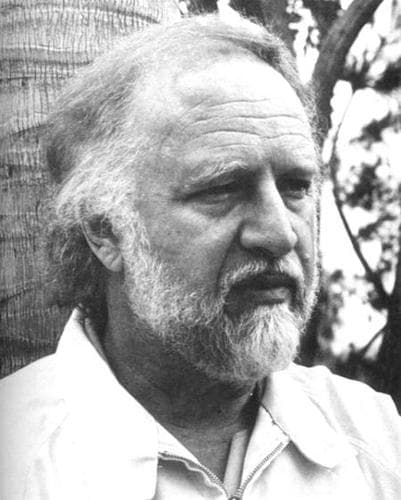
Richard Matheson (1954)
Genre
Fantasy / Science Fiction
Reading Time
317 min
Key Themes
See below
Sign in to track this book
In a world overrun by the living dead, the last human survivor hunts vampires by day and barricades himself against their siege by night, questioning who the true monster has become.
Robert Neville is the sole survivor of a global pandemic that turned humanity into vampiric creatures. He lives in a fortified house in Los Angeles, carefully boarding up windows and reinforcing his doors each evening. His days are a routine of hunting dormant vampires, scavenging for supplies, and conducting scientific experiments to understand and cure the disease. He drives through the empty city in his station wagon, impaling sleeping vampires with wooden stakes and burning their bodies. The city's silence is broken only by the distant howls of the creatures, especially Ben Cortman, a former neighbor who now taunts Neville nightly from outside his home, always demanding he 'come out!'
Driven by a need for understanding and a cure, Neville spends much of his time on scientific research. He has a makeshift laboratory at home, dissecting vampire bodies, analyzing blood samples, and reading medical texts he saved from libraries. He discovers two types of vampires: living, infected humans who are vulnerable to sunlight and stakes, and reanimated dead, who are immune to stakes but repelled by garlic and mirrors. His experiments are often frustrating and show little progress, highlighting his isolation and the huge problem he faces alone.
One day, Neville sees a stray dog, thin and scared, wandering the streets. Overwhelmed by loneliness and a desire for companionship, he spends weeks trying to lure the dog to his home, leaving out food and patiently waiting. The dog is deeply traumatized and resists his efforts, but Neville's persistence eventually works. He captures the dog and brings it inside, hoping for a bond. However, the dog is already infected with the plague, though it appears differently, and its health worsens. Despite his efforts to cure it, the dog eventually dies, leaving Neville even more isolated and heartbroken.
After years of living alone, Neville is shocked to see a living woman, Ruth, walking in the sunlight. He follows her and brings her back to his home, initially suspicious but also relieved by the possibility of human connection. Ruth is cautious and secretive, refusing to answer many of his questions. Neville, desperate for companionship, overlooks her evasiveness. They share a meal, and for the first time in years, Neville experiences something like normal human interaction, a fragile hope that he might not be the last human after all. Her presence immediately changes his routine and outlook.
Neville's hope shatters when he discovers Ruth's true nature. He finds a note from her, revealing she is not fully human but one of the 'new' vampires—those who contracted the disease but are learning to control it and live in a new society. She was sent to spy on him, to assess his threat to their emerging civilization. Ruth confesses she is also infected and takes pills to suppress her vampiric urges. She urges Neville to flee, warning him her people will come for him. This revelation is a deep betrayal, forcing Neville to face the reality that he is an enemy to the new world.
Through Ruth's confession and his later capture, Neville finally understands the full scope of the change that has occurred. He learns that the 'new' vampires, unlike the wild, mindless creatures he has been hunting, are an organized society. They are trying to build a new world, a new order, and they see Neville as a dangerous relic of the past, a murderer who has systematically eliminated their kind. They have established laws and a social structure, and they have developed a serum that allows them to suppress the more violent aspects of their vampirism, making them appear almost human during the day.
Following Ruth's departure, the 'new' vampires, led by a man named Virgus, storm Neville's house. He fights bravely but without success, falling to their numbers. He is captured, injured, and taken to a makeshift prison. Here, he observes the organized nature of his captors, their quiet efficiency, and their clear intent. He is treated as a criminal, an outsider, and a threat to their growing society. The roles have completely reversed; he is no longer the hunter but the hunted, awaiting judgment from those he once considered monsters.
Neville is brought before a tribunal of the 'new' vampires. He tries to explain his actions, his scientific search for a cure, and his belief that he was eradicating a plague. However, from their perspective, he is a mass murderer, having killed many members of their species. His arguments are ignored, as they see him as a symbol of the old world's prejudice and violence against their kind. He is condemned to death, to be executed by injection, a method chosen to avoid unnecessary pain and to symbolize their more 'civilized' approach compared to his staking.
Before his execution, Ruth visits Neville in his cell. She brings him a small packet of pills, explaining they will ensure a painless death. She expresses regret and necessity, acknowledging his scientific efforts but stating that he cannot be allowed to live in their new world. During this conversation, she reveals the irony of his existence: to the 'new' vampires, Neville is a monstrous legend, a terrifying figure who stalks their kind by day, killing them without mercy. He is their boogeyman, their past, and their greatest fear, just as vampires were once his.
Neville takes the pills Ruth provided. As he feels the poison working, he looks out at the gathering crowd of 'new' vampires, their faces a mix of fear and triumph. He sees their children, healthy and alive, and understands they are the future. He finally grasps the change in perspective: he is not the hero, but the monster. He is the last remnant of a past era, a living legend of terror to the new dominant species. With his last breath, he realizes he has become the very thing he fought against—a legend, a myth, a symbol of fear to a world that has moved on without him. He dies, and the new world begins.
The Protagonist
Neville transitions from a hunter of monsters to being perceived as a monster himself, ultimately realizing his role as the last of a dying species.
The Supporting/Antagonist
Ruth reveals her true nature, forcing Neville to confront the reality of the 'new' world and ultimately orchestrating his peaceful demise.
The Antagonist/Mentioned
Cortman remains a static, antagonistic force throughout, a constant reminder of Neville's peril.
The Supporting Antagonist
Virgus introduces and enforces the new social order, acting as the judge and executioner of Neville.
The Supporting
The dog briefly alleviates Neville's loneliness but ultimately succumbs to the plague, deepening his isolation.
Robert Neville's deep isolation is the main theme, driving much of his character's motivation and psychological state. His daily life shows extreme solitude, broken only by Ben Cortman's taunts or the brief, tragic companionship of the dog. This theme is clear in his careful routines, his scientific efforts born from a need for purpose, and his desperate, almost naive, acceptance of Ruth. The story shows the damaging psychological effect of being the last of one's kind, pushing Neville to the edge of sanity and making him vulnerable to manipulation.
“He was an anachronism, a disease. And they were the cure.”
The novel changes traditional definitions of human and monster. Initially, Neville sees himself as the last human, fighting against monstrous vampires. However, as the 'new' vampire society appears, the perspective shifts. Neville's actions—killing their kind—are seen as monstrous by the 'new' vampires. The story makes the reader question whether humanity is defined by species or by action, and whether survival justifies any means. The 'new' vampires, despite their condition, seek order and civilization, making Neville's 'human' actions seem barbaric in their eyes.
“Full circle. A new terror born in death, a new superstition entering the unassailable fortress of forever. I am legend.”
The story explores the idea of evolution, not just biologically but socially. The plague forces an adaptation, creating a new species (or sub-species) that must establish its own norms and social structures. Neville, by sticking to the old ways, represents a species unable to adapt. The 'new' vampires, in contrast, are evolving, learning to control their urges, form communities, and even develop a form of medicine. Their rise signals the natural progression of life, where the old makes way for the new, and the 'fittest' are those who can adapt to radically altered circumstances.
“They were trying to build a new world. And he, Robert Neville, was the old world.”
Neville, as a scientist, tries to understand and fight vampirism through rational, empirical methods. He dissects bodies, analyzes blood, and seeks a cure, dismissing traditional vampire lore as superstition. However, he gradually discovers that some 'superstitions' (like garlic and mirrors) have a scientific basis in their effect on the 'reanimated dead.' The emergence of the 'new' vampires further complicates this, as their biology and social structure challenge his initial scientific understanding. Ultimately, the story suggests that science must adapt to new realities and that what one group calls 'superstition' can be a basic truth for another, especially when dealing with an evolving species.
“Scientific fact: the vampires were not afraid of the cross. But they were afraid of him.”
The story is told primarily through Robert Neville's isolated viewpoint.
The narrative is primarily delivered through Robert Neville's perspective, immersing the reader in his solitude and paranoia. This limited viewpoint enhances the sense of isolation and uncertainty, as the reader only knows what Neville knows. It effectively builds suspense and horror, as the true nature of the 'vampires' and the evolving world is gradually revealed through his discoveries and encounters. This device is crucial for the twist ending, as it allows the author to control information and ultimately subvert the reader's understanding of who the true 'monster' is.
Subtle clues about Ruth's true identity and the 'new' vampires' existence.
Ruth's initial evasiveness, her refusal to answer direct questions, and her sudden concern for Neville's well-being despite their brief acquaintance, all subtly foreshadow her true nature as a 'new' vampire and spy. Her 'illness' and the pills she takes also hint at her condition. These elements create a growing sense of unease and suspicion, preparing the reader for the eventual revelation of her betrayal and the existence of an organized vampire society. This device heightens the impact of the plot twist.
The reversal of roles where the hunter becomes the hunted and the 'legend'.
The entire premise of 'I Am Legend' is built on profound irony. Neville sees himself as the last human hero, fighting monstrous vampires. However, the ultimate revelation is that he has become a monstrous legend to a new, evolving species. His attempts to eradicate them are viewed as heinous crimes, making him the ultimate antagonist from their perspective. This situational irony completely flips the protagonist/antagonist dynamic, redefining what it means to be 'human' and 'monster' and forcing the reader to re-evaluate all of Neville's actions.
Neville's relentless, ultimately futile, search for a cure for vampirism.
Neville's scientific quest for a cure serves as a primary driving force for his actions and intellectual engagement throughout his isolation. It provides him with purpose and a reason to continue living. However, the 'cure' ultimately proves to be irrelevant or even detrimental from the perspective of the 'new' vampires, who have adapted and formed a new society. The MacGuffin highlights the futility of fighting a natural evolutionary process and underscores the tragic irony of Neville's solitary struggle.
“Full dark, no stars. The words came to him from a long-forgotten movie. They were appropriate now.”
— Robert Neville reflecting on the desolate world at night.
“The strength of the vampire, he knew, was that no one believed in them. But he did.”
— Neville contemplating the nature of his enemy and his unique awareness.
“They were not afraid of him, not really. They were afraid of what he represented.”
— Neville's realization about his role in the new world order.
“He was an anomaly. A throwback. A horror. A legend.”
— Neville understanding how he is perceived by the new society.
“There was no answer. There would be no answer. There was never any answer for anything.”
— Neville grappling with the futility of his situation.
“It was not the fear of the unknown. It was the fear of the known. The fear of what was waiting for him.”
— Neville's dread of the vampires, a known and constant threat.
“Sometimes he wished he could just stop thinking. Just let it all go. But he couldn't.”
— Neville's internal struggle with his own mind and the burden of survival.
“He was the last man on Earth. And he was not alone.”
— A paradoxical statement highlighting Neville's unique isolation among the transformed.
“The world was a graveyard. And he was the last mourner.”
— Neville's somber view of the post-apocalyptic landscape.
“He knew, with a terrible certainty, that they were watching him. Always watching.”
— Neville's constant paranoia and the feeling of being hunted.
“He was not a monster. He was a man. And he would die like a man.”
— Neville's defiance in the face of his inevitable end.
“Only the dead know peace.”
— A grim reflection on the only escape from his torment.
“He was the past. They were the future.”
— Neville recognizing the shift in dominance and his obsolescence.
“He had to keep going. No matter what. No matter how much it hurt.”
— Neville's unwavering determination to survive.
Ready to see how well you understood this book? Take our interactive quiz with 10 questions.
Biography coming soon.







