“I was a strange young man then, with many odd ideas and a mind that worked in a different way from other people's.”
— The narrator reflecting on his youth and unique perspective.

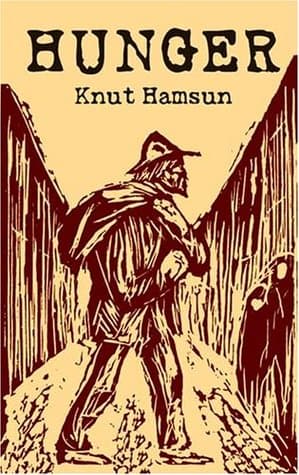
Knut Hamsun (2008)
Genre
Fantasy / Science Fiction / Young Adult / Romance
Reading Time
240 min
Key Themes
See below
Sign in to track this book
Knut Hamsun's *Hunger* depicts a starving writer's descent into alienation and self-destruction, painting an unforgettable portrait of a man pushed to his limits.
The novel begins with the unnamed protagonist, a young writer, arriving in Christiania (modern-day Oslo) without money, possessions, or prospects. He feels an intense, constant hunger. He tries to write for newspapers, but his work is often rejected or poorly paid, barely preventing starvation. His pride stops him from asking for help, and he often gives away what little money he gets, making his suffering worse. He wanders the city streets, a thin, isolated figure, observing the world with intellectual curiosity and deep despair. His mind, though sharp, starts to play tricks on him due to malnutrition, leading to more erratic thoughts and behaviors.
Driven by extreme hunger, the protagonist eventually pawns his only valuable possession, a blanket, for a small amount. This small sum, however, feels like a fortune to him. He experiences a brief, almost manic period of imagined wealth, buying himself a meal and even giving money to strangers, despite his desperate situation. This generosity is a recurring trait, showing his paradoxical pride and self-destructive tendencies. The temporary relief ends quickly, and he soon finds himself back in the same state of poverty, with hunger returning strongly. His mental state continues to worsen, marked by grand statements and self-importance, often followed by deep shame.
While walking the streets, the protagonist repeatedly sees a young woman he fantasizes about and names Ylajali. She becomes an intense, almost delirious obsession for him. Their interactions are brief, often imagined or twisted by his hunger-affected mind. He projects his desires for beauty, connection, and understanding onto her, even as his appearance and erratic behavior likely push her away. He creates elaborate stories about her in his mind, using her as a muse for his writing and a focus for his increasingly unstable thoughts. These encounters offer fleeting moments of emotional intensity amid his suffering, but they ultimately deepen his isolation as he sees the gap between his fantasies and reality.
The protagonist often tries to submit his articles and stories to various newspaper editors, hoping for a breakthrough that would ease his hunger. His interactions with editors are often filled with anxiety and a desperate need for validation. He presents his work with a mix of arrogance and insecurity, sometimes acting intellectually superior to hide his deep poverty. Many of his submissions are rejected, or he receives only a tiny payment, barely enough for a single meal. The repeated rejections fuel his despair and reinforce his sense of failure, pushing him further into mental and physical suffering. He sometimes invents stories or exaggerates his situation to get sympathy or attention.
As his hunger increases and lasts longer, the protagonist's mental state significantly declines. He experiences vivid hallucinations, seeing strange figures, hearing voices, and misinterpreting everyday events. Paranoid delusions become common; he imagines people watching him, judging him, or plotting against him. He engages in long, complicated internal monologues, often arguing with himself or imagined people. The line between reality and his inner world blurs, making it hard for him to function. These episodes are often followed by clear moments where he recognizes his madness, only to slip back into it. His hunger is not just physical pain but a force that reshapes how he sees the world.
In one particularly difficult episode, driven to madness by starvation, the protagonist tries to eat his own finger. He chews on it, convinced it might provide some nourishment, showing the extreme psychological impact of his hunger. Later, in another moment of deep despair and delusion, he tries to eat a piece of his shoe. These acts are not just symbolic; they show the complete degradation of his physical and mental state. They highlight the animalistic instincts that emerge when people are pushed past their limits, stripping away dignity and reason. These moments are among the most direct depictions of his suffering.
The protagonist often falls behind on his rent, causing constant anxiety and tense interactions with his landlords. He often tries to charm or trick them, or simply avoids them, to gain time. His pride makes it impossible for him to admit his poverty directly, so he invents elaborate excuses or promises of future payment. Eventually, he is evicted from his rooms, forced to wander the streets or sleep in parks. This cycle of finding temporary shelter and then being thrown out reinforces his unstable and isolated existence, further breaking his ties to any sense of stability or belonging. Each eviction pushes him deeper into homelessness and despair.
A recurring and contradictory part of the protagonist's character is his habit of giving away money, even when he is near collapse from hunger. He gives coins to beggars, offers money to strangers, or leaves it in unexpected places. These acts are not driven by true altruism but by a complex mix of pride, a desire to appear generous despite his true situation, and perhaps a subconscious self-sabotaging impulse. He cannot stand the thought of pity or appearing weak, so he overcompensates. These actions ensure his continued suffering, yet they are central to his self-perception and his refusal to completely give in to the indignity of his situation.
The protagonist has several encounters with policemen, often because of his erratic behavior, homelessness, or disheveled appearance. These interactions cause him deep humiliation. He tries to maintain an air of dignity and intellectual superiority, often getting into philosophical or nonsensical arguments with the officers, but his attempts fail. The policemen represent the societal order he is increasingly outside of, and their authority highlights his powerlessness. These encounters often end with him being dismissed, sometimes with a small act of kindness or a stern warning, but always leaving him feeling more exposed, misunderstood, and alienated from society. His pride is constantly hurt.
As his isolation and hunger grow, the protagonist's grasp on reality weakens further. He begins to have elaborate conversations with inanimate objects, especially a clock, giving them personality and responding to his own internal monologues as if they were external voices. He also invents an imaginary friend, with whom he shares his thoughts and frustrations, creating simulated companionship in his deep loneliness. These episodes show his deteriorating mental health, a desperate attempt to fill the void created by his social isolation and physical suffering. They show the psychological cost of his prolonged deprivation and his struggle to keep a clear sense of self.
At one point, the protagonist sells an article or receives a small sum of money, giving him a brief period of relative comfort. He eats a good meal, finds new lodging, and even allows himself a moment of hope. However, this relief is always temporary. His self-destructive tendencies, along with his inability to manage money and continued rejections from publishers, quickly lead him back to his original state of poverty. This cycle of fleeting hope followed by despair shows the pervasive nature of his suffering and his inability to escape the forces that drive him to the edge. The brief moments of relief only make the subsequent fall feel harder.
Having reached his absolute limits, both physically and mentally, the protagonist can no longer endure Christiania or his life there. He feels defeated and knows that staying will only lead to his complete destruction. In a final, desperate act, he approaches a ship in the harbor and gets a job as a deckhand, despite having no experience. This decision is presented not as a hopeful new start, but as an escape, a flight from the city that has become a symbol of his torment. The novel ends with him sailing away from Christiania, his future uncertain but free from the immediate suffering he has endured.
The Protagonist
From a struggling, yet somewhat functional, writer, he descends into extreme physical and mental degradation, eventually choosing to escape his torment by leaving Christiania. His arc is one of decline, not traditional growth.
The Supporting
She remains a static, elusive figure, primarily serving as a catalyst for the protagonist's internal monologues and romantic delusions.
The Mentioned
The policemen are static figures, representing external societal judgment and control.
The Supporting
They remain static figures, acting as catalysts for the protagonist's increasing homelessness.
The Mentioned
They are static, representing the external, often unyielding, world of publishing.
Hunger is not just a physical sensation; it is a force that dominates the protagonist's life, eroding his body, mind, and spirit. It blurs the line between reality and hallucination, driving him to irrational acts like trying to eat his own finger or shoe. Hunger dictates his every thought and action, changing him from a rational person into a desperate animal. This theme appears in every scene, from his constant calculations of how to get food to his vivid delusions and the deep shame he feels about his thin body. It is the central antagonist, shaping the entire story.
“My brain was a clear, cold flame, and I felt as if I were in a state of grace.”
The protagonist is deeply isolated from society, from other people, and from himself. His poverty and erratic behavior push him to the edges of Christiania, making real connection impossible. He cannot form lasting relationships and often ruins potential interactions through his pride or strange statements. His internal world becomes his only companion, leading to delusions and conversations with inanimate objects. This isolation is both a result of his circumstances and a self-imposed condition, driven by a fierce pride that prevents him from seeking help. He is an outsider watching a world he cannot join.
“I was a stranger in this town, a stranger to myself.”
The protagonist's intense, almost pathological pride drives his suffering. He cannot bear to appear weak or needy, leading him to refuse help, give away his meager money, and invent elaborate lies to keep up a facade of dignity. This pride is self-destructive, ensuring his continued poverty and making his hunger worse. It prevents him from making practical decisions and pushes him further into isolation. His acts of generosity, while seeming altruistic, often stem from this same pride, a desperate attempt to assert control and superiority even as he starves.
“I preferred to die rather than reveal my misery to a single soul.”
The novel explores the link between genius, suffering, and madness. The protagonist is a writer, and his heightened sensitivity and intellect often mix with his mental decline. His hunger-induced delusions sometimes fuel his creative impulses, leading to strange but vivid literary ideas. However, the suffering also distorts his view of reality, making it hard for him to produce coherent work. The narrative questions whether his 'madness' is a disease or an extreme form of the artistic temperament, pushed to its limits by deep deprivation. His writing is both a lifeline and a source of further despair.
“My brain was a clear, cold flame, and I felt as if I were in a state of grace.”
Christiania, the novel's setting, is largely indifferent to the protagonist's suffering. While he interacts with various people—landlords, policemen, editors, and strangers—most remain detached from his plight. Society functions around him, unaware or uncaring, highlighting his deep isolation. There are occasional small acts of kindness, but they are brief and do not change his situation. This indifference shows the harsh realities of poverty and marginalization, suggesting that individuals can easily be overlooked in urban life, unseen and unheard. The city is a busy background against which his solitary pain unfolds.
“The city lay before me, indifferent and vast, a tomb for all my hopes.”
The narrative is told from the protagonist's highly subjective and often unreliable perspective.
The entire novel is narrated through the first-person stream of consciousness of the unnamed protagonist. This technique provides immediate and unfiltered access to his thoughts, feelings, and increasingly distorted perceptions. It allows the reader to experience his hunger, paranoia, and delusions directly, creating a profound sense of psychological immersion. However, it also means the reader must constantly question the reliability of the narrator, as his mental state is severely compromised by starvation. This subjective lens is crucial for depicting the internal landscape of a mind unraveling.
The protagonist's mental state and hunger cause him to perceive and report events inaccurately.
The protagonist is an archetypal unreliable narrator. His prolonged starvation and mental deterioration lead him to hallucinate, misinterpret events, and engage in elaborate self-deception. He often contradicts himself, exaggerates situations, or invents facts to suit his internal narrative. This unreliability is not merely a stylistic choice but a fundamental aspect of the novel's exploration of the human mind under extreme duress. It challenges the reader to discern truth from delusion, emphasizing the subjective nature of reality when sanity is compromised by physical suffering.
Hunger transcends its literal meaning to symbolize existential dread, spiritual emptiness, and societal neglect.
While literally representing physical starvation, hunger in the novel also functions as a powerful symbol. It symbolizes the protagonist's spiritual emptiness, his existential angst, and his yearning for meaning and connection. It can also be seen as a symbol for artistic ambition, a gnawing desire to create and be recognized, which consumes him even as it destroys his body. Furthermore, it symbolizes the societal neglect of the marginalized, highlighting how a person can be left to starve in the midst of a bustling city, unseen and uncared for.
The city of Christiania functions as a confusing, indifferent, and inescapable maze for the protagonist.
Christiania (Oslo) is not merely a backdrop but an active character in the novel, functioning as a labyrinth. The protagonist wanders its streets aimlessly, often getting lost, and the city itself seems to mirror his internal confusion and alienation. It is a place of both fleeting hope (the newspaper offices, Ylajali) and profound despair (evictions, constant hunger). The city's indifference to his suffering makes it an oppressive force, an inescapable maze that traps him in his misery until his eventual escape. It embodies the harsh realities of urban life for the impoverished.
“I was a strange young man then, with many odd ideas and a mind that worked in a different way from other people's.”
— The narrator reflecting on his youth and unique perspective.
“And the hunger, the hunger was always there, gnawing, a dull ache that never quite left me.”
— A recurring thought about the protagonist's constant state of starvation.
“My brain was a seething cauldron of thoughts, a thousand voices clamoring for attention, each more absurd than the last.”
— Describing his chaotic mental state due to lack of food and sleep.
“I had no one to talk to, no one to share my thoughts with, and so I talked to myself, whispered secrets to the walls.”
— Illustrating his profound loneliness and isolation in the city.
“It was as if my very soul was a raw wound, exposed to the elements, throbbing with an unbearable pain.”
— A vivid description of his emotional and spiritual suffering.
“I was a leaf tossed about by the wind, without direction, without purpose, utterly at the mercy of fate.”
— Feeling powerless and adrift in his circumstances.
“To invent, to create, that was my only solace, my only escape from the harsh reality of my existence.”
— Finding a brief respite in his imagination and writing.
“The city itself seemed to conspire against me, its indifferent eyes watching my slow descent into madness.”
— Perceiving the urban environment as hostile and uncaring.
“I was filled with an inexplicable joy, a sudden rush of euphoria that made me want to sing and dance in the streets.”
— A momentary, almost manic, shift in his mood despite his grim situation.
“My pride, that foolish, stubborn pride, would not allow me to beg, even when my stomach cried out in protest.”
— Reflecting on his refusal to ask for help, driven by pride.
“Every step was an effort, every breath a struggle, as if my body were a heavy burden I had to drag along.”
— Describing the physical toll of his prolonged hunger and exhaustion.
“I clung to my eccentricities like a drowning man to a straw, for they were all I had left of myself.”
— His unique thoughts and behaviors becoming a last vestige of his identity.
“The world was a blur, a kaleidoscope of distorted images and sounds, and I was merely a phantom drifting through it.”
— Experiencing reality in a disoriented and detached manner.
“I thought I was going to die, and a strange calm descended upon me, a peaceful resignation.”
— Contemplating death and finding a moment of tranquility in it.
Ready to see how well you understood this book? Take our interactive quiz with 10 questions.
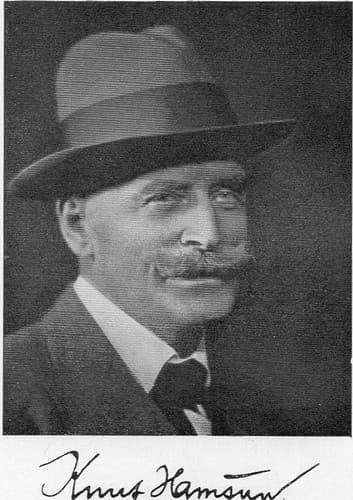
Knut Hamsun was a Norwegian writer who was awarded the Nobel Prize in Literature in 1920. Hamsun's work spans more than 70 years and shows variation with regard to consciousness, subject, perspective and environment. He published more than 20 novels, a collection of poetry, some short stories and plays, a travelogue, works of non-fiction and some essays.







