“The greatest good for the greatest number is a fine ideal, but it's cold comfort to the one who's sacrificed.”
— Ashley's internal struggle with utilitarian ethics.

Genre
Fantasy / Science Fiction / Romance
Reading Time
350 min
Key Themes
See below
Sign in to track this book
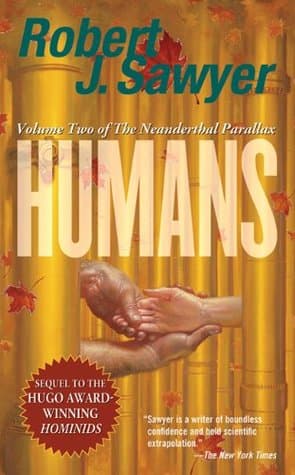
A Neanderthal physicist from an alternate Earth where his species dominates returns to our world, rekindling a forbidden romance and challenging humanity's deepest beliefs through a clash of parallel civilizations.
After his initial visit to our Homo sapiens Earth, Neanderthal physicist Ponter Boddit prepares to return to his parallel world, which he calls 'Neanderthal Earth.' He travels with a group of Homo sapiens scientists and diplomats, including his lover, geneticist Dr. Mary Vaughan, and her colleague, physicist Dr. Louise Benoît. The journey through the quantum mirror, a device linking the two Earths, is a significant event, marking the first ongoing inter-dimensional exchange between the two different human civilizations. The Homo sapiens want to learn about Neanderthal society, technology, and philosophy, while Ponter hopes to improve understanding between the two species.
Upon arrival, the Homo sapiens group immediately notices the differences on Neanderthal Earth. The sky is orange because of a different atmospheric composition, and the air smells unique. They stay in a secure compound and begin their observations. Mary Vaughan is especially interested in the genetic and physical differences between Homo sapiens and Neanderthals, noting their larger brains and unique social structures. Louise Benoît, a physicist, is fascinated by the quantum mirror technology and the Neanderthals' scientific advancements. The first interactions are careful but full of mutual curiosity, with Ponter acting as an important cultural go-between.
The group quickly learns that Neanderthal society is highly advanced, particularly in environmental sustainability and social justice. They have no money, no crime, and a communal existence. Their technology includes advanced quantum computing, fusion power, and sophisticated medical science. Ponter explains their 'Companion' implant, a neural device that prevents violence and promotes empathy, which is a key part of their peaceful society. Mary and Louise are impressed but also troubled by the lack of individual privacy and the seemingly strict social controls, especially the absence of art and fiction as Homo sapiens understand it.
A central point of discussion and tension is the 'Companion' implant. Ponter explains that every Neanderthal receives one at puberty; it monitors their emotional state, preventing aggressive impulses and ensuring social harmony. While it has eliminated crime and war, the Homo sapiens, particularly Mary, view it with suspicion, seeing it as an infringement on free will and a form of state control. They debate the ethical implications of such a device, comparing it with Homo sapiens' own struggles with violence and conflict. Ponter defends the Companion, arguing it allows for a truly peaceful and prosperous society.
Mary Vaughan and Ponter Boddit's romantic relationship continues, but it is often complicated by their different cultural backgrounds and biological realities. Mary struggles with Ponter's Neanderthal bluntness and his society's lack of emotional nuance, while Ponter finds Homo sapiens' complexities and occasional irrationality puzzling. Their attempts at intimacy reflect the larger inter-species cultural exchange, showing both the potential for connection and the deep differences that must be overcome. Their bond, however, remains a powerful symbol of the potential for understanding between the two species.
A critical and sensitive revelation occurs when the Homo sapiens group, particularly Mary, tells the Neanderthal scientists that, in their own timeline, Neanderthals went extinct. This news is devastating to the Neanderthals, who have no concept of extinction in their peaceful, sustainable world. Ponter and his colleagues struggle to understand how an entire species could simply vanish. This revelation forces the Neanderthals to confront a terrifying possibility about their own future and prompts them to consider what factors might have led to their demise in the Homo sapiens' reality, leading to intense scientific and philosophical discussions.
Prompted by the news of their extinction in the parallel timeline, Neanderthal and Homo sapiens scientists begin working more intensely to understand the point of divergence between their two histories. They analyze genetic data, archaeological records, and environmental factors. One theory that emerges is that a key difference might lie in the presence of a specific virus or pathogen that affected one species but not the other, leading to a population bottleneck for the Neanderthals on the Homo sapiens Earth. This joint research creates a deeper scientific bond between the two groups.
Physicist Louise Benoît, a key member of the Homo sapiens group, works to understand the quantum mirror technology that connects the two Earths. She works closely with Neanderthal physicists, learning the complex principles behind its operation. Her research uncovers that the mirror is not just a portal but a sophisticated piece of technology that uses quantum entanglement to create a stable inter-dimensional link. There are hints that the mirror might have been discovered rather than invented in the traditional sense, raising questions about its ultimate origin and purpose, and whether it could be a natural phenomenon or a relic of an even older civilization.
As the exchange continues, both Homo sapiens and Neanderthals face ethical dilemmas. The Neanderthals must decide how to integrate the knowledge of their potential extinction into their peaceful society. The Homo sapiens, in turn, question whether they should introduce aspects of Neanderthal technology, like the Companion, into their own conflict-ridden world. Discussions begin about establishing a more permanent inter-dimensional presence and the potential for a larger-scale exchange of people and ideas. The two species must decide how much to influence each other's destinies, balancing progress with preserving unique cultures.
After a transformative period, the Homo sapiens group prepares to return to their own Earth. Mary and Ponter share a bittersweet farewell; their relationship has deepened despite the challenges. The Homo sapiens return with a wealth of knowledge, a new perspective on their own society, and respect for the Neanderthals. They carry back not only scientific data but also philosophical insights into peace, sustainability, and communal living. The Neanderthals, while saddened by the departure, are left with a renewed sense of purpose and a determination to understand their past and secure their future, forever changed by the encounter with their parallel kin.
The Protagonist
Ponter evolves from a logical, somewhat detached observer of Homo sapiens to someone deeply invested in understanding and connecting with them, grappling with the emotional nuances of inter-species relationships.
The Protagonist
Mary's initial scientific curiosity deepens into a profound personal and ethical exploration, challenging her understanding of humanity and love.
The Supporting
Louise expands her scientific understanding of inter-dimensional travel and gains a broader perspective on the possibilities of advanced physics.
The Supporting
Adikor deepens his scientific understanding through inter-species collaboration and confronts the existential threat of his species' potential past extinction.
The Supporting
Ruth successfully manages a complex diplomatic mission, expanding her understanding of inter-species relations and global politics.
The Mentioned
Not applicable, as Kralt's role is primarily to represent the Neanderthal governing body.
The novel explores what it means to be 'human' by contrasting Homo sapiens and Neanderthal societies. It questions whether intelligence, empathy, violence, or creativity are defining traits. The Neanderthals, with their peaceful, communal, and logical society, challenge Homo sapiens' beliefs about progress and civilization. Scenes involving the 'Companion' implant make readers consider if true freedom requires the capacity for harm, and if a society without conflict is a higher form of existence, or a suppression of fundamental aspects of being.
“Perhaps the most human thing is to strive for peace, even if it means sacrificing some measure of what we call 'free will.'”
The 'Companion' implant is the main technological marvel and ethical problem of the story. While it has eradicated crime, war, and poverty on Neanderthal Earth, Homo sapiens view it with deep suspicion, seeing it as an infringement on individuality and free will. The debates surrounding the Companion highlight the tension between security and liberty, and technology's potential to both improve and control. The novel asks if such a device is a utopian solution or a dystopian nightmare, and if its benefits outweigh the cost to individual autonomy, as seen in the discussions between Mary and Ponter.
“We traded the freedom to harm for the freedom from harm. Is that not a fair exchange?”
The interactions between the two Earths show cultural relativism. Each species struggles to understand the other's fundamental values, social norms, and emotional expressions. The Neanderthals find Homo sapiens' art, fiction, and emotional volatility perplexing, while Homo sapiens are confused by the Neanderthals' lack of individual privacy, bluntness, and absence of crime. The novel demonstrates the challenges and rewards of bridging cultural divides, showing that what is 'normal' or 'right' is deeply ingrained in one's societal upbringing, as exemplified by Mary and Ponter's relationship.
“Your world is a symphony of discord, ours a quiet harmony. Neither is inherently superior, merely different.”
The revelation that Neanderthals went extinct on Homo sapiens Earth introduces an existential theme. The Neanderthals must deal with the concept of their own potential non-existence, forcing them to re-evaluate their history and future. This knowledge creates an urgency for inter-species collaboration, as both sides seek to understand the point of divergence and learn from the past. It highlights the fragility of species and the responsibility that comes with knowledge of alternative timelines, pushing the Neanderthals to consider how their choices might secure their longevity.
“To know that your kind vanished in another reality... it is a ghost that haunts our very existence.”
A portal connecting two parallel Earths.
The Quantum Mirror is the central plot device, serving as the physical link between Homo sapiens Earth and Neanderthal Earth. Its existence allows for the entire premise of the novel: inter-dimensional travel and cultural exchange. Beyond being a mere portal, it represents advanced scientific understanding (particularly quantum physics) and poses questions about its origin and stability. The mirror facilitates all interactions, drives the scientific curiosity of characters like Louise Benoît, and is the constant reminder of the parallel realities. Its functionality and limitations are key to the narrative's structure.
A neural device preventing violence and promoting empathy in Neanderthals.
The Companion Implant is a crucial plot device that defines Neanderthal society and generates significant ethical debate. This neural device, implanted at puberty, monitors and suppresses aggressive impulses, effectively eliminating crime, war, and most forms of social discord. It is the primary differentiator between Neanderthal and Homo sapiens social structures. For the plot, it serves as a constant source of discussion regarding free will, societal control, and the nature of peace, forcing both species to confront their deepest values. Its presence directly impacts character perceptions and decisions.
The existence of two distinct Earths where different hominid species evolved.
The overarching plot device is the concept of parallel Earths, specifically one where Homo sapiens evolved to dominance and another where Neanderthals did. This allows for a direct, comparative study of two distinct paths of intelligent life. It creates inherent conflict and curiosity, as characters from each world are forced to confront an 'other' that is both similar and profoundly different. This device enables the exploration of alternative evolutionary, social, and technological developments, driving the entire narrative and thematic core of the novel.
“The greatest good for the greatest number is a fine ideal, but it's cold comfort to the one who's sacrificed.”
— Ashley's internal struggle with utilitarian ethics.
“Love isn't about finding the perfect person, but about seeing an imperfect person perfectly.”
— Poonam reflecting on her relationship with Ashley.
“Reality is just a crutch for people who can't handle drugs.”
— A humorous, cynical observation by an AI.
“To be human is to be flawed, to strive, to fall, and to rise again.”
— A general philosophical statement about humanity.
“The universe doesn't care about your feelings, but that doesn't mean you shouldn't.”
— A character grappling with existential indifference.
“Every choice you make ripples outwards, touching lives you'll never know.”
— Highlighting the interconnectedness of actions.
“Sometimes, the only way to move forward is to let go of what you thought you knew.”
— A character experiencing a paradigm shift.
“Hope is a dangerous thing, but despair is a deadlier one.”
— Discussing the power of hope in difficult situations.
“The most profound truths are often found in the simplest acts of kindness.”
— Emphasizing the importance of compassion.
“What defines us isn't where we come from, but where we choose to go.”
— A character's journey of self-discovery.
“Fear is the mind-killer. It is the little-death that brings total obliteration.”
— A character quoting a famous line, applying it to their own struggle.
“Even in the vast emptiness of space, a single human heart can hold an entire universe of feeling.”
— A romantic reflection on human emotion in a cosmic setting.
“The only constant in the universe is change, and the only certainty is uncertainty.”
— A philosophical musing on the nature of existence.
“Sometimes, the most alien thing you encounter is another human being.”
— A character reflecting on the complexity of human interaction.
Ready to see how well you understood this book? Take our interactive quiz with 10 questions.
Biography coming soon.







