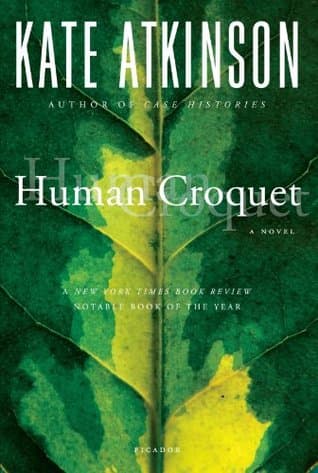
The Fairfax Family and Lythe
Isobel Fairfax grows up in the seemingly ordinary 1960s British suburb of Lythe, introducing her unusual family. Her father, Charles, is a war hero with a difficult past. Her mother, Eliza, vanished years ago, leaving a gap in their lives. Isobel lives with her older brother, Charles Jr. (Charley), and her Aunt Vinny, a practical but unhelpful woman. Lythe itself is not entirely normal; it sits on an ancient Elizabethan estate, suggesting a deeper, more complex history that subtly affects the present. Isobel often feels out of place and connected to the past, hinting at the time-bending events to come.
The Disappearance of Eliza
Eliza Fairfax's disappearance is a central puzzle in Isobel's life. The official story is that Eliza simply left, but Isobel feels there is more to it. Her father, Charles, rarely talks about Eliza, and the subject is generally avoided. This unresolved mystery fuels Isobel's thoughts and her growing wish to find the truth. The lack of closure about her mother's fate leaves Isobel with a deep sense of loss and a constant suspicion about her family's outward appearance. She starts to notice small clues and inconsistencies that suggest a darker story than the one she has been told.
Shakespearean Echoes and Time Slips
As Isobel grows up, she begins to experience unsettling 'time slips' and encounters with figures from Lythe's Elizabethan past, especially those linked to the original estate and its tutor, William Shakespeare. These are not just dreams; they are vivid, disorienting shifts where the past enters the present. She sees glimpses of Elizabethan life, hears old speech, and sometimes briefly inhabits historical moments. These experiences are both frightening and fascinating, blurring the lines between reality and illusion and suggesting that the past is not truly gone but merely waiting to reappear. Specific locations or objects in Lythe often trigger these events.
The Croquet Game and Its Rules
A metaphorical and sometimes literal game of 'human croquet' shapes the novel's structure. This game, with its seemingly random but very important rules, represents the complex, often cruel, and connected relationships and events that define Isobel's life. The 'wickets' and 'mallets' are the people and situations that drive or hinder characters, often with unexpected results. Isobel often refers to these rules, trying to understand the irrationality around her. The game helps explain fate, cause and effect, and the intricate web of decisions and accidents that determine one's path, showing the often-futile struggle against predetermined outcomes.
The Identity of Isobel
A key and unsettling part of Isobel's journey is the idea that she might not be the 'original' Isobel Fairfax. Hints suggest there might have been another Isobel, perhaps her mother's sister, who died young, or even that Isobel herself is a reincarnation or a replacement. This uncertainty about her own identity is deeply confusing, adding to her feeling of being an outsider and her search for truth. The possibility of being a doppelgänger or living a borrowed life makes her question her memories, her relationships, and her very existence, further blurring the lines between personal history and collective memory.
Charley's Descent and the Family Secrets
Isobel's older brother, Charley, becomes increasingly troubled and withdrawn as the story continues. He holds important family secrets, especially about their mother, Eliza, and his own identity. Charley often speaks in riddles, hints at dark truths, and struggles with what seems to be a mental illness or a deep personal crisis. His erratic behavior and cryptic statements are both a source of worry for Isobel and an important, though unreliable, source of information about the past. His decline is linked to the unraveling of the Fairfax family's carefully built facade.
The Truth About Eliza's Fate
Through her time slips, investigations, and Charley's fragmented disclosures, Isobel slowly puts together the truth about her mother, Eliza. It turns out Eliza did not abandon the family but was murdered by Charles, Isobel's father, and buried in the family garden. This act was covered up, and the family, including Aunt Vinny, helped maintain the lie. This discovery shatters Isobel's view of her father as a war hero and her family as merely eccentric, revealing a deep darkness at the core of their lives and explaining much of the lingering guilt and oddness in Lythe.
The Elizabethan Connection and Isobel's Role
Isobel learns that the Fairfax family's history is closely tied to the Elizabethan era, especially with a family called the Lythes and their tutor, William Shakespeare. She discovers that her family has been repeating a pattern of tragedy, betrayal, and murder that mirrors events from that distant past. Isobel herself is a reincarnation or spiritual echo of an Elizabethan girl, also named Isobel, who was involved in a similar tragic love triangle and death. This realization explains her time slips and her strong sense of déjà vu, suggesting a predetermined fate she is trying to escape or change.
Confronting the Past and Present
Knowing about Eliza's murder, Isobel confronts her father, Charles. The confrontation is filled with denial, guilt, and the weight of decades of lies. Charles's war trauma is presented as a partial reason for his actions, but it does not excuse them. Isobel also grapples with the involvement of other family members, especially Aunt Vinny, who knew the truth and helped keep the deception going. This confrontation is a key moment, forcing Isobel to compare her idealized image of her family with the grim reality and decide how she will move forward with this devastating knowledge, breaking the cycle of silence.
The Enduring Cycle and Isobel's Choice
As the novel ends, Isobel understands that the 'human croquet' game, the cycles of fate and family tragedy, are powerful. She sees the patterns from the Elizabethan past repeating in her own life, particularly the tragic love triangle involving her, her brother Charley, and a young man named Tom. The story suggests that Isobel could repeat the fate of her Elizabethan namesake, but she chooses to break free from the predetermined cycle. Her decision shows an attempt to take control and forge her own path, rather than giving in to the tragic echoes of history. The ending is bittersweet, acknowledging the lasting impact of the past but offering a hint of hope for individual freedom.