“The greatest gift of all is the present moment.”
— Tom Hazard often reflects on the value of living in the now, despite his long life.

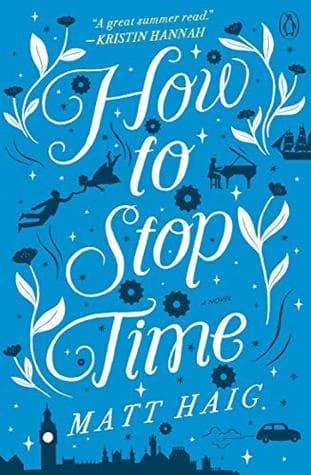
Matt Haig (2017)
Genre
Fantasy / Historical Fiction / Science Fiction / Romance
Reading Time
420 min
Key Themes
See below
Sign in to track this book
A centuries-old man, tired of outliving loved ones, risks everything for a forbidden romance. This relationship might teach him to live in the present, despite a secret society watching him and his past memories.
Tom Hazard looks 41 but is centuries old due to a rare condition called 'althusianism.' He moves to London to teach history. He belongs to the Albatross Society, a secret group that protects althusians and has a strict rule: never fall in love, to avoid revealing their condition. Tom's handler, Hendrich, reminds him of the rules and the dangers of attachment. Tom hopes this new life will be quiet, a break from his long and often painful past. On his first day, he meets Camille, a French teacher, who immediately interests him with her kindness and insight.
As Tom gets used to his new teaching job and daily life, his mind often goes back to his past, especially his life in 17th-century France and England. He remembers his deep love for his wife, Rose, and the arrival of the plague. He recalls their attempts to escape the disease, their search for safety, and the sad moment Rose got sick. The pain of her death, and the later loss of their daughter, Marion, who also had his condition and disappeared, remains the central wound of his life. This fuels his desire to find Marion.
Despite the Albatross Society's warnings and his own inner struggle, Tom feels drawn to Camille. They talk about history, life, and their experiences. Tom carefully leaves out the truth of his age. Camille's warmth, intelligence, and real interest in him start to break down the emotional barriers Tom has built over centuries. Their connection grows through shared moments, including a school trip where Tom's vast historical knowledge is subtly shown, making Camille curious about his unusual insights.
Tom starts to doubt Hendrich's reasons. He learns that the Albatross Society, while claiming to protect althusians, also controls their lives significantly, often isolating them and discouraging real human connection. Tom discovers that Hendrich has been manipulating althusians for centuries, not just to protect them, but for his own benefit and power. This realization strengthens Tom's defiance and his resolve to break free from the Society's control, especially as his feelings for Camille grow.
Through his centuries of life, Tom has searched for his daughter, Marion, who also is an althusian and disappeared after Rose's death. He carries a small wooden bird carved by Rose, a constant reminder of his family and his mission. As he gets closer to Camille, his desire to find Marion grows, driven by the hope of creating a new, real life that includes both of them. He uses his historical knowledge and subtle questions to find possible clues, believing Marion might still be alive and hidden in the modern world.
Hendrich, seeing Tom's growing attachment to Camille, becomes more openly threatening. He shows he knows about Tom's past relationships and uses this to control him. Tom realizes that Hendrich is not just a protector but a captor, who sees althusians as tools rather than people. The pressure from Hendrich, combined with Tom's new love for Camille, pushes him to a breaking point. He decides he can no longer live under the Society's control and plans to escape, even if it means cutting ties with the only community of people like him.
Convinced he cannot build a future with Camille without being honest, Tom decides to tell her his true age and condition. He explains his centuries-long life, his past, and the Albatross Society. This confession is a huge risk, as it could expose him to danger from Hendrich and possibly scare Camille away. To his surprise and relief, Camille, though shocked at first, listens with an open mind and deep empathy. Her reaction confirms Tom's belief that she is different from anyone he has met before.
Hendrich, aware of Tom's confession and defiance, confronts him directly. The confrontation shows Hendrich's full power and his harsh methods. Hendrich tries to force Tom back into line, threatening Camille and anyone Tom cares about. Tom, strengthened by his love for Camille and his determination to find Marion, refuses to give in. The encounter is tense and dangerous, pushing Tom to use his centuries of experience and cleverness to outsmart Hendrich, leading to a clear break from the Society's control, though with consequences.
After breaking from Hendrich, Tom, with Camille's help, searches more intensely for Marion. Using clues and his historical memory, he finds her. The reunion with his daughter, after centuries, is emotional. Marion, also an althusian, has been living her own long life. With Marion found, Tom and Camille decide to build a life together, accepting the challenges and joys of their unique situation. They choose to live in the present, finding happiness in their shared future, free from Hendrich's influence.
Tom, now free from the Albatross Society and reunited with his daughter, finally learns to live fully in the present. He continues to teach history, but now with a new appreciation for human experience, sharing his unique perspective with his students. His relationship with Camille grows deeper, built on honesty, love, and respect. He finds peace in his long life, no longer burdened by the past, but enriched by it. The novel ends with Tom looking forward to the future, ready for whatever centuries may bring, with his loved ones by his side.
The Protagonist
Tom transforms from a man trapped by his past and the Society's rules into someone who embraces the present, finds love, and reunites with his daughter.
The Supporting
Camille remains steadfast and accepting, inspiring Tom to live authentically and embrace love.
The Antagonist
Hendrich remains a static antagonist, embodying the forces of control and fear that Tom must overcome.
The Supporting
Her influence on Tom is constant, a reminder of what he lost and what he seeks to regain.
The Supporting
Marion's arc is primarily off-page, but her reunion with Tom signifies the protagonist's healing and the completion of his quest.
The Mentioned
His story serves as a historical parallel to Tom's own experiences, without a personal arc within the main narrative.
The Mentioned
No personal arc, serves as a historical figure in Tom's memories.
The Mentioned
No personal arc, serves as a historical figure in Tom's memories.
The novel explores how identity changes and is challenged by living for centuries. Tom struggles to keep a sense of self through many lives and roles, often feeling like a collection of memories rather than one person. His journey is about connecting his past with his present, accepting his unique condition, and finding an authentic self that can love and connect. His choice to teach history, which he has lived, is part of this search for purpose and identity.
“I had existed whole years without her, but that was all it had been. An existence. A book with no words.”
A main theme is the deep pain of loving and losing mortals when one lives forever. Tom's lasting grief for Rose and his search for Marion show the heavy emotional cost of his condition. The Albatross Society's rule against love comes from this burden, aiming to protect althusians from repeated heartbreak. However, the novel argues that love, despite its pain, is necessary for a meaningful life, even for those who live 'forever.'
“The only way to stop time is to fall in love.”
The book looks at how time feels. For Tom, time is not a straight line but a vast, connected web of memories, with past events as clear as the present. His ability to recall specific moments shows how memory shapes perception. The story moves between centuries, showing Tom's inner experience and emphasizing how history is not just facts but a living part of his mind. It questions what it means to truly 'live' through time versus just existing.
“Time is not a thing. It is a feeling. It is a rhythm. It is a memory.”
The conflict between individual freedom and group control is shown in Tom's fight against the Albatross Society and its leader, Hendrich. The Society, while claiming to protect althusians, actually limits their lives, telling them where to go and forbidding love. Tom's journey is about breaking free from this oppressive system to live a life he chooses, making his own decisions about love, family, and purpose. It explores the idea that real protection should not come at the cost of personal freedom and emotional fulfillment.
“We are not free. We are just in a bigger cage.”
Despite his long lifespan, Tom wants the simple, deep connections that define human experience. His initial isolation and fear of attachment are eventually overcome by his desire for real closeness with Camille and reunion with Marion. The novel suggests that true humanity is not about how long one lives, but about the quality of relationships and the courage to be vulnerable. It shows the universal need for belonging and understanding, no matter one's unique circumstances.
“To be alone is to be a seed, waiting for the soil. To be with someone is to be a tree, with roots, with leaves, with fruit.”
Interweaving Tom's past lives with his present-day experiences.
The novel employs frequent flashbacks, seamlessly shifting between Tom's current life as a history teacher in London and his centuries of past experiences. These non-linear narrative segments are not merely historical accounts but vivid, emotionally charged memories that directly inform Tom's present actions and feelings. This device allows the reader to understand the weight of Tom's past, the origins of his trauma, and the depth of his knowledge, while also creating a sense of timelessness that reflects Tom's own subjective experience of time.
A secretive organization controlling and protecting althusians.
The Albatross Society serves as a central plot device, providing both the framework for Tom's existence and the primary source of external conflict. It acts as a secret society that manages and protects althusians, dictating their lives, providing new identities, and enforcing strict rules, most notably the prohibition of falling in love. This organization represents the societal and institutional forces that try to control individual lives, and its leader, Hendrich, embodies the antagonist who must be overcome for Tom to achieve freedom and happiness.
The rare condition of extreme longevity and slow aging.
The fictional condition of 'althusianism' is the core speculative element of the novel. It allows certain individuals, like Tom, to age at an incredibly slow rate, granting them practical immortality. This device is the catalyst for all major plot points: Tom's vast historical experiences, his profound loneliness and grief, the existence of the Albatross Society, and his search for his daughter. It creates the fundamental premise that drives the narrative and explores the philosophical implications of living an extraordinarily long life.
A symbolic memento of Tom's lost family and enduring hope.
The small wooden bird carved by Rose, Tom's wife, is a recurring symbolic object. It represents Tom's enduring love for his family, his grief over their loss, and his unwavering hope of finding Marion. The bird is a tangible link to his past, a physical reminder of what he lost and what he is striving to reclaim. Its presence throughout the narrative underscores Tom's internal journey and his deep emotional attachment to his origins, serving as a beacon of memory and a promise of future reunion.
“The greatest gift of all is the present moment.”
— Tom Hazard often reflects on the value of living in the now, despite his long life.
“The only way to enjoy time is to not count it.”
— A realization Tom comes to about his unique condition and the human perception of time.
“We are all just a collection of memories.”
— Tom muses on the essence of identity and how his long life has shaped his 'collection'.
“Love is the only thing that makes time bearable.”
— Tom's enduring love for Rose and his daughter, Marion, is a central theme.
“The past is never dead. It's not even past.”
— A common sentiment for Tom, whose past is literally always present for him.
“To live is to suffer, to survive is to find some meaning in the suffering.”
— Tom's long life has been filled with loss and pain, forcing him to seek meaning.
“Every life is a story. And every story has an end.”
— Tom, as a history teacher, understands the narrative arc of lives and eras.
“Don't wish for time to pass. You'll regret it when it does.”
— A warning from Tom, who has seen countless people wish their lives away.
“The world is always ending, and always beginning.”
— Tom's perspective on the continuous cycle of change and renewal throughout history.
“We are all made of stardust and stories.”
— A poetic reflection on the human condition and our place in the universe.
“Sometimes you have to be lost to find yourself.”
— Tom's journey often involves periods of isolation and searching for identity.
“The hardest part of living for a long time is watching everyone else die.”
— The central tragedy and burden of Tom's condition as an 'Albatross'.
“To be human is to be a collection of contradictions.”
— Tom observes the complex and often paradoxical nature of human behavior.
“The future is just a really long present.”
— Tom's unique understanding of time, where past, present, and future blend.
Ready to see how well you understood this book? Take our interactive quiz with 10 questions.

Biography coming soon.







