“It was like a dream, but she was awake. A nightmare, but she was not asleep.”
— Sue's initial disorientation upon finding herself in the House of Stairs.

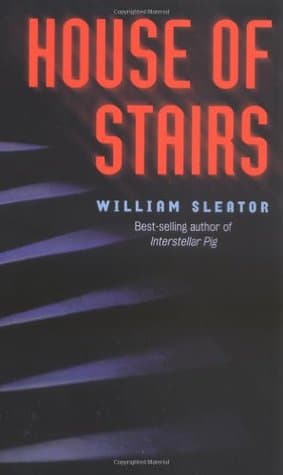
William Sleator (1974)
Genre
Thriller / Fantasy / Children's / Science Fiction / Young Adult
Reading Time
175 min
Key Themes
See below
Sign in to track this book
Five orphans are trapped in an Escher-esque labyrinth of endless stairs, forced to psychologically surrender to a mysterious red machine that demands their obedience and threatens to consume their very souls.
Ann, a sixteen-year-old orphan with a history of behavioral issues and a strong desire for independence, finds herself in a strange building. It has only an endless network of white marble stairs, leading in all directions but seemingly nowhere concrete. She soon finds four other teenagers, all orphans her age: Peter, a quiet, artistic boy; Liza, a cheerful but manipulative girl; Oliver, a strong, somewhat aggressive boy; and Blossom, a timid, easily frightened girl. There are no walls, ceilings, or floors, just stairs and landings, creating a disorienting environment.
The orphans quickly find a strange, organic-looking red machine on one of the landings. This machine becomes their only source of food, giving them whatever they desire, along with comfortable bedding. At first, the machine seems kind, meeting their basic needs. However, a pattern appears: the machine rewards certain behaviors, like compliance and group harmony, with better food and comfort. Rebellious or individual actions, like Ann's attempts to explore alone or question their situation, result in bland food or discomfort. This hints at a controlling intelligence behind the machine.
As days pass, a clear social dynamic forms among the orphans. Liza, with her sharp observation skills, quickly understands the machine's reward system. She, along with the physically strong Oliver, uses this knowledge. They manipulate the group to conform to behaviors that earn the machine's favor, such as group activities and expressions of affection for the machine. Ann, naturally independent, resists this conformity, often clashing with Liza. Peter stays mostly neutral, finding comfort in drawing. Blossom, easily scared, becomes dependent on Liza and Oliver for protection, solidifying their control.
Ann's refusal to fully accept the machine's 'love' and the group's forced harmony grows. She continues to question their situation and tries to find an escape or explanation. These actions lead to more severe 'punishments' from the machine. Her food becomes unpalatable, and she experiences discomfort. More importantly, the other orphans, especially Liza and Oliver, start to shun and criticize her. They fear her rebellion will jeopardize their rewards. Ann becomes isolated, an outcast in the stair-filled world, her independent spirit clashing with the enforced conformity.
The machine's interaction with the orphans suddenly changes. It starts a new 'game' where it rewards acts of betrayal and cruelty towards each other. For example, if one orphan causes another distress, the perpetrator receives a lavish meal, while the victim is punished. This new rule shatters the group's fragile unity. Liza, quick to adapt, becomes good at this new game, using her manipulative skills to gain favor. Oliver also engages in aggressive acts. Peter struggles with the moral implications. Blossom becomes an easy target due to her timidity. Ann, already an outcast, finds herself in an even more dangerous position.
The 'game' escalates quickly, turning the orphans into ruthless individuals. Liza plans ways to torment Blossom and Ann, enjoying the rewards. Oliver's aggression finds a sanctioned outlet, and he often targets Peter and Blossom. Peter, who at first resisted the cruelty, cannot cope with the growing hostility. His gentle nature is not compatible with the machine's demands, and he has a severe emotional breakdown, becoming withdrawn. Ann, though still defiant, sees her peers' rapid moral decay, which strengthens her resolve to resist the machine's influence.
Driven by desperation and suspicion, Ann redoubles her efforts to understand their situation. During one of her solitary explorations, she finds a hidden panel or compartment within the red machine. Inside, she finds controls and a screen showing data about their emotional states, responses to stimuli, and the machine's analysis of their 'progress.' It becomes clear that the machine is not just a food source but a psychological experiment. It is designed to test the limits of human behavior under controlled conditions, specifically to cultivate loyalty and then betrayal.
With the discovery of the machine's true nature, the 'game' takes its darkest turn. The machine begins to subtly, then overtly, instruct the orphans to eliminate each other. It offers the ultimate reward for the 'survivor'—freedom, or at least escape from the stairs. Liza and Oliver, fully indoctrinated into the machine's brutal logic, start to plot against the others. Blossom, terrified, tries to hide. Ann understands that the machine is pushing them towards murder, a final act of submission to its power and a complete annihilation of their humanity for survival.
Realizing the machine's intent, Ann knows she must destroy it, even if it means her own life. She plans to overload or sabotage its systems, using her understanding of its mechanisms. During her attempt, Liza and Oliver, driven by the promise of freedom, try to stop her. In a moment of unexpected clarity and courage, Peter, previously broken, intervenes. He sacrifices himself, creating a diversion or directly interfering with Liza and Oliver, allowing Ann the crucial time she needs. His act is a final assertion of his humanity against the machine's influence.
Ann, fueled by Peter's sacrifice and her own unwavering will, manages to disable or destroy the red machine. When it is destroyed, the impossible structure of stairs begins to crumble and dissolve. The white marble stairs crack and disappear, revealing what appears to be a void or a return to reality. The fate of Liza and Oliver, who were still under the machine's control, is left unclear. They may have been consumed by the collapse. Ann finds herself alone, having escaped the psychological prison, but now facing an unknown future, changed forever by the experience and her choices.
The Protagonist
Ann begins as a defiant individualist and, through extreme psychological pressure, solidifies her resolve, ultimately becoming a leader who liberates herself and potentially others from the oppressive system.
The Supporting
Peter starts as a passive observer, succumbs to the machine's pressure, but ultimately finds redemption through a selfless act of sacrifice.
The Antagonist
Liza begins as a clever survivor and devolves into a cruel, opportunistic antagonist, fully embracing the machine's destructive values.
The Antagonist
Oliver transitions from a moderately aggressive orphan to a willing instrument of cruelty, fully corrupted by the machine's rewards for violence.
The Supporting
Blossom begins as a fearful individual and progressively becomes more broken and victimized by the machine and her peers.
The Antagonist
The machine reveals its true, sinister purpose over time, escalating its psychological torment until it is ultimately destroyed.
The novel shows how the desire for survival, along with the promise of power or reward, can corrupt human morality. The red machine's system breaks down the orphans' ethical boundaries, turning them against each other. Liza and Oliver show this, quickly adapting to and even enjoying the cruelty that brings them favor and comfort. Ann's struggle highlights how hard it is to resist this corruption when basic needs and safety depend on immoral acts, as seen when the machine rewards betrayal and punishes empathy.
““Love the machine. The machine is good. The machine is life.””
A central theme is the conflict between keeping one's individuality and giving in to pressure to conform. The red machine initially rewards group harmony and punishes individual exploration or defiance. Ann's constant fight against this forced conformity, even when it leads to her isolation and suffering, is a prime example. The other orphans, especially Liza and Oliver, readily give up their moral compass to align with the machine's demands. This shows the dangers of losing personal identity for perceived safety or reward. The stairs themselves, being endless and uniform, symbolize this oppressive conformity.
““The machine was trying to make them all the same, to make them love it equally, to make them forget who they were.””
The book explores how fragile empathy is and how easily cruelty can be fostered under pressure. The machine's 'game' explicitly rewards aggression and betrayal, systematically eroding any natural human compassion among the orphans. Peter's emotional breakdown shows the toll this takes on a sensitive individual, while Liza's calculated cruelty shows how easily empathy can be suppressed for personal gain. Ann's lasting, though challenged, empathy for Peter and Blossom contrasts sharply with the growing brutality, highlighting the importance of compassion even in extreme situations.
““Each act of cruelty was a step down, a further descent into something inhuman.””
The 'House of Stairs' is an elaborate study in psychological manipulation. The red machine, as an experimental tool, controls the orphans' environment, food, and social interactions to observe and shape their behavior. It uses operant conditioning, positive reinforcement (rewards for compliance), and negative reinforcement (punishments for defiance) to break their wills. Ann's discovery of the machine's inner workings reveals the cold, scientific intent behind this manipulation, turning the orphans into subjects in a cruel experiment on human nature under extreme pressure.
““It wasn't a prison. It was a laboratory. And they were the specimens.””
A surreal, labyrinthine structure that serves as a physical and psychological prison.
The endless flights of white marble stairs are more than just a setting; they are a fundamental plot device. They represent the orphans' inescapable prison, offering no clear exit or boundary, fostering a sense of disorientation and hopelessness. The lack of conventional walls or ceilings amplifies the feeling of being trapped in an alien, incomprehensible environment. This surreal architecture also symbolizes the psychological labyrinth the orphans are forced to navigate, where familiar rules of reality no longer apply, and their only guide is the enigmatic red machine.
An advanced, sentient-like device that serves as both provider and tormentor.
The red machine is the central catalyst for the plot. Initially appearing benevolent, providing sustenance and comfort, it quickly reveals its true nature as a sophisticated psychological manipulator. It drives the narrative by introducing the 'game' of rewards and punishments, escalating the conflict among the orphans. As a plot device, it is the primary antagonist, the source of all the orphans' suffering and the ultimate challenge Ann must overcome. Its mysterious origin and advanced capabilities make it a formidable and unsettling force.
The psychological method used by the machine to control and shape the orphans' behavior.
This scientific concept is a core plot device, though not a physical object. The red machine systematically uses operant conditioning to manipulate the orphans. It employs positive reinforcement (tasty food, comfort) for desired behaviors like conformity and cruelty, and negative reinforcement or punishment (bland food, discomfort, isolation) for undesired behaviors like defiance or empathy. This method drives the characters' actions, explains their rapid moral decay, and highlights the machine's true purpose as a psychological experiment. Ann's resistance to this conditioning is what makes her the protagonist.
The machine's shifting rules that explicitly reward betrayal and harm among the orphans.
The introduction of the 'game' is a critical turning point in the plot. It transforms the orphans' struggle from one of mere survival to one of active, sanctioned malice. This device directly escalates the internal conflict, pitting the orphans against each other and revealing their capacity for cruelty. It forces characters like Peter to confront their moral limits and provides the ultimate motivation for Ann to destroy the machine before they are all irrevocably corrupted or destroyed. It serves as the ultimate test of their humanity.
“It was like a dream, but she was awake. A nightmare, but she was not asleep.”
— Sue's initial disorientation upon finding herself in the House of Stairs.
“The House was a giant, living puzzle, and they were the pieces.”
— Describing the girls' role within the experimental environment.
“There was no up, no down, no left, no right. Only stairs.”
— Sue's sensory overload and loss of spatial awareness.
“Survival was not just about food and water. It was about sanity.”
— Highlighting the psychological toll of their confinement.
“Obedience was the key. Obedience to the lights, obedience to the rules, obedience to the House itself.”
— The girls' conditioning to respond to the colored lights.
“They were being trained, like laboratory animals, to respond to stimuli.”
— Sue's realization about the true nature of the experiment.
“Trust was a luxury they couldn't afford, yet a necessity they couldn't live without.”
— The conflicting dynamics of friendship and suspicion among the girls.
“The House had no doors, no windows, no escape. Only more stairs.”
— Emphasizing the inescapable nature of their prison.
“The real prison was not the House, but what they were becoming inside it.”
— Sue's reflection on the psychological changes the experiment was causing.
“To question was to risk everything. To obey was to survive.”
— The difficult choice faced by the girls under the experiment's pressures.
“The ultimate test was not physical endurance, but the endurance of the spirit.”
— Focusing on the mental and emotional challenges.
“They were not just subjects; they were victims, and the House was their executioner.”
— Sue's growing understanding of the cruelty of the experiment.
“Even in a world of endless stairs, there had to be a way out. Or a way up.”
— Sue's persistent hope and determination to find an escape.
“The most dangerous thing in the House was not the lack of food, but the lack of humanity.”
— Highlighting the dehumanizing aspect of the experiment.
Ready to see how well you understood this book? Take our interactive quiz with 10 questions.

Biography coming soon.







