“This is not for you.”
— Opening line of the book, setting a mysterious tone.

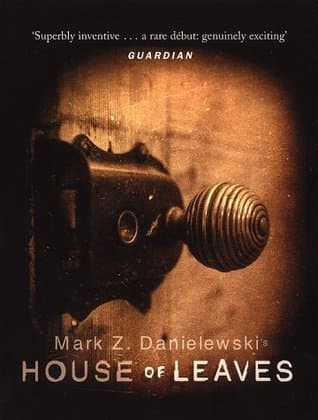
Mark Z. Danielewski (2000)
Genre
Thriller / Fantasy / Mystery
Reading Time
1200 min
Key Themes
See below
Sign in to track this book
An ordinary house on Ash Tree Lane turns into an impossible, expanding maze, trapping a family in its terrifying story of creature darkness and a reality-defying abyss.
The story begins with Johnny Truant, a troubled tattoo parlor apprentice in Los Angeles. His friend Lude calls him, saying an elderly, blind man named Zampanò has died in his apartment. Johnny, Lude, and a stripper named Thumper explore Zampanò's chaotic apartment and find a large, messy manuscript. This manuscript, which Zampanò had written for years, is a detailed academic analysis of a documentary film called 'The Navidson Record,' a film Johnny has never heard of. Johnny becomes engrossed with the manuscript, believing it holds a dangerous truth, and starts the difficult job of editing it, while also writing about his own declining mental state and past problems.
Zampanò's manuscript introduces Will Navidson, a Pulitzer Prize-winning photojournalist, and his partner Karen Green, a former fashion model, who move with their two children, Chad and Daisy, into a house on Ash Tree Lane in Virginia. They immediately notice strange architectural impossibilities: a new interior hallway appears, and the house's inside is larger than its outside. Navidson, a documentarian, films these oddities, creating 'The Navidson Record.' The discovery of a dark, maze-like space behind a closet door, called the 'Antechamber,' starts their terrifying encounters with the house's changing, impossible geography.
Will Navidson, wanting to understand, goes into the house's expanding interior with his brother Tom and friends. They find vast, dark corridors, staircases leading nowhere, and seemingly endless rooms. The house does not follow physics or architecture, often changing its layout and making a low, guttural growl. During one early trip, Tom gets lost and almost dies, saved by Navidson. These early trips show the house as an active, malevolent thing that plays with its inhabitants' perceptions and sanity, always challenging their understanding of space and reality.
As the house's mysteries deepen and the danger grows, Navidson puts together a team of explorers: the experienced Holloway Roberts, the young Jed Leeder, and the careful Kirby. Their goal is to map the maze. The house, however, begins to affect them deeply. Holloway, in particular, becomes paranoid and claustrophobic, convinced the house is a living thing trapping them. His mental state quickly worsens, leading to violent outbursts and eventually, a tragic fight with his teammates, ending with his disappearance (and implied death) inside the house, leaving Jed and Kirby traumatized.
Karen Green struggles with the horror in their home. Constant fear for her children, Chad and Daisy, and the house's unsettling presence push her to her limit. She asks Will to leave, but his journalistic instinct and obsession with 'The Navidson Record' keep him from abandoning the house. Tension between them grows as Karen feels isolated and terrified by Will's focus on documenting the inexplicable, even at the cost of their family's safety and her own sanity. She eventually takes the children and leaves the house, seeking refuge from its pervasive dread.
After Karen and the children leave, Will Navidson, feeling responsible for his team and needing answers, goes on a solo trip into the house's deepest, most dangerous parts. He experiences extreme sensory deprivation, disorientation, and sees what he thinks is a 'Minotaur' – an unseen presence that embodies the house's evil. He gets badly hurt, including a broken leg, and almost dies from dehydration and exhaustion. This journey tests his resilience and his understanding of reality, pushing him to his physical and mental limits inside the house's impossible geometry.
Despite her fear and trauma, Karen Green, driven by her love for Will, cannot leave him. She returns to Ash Tree Lane and, against all odds, goes into the maze-like house to find him. Her journey is full of terror and uncertainty, but her determination helps her navigate the shifting corridors. She eventually finds a badly injured and delirious Will. With help from Tom and others who stayed outside, she pulls him out of the house, bringing him to safety. This marks a reconciliation and reaffirmation of their bond amid extraordinary circumstances.
After Will's rescue, the Navidson family tries to rebuild their lives away from Ash Tree Lane. However, the house's influence is inescapable. The trauma remains, and the house's mystery continues to haunt them, especially Will. He eventually makes a final, more reflective film, 'Stillness,' which explores the house's impact on his family and his own mind. The house itself eventually collapses or disappears under mysterious circumstances, but its legend and the questions it raised about reality, perception, and the unknown continue for the characters and for readers of Zampanò's manuscript.
Throughout editing Zampanò's manuscript, Johnny Truant's mental state steadily worsens. His footnotes, which increasingly fill the text, show his descent into paranoia, drug abuse, promiscuity, and self-harm. He deals with traumatic memories of his institutionalized mother, Pelafina H. Lievre, whose letters from the asylum are mixed into Johnny's narrative. He sees similarities between the maze-like house and his own internal struggles, convinced that Zampanò's work is cursed or actively manipulating his mind. The line between his reality and 'The Navidson Record's' fictional world blurs, leading to a psychological breakdown.
As Johnny's sanity erodes, he fixates on the recurring Minotaur symbol in Zampanò's text, seeing it as a key to the house's (and perhaps his own) deepest secrets. He looks into philosophical and mythological discussions, seeing connections between the house, the Minotaur, and his own internal demons. His search for truth in Zampanò's impossible narrative drives him to extreme measures, including more drug use and dangerous encounters. He tries to find proof of 'The Navidson Record's' existence, but finds none, further blurring reality and fiction and increasing his mental anguish.
Mixed with Johnny's footnotes are poignant and increasingly fragmented letters from his mother, Pelafina H. Lievre, written from the mental institution where she was. Her letters describe her own descent into madness, her love for Johnny, and cryptic references to a 'house' and other unsettling images. These letters offer a crucial, though unreliable, look into Johnny's traumatic childhood and the potential hereditary nature of his mental instability. They suggest a cycle of madness and a deep sense of loss and abandonment that underlies Johnny's present struggles, connecting his personal story directly to the themes of the Navidson story.
The book ends with an editor's note, likely from a third party who has taken over Johnny's manuscript. This final voice expresses worry for Johnny's fate, hinting at his disappearance or death, and questions the truth of Zampanò's work, Johnny's footnotes, and even the editor's own role. The ending offers no clear answer, instead showing the unreliability of all stories and the subjective nature of truth. The reader is left to consider the reality of 'The Navidson Record,' the house's existence, Johnny's sanity, and the nature of the book they have just read, embracing the pervasive ambiguity and the unsettling idea that the 'house' is a metaphor for the human mind itself.
The Protagonist
Johnny begins as a cynical but functional individual, progressively descending into paranoia and madness as he becomes entangled with Zampanò's manuscript, ultimately disappearing or succumbing to his mental illness.
The Author (within the narrative)
Zampanò's arc is only revealed posthumously through his manuscript, showing his lifelong obsession with 'The Navidson Record' and the house, culminating in his solitary death.
The Protagonist (within Zampanò's text)
Navidson begins as a detached documentarian, transforming into a desperate explorer and ultimately a man profoundly changed by his encounters with the house, leading him to create a final, reflective film.
The Supporting (within Zampanò's text)
Karen initially reacts with fear and a desire to escape the house, but her love for Will ultimately strengthens her, leading her to bravely confront the house to save him.
The Supporting/Mentioned
Her arc is presented through her letters, detailing her gradual descent into severe mental illness, culminating in her death in the asylum.
The Supporting (within Zampanò's text)
Holloway begins as a professional leader, but the house's influence causes him to descend into paranoia and violence, leading to his demise.
The Supporting (within Zampanò's text)
Tom consistently supports his brother, acting as a grounding force and ultimately aiding in Will's rescue, remaining a stable presence.
The Supporting (within Zampanò's text)
Chad is a passive recipient of the house's terror, experiencing trauma that profoundly affects his childhood.
The Supporting (within Zampanò's text)
Daisy, like Chad, experiences the house's trauma, which marks her childhood and contributes to the family's suffering.
The novel explores how individuals define themselves when faced with the unknown and the collapse of established reality. Johnny Truant's search for his own identity connects to understanding Zampanò's manuscript and his mother's past. Similarly, Will Navidson's identity as a documentarian is challenged and changed by the impossible house, forcing him to confront his limits and the meaning of his art. The house acts as a mirror, reflecting and distorting the characters' internal states, making them question who they are without the stability of a known world.
“This is not for you.”
'House of Leaves' constantly blurs the lines between reality and fiction, sanity and madness. Zampanò's manuscript describes an impossible house that defies physical laws, challenging the characters' (and the reader's) idea of what is real. Johnny Truant's footnotes further destabilize this, as his own mental state worsens and he questions 'The Navidson Record's' existence. The book uses unreliable narrators, conflicting information, and experimental formatting to suggest that reality is subjective, built through stories, and ultimately fragile.
“We all create our own monsters.”
Loss fills the story on many levels. Johnny Truant deals with losing his mother to mental illness and losing his own sanity. The Navidson family faces the potential loss of their home, their safety, and even their lives inside the house's maze. The house itself can represent an unfillable emptiness, a deep absence. This theme is explored through the characters' emotional responses to these losses, their attempts to cope, and the lasting scars left by their experiences, showing the psychological impact of deep absence and trauma.
“Some things are just too big to know.”
The entire novel shows the power of stories. Zampanò's elaborate, fictional academic text creates a reality for 'The Navidson Record.' Johnny Truant's footnotes become his own desperate story, a story of his mind unraveling. The book itself is a nested story, a story about a story about a film. This theme shows how stories shape our understanding of the world, how they can create truth, spread myths, and even drive people to madness. It questions the author's authority and the reader's part in making meaning.
“And it is true, everything is true.”
At its core, 'House of Leaves' is a horror story driven by fear of the unknown. The house's impossible, changing interior represents an ultimate unknown, a space that cannot be understood. The characters' terror comes not just from physical danger, but from the existential dread of encountering something fundamentally alien to their understanding of the world. This fear appears as claustrophobia, paranoia, and deep disorientation. The novel suggests that the most terrifying things are those that cannot be categorized or explained, tapping into basic anxieties about chaos and meaninglessness.
“The greatest fear, however, is not the fear of darkness, but the fear of not knowing.”
Multiple layers of storytelling, each with its own narrator and purpose.
The book employs a complex system of nested narratives. The outermost layer is the 'Editor's' introduction and conclusion. Within that is Johnny Truant's narrative, presented through his footnotes, detailing his discovery and editing of Zampanò's manuscript. The innermost layer is Zampanò's academic analysis of 'The Navidson Record.' This structure creates multiple layers of unreliability, as each narrator interprets and distorts the story, forcing the reader to constantly question the veracity of what they are reading and who is truly in control of the narrative.
Characters whose credibility is compromised, blurring truth and fiction.
Both Johnny Truant and Zampanò serve as unreliable narrators. Johnny's mental deterioration, drug abuse, and traumatic past make his accounts of editing the manuscript and his personal life highly suspect. Zampanò, a blind man analyzing a film he supposedly couldn't see, fills his manuscript with contradictions, non-existent sources, and increasingly deranged academic prose. This device ensures that the reader can never fully trust any single account, contributing to the book's pervasive sense of ambiguity and its exploration of the subjective nature of truth.
Unconventional page layouts and text manipulation to reflect narrative themes.
Danielewski extensively uses experimental typography and formatting to enhance the narrative. This includes text arranged in unusual shapes (like the house's labyrinth), colored words (blue for the house, red for the Minotaur), footnotes within footnotes, text running vertically or upside down, and vast expanses of white space. This device visually represents the disorientation and impossible geometry of the house, the fragmented nature of Johnny's mind, and the overwhelming scholarly detail of Zampanò's work. It makes the physical book itself a part of the immersive, unsettling experience.
A recurring mythological symbol representing the house's monstrous, confusing nature.
The Minotaur and labyrinth motif is central to both Zampanò's analysis and Johnny's interpretation. The house itself is a physical labyrinth, a confusing and dangerous maze. The Minotaur represents the unseen, monstrous entity or force within the house, a terrifying presence that torments its inhabitants. For Johnny, the Minotaur becomes a symbol of his own internal demons and the elusive truth he seeks. This mythological allusion grounds the supernatural horror in a timeless archetypal fear, emphasizing themes of entrapment, confusion, and the confrontation with the monstrous self.
A self-referential narrative that calls attention to its own artificiality.
The entire novel is a metafictional exercise. It is a book about a manuscript about a film that may or may not exist, constantly acknowledging its own construction. Johnny Truant frequently comments on the act of editing and writing, while Zampanò's footnotes often discuss the academic process itself. This device forces the reader to confront the nature of storytelling, authorship, and the relationship between text and reality. It blurs the line between the 'real' world of the reader and the fictional world of the book, inviting participation in the creation of meaning.
“This is not for you.”
— Opening line of the book, setting a mysterious tone.
“The house is bigger on the inside than it is on the outside.”
— Describing the central anomaly of the Navidson house.
“I am not a fool. I am not a madman. I am not a liar. I am not a thief.”
— Johnny Truant asserting his reliability as a narrator.
“The darkness is not empty. It is full of things we cannot see.”
— Reflecting on the house's endless corridors.
“We all create stories to protect ourselves.”
— Commentary on the characters' coping mechanisms.
“The labyrinth is not meant to be solved; it is meant to be experienced.”
— Philosophical insight about the house's nature.
“Sometimes the only way to find yourself is to get lost.”
— Johnny Truant reflecting on his journey.
“The house does not want to be understood. It wants to be feared.”
— Analyzing the house's malevolent presence.
“Words are the only way to make sense of the senseless.”
— Emphasizing the role of language in the narrative.
“There is no center. There is only the endless.”
— Describing the house's infinite corridors.
“The past is a ghost that haunts the present.”
— Reflecting on characters' traumatic histories.
“To enter the house is to leave the world behind.”
— Highlighting the house's isolating effect.
“The truth is not in the facts, but in the spaces between them.”
— Commentary on the book's layered narrative.
“Fear is the only thing that grows in the dark.”
— Describing the psychological impact of the house.
Ready to see how well you understood this book? Take our interactive quiz with 10 questions.

Biography coming soon.







