“The air was hot and dry. Above them, the sun beat down from a cloudless sky.”
— Jack and Annie arrive in ancient Greece, feeling the immediate change in environment.

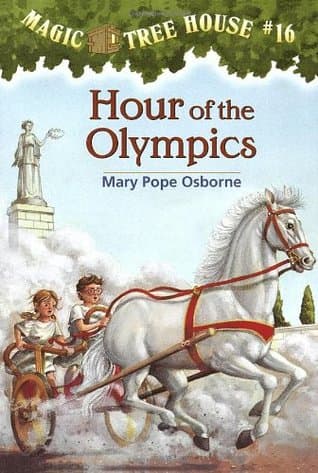
Mary Pope Osborne (1986)
Genre
Fantasy / Children's / Historical Fiction / Young Adult
Reading Time
70 min
Key Themes
See below
Sign in to track this book
Jack and Annie travel to ancient Greece, where Annie's wish to see the male-only Olympic Games leads them into trouble.
Jack and Annie arrive in ancient Greece, transported by the Magic Tree House. They land in an olive grove near Olympia. A note tells them their mission: find the 'fourth special writing' for Morgan le Fay. They quickly learn the Olympic Games are about to start. They meet Aristides, a young boy training for the Games, who explains the rules, including that only men can watch or compete. Annie is immediately upset by this rule.
Aristides tells them more about the Olympic Games. He explains that all athletes must swear an oath to Zeus that they have trained for ten months and will compete fairly. He also stresses the strict rule against women attending, even as viewers, under penalty of death. Annie, feeling wronged by women's exclusion, wants to see the Games anyway. Jack, always careful, worries about the danger of breaking such a serious law.
Annie decides she will see the Olympic Games. She plans to disguise herself as a boy, finding a tunic and cutting her hair short. She tells Jack to go ahead without her. Jack is very uneasy, knowing the severe consequences if she is caught. He tries to talk her out of it, but Annie's adventurous spirit and sense of unfairness override his worries. She promises to meet him later, leaving Jack to walk to the stadium alone, full of dread.
Jack reaches the Olympic stadium, a large, open-air arena packed with thousands of people. He is amazed by its size and the excitement. He finds a seat and watches the athletes march in, led by heralds. The opening ceremonies are grand, with trumpets playing and a strong sense of tradition. Jack feels both excited and anxious, constantly looking for Annie and worrying about her safety, while also trying to appreciate the event's history.
The Olympic Games begin with the footraces. Jack watches closely as athletes compete with speed and strength. He is especially impressed by the runners' focus. The crowd cheers, and Jack feels the energy of the ancient event. Despite the thrill of the races, he keeps thinking about Annie. He scans the crowd, hoping to see her, but also fearing her being found out. His excitement mixes with ongoing worry.
While Jack watches the races, Annie, disguised as a boy, tries to sneak into the stadium. She gets past some guards but a more watchful official spots her and asks questions. Her disguise is not perfect, and her feminine features are noticed. Realizing she is caught, Annie quickly runs away. She uses her speed to avoid the guards, running through the crowded paths outside the stadium, her heart pounding with fear of being caught and facing punishment for women at the Games.
After her close call, Annie finds Jack outside the stadium. She is shaken but safe, and Jack is relieved. They agree it is too risky for Annie to try to enter again. Together, they watch the awards ceremony from afar. They see the winners crowned with olive branches, a simple symbol of their achievement. This moment helps them appreciate the Games, even with Annie's earlier exclusion.
As they watch the end of the Games, Jack and Annie meet an old, blind poet sitting under an olive tree. The poet recites verses, and Jack realizes this might be their clue. They approach him, and the poet, sensing them, shares his thoughts about the true meaning of the Olympics – not just winning, but striving for excellence and peace. He then reveals that the 'fourth special writing' is a poem, an ode to the Olympic spirit, which he recites. This poetic form of writing surprises Jack, who usually looks for scrolls.
The blind poet explains that during the Olympic Games, a sacred truce, called the Ekecheiria, stops all wars across Greece. This allows athletes and spectators to travel safely to and from Olympia. He stresses that the Games are a time of peace and unity, a break from the constant fighting between city-states. This news about the truce deeply affects Jack and Annie, showing a noble purpose behind the contests that goes beyond just competition. The poet's words about peace resonate with the children.
After hearing the poet's 'special writing' – the ode to the Olympics and peace – Jack quickly writes it in his notebook, completing their mission. They thank the poet and hurry back to the Magic Tree House. As they climb inside, Jack and Annie think about their adventure. They discuss the excitement of the Games, the unfairness of the rules for women, and the deep message of peace from the Olympic truce. With the book open to their home, they wish for the tree house to take them back to Frog Creek, Pennsylvania, their task done.
The Protagonist
Jack learns to balance his cautious nature with a deeper understanding of historical context and the importance of empathy, particularly regarding Annie's frustration with gender inequality.
The Protagonist
Annie learns that while breaking rules can be dangerous, her strong sense of justice and desire for inclusion are valuable traits, even if she must find safer ways to express them.
The Supporting
Aristides serves primarily as an informative character, providing exposition about the Olympic Games to Jack and Annie.
The Supporting
The Blind Poet serves as a wise sage, delivering the central thematic message of the book about the true spirit of the Olympics and peace.
The Mentioned
Morgan le Fay's character remains consistent as the unseen guiding force for the children's adventures.
The Mentioned
Zeus serves as a cultural reference point, emphasizing the religious aspects of the ancient Olympics.
A main theme is historical gender inequality, especially women's exclusion from the ancient Olympic Games. Annie's strong reaction to the rule – 'No girls allowed!' – highlights the unfairness. Her attempt to disguise herself and sneak in, despite the danger, shows her belief in equal access and her refusal to accept unfair limits. This theme is key to Annie's character and offers a relatable point of frustration for young readers, as when she says, "That's not fair!" after learning the rules.
“"No girls allowed!" cried Annie. "That's not fair!"”
Beyond just sports, the book looks at the deeper meaning of the ancient Olympic Games. It highlights ideas like striving for excellence, fair play, and, most importantly, peace. The Blind Poet's mention of the 'sacred truce' (Ekecheiria) shows that the Games were a time when all wars stopped, bringing unity among the often-fighting Greek city-states. This theme raises the Olympics from a sports event to a symbol of human hope and harmony, as the poet explains.
““The Games are not just about winning or losing,” said the poet. “They are about striving for excellence and, most of all, for peace.””
The contrast between Jack's careful nature and Annie's adventurous spirit drives much of the story. Jack's constant worry about rules and danger differs from Annie's impulsive bravery, especially when she decides to disguise herself to see the Games. This theme explores the balance between taking risks and being responsible. Annie's courage leads to an exciting escape, while Jack's caution keeps them grounded, reminding them of possible problems and ensuring their safety, as seen in his constant concern for Annie.
“"Oh, Annie," whispered Jack. "This is really dangerous."”
The 'fourth special writing' turns out to be a poem recited by a blind poet, not a physical scroll. This shows the lasting power of spoken stories, poetry, and tales to preserve history, wisdom, and culture. The poet's ode to the Olympics captures the essence of the Games and finishes Jack and Annie's quest, showing that knowledge and truth can come through art, not just written facts. Jack's initial surprise that the 'writing' is a poem emphasizes this theme.
“"The fourth special writing is a poem," said the poet. "It is an ode to the Olympic spirit."”
A magical vehicle for time travel and adventure.
The Magic Tree House is the central plot device that transports Jack and Annie to different historical periods and fantastical realms. It functions as a narrative catalyst, initiating their adventures and providing the means for their return home. Its magical nature allows for immediate immersion into diverse settings without extensive exposition, making it a convenient and exciting way to introduce children to history and various cultures. It typically requires a book and a wish to activate its powers.
A specific task given to the protagonists to drive the plot.
Jack and Annie are consistently given missions by Morgan le Fay, which serve as the primary motivation for their adventures. In 'Hour of the Olympics,' their quest is to find the 'fourth special writing.' This device provides a clear goal, structures the plot, and allows for the introduction of various elements relevant to the historical setting. The ambiguity of what the 'writing' might be adds an element of mystery and discovery to their journey.
Hints or clues about future events or conflicts.
The early mention of the strict rule against women at the Olympic Games, coupled with Annie's immediate indignation ('That's not fair!'), foreshadows her attempt to defy this rule. This device builds anticipation and tension, preparing the reader for Annie's eventual, risky plan to disguise herself and try to enter the stadium. It establishes a clear conflict that will drive a significant portion of the plot, making her actions understandable based on her character.
A character who provides wisdom, guidance, or crucial information.
The Blind Poet serves as a classic wise sage archetype. He is an elderly, knowledgeable figure who, at a pivotal moment, provides Jack and Annie with the solution to their quest—the 'fourth special writing'—and imparts deeper wisdom about the true meaning of the Olympics and peace. This device allows for the direct delivery of thematic messages and helps the protagonists complete their mission, often appearing when they are at a standstill.
“The air was hot and dry. Above them, the sun beat down from a cloudless sky.”
— Jack and Annie arrive in ancient Greece, feeling the immediate change in environment.
“They were in a small, round building made of stone. A narrow opening let in the light.”
— Describing the interior of the 'time travel' pod after their arrival.
“Annie giggled. 'We're really in ancient Greece!'”
— Annie's excited realization upon confirming their location.
“'We have to find a special story,' said Jack, pulling out the research book.”
— Jack reminding Annie of their mission from the Magic Tree House.
“Every four years, men from all over Greece gathered in Olympia to compete in games.”
— From the research book, explaining the basics of the Olympic Games.
“The stadium was huge! It was an open field surrounded by grassy hills.”
— Jack and Annie's first impression of the ancient Olympic stadium.
“'Look!' whispered Annie. 'Runners!'”
— Annie spotting the athletes preparing for the races.
“The sound of trumpets filled the air. A man in a white toga stepped forward.”
— The start of the Olympic Games ceremony.
“He held up a torch. 'Let the games begin!' he boomed.”
— The official declaration for the start of the Olympic Games.
“The runners took off! Dust flew up from their bare feet.”
— Description of the footrace beginning.
“'They're running barefoot!' whispered Jack.”
— Jack's observation about the ancient Olympic athletes' attire.
“He felt a rush of excitement. He was watching history!”
— Jack's internal thought while observing the ancient Olympics.
“Annie pointed. 'Look! The winner!'”
— Annie spotting the victor of a race.
“A wreath of olive leaves was placed on his head.”
— The prize given to the Olympic victor.
Ready to see how well you understood this book? Take our interactive quiz with 10 questions.

Biography coming soon.







