“Horrid Henry was horrid. Everyone said so.”
— The opening line of many Horrid Henry books, establishing his character.

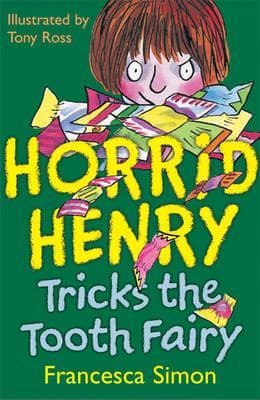
Francesca Simon (1997)
Genre
Children's
Reading Time
90 min
Key Themes
See below
Sign in to track this book
Horrid Henry schemes to outsmart the Tooth Fairy, banish an annoying houseguest, and unleash his chaos upon a family wedding, showing that even good intentions can't tame his naughty nature.
Horrid Henry wants money but does not want to wait to lose a tooth naturally. He plans to trick the Tooth Fairy. He puts a pebble under his pillow, hoping she won't notice in the dark. The next morning, he finds a note from the Tooth Fairy stating she only takes teeth, not pebbles. Henry tries again, this time putting a tiny piece of chewing gum under his pillow. Again, he receives a note and no money. Finally, he tries to trick his younger brother, Perfect Peter, into giving him one of his baby teeth, but Peter refuses. Henry's attempts to outsmart the Tooth Fairy fail repeatedly, much to his frustration.
Horrid Henry wakes up wanting a 'perfect day' after hearing his parents praise Perfect Peter's good behavior. He believes that if he acts perfectly, he will get treats and avoid chores. He follows his parents' instructions carefully, even eating his vegetables and tidying his room, which is unusual for him. However, his efforts are misunderstood or overlooked. His parents suspect his sudden change in behavior, and he ends up doing more chores than usual because they assume he is in a helpful mood. By the end of the day, Henry is tired and frustrated, realizing that being 'perfect' does not benefit him.
As Christmas nears, Horrid Henry wants specific presents, especially a new video game. He tries various ways to get what he wants. He writes a long, demanding letter to Santa, listing only expensive items. He also tries to 'help' his parents with their Christmas shopping by subtly pointing out the items he desires, often annoying them. He even tries to trick Perfect Peter into asking for the same things, hoping their parents will buy two. On Christmas morning, Henry is disappointed he did not get everything on his list, especially the video game, while Peter is happy with his thoughtful, if less flashy, gifts.
Horrid Henry dislikes school dinners, especially when Mrs. Oddbod, the strict dinner lady, serves unappetizing food like lumpy mashed potatoes or slimy spinach. Henry tries every trick to avoid eating his greens: hiding them under his plate, trying to pass them to other students, and even pretending to be sick. Mrs. Oddbod, however, is watchful and catches him every time, forcing him to finish his meal. Their daily battles entertain some students and scare Henry. His attempts to outsmart Mrs. Oddbod always fail, leaving him grumbling and wanting crisps and sweets instead.
Horrid Henry and Perfect Peter meet a new babysitter, Miss Impolita, who is overly strict and cheerful. Henry immediately dislikes her and tries to make her evening miserable, hoping she won't return. He pulls a series of pranks, including hiding her shoes, tampering with the television remote, and making loud, spooky noises. He tries to get Peter to join in, but Peter refuses. Miss Impolita, however, remains calm, dealing with each prank, which only frustrates Henry more. By the end of the evening, Henry has failed to drive her away.
It is Sports Day at school, an event Horrid Henry usually hates. However, he wants to win at least one race for the glory and the prize. He enters various events, including the sack race and the three-legged race. Henry tries to cheat at every chance: tripping other competitors, taking shortcuts, and trying to sabotage equipment. Despite his efforts, his cheating attempts are either stopped by teachers or backfire, causing him to lose. Perfect Peter, on the other hand, wins a prize for his good sportsmanship, much to Henry's disgust and envy.
Horrid Henry hosts a sleepover with his friends Moody Margaret, Rude Ralph, and Greedy Graham. Henry organizes a series of chaotic activities. They have a big pillow fight, tell scary stories that are more gross than frightening, and raid the kitchen for forbidden snacks. Henry leads them in pranks, including trying to scare Perfect Peter, who is trying to sleep in his room. The night becomes a noisy, sugar-fueled mess, much to the exasperation of Henry's parents, who constantly try to get the boys to settle down. The sleepover ends with everyone tired and the house messy.
The family goes on holiday, which Horrid Henry immediately dislikes. Whether it is a camping trip or a visit to a historical site, Henry finds fault with everything. He complains about the food, the activities, the weather, and his parents' choices. He refuses to participate in family outings, preferring to sulk or cause trouble. He deliberately makes noise in the tent, hides Peter's belongings, and makes life difficult for everyone. His constant grumbling and misbehavior turn what should be a relaxing break into a stressful ordeal for his parents and Perfect Peter.
It is Horrid Henry's birthday, and he wants the best party ever, meaning it must be exactly what he wants. He decides the guest list, the games, and most importantly, the presents. He is particularly demanding about the cake. During the party, Henry is a difficult host, often arguing with his friends, especially Moody Margaret, over games and prizes. He is impatient for presents and openly shows disappointment if a gift is not to his liking. Despite the chaos he creates, Henry considers the party a success because it was all about him, even if his guests and parents are left tired.
Henry's parents invite a dull, overly polite relative, Aunt Ruby, for dinner. Henry finds her boring and her constant praise of Perfect Peter infuriating. Determined to make her leave, Henry uses a series of 'horrid' tactics. He makes rude noises, tells disgusting jokes, and deliberately spills food. He tries to get Peter to join in, but Peter, as usual, behaves well. Henry's parents are embarrassed, but Aunt Ruby, though clearly uncomfortable, tries to stay composed. Henry's efforts eventually work when Aunt Ruby leaves early, much to Henry's satisfaction and his parents' embarrassment.
Horrid Henry desperately wants a pet, specifically a hamster, but his parents are hesitant, knowing his history with responsibility. He tries to convince them he has changed, even trying to be kind to Perfect Peter for a day. However, his true nature quickly appears. When he finally gets a trial hamster, he is too rough with it, forgets to feed it, and tries to teach it 'tricks' that involve scaring Peter. The hamster quickly escapes or is returned, showing his parents that Henry is not ready for a pet. Peter, meanwhile, cares for his goldfish diligently.
Henry is cast in the school play, much to his dismay, as he would rather be playing. He is given a small role, but he turns it into a starring role for chaos. During rehearsals, he refuses to learn his lines, improvises rude dialogue, and disrupts the other actors. On the night of the performance, he deliberately messes up his costume, makes funny faces at the audience, and tries to trip up other children on stage. His antics cause laughter from the audience, but frustration for the teachers and other students. The play ends in a mess, largely because of Henry's deliberate misbehavior.
The Protagonist
Henry remains consistently horrid throughout the stories, rarely learning lasting lessons, as his core personality is his defining trait.
The Supporting
Peter's character remains consistently 'perfect,' serving as a foil to Henry.
The Supporting
Their character remains largely consistent, reacting to their sons' behaviors.
The Supporting
Margaret remains consistently 'moody' and competitive.
The Supporting
Ralph's character is consistent as a loyal, rude friend.
The Supporting
Graham consistently remains 'greedy' throughout the stories.
The Supporting
Susan's character is consistent as Margaret's loyal companion.
The Mentioned
The Tooth Fairy remains a consistent, unyielding magical figure.
This theme explores the constant tension between a child's natural desire for mischief, rule-breaking, and self-gratification (Henry) and the desire for order, good behavior, and adherence to rules (Peter, parents, teachers). Henry's every action is an attempt to disrupt or bypass established norms, whether he tries to trick the Tooth Fairy, cheat at Sports Day, or ruin a family holiday. This contrast often creates comedy, highlighting the universal struggle between childhood impulsiveness and the need for structure. The stories consistently show Henry failing to fully escape the consequences of his actions or the boundaries of the adult world, but he never truly learns a lasting lesson.
“''I'm not eating that,' said Henry. 'It looks like green slime.'”
The relationship between Horrid Henry and Perfect Peter is a central example of sibling rivalry. Henry's constant tormenting of Peter comes from a mix of jealousy, annoyance at Peter's 'perfection,' and a desire for attention. Peter, in turn, often frustrates Henry with his unwavering good behavior and tendency to tell on Henry. This rivalry drives many of Henry's schemes, as he often tries to outsmart, annoy, or get one-up on his younger brother. It highlights the complex dynamics between siblings, where love and frustration often exist together, though Henry's frustration usually outweighs any affection.
“Perfect Peter sighed. 'Henry, you know the Tooth Fairy only takes real teeth.'”
While Henry's schemes often backfire or lead to immediate negative outcomes (like not getting money from the Tooth Fairy, or doing more chores on his 'perfect day'), a key part of his character is his consistent failure to learn lasting lessons from these consequences. The theme explores how children, especially those with strong personalities like Henry, can be unaffected by traditional disciplinary methods. Each story presents a new scenario where Henry tries to outwit the system, faces a consequence, but remains unchanged, ready for the next horrid adventure. This lack of lasting change is part of the series' appeal, as readers know Henry will always be horrid.
“Henry scowled. It hadn't been a perfect day at all. It had been the worst day ever.”
The stories are told almost entirely from Horrid Henry's perspective, offering a humorous and often exaggerated view of the world through a mischievous child's eyes. Adults are often shown as bumbling, unfair, or easily outwitted (though Henry often fails). Rules are seen as obstacles, and desires for treats, toys, and avoiding chores fill Henry's thoughts. This theme lets young readers identify with Henry's frustrations and desires, even if they do not approve of his horrid actions. It validates the intense emotions and simple logic that often govern a child's world, making the stories relatable and funny.
“Why did grown-ups always want you to do boring things?”
Henry's actions and their repercussions are often comically overblown.
The series heavily relies on exaggeration to create humor. Henry's horridness is amplified beyond typical childhood naughtiness, making his schemes outlandish and his reactions dramatic. For instance, his attempts to trick the Tooth Fairy are absurdly simple, and his 'perfect day' is a painstaking, unnatural effort. This device highlights the contrast between his grand plans and their often anticlimactic or disastrous results, making the stories consistently funny and engaging for young readers.
Perfect Peter serves as a direct contrast to Horrid Henry.
Perfect Peter functions as a classic foil character to Horrid Henry. His unwavering goodness, obedience, and politeness serve to highlight Henry's naughtiness, selfishness, and rebellion. Peter's presence often provides the motivation for Henry's mischief (e.g., jealousy), and his reactions to Henry's antics further emphasize Henry's 'horrid' nature. This device creates a clear moral contrast and often drives the plot forward through their sibling rivalry, providing a constant source of conflict and humor.
Recurring phrases and situations reinforce character traits and humor.
The series employs several running gags, such as Henry's frequent use of the word 'horrid,' his disdain for Peter's 'perfection,' and his constant battles with school dinners or chores. These recurring elements create familiarity for the reader, reinforce the established personalities of the characters, and provide consistent comedic beats. They allow for quick characterization and often serve as shorthand for Henry's predictable reactions to various situations, contributing to the series' distinctive voice and humor.
“Horrid Henry was horrid. Everyone said so.”
— The opening line of many Horrid Henry books, establishing his character.
“Henry was not pleased. He hated losing. He hated sharing. Most of all, he hated being told what to do.”
— Henry's internal thoughts about a situation where he isn't getting his way.
“He decided to play a trick on her. A really horrid trick.”
— Henry's decision to get back at someone or achieve his goal through mischievous means.
“Perfect Peter sighed. He was always sighing.”
— Describing Perfect Peter's characteristic reaction to Henry's antics.
“But Henry didn't care. He never cared.”
— Highlighting Henry's disregard for rules or others' feelings.
“Mums always said things like that. Dads too.”
— Henry's observation about common parental sayings or rules.
“He waited. And waited. And waited. Nothing happened.”
— Henry's impatience when his plans don't immediately unfold as expected.
“He knew exactly what to do. He always did.”
— Henry's confidence in his own (often horrid) schemes.
“Horrid Henry made a face. He was very good at making faces.”
— A common physical reaction from Henry, often in defiance or disgust.
“This was going to be brilliant. Absolutely brilliant.”
— Henry's enthusiastic assessment of one of his horrid plans.
“He grinned a horrid grin.”
— Describing Henry's signature smile when he's up to no good.
“Peter sighed again. He couldn't help it.”
— Reiterating Peter's frequent reaction to Henry, showing his resignation.
“It was all Horrid Henry's fault. It always was.”
— A common refrain from others, blaming Henry for any trouble.
“Henry loved money. He loved it more than anything.”
— Highlighting Henry's strong motivation for many of his schemes.
Ready to see how well you understood this book? Take our interactive quiz with 10 questions.

Biography coming soon.

Dan Gemeinhart
4.5
Kate O'Hearn
4.4

Jeanne Birdsall
4.4

Jen Wang
4.4
Wendelin Van Draanen
4.3

John Marsden
4.3

Chris Van Allsburg
4.3
Jennifer A. Nielsen
4.2