“I'm not eating that! It's green and slimy and smells like socks!”
— Henry refusing to eat vegetables at dinner.

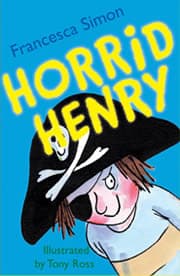
Francesca Simon (2008)
Genre
Children's
Reading Time
90 min
Key Themes
See below
Sign in to track this book
Horrid Henry is a mischievous menace whose funny escapades and constant torment of his saintly brother, Perfect Peter, guarantee chaotic fun and a good laugh for any child who loves a bit of naughtiness.
Horrid Henry wakes up wanting to have a 'perfect day,' which, for him, means doing everything he should not. He refuses his breakfast, makes a mess, and generally disobeys his parents. When his mother suggests he could be 'perfect' like his brother, Perfect Peter, Henry decides to be as horrid as possible. He throws a tantrum in a shop, refuses to share his toys, and is sent to his room. Despite his parents' frustration, Henry feels he has achieved his goal of a perfectly horrid day, to the annoyance of his family, especially Peter, who is genuinely good.
Henry's parents, hoping to teach him manners and control, make him attend a dance class. Henry, of course, hates the idea and plans to make it as bad as possible. He refuses to participate correctly, makes rude noises, trips other children, and generally causes problems in the class, to the anger of Miss Impatience Tutu, the dance teacher. He particularly targets Perfect Peter, who is enjoying the class. Henry's actions eventually lead to chaos, with children falling and the teacher completely fed up. He is eventually removed from the class, which makes him happy, as he successfully ruined it for himself and others.
When Henry's usual babysitter, the easily tricked Miss Oddbod, is not available, his parents hire a new one: the strict Miss Battle-Axe. Henry, used to scaring his babysitters, tries all his normal tricks – refusing to go to bed, asking for sweets, and making loud noises. However, Miss Battle-Axe is not bothered at all. She makes him eat his vegetables, sends him straight to bed, and even makes him tidy his room. Henry and Peter are both scared of her, and for once, Henry is completely defeated and well-behaved, showing that some adults are even tougher than he is.
It is Horrid Henry's birthday, and he wants to have the best party ever, which means getting all the attention and the best presents. He invites his friends, including Rude Ralph, Moody Margaret, and Sour Susan, as well as Perfect Peter and his 'goofy' friends. Henry tries to grab all the presents, cheat at party games, and generally make sure he wins everything. The party quickly turns into typical Henry chaos, with food fights, arguments over toys, and everyone generally having a horrid time, except for Henry, who enjoys the trouble he created. His parents are left to clean up the mess and deal with his 'perfect' birthday celebration.
The Protagonist
Henry remains consistently horrid throughout the stories, finding joy in his misbehavior and rarely learning lessons, which is central to his enduring appeal.
The Supporting
Peter remains consistently perfect, serving as a stable contrast to Henry's chaos.
The Supporting
Her struggle to control Henry is a recurring element, showcasing the ongoing battle between parental authority and childhood defiance.
The Supporting
He consistently tries to enforce rules, often in vain, highlighting Henry's unwavering determination to be horrid.
The Supporting
Margaret consistently acts as a peer who can match Henry's horridness, providing a dynamic of rivalry and shared mischief.
The Supporting
Ralph's role is primarily to reinforce Henry's social environment of mischief, remaining a consistent follower.
The Supporting
Susan's character reinforces the dynamic of the 'horrid' children, providing a consistent presence in Henry's social circle.
The Supporting
Miss Battle-Axe's brief appearance serves to show that even Horrid Henry has his limits and can be outmatched by a truly formidable adult.
The Mentioned
Her character arc is one of escalating frustration and eventual defeat by Henry's antics.
A main theme is Henry's active defiance of adult rules and expectations. He chooses to be 'horrid' instead of 'perfect,' finding joy and identity in his rebellion. This is clear in 'Horrid Henry's Perfect Day' where his goal is to be as disobedient as possible, and in 'Horrid Henry's Dance Class' where he ruins the activity he is forced into. The book celebrates this non-conformist spirit, often showing Henry getting his way, even if it means annoying the adults around him.
“''I'm not perfect,' he said cheerfully. 'I'm horrid!'”
The relationship between Horrid Henry and Perfect Peter is a core part of the book, showing classic sibling rivalry. Henry is always annoyed by Peter's goodness and often tries to bother him or do better than him. Peter, in turn, is often the victim of Henry's pranks. This is clearly seen in 'Horrid Henry's Dance Class' where Henry purposely trips Peter, and in 'Horrid Henry's Birthday Party' where Henry tries to get all the attention and presents, often at Peter's expense. The difference between their personalities creates much of the humor and plot.
“Perfect Peter sighed. He was always sighing. That's what perfect people did.”
The book often shows how frustrated and powerless adults are when dealing with a truly determined and mischievous child like Henry. Henry's parents, Miss Impatience Tutu, and even other children's parents at the birthday party, struggle to control him, often ending up defeated or exhausted. This theme connects with adult readers who can understand the parents' difficult situation, while children enjoy seeing authority figures challenged. Only Miss Battle-Axe manages to change this, showing a moment of adult success.
“His mum and dad just sighed. They did a lot of sighing when Henry was around.”
The stories consistently show the appeal of being naughty and breaking rules from a child's point of view. Henry finds real enjoyment and satisfaction in his horridness, and his adventures often end with him feeling successful because of the chaos he has caused. This is clear in 'Horrid Henry's Perfect Day,' where he feels he achieved his goal, and in 'Horrid Henry's Birthday Party,' where he enjoys the trouble. The book taps into the common childhood fantasy of getting away with naughtiness.
“Henry grinned. His perfect day was going perfectly.”
Perfect Peter serves as a direct contrast to Horrid Henry, highlighting Henry's 'horridness'.
The most prominent plot device is the use of character foils, specifically the pairing of Horrid Henry and Perfect Peter. Peter's inherent goodness, obedience, and preference for quiet activities directly contrast with Henry's naughtiness, disobedience, and love for chaos. This contrast is not just for comedic effect but also serves to define Henry's character more sharply. Peter's reactions to Henry's antics often underscore just how horrid Henry is, while Henry's disdain for Peter's perfection emphasizes his own rebellious nature.
Each chapter is a self-contained short story, focusing on a single event or challenge for Henry.
The book employs an episodic structure, with each chapter functioning as a complete short story. This allows for quick, engaging narratives that don't require complex overarching plots, making it ideal for young readers. Each episode presents Henry with a new situation (a dance class, a new babysitter, his birthday) that he then proceeds to disrupt or dominate through his horridness. This structure allows for a consistent character portrayal without needing significant character development, reinforcing Henry's unchanging nature.
Events and Henry's behavior are often exaggerated for comedic effect.
Exaggeration is a key comedic device used throughout the book. Henry's naughtiness is often pushed to extreme levels, such as throwing a full tantrum in a shop or causing complete pandemonium at a dance class. Similarly, the reactions of the adults, particularly the parents' sighs and Miss Impatience Tutu's exasperation, are often hyperbolized. This heightens the humor and makes Henry's actions seem larger than life, engaging young readers who enjoy the outrageousness of his behavior and the dramatic consequences.
Characters' names often reflect their primary personality traits.
Many characters in the book are given names that directly describe their personality or role. 'Horrid Henry' and 'Perfect Peter' are the most obvious examples, immediately establishing their opposing natures. Other characters like 'Moody Margaret,' 'Rude Ralph,' 'Sour Susan,' and 'Miss Impatience Tutu' also have names that give the reader an instant understanding of their key characteristics. This device simplifies character introduction and reinforces their archetypal roles within Henry's world, making them memorable for young readers.
“I'm not eating that! It's green and slimy and smells like socks!”
— Henry refusing to eat vegetables at dinner.
“Perfect Peter is so perfect, he probably eats broccoli for fun!”
— Henry complaining about his annoyingly well-behaved brother.
“Why do I have to go to bed? The sun's still up!”
— Henry protesting his bedtime.
“I'm not doing my homework! Homework is boring and stupid!”
— Henry rebelling against school assignments.
“Moody Margaret is the meanest girl in the whole world!”
— Henry describing his nemesis and neighbor.
“I want to watch TV! Now!”
— Henry demanding screen time.
“Why does Perfect Peter get to have all the fun?”
— Henry feeling jealous of his brother's privileges.
“I'm not sharing! It's mine!”
— Henry refusing to share toys or treats.
“This is the worst day ever!”
— Henry reacting dramatically to a minor setback.
“I'm going to be a pirate when I grow up!”
— Henry daydreaming about an adventurous future.
“Why do grown-ups always get to make the rules?”
— Henry questioning adult authority.
“I hate brushing my teeth! It's a waste of time!”
— Henry protesting personal hygiene routines.
“Let's play a trick on Perfect Peter!”
— Henry plotting mischief against his brother.
“I'm not going to school! School is for boring people!”
— Henry trying to avoid attending school.
Ready to see how well you understood this book? Take our interactive quiz with 10 questions.

Biography coming soon.
Dan Gemeinhart
4.5
Kate O'Hearn
4.4

Jeanne Birdsall
4.4

Jen Wang
4.4
Wendelin Van Draanen
4.3

John Marsden
4.3

Chris Van Allsburg
4.3
Jennifer A. Nielsen
4.2