“Hop on Pop.”
— The title phrase encouraging playful interaction.

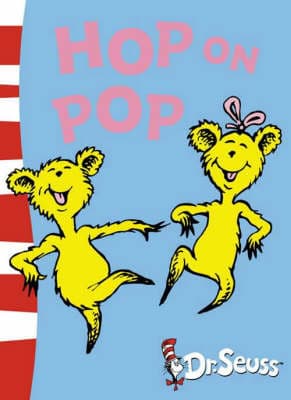
Dr. Seuss (1963)
Genre
Fantasy / Children's / Young Adult
Reading Time
10 min
Key Themes
See below
Sign in to track this book
Through playful rhymes and illustrations, 'Hop on Pop' makes the alphabet an interactive game where changing a single letter reveals new words for young readers.
The book starts with simple, two-letter words like 'UP' and 'PUP', showing how a small change creates a new word. It then shows a 'PUP' going 'UP'. This is followed by 'UP' and 'DOWN', with a picture of a small brown dog, a 'PUP', jumping up and down. The text highlights these basic ideas, using large, clear letters and repeated words to help young readers understand the sounds and meanings. The pictures show a playful pup doing these actions, making the ideas clear for children.
The phrase 'HOP ON POP' is introduced, showing two small, blue-haired children happily hopping on their red-shirted father, Pop. This section also looks at other action words like 'WE SIT', 'WE TWO', 'WE ALL', 'SIT ON A WALL'. The children are seen sitting on a low, red wall, reinforcing the idea of 'sit'. The text continues to build simple sentences and rhyming patterns, helping children sound out and recognize words in familiar scenes of play and family.
This part introduces objects and their words. A 'FOX IN A BOX' is shown, with the fox looking out of a red box. This pairing helps children understand prepositions and object names. The story then goes to 'FISH IN A DISH', showing a blue fish in a yellow dish, and 'RED', 'RED', 'ALL RED', with a red bed. These simple, colorful pictures and repeated words help with color recognition and naming objects, building words in an engaging way for young readers.
Ideas of size are introduced with 'TALL' and 'SMALL'. A tall blue boy stands next to a small red girl. This leads into 'WE ALL PLAY BALL', showing the tall boy and small girl playing with a red ball. The text then presents 'BALL' and 'WALL', showing the ball hitting a wall. This section uses opposite adjectives and common play activities to expand the reader's vocabulary and understanding of descriptive words, while keeping the book's simple rhyming structure.
This section focuses on words ending with '-AY'. It begins with 'DAY', showing a bright, sunny scene. This moves to 'WE PLAY', with children playing outdoors. Then, 'WHAT DO WE SAY?'. A boy asks, 'HELLO, HELLO'. The focus is on word families and their sounds. The pictures show children talking and playing, connecting the written words to speaking and everyday experiences, making learning interactive and fun for young children.
The book mentions feelings with 'MY DAD IS SAD'. Pop is shown with a tear, looking sad. The text emphasizes this with 'VERY, VERY SAD'. This simple sentence introduces an emotional idea directly, letting children recognize and relate to feelings. The picture clearly shows Pop's sadness, helping children connect the word 'sad' to a visual of the emotion, expanding their understanding beyond just objects and actions.
This part includes counting and colors. 'ONE FISH, TWO FISH, RED FISH, BLUE FISH' is shown, with many colorful fish. While a direct quote from another Seuss book, it fits the rhyming and simple word structure of 'Hop on Pop'. The pictures feature different fish, helping with both numbers and colors. This playful repetition and visual aid help children practice counting and color identification within rhyming words.
The book introduces words like 'BOOK', 'COOK', and 'LOOK'. A chef character, 'COOK', is shown reading a 'BOOK', and then looking at something in a pot. This sequence connects actions with objects, showing how words relate to daily activities. The simple pictures clearly show the 'COOK' and the 'BOOK', making the words easy to identify and understand in context. This section encourages an early enjoyment of reading and common household activities.
This part focuses on words with similar sounds, like 'HAT' and 'CAT'. A character is shown saying 'SEE MY HAT' while pointing to a hat, and then 'SEE MY CAT' while pointing to a cat. The pictures clearly show the difference between the hat and the cat, helping children understand the distinct meanings of similar-sounding words. This helps with phonics and word recognition through simple sentences and clear pictures.
The story returns to the fun of learning and playing with words. 'WE LIKE TO PLAY' shows children happily doing various activities. 'WE LIKE TO SAY' highlights the enjoyment of speaking and rhyming. The book ends by repeating that learning words can be a fun game. The children's happy faces in the pictures show this message, leaving the reader with a good feeling about exploring language.
The Supporting
Pop remains a static character, consistently embodying the role of a parent and a rhyming partner.
The Protagonist
The children's 'arc' is one of active engagement and learning, demonstrating the book's lessons.
The Supporting
The Pup serves a singular illustrative purpose and does not undergo development.
The Mentioned
The Fox is a static character, serving only as a visual aid for a word pair.
The Mentioned
The Fish are static, illustrative elements in the book.
The Mentioned
The Cook is a static, illustrative character with no development.
The main theme of 'Hop On Pop' is giving young children a fun and easy introduction to language. The book shows rhyming words, word families (e.g., 'day', 'play', 'say'), and simple sentences. Through repetition, large print, and clear pictures, it teaches children to see patterns in words, sound out new words by changing initial letters (e.g., 'Pop' to 'Hop'), and build basic vocabulary. The whole book is a direct lesson in early phonics and getting ready to read.
“WE SEE A PUP. PUP IS UP. UP. PUP. POP. PUP IS UP ON POP.”
The book always shows learning as a fun and interesting activity. The children are seen playing, laughing, and interacting with their surroundings in a happy way while also learning new words. The famous 'HOP ON POP' scene shows this, turning a potentially naughty act into a lighthearted word lesson. This theme creates a good feeling about reading and education, making the process seem like a game instead of work, which is important for young children.
“WE LIKE TO PLAY. WE LIKE TO SAY. WHAT DO WE SAY?”
'Hop On Pop' bases its word lessons on ideas and experiences familiar to young children. It covers actions (hop, sit, play), objects (box, dish, ball, hat, cat, book), basic feelings (sad), and how things are placed (up, down, in). By connecting words to real, understandable situations and items, the book makes abstract language ideas clearer for its young audience. This way helps children build a basic vocabulary relevant to their daily lives.
“MY DAD IS SAD. VERY, VERY SAD.”
While not directly stated as a main theme, the interactions between Pop and the children quietly show the value of parents and children learning together. The 'HOP ON POP' scene, though simple, shows a playful and accepting father. The book encourages reading together, where parents and children can explore words, point to pictures, and sound out words. This interactive part helps build connections and supports a home where early reading is encouraged.
“HOP ON POP. WE LIKE TO HOP. WE LIKE TO HOP ON TOP OF POP.”
Frequent reuse of words and phrases to reinforce learning.
Dr. Seuss heavily employs repetition of words and simple sentence structures throughout 'Hop On Pop'. For instance, 'UP. PUP IS UP.' and 'WE SIT. WE TWO. WE ALL. SIT ON A WALL.' This device is crucial for early readers as it helps them memorize words, recognize patterns, and build confidence by encountering familiar text. The rhythmic nature of the repetition also makes the book engaging and enjoyable to read aloud, aiding in auditory learning and comprehension.
The use of rhyming words and similar initial sounds to teach phonics.
The core of 'Hop On Pop' lies in its consistent use of rhyme (e.g., 'hop' and 'pop', 'fox' and 'box', 'fish' and 'dish') and subtle alliteration. This literary device is fundamental for teaching phonological awareness, helping children understand that words with similar sounds often share similar spellings. By highlighting these phonetic relationships, the book guides young readers in decoding new words and grasping the basic principles of English orthography in a fun, accessible manner.
Direct visual representation of words and actions.
Every page of 'Hop On Pop' features clear, simple illustrations that directly correspond to the words being presented. When the text says 'PUP IS UP', an image of a pup going up appears. This strong word-picture association is vital for young children who are still developing their reading skills. It provides immediate context for new vocabulary, helping children to understand the meaning of words without having to rely solely on decoding skills, thus building comprehension and vocabulary simultaneously.
Simplistic language to ensure accessibility for beginners.
The book deliberately uses a very restricted vocabulary and extremely simple, often two- or three-word, sentence structures. This intentional limitation prevents overwhelming emergent readers and allows them to focus on mastering a small set of words and basic grammatical patterns. By keeping the language straightforward, the book ensures that children can experience success in reading, which is a powerful motivator for continued learning and builds foundational literacy skills without frustration.
“Hop on Pop.”
— The title phrase encouraging playful interaction.
“We like to hop on top of Pop.”
— Children gleefully jumping on their father.
“STOP You must not hop on Pop.”
— A cautionary moment in the playful chaos.
“Pat sat on hat.”
— A simple, humorous scene of sitting on a hat.
“Three fish in a tree. Fish in a tree? How can that be?”
— A whimsical, nonsensical image questioning reality.
“Cup. Pup. Pup in cup.”
— A playful pairing of words and images.
“All tall. We all are tall.”
— A moment of unity and self-description.
“Mouse on house.”
— A simple, visual rhyme describing a scene.
“See Bee. We see a bee.”
— Observation of a bee with repetitive language.
“Red. Ned. Ned is red.”
— A color and name association for early readers.
“Day. Play. We play all day.”
— Celebrating endless playtime.
“Thing. Sing. Sing a song of things.”
— Encouraging creativity through song.
“Ball. Wall. We play ball on the wall.”
— Describing a playful activity with a ball.
“Night. Light. Light the light at night.”
— A comforting image for bedtime.
“Brown. Down. Brown goes down.”
— A simple action and color description.
Ready to see how well you understood this book? Take our interactive quiz with 10 questions.
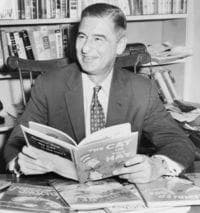
Dr. Seuss, born Theodor Seuss Geisel, was a beloved American children's author and illustrator. He is renowned for his imaginative tales and whimsical rhymes, including iconic works like 'The Cat in the Hat,' 'Green Eggs and Ham,' and 'Oh, the Places You'll Go!'. His unique style and memorable characters have made him a staple in children's literature for generations.







