“There are some things worth dying for, and others worth killing for. Freedom, I believe, falls into both categories.”
— Early in the story, discussing the motivations behind a daring plan.

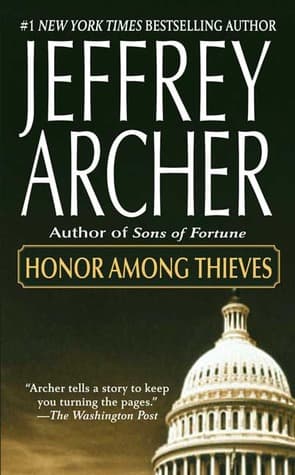
Jeffrey Archer (1993)
Genre
Thriller / Historical Fiction / Mystery
Reading Time
960 min
Key Themes
See below
Sign in to track this book
A CIA rookie and a hardened Mossad agent race across continents to stop Saddam Hussein's elaborate plot to steal and publicly destroy the Declaration of Independence on July 4th.
In April 1994, in his Baghdad palace, Saddam Hussein meets with his trusted advisors, including General Rashid and his chief forger, Karim. Humiliated by the Gulf War and sanctions, Saddam reveals his plan for revenge against the United States: to steal the original Declaration of Independence from the National Archives in Washington D.C. and publicly destroy it on July 4th. He offers a $100 million reward to whoever can accomplish this task, sparking a scramble among criminal organizations. His goal is not just the document's destruction, but the psychological blow and humiliation it would inflict upon the American people and the Clinton administration.
General Vladimir Antonov, a respected but financially struggling former KGB operative now working for the Russian mafia, is approached by an intermediary for Saddam Hussein. Antonov, whose daughter has a severe illness requiring expensive medical treatment, is offered the $100 million reward if he steals the Declaration. Despite his initial moral reservations, Antonov's love for his daughter and his desperate financial situation compel him to accept. He begins to assemble a team of skilled international criminals, using his old contacts and the resources of the Russian mafia to plan the operation.
In Washington D.C., CIA analyst Scott Bradley, a rising star with a keen intellect and patriotism, intercepts a coded message from Baghdad. The message, though encrypted and seemingly innocuous, contains a phrase about 'America's birthright' and 'Independence Day,' sparking an unsettling feeling in Scott. He brings his concerns to his superiors, but they dismiss it as an overreaction, focused on immediate threats. Undeterred, Scott continues to investigate, convinced that something significant is being planned against the U.S., even if he cannot yet pinpoint the target or the threat.
In Tel Aviv, Hannah Kopec, a Mossad agent, is assigned to investigate intelligence pointing to a large sum of money being transferred from Iraq to various international criminal organizations. Hannah, who lost her family in a terrorist attack orchestrated by Iraqi-backed groups, is driven by a personal vendetta. Her superiors believe this financial movement could indicate a new Iraqi-sponsored terrorist operation, potentially targeting Israel or its allies. Hannah, known for her analytical skills and determination, begins to trace the money trail, which soon leads her to interconnected criminal networks operating across Europe and the Middle East.
Scott Bradley, through analysis of intercepted communications and an understanding of Saddam's psychological warfare, begins to identify the true target: the Declaration of Independence. At the same time, Hannah Kopec, following the money and observing Antonov's team, also deduces that a high-value American historical artifact is the objective. Their independent investigations, though separate, start to point towards a single, audacious plot. Both agents realize the immense symbolic and historical significance of the Declaration and the catastrophic consequences if Saddam succeeds.
Scott Bradley, facing skepticism from his own agency, arranges a meeting with Hannah Kopec through diplomatic channels. Despite initial mistrust and professional rivalry—the CIA and Mossad often operate with secrecy even from allies—they quickly recognize each other's competence and the gravity of the situation. Their shared objective to prevent the destruction of the Declaration of Independence forces them into an uneasy but necessary alliance. They pool their intelligence, combining Scott's understanding of the American context with Hannah's expertise in international criminal networks and Iraqi operations.
General Antonov and his team, consisting of a master safe-cracker, a tech expert, and several trained operatives, meticulously plan the heist. They exploit weaknesses in the National Archives' security, using forged credentials, insider information, and technology to bypass alarms and surveillance. Their plan involves creating a diversion, disabling key security systems, and executing a fast operation to extract the Declaration from its protective casing. Their preparations are intricate, involving multiple dry runs and the acquisition of specialized equipment, all orchestrated under Antonov's precise leadership.
As July 4th approaches, Scott and Hannah intensify their efforts, racing against the clock. They analyze every piece of intelligence, every potential lead, trying to predict Antonov's next move. They realize that the plot is not just about stealing the Declaration, but about its public destruction, meaning the document will be moved to a specific location for its grand finale. Their investigation takes them across continents, from the back alleys of Europe to high-stakes intelligence briefings, as they try to anticipate where and how the final act of Saddam's revenge will unfold, constantly feeling one step behind Antonov's cunning plan.
On the night of July 3rd, Antonov and his team execute their meticulously planned heist. Despite heightened security awareness prompted by Scott and Hannah's warnings, the team's precision and innovative tactics allow them to overcome the National Archives' defenses. They create a diversion, disable security systems, and, in a tense, silent operation, remove the Declaration of Independence from its vault. The theft is clean and swift, leaving minimal immediate traces. The world wakes up on July 4th to the shocking news that America's most cherished historical document has been stolen, sending the U.S. government into a state of panic and humiliation.
Following the theft, a video message from Saddam Hussein is broadcast globally, claiming responsibility and announcing his intention to publicly destroy the Declaration of Independence on live television. The location for this act of defiance is a remote desert location in Iraq, chosen for its symbolic representation of Saddam's power and his disdain for the West. The world watches in horror as the countdown to the destruction begins, while the U.S. government faces unprecedented pressure and humiliation, unable to prevent the impending catastrophe.
With the Declaration stolen and its impending destruction announced, Scott and Hannah, now operating with the full backing of their respective governments, embark on a desperate chase. They track Antonov's movements, realizing he is heading towards Iraq to deliver the document and claim his reward. Their pursuit is fraught with danger, involving high-stakes air travel, covert operations, and navigating treacherous political landscapes. They know their window of opportunity is closing rapidly, and failure is not an option as they race towards the designated destruction site in the Iraqi desert, hoping to intervene before it is too late.
Just as Saddam Hussein prepares to publicly destroy what he believes is the original Declaration of Independence, Scott Bradley and Hannah Kopec, having arrived at the scene after a harrowing journey, reveal a shocking truth. Through their investigation and a last-minute intelligence coup, they expose that the document in Saddam's possession is a brilliant forgery created by Karim, Saddam's own chief forger. Antonov, driven by a deeper moral compass or perhaps a desire for double-crossing, had switched the original with the fake at some point, unbeknownst to Saddam, saving the true Declaration from destruction.
Following the revelation of the forgery, General Antonov, who is present to collect his reward, makes a dramatic confession. He reveals that he never intended to allow the original Declaration to be destroyed. He used the opportunity to secure the $100 million for his daughter's treatment, but secretly replaced the original with Karim's forgery. He then reveals the true Declaration's location—a secure, undisclosed vault he had arranged, intending to return it after his daughter's medical needs were met. This revelation throws Saddam's plan into chaos and infuriates the dictator, while Scott and Hannah are relieved but still face the challenge of recovering the original.
Scott and Hannah, following Antonov's instructions, retrieve what they believe to be the original Declaration. However, upon closer inspection, a final, devastating twist is revealed: this document, too, is a forgery. It is a masterpiece created by Karim, Saddam's forger, who, in a breathtaking act of defiance and artistry, had replaced the original with his own work even before Antonov's involvement. The true original Declaration of Independence was actually destroyed by Saddam Hussein in a private ceremony days earlier, believing it to be the forgery. Karim, having perfected his craft, had orchestrated this ultimate deception, ensuring that while the world thought a forgery was destroyed, the real document was lost forever, a final, subtle act of revenge against Saddam and America.
The Protagonist
Scott evolves from an overlooked analyst to a key operative, proving his worth and leadership under extreme pressure.
The Protagonist
Hannah channels her personal grief into professional drive, learning to trust and collaborate for a greater cause.
The Antagonist
Saddam's arrogance leads to his ultimate humiliation, as his grand plan is repeatedly undermined by those he trusts.
The Supporting
Antonov attempts to navigate a morally ambiguous path, ultimately choosing to preserve history while securing his family's future.
The Supporting
Karim, initially a loyal subordinate, orchestrates the ultimate act of artistic and political subversion, revealing his true genius and defiance.
The Mentioned
N/A
The Supporting
N/A
The Mentioned
N/A
This theme drives several key characters. Scott Bradley is motivated by patriotism and a desire to protect his nation's heritage, shown by his relentless pursuit of the Declaration's thieves even when his superiors are skeptical. General Antonov is motivated by the desperate need to save his daughter's life, forcing him to compromise his honor and engage in a criminal act. However, even Antonov's actions are tempered by a moral compass that prevents him from allowing the true destruction of the historical document, suggesting a complex interplay between personal loyalty and a broader respect for heritage. Saddam Hussein, on the other hand, embodies a twisted patriotism, seeking to humiliate an adversary for what he perceives as a national slight.
““There are some things in life, General, that are worth more than a hundred million dollars. The soul of a nation, for instance.””
The narrative is woven with layers of deception and betrayal, forming the core of its thrilling plot twists. Saddam Hussein's entire plan is an act of psychological warfare and deception against the U.S. However, he himself becomes the victim of multiple betrayals. General Antonov betrays Saddam by replacing the original Declaration with a forgery. Most profoundly, Karim, Saddam's own trusted forger, orchestrates the ultimate deception by replacing the original with his own forgery, ensuring its destruction while Saddam believes he is destroying the fake. This theme highlights the fragility of trust and the unpredictable nature of human motives, where even those seemingly under control can harbor their own hidden agendas.
““The greatest trick the devil ever pulled was convincing the world he didn't exist. The second greatest was convincing Saddam that a forgery was the original.””
The Declaration of Independence is not merely a document; it is a symbol of American identity, freedom, and history. Saddam Hussein's choice to target it underscores its immense symbolic power, as its destruction would represent a deep psychological wound for the U.S. Scott Bradley's dedication to protecting it is rooted in his understanding of this symbolic value. The ultimate twist, where the original is indeed destroyed but through an elaborate deception, reinforces the idea that symbols can be manipulated, and that the meaning derived from them can be more powerful than their physical existence. The book explores how nations define themselves through their historical artifacts and how adversaries seek to undermine that identity.
““Destroying the Declaration of Independence would be worse than any military defeat. It would be a wound to the American soul.””
Revenge is a primary motivator for several characters, but its manifestations differ. Saddam Hussein seeks revenge against the U.S. for his humiliation in the Gulf War, desiring to inflict a similar psychological blow. Hannah Kopec is driven by a profound personal quest for justice and revenge against those who murdered her family, making her a relentless and formidable agent. However, the novel suggests that true justice is complex and not always achieved through direct confrontation. Karim's ultimate act of deception can be seen as a form of artistic justice, a subtle yet devastating revenge against Saddam for his tyranny, demonstrating that justice can be served in unexpected and highly nuanced ways, often through intellectual superiority rather than brute force.
““Revenge, like a fine wine, improves with age, and is best served cold, and with a touch of artistry.””
The novel portrays the world of international espionage, highlighting both the rivalries and necessary collaborations between intelligence agencies. Initially, Scott Bradley faces skepticism within his own CIA, and there is an inherent mistrust between the CIA and Mossad. However, the gravity of Saddam's plot forces Scott and Hannah Kopec to forge an uneasy but effective alliance. Their collaboration, pooling resources and expertise from different national intelligence structures, shows that despite political and historical differences, cooperation is essential in confronting global threats. The book shows the complex logistics, information sharing, and covert operations involved in multi-national intelligence efforts.
““In this game, trust is a luxury, but necessity often makes strange bedfellows.””
The Declaration of Independence as the central object of desire and conflict.
The Declaration of Independence serves as the ultimate MacGuffin in 'Honor Among Thieves.' It is the object that drives the entire plot: Saddam Hussein wants to steal and destroy it, Antonov is hired to acquire it, and Scott and Hannah are tasked with protecting it. Its symbolic value is immense, making its theft a catastrophic event. While its physical presence is crucial, its true importance lies in what it represents and the actions it compels the characters to take, rather than its inherent properties as a document. The twists regarding its authenticity further emphasize its role as a narrative catalyst.
Misleading clues and assumptions about the Declaration's fate.
The novel employs several red herrings, primarily concerning the authenticity of the Declaration of Independence. The initial assumption is that Antonov will steal the original and deliver it for destruction. However, the first twist reveals Antonov swapped it for a forgery. This leads the audience to believe the original is safe, a major red herring. The second twist, revealing Karim's earlier, more profound deception, further misdirects the audience, making them believe Antonov's recovered document is the true original. These misdirections build suspense and contribute to the triple-twist ending, keeping the reader constantly guessing about the true state of the MacGuffin.
The countdown to July 4th and the Declaration's destruction.
The ticking clock is a prominent plot device, creating relentless suspense throughout the narrative. From the moment Saddam Hussein sets July 4th as the date for the Declaration's destruction, a definitive deadline is established. This countdown intensifies the urgency of Scott and Hannah's mission, forcing them to race against time to uncover the plot and prevent the catastrophe. Each passing day and each new piece of intelligence heightens the stakes, driving the characters' actions and accelerating the plot's pace towards its dramatic climax. The fixed deadline ensures that the narrative maintains a high level of tension and urgency.
Multiple layers of betrayal and hidden agendas.
The double-cross is a recurring and escalating plot device, culminating in the novel's famous triple-twist ending. Initially, General Antonov's agreement to steal the Declaration for Saddam is a clear act. However, his secret plan to replace the original with a forgery constitutes the first double-cross against Saddam. This is then superseded by Karim's even more elaborate and earlier double-cross, where he replaces the original with his own perfect forgery, effectively deceiving both Saddam and Antonov. These layers of betrayal keep the reader off-balance, constantly re-evaluating character motives and the true state of the plot, making the ending particularly shocking and memorable.
“There are some things worth dying for, and others worth killing for. Freedom, I believe, falls into both categories.”
— Early in the story, discussing the motivations behind a daring plan.
“The only thing more dangerous than a man with nothing to lose is a man with everything to gain.”
— A character reflects on the desperation and ambition driving the antagonists.
“History is written by the victors, but the truth, like a river, always finds its way to the sea.”
— Contemplating the manipulation of historical narratives and the persistence of truth.
“Loyalty, like love, is not something you can demand; it must be earned, often at great cost.”
— A character grapples with betrayal and the true meaning of allegiance.
“In the game of espionage, the greatest weapon is often the one no one knows you possess: information.”
— Highlighting the strategic importance of intelligence gathering.
“The line between courage and foolishness is often blurred, visible only in hindsight.”
— A moment of reflection on a risky decision made under pressure.
“Even the most carefully laid plans can unravel with a single, unexpected thread.”
— Referring to unforeseen complications in a complex operation.
“Justice, true justice, is not about revenge, but about balance, about setting things right.”
— A discussion about the motivations behind seeking retribution.
“A man's worth is not measured by the gold in his pockets, but by the integrity in his heart.”
— A philosophical observation on character versus material wealth.
“The past is a stubborn beast; it never truly lets go, always lurking, waiting to pounce.”
— A character haunted by past events and their consequences.
“Sometimes, the greatest honor lies in admitting defeat, especially when victory means sacrificing everything you stand for.”
— A difficult choice faced by a protagonist regarding a moral compromise.
“Fear can be a powerful motivator, but hope, even a flicker of it, can move mountains.”
— Contrasting the influence of fear and hope in dire circumstances.
“The greatest trick the devil ever pulled was convincing the world he didn't exist, and the greatest trick of a thief is to make you believe he's honest.”
— A cynical observation on deception and the nature of criminals.
“To truly understand an enemy, you must first understand what they love, not just what they hate.”
— A strategic insight into psychological profiling of an adversary.
Ready to see how well you understood this book? Take our interactive quiz with 10 questions.

Jeffrey Howard Archer, Baron Archer of Weston-super-Mare is an English novelist, life peer, convicted criminal, and former politician. Before becoming an author, Archer was a Member of Parliament (1969–1974), but did not seek re-election after a financial scandal that left him almost bankrupt.







