“Homer was a boy who lived in Centerburg where his father ran the tourist camp and his mother made doughnuts.”
— Opening description of the main character and setting.

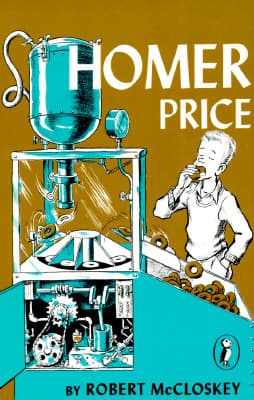
Robert McCloskey (1943)
Genre
Children's / Young Adult
Reading Time
120 min
Key Themes
See below
Sign in to track this book
In Centerburg, young Homer Price experiences many funny misadventures, from stopping bandits with his pet skunk to controlling a runaway donut machine that almost covers the town in fried dough.
Homer Price helps his parents run their diner in Centerburg. They get a new donut machine, a modern device meant to make perfect donuts automatically. But during its first public use, a small fly lands on the 'stop' button, jamming it. The machine then makes donuts non-stop, faster than anyone can eat them. The diner quickly fills with piles of donuts, threatening to cover the whole town. Homer quickly suggests calling the local sheriff, but even the sheriff is puzzled. The townspeople eventually decide to sell the donuts to tourists, turning the accident into a profitable, though messy, business.
While the donut machine is making too many donuts, a rich socialite, Mrs. Penelope Lapin, stops at the diner. She is known for her expensive pearl necklace. While she is watching the donut show, four famous jewel thieves, dressed as regular customers, try to steal her necklace. Homer, with his pet skunk Aroma's sharp senses, notices something wrong. Aroma, known for her strong smell, helps track the thieves as they try to escape through the growing piles of donuts. Her distinct smell leads Homer and the sheriff right to the criminals, who are caught among the sweet-smelling mess, and the necklace is found.
Mr. Gabby, a rich man who lives outside Centerburg, is famous for owning the world's largest ball of string. One day, the huge ball, which he keeps in his barn, disappears. Mr. Gabby is upset and offers a reward for its return. Homer Price, known for being smart, takes on the case. He checks the barn and the area around it for clues. Homer eventually finds that the ball of string wasn't stolen; it rolled away down a hill during a storm and got stuck in a valley. With help from the townspeople, they get the giant ball of string back, and Mr. Gabby is very happy, giving Homer a generous reward.
Homer and his friends love collecting comic books, and their main goal is to find a rare issue of 'The Super-Duper,' a comic that promises a prize to anyone who solves its puzzle. They spend their money and free time looking through every store and attic in Centerburg. Their search leads them to an old junk shop run by an unusual man. After much looking, they finally find a dusty copy of 'The Super-Duper.' However, the puzzle is very hard. Homer and his friends work together, using their knowledge and effort, and eventually solve the puzzle. The prize, to their surprise, is not a big fortune but a simple, heartfelt message about the value of friendship and hard work.
After the donut machine problem, the machine is fixed and keeps making donuts, but with more oversight. One day, Sheriff Bidwell, a proud man, arrives at the diner wearing a brand-new suit, eager to show it off. Homer, still helping, is glazing the fresh donuts. By accident, Homer slips, sending donut glaze directly onto the sheriff's clean new suit. The sheriff is embarrassed and at first very angry. But Homer's honest apology and offer to help clean it, along with the townspeople's good humor, eventually make the sheriff laugh it off, though his suit stays a sticky, sweet mess.
Centerburg has a local invention competition, and Homer Price, always full of ideas, decides to enter. He sees that Mrs. Limburger, a local baker, constantly has mice in her shop. Homer sets out to invent a kind and new mousetrap. His invention is a 'musical mousetrap' that, instead of snapping, plays a catchy tune when a mouse enters, luring it into a cage with cheese. The trap is made to be harmless and fun. At the competition, Homer's invention is a success, not just for its cleverness but also for its fun nature. He wins the competition, and Mrs. Limburger is happy to have a musical, mouse-catching solution for her bakery.
The Protagonist
Homer's arc shows his consistent growth in resourcefulness and his increasing reputation as a clever and helpful member of his community.
The Supporting
Aroma consistently demonstrates her loyalty and usefulness, solidifying her role as an indispensable companion to Homer.
The Supporting
Mr. Price maintains his role as a grounded, hardworking father, often learning to appreciate Homer's unconventional solutions.
The Supporting
Mrs. Price consistently provides a stable and loving presence, adapting to the town's quirks with grace.
The Supporting
Sheriff Bidwell learns to trust and rely on Homer's unique abilities, becoming more effective in his role.
The Supporting
Mrs. Lapin experiences a dramatic event in Centerburg that reinforces the town's unique charm and resourcefulness.
The Supporting
Mr. Gabby's distress over his lost string highlights his attachment to his unique possessions and his gratitude for community help.
The Supporting
Freddy remains a steadfast friend, sharing in Homer's adventures and discoveries.
A main theme is the strength of cleverness and practical thinking in solving unexpected problems. Homer Price always shows he can think creatively, whether finding a way to stop an endless donut machine, tracking jewel thieves with his skunk, or getting back a giant ball of string. The book celebrates how ordinary people can be resourceful in unusual situations, often showing that simple, creative solutions work better than complicated ones. This is clear in Homer's musical mousetrap, a kind and effective invention.
““There’s a perfectly good way to do everything, if you just stop and think about it.””
The book clearly shows Centerburg's unique nature and close community. Despite the strange events, there is a comforting feeling of neighborliness and support. The townspeople work together to handle the donut overflow, search for Mr. Gabby's string, and join local competitions. The odd qualities of characters like Mr. Gabby and Sheriff Bidwell add to the town's charm, making Centerburg a place where normal and magical things happen together, creating a strong sense of identity and belonging for its residents.
““Centerburg was just like any other town, except for a few things, and those few things made all the difference.””
The 'Sensational Donut Machine' chapter is a good example of this theme. It shows how modern technology, meant for efficiency, can fail in surprising and overwhelming ways. The machine's endless donut production, caused by a simple fly, shows the funny and sometimes messy results of relying too much on machines. This theme suggests a warning about progress, showing that human creativity and ability to adapt are still important, even with advanced machines.
““The machine hummed and whirred and made donuts at a terrific speed, but it couldn't be stopped!””
Homer's adventures often involve working with and getting help from his friends and the Centerburg community. Whether it's his bond with his pet skunk, Aroma, or his joint efforts with friends to find a rare comic book, the stories show the strength that comes from working together. The townspeople's combined effort to deal with the donut crisis or get back Mr. Gabby's string shows how a community can unite to solve problems, reinforcing that shared experiences and helping each other are very valuable.
““It takes a whole town to find a ball of string that big.””
Each chapter functions as a self-contained short story.
The book is structured as a series of independent, yet interconnected, episodes in Homer Price's life. Each chapter presents a new problem or adventure that Homer must solve, with its own beginning, middle, and end. While characters like Homer and Aroma are consistent, the plots of each episode are distinct. This allows for varied scenarios, keeps the narrative fresh, and makes the book highly accessible for young readers, as they can enjoy individual stories without needing to recall complex overarching plots.
Using extreme situations for comedic effect.
McCloskey frequently employs exaggeration to create humorous situations. The most prominent example is the donut machine endlessly producing donuts until they threaten to bury the town. Other instances include Mr. Gabby's impossibly large ball of string and the dramatic chase involving Aroma and the jewel thieves. This device amplifies the absurdity of the situations, making them more memorable and entertaining for the reader, and highlights the resilient and often comical reactions of the Centerburg residents to these over-the-top events.
The setting itself functions as a character, fostering peculiar events.
Centerburg is more than just a backdrop; it's a character in its own right, a magnet for odd occurrences and home to quirky individuals. The town's unique atmosphere and its residents' particular habits (like collecting giant balls of string or being unusually susceptible to donut overproduction) are integral to the plot. The town's inherent eccentricity provides the fertile ground for the unusual problems Homer encounters, making the improbable seem plausible within its charmingly strange confines.
A pet with a unique skill that aids the protagonist.
Aroma, Homer's pet skunk, serves as a classic animal companion, but with a distinctive twist. Her powerful scent, typically a deterrent, becomes a crucial plot device in solving the jewel theft. Her intelligence and loyalty make her more than just a pet; she is an active participant in Homer's adventures, often providing the critical element needed to resolve a conflict. She adds a layer of charm and humor, while also demonstrating the unexpected usefulness of unusual traits.
“Homer was a boy who lived in Centerburg where his father ran the tourist camp and his mother made doughnuts.”
— Opening description of the main character and setting.
“The doughnut machine was a wonderful invention, but it had one little fault: it wouldn't stop making doughnuts.”
— Homer's uncle's doughnut machine goes haywire, creating a comical situation.
“It's a very simple thing to make a million doughnuts if you have a doughnut machine.”
— Reflection on the runaway doughnut production.
“Homer had a way with animals, and he could usually get them to do what he wanted.”
— Describing Homer's skill with pets and strays.
“The sheriff was a very important man in Centerburg, and he liked to keep things quiet and peaceful.”
— Introduction of the local law enforcement.
“Sometimes the simplest things can cause the biggest problems.”
— Moral from one of Homer's misadventures.
“Homer thought it was a fine thing to have a uncle who could invent such a machine.”
— Homer's admiration for his uncle's creativity.
“In Centerburg, everyone knew everyone else's business, but they were all friends anyway.”
— Description of the close-knit community.
“The robbers didn't count on Homer being so clever.”
— Homer outsmarts criminals in one story.
“A boy with a good idea can sometimes solve a problem that stumps the grown-ups.”
— Theme of youthful ingenuity prevailing.
“It's not every day that a skunk decides to help catch a thief.”
— Homer uses an unusual animal ally in a caper.
“Homer's mother said, 'If you can't fix it with doughnuts, it probably can't be fixed.'”
— A humorous take on the family's doughnut-centric life.
“The town celebrated with a parade, and Homer was the hero of the day.”
— Conclusion of one of Homer's successful adventures.
“Sometimes the best plans are the ones you make up as you go along.”
— Homer's improvisational approach to problems.
Ready to see how well you understood this book? Take our interactive quiz with 10 questions.

Biography coming soon.

Dan Gemeinhart
4.5
Kate O'Hearn
4.4

Jeanne Birdsall
4.4

Jen Wang
4.4

Wendelin Van Draanen
4.3

John Marsden
4.3

Chris Van Allsburg
4.3
Jennifer A. Nielsen
4.2