“The greatest battles of life are fought within the mind.”
— Drizzt's internal struggle and philosophical outlook.

Sign in to track this book
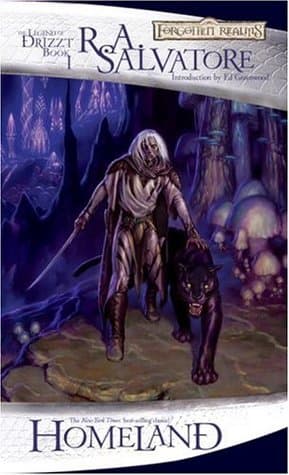
A drow outcast defies his murderous family and the evil of his race in the sunless Underdark, seeking a new life beyond the shadows.
Drizzt Do'Urden is born the third son of Matron Malice Do'Urden of House Do'Urden during a raid on House DeVir. His birth, at the same time his brother Dinin kills the House DeVir patriarch, means he should be sacrificed to Lolth as the third son. However, his eldest brother, Nalfein, dies in a magical fight with the House DeVir Matron, making Drizzt the second son. This saves Drizzt from sacrifice. His father, Zaknafein, a master weapons-master, takes an immediate interest in the child.
Drizzt spends his first sixteen years in the women's quarters, learning about drow society and Lolth worship. His mother, Matron Malice, and his sisters, Briza and Vierna, teach him. But his father, Zaknafein, truly shapes him, secretly teaching him combat and sharing his dislike for drow cruelty. Zaknafein sees Drizzt's goodness and encourages it, often challenging his son's views on drow life, hinting at a world beyond Menzoberranzan's rules. This secret teaching helps Drizzt develop his moral sense.
At sixteen, Drizzt begins training at Melee-Magthere, the academy for male drow warriors. He quickly proves to be an amazing fighter, better than his peers, including his brother Dinin. Despite his skill, Drizzt dislikes the academy's brutal lessons, which praise torture, lies, and violence. He argues with instructors and other students about their cruelty, especially when he refuses to torture surface elves during a training exercise. His actions anger the academy and his family, who see his compassion as weakness and a betrayal of drow ideals.
During a raid on a surface elf village, a required part of Melee-Magthere training, Drizzt cannot kill an innocent elf child. He pretends to kill the child, leaving it alive. This act of mercy strengthens his inner conflict and his decision to reject his society's evil. His actions are questioned, but his skill keeps him from immediate exposure. The event troubles him deeply, making him question his place in a world that demands such barbarity and increasing his feeling of being an outsider from his family and culture.
Matron Malice, suspecting Drizzt's compassion and the threat he poses to the house's standing with Lolth, plans to sacrifice him. Zaknafein, seeing Drizzt's strong morals and knowing he cannot survive in drow society, steps in. To save Drizzt from his mother's anger and certain sacrifice, Zaknafein publicly challenges Malice's power and offers himself as a sacrifice to Lolth instead. This selfless act is a deep show of love. It further isolates Drizzt, giving him great guilt and a strong will to honor his father's memory by living with integrity.
Devastated by his father's sacrifice and unable to accept the drow way of life, Drizzt decides to leave Menzoberranzan. He goes into the dangerous Underdark, seeking a life free from Lolth's tyranny and his family's evil. His first journey is full of danger and loneliness, as he moves through the tunnels, meeting monsters and hostile drow patrols. During this time, he struggles with his identity, letting go of what he was expected to be and making his own path, guided by the morals his father taught him.
While wandering alone, Drizzt finds a figurine that summons Guenhwyvar, a magical black panther from the Astral Plane. Guenhwyvar becomes his constant companion and protector, a strong ally in the harsh Underdark. Their bond is instant and deep, giving Drizzt much-needed company and a sense of belonging. Guenhwyvar's presence shows Drizzt's connection to nature and his rejection of the drow's artificial, cruel world. It contrasts sharply with the betrayal and manipulation he experienced in Menzoberranzan.
Drizzt's leaving is a serious insult to House Do'Urden, threatening their standing with Lolth. Matron Malice, angry at his betrayal, sends Dinin and Vierna to hunt him down and either bring him back or kill him. The chase is relentless, forcing Drizzt to constantly avoid his former family, who know the Underdark's dangers and his fighting style. These meetings are emotional, as Drizzt faces his family's twisted loyalty and evil. This further solidifies his decision to cut all ties with Menzoberranzan and fully embrace his individuality.
In a final fight, Drizzt faces his brother Dinin. Dinin, driven by Malice's orders and his own jealousy, tries to capture Drizzt. The battle is fierce, showing Drizzt's superior skill and his deep understanding of drow combat. Despite not wanting to hurt his own family, Drizzt must defend himself. He defeats Dinin but chooses not to kill him, leaving him wounded and shamed. This act of mercy further separates Drizzt from his drow heritage and shows his commitment to a moral code beyond Menzoberranzan's brutal laws.
After years of wandering and avoiding his family, Drizzt decides to leave the Underdark entirely and seek the surface world. He realizes that true freedom and a chance for a good life cannot be found in the oppressive darkness of his birthright. This decision ends his inner struggle with his drow heritage and starts a new chapter. With Guenhwyvar, Drizzt begins a dangerous ascent, leaving behind the only world he has known to find light and acceptance, an outcast but now truly free.
The Protagonist
Drizzt begins as a conflicted drow, torn between his inherent goodness and the evil of his society, ultimately choosing to reject his heritage and forge his own path. He transforms from an unwilling participant in drow society to a determined outcast seeking light.
The Supporting
Zaknafein begins as a cynical but resigned member of drow society, secretly nurturing Drizzt's goodness, and ends as a heroic martyr, sacrificing himself for his son's chance at freedom.
The Antagonist
Malice remains a static character, unwavering in her evil and ambition, serving as the primary representation of the drow society Drizzt rejects.
The Supporting
Dinin remains consistently cruel and envious, serving as a foil to Drizzt's moral character and a representation of the typical drow male.
The Supporting
Vierna's character shows the corrupting influence of Lolth's faith, as her initial, albeit harsh, care for Drizzt transforms into fanatical pursuit.
The Supporting
Guenhwyvar's role is primarily to be Drizzt's unwavering companion and protector, providing stability and loyalty throughout his journey.
This theme is central to Drizzt's journey, as he fights against the evil of drow society. His goodness and compassion go against the drow's worship of Lolth and their culture of cruelty, lies, and ambition. Drizzt's refusal to torture surface elves during his academy training, and his decision to leave Menzoberranzan, show his struggle to keep his own moral sense against pressure to conform. The entire story shows how one person can reject their destiny.
“For Drizzt Do'Urden, it was a world of black and white, and he was alone in the gray.”
The conflict between good and evil is the main theme of 'Homeland.' Drizzt represents goodness, a clear contrast to the drow's evil and their goddess, Lolth. Every action Drizzt takes, from sparing the elf child to leaving Menzoberranzan, is a choice for good. Drow society, with its sacrifices, torture, and constant backstabbing, represents evil. Zaknafein's character also explores this, showing that even in an evil society, some can secretly hold goodness and sacrifice themselves for it. Drizzt's journey is about finding and accepting his own good nature.
“His world was not a world of light and shadow, but of good and evil, and the lines were drawn in blood.”
Drizzt's family, House Do'Urden, shows the treachery and ambition of drow society. His birth itself involves a family coup and his eldest brother's death. Growing up, Drizzt faces betrayal from his mother, Matron Malice, who plots against him and sacrifices his father. His siblings, Dinin and Vierna, also betray him, hunting him to kill him. Only Zaknafein, Drizzt's father, shows true family love and loyalty through his self-sacrifice, making the other betrayals even more painful.
“A house of lies, built upon the bones of trust.”
Drizzt's journey is one of self-discovery. Born into a society that says he is an evil drow, he spends the novel figuring out who he really is. His inner conflict comes from the difference between his compassion and the cruelty expected of him. Through his training, his moral choices (like sparing the child), and his father's teaching, Drizzt slowly sheds the drow identity forced upon him. His decision to leave the Underdark is the ultimate act of self-definition. He chooses to create his own identity based on his values rather than his birthright, becoming the ranger he was meant to be.
“He was a drow, yes, but he was also Drizzt, and that was a difference he would not ignore.”
A magical item that summons Guenhwyvar, Drizzt's panther companion.
This magical figurine serves as a crucial plot device, providing Drizzt with his most enduring companion, Guenhwyvar. When Drizzt is at his most isolated and vulnerable in the Underdark, the figurine allows him to summon a powerful and loyal ally. It symbolizes Drizzt's connection to a different, more natural world, contrasting with the artificiality and cruelty of drow magic. The figurine not only gives Drizzt a powerful combat partner but also a source of emotional support and unconditional acceptance, which is vital for his psychological survival.
The pivotal event where Drizzt's father sacrifices himself to save his son.
Zaknafein's sacrifice is the central turning point in Drizzt's life. It directly saves Drizzt from being sacrificed to Lolth by Matron Malice, but more importantly, it deeply solidifies Drizzt's resolve to reject drow society. This act of selfless love and moral integrity provides Drizzt with both immense guilt and a powerful motivation to honor his father's memory by living a life of goodness. It effectively severs Drizzt's last emotional tie to Menzoberranzan, making his eventual departure inevitable and providing the impetus for his long journey of self-discovery.
A drow custom dictating the sacrifice of the third male child.
The 'third son rule' is introduced at the very beginning of the novel, immediately establishing the brutal and arbitrary nature of drow society. Drizzt's birth as a third son initially marks him for sacrifice, but the timely death of his eldest brother, Nalfein, elevates Drizzt to the second son, saving his life. This rule serves as an early example of the inherent cruelty of drow culture and establishes Drizzt's unique, almost fated, existence. It also highlights the precariousness of life in Menzoberranzan and foreshadows the constant threats Drizzt will face from his own family.
“The greatest battles of life are fought within the mind.”
— Drizzt's internal struggle and philosophical outlook.
“Survival is not a matter of a single choice, but a series of choices.”
— Drizzt reflecting on his difficult upbringing in Menzoberranzan.
“Evil is not born, it is made.”
— Drizzt contemplating the nature of his own kin and the drow society.
“A true warrior fights not because he hates what is in front of him, but because he loves what is behind him.”
— Zaknafein teaching Drizzt about the true motivations of a fighter.
“The darkness of the Underdark is not merely the absence of light, but a presence unto itself.”
— Describing the oppressive atmosphere of Menzoberranzan.
“Prejudice is a disease of the mind, and it is a disease that can be cured.”
— Drizzt's early thoughts on the ingrained biases of drow society.
“Honor is not a gift, but a choice.”
— Zaknafein's lessons to Drizzt about personal integrity.
“Sometimes, the only way to find your true path is to get lost.”
— Drizzt's journey of self-discovery and rebellion against his society.
“The greatest strength of a people is not in their numbers, but in their unity.”
— Reflecting on the fractured nature of drow houses and their constant infighting.
“A lie can travel halfway around the world while the truth is still putting on its shoes.”
— Zaknafein warning Drizzt about the power of deceit in drow society.
“Fear is a powerful weapon, but it is also a double-edged sword.”
— The drow's use of fear to control their populace and its eventual drawbacks.
“To deny one's nature is to deny oneself.”
— Drizzt struggling with his inherent goodness in a wicked society.
“The path of least resistance is often the path of regret.”
— Drizzt choosing to defy expectations and forge his own destiny.
“Even in the deepest darkness, a single spark of light can ignite a fire.”
— Drizzt's unwavering hope and good nature in the corrupt Underdark.
Ready to see how well you understood this book? Take our interactive quiz with 10 questions.
Biography coming soon.







