“Every house has a story to tell. Some are just more willing to share their secrets than others.”
— Mags's opening line, setting the tone for the house's central role.

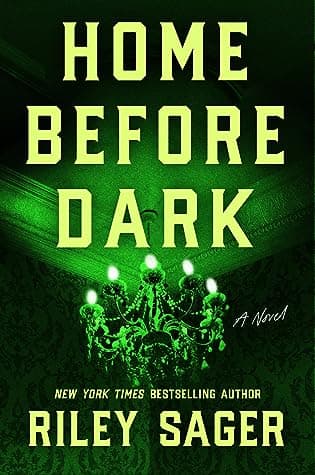
Riley Sager (2020)
Genre
Thriller / Mystery
Reading Time
8-9 hours
Key Themes
See below
Sign in to track this book
A daughter who doubted her father's bestselling haunted house memoir inherits the infamous estate, only to find its terrifying stories might be true as she unearths its dark, lingering secrets.
Maggie Holt, a home restorer, receives an unexpected inheritance: Baneberry Hall, the Vermont estate her family fled twenty-five years ago. Her father, Ewan Holt, wrote the bestselling 'House of Horrors' about their three-week stay, detailing terrifying supernatural events. Maggie, who remembers none of the events and disbelieves in ghosts, sees the book as fiction that exploited her family. Her plan is to quickly renovate and sell the property, hoping to leave the controversial past behind. However, the town of Bartleby and Baneberry Hall itself hold secrets that begin to challenge her skepticism.
Upon arriving at Baneberry Hall, Maggie finds the house preserved exactly as her father left it, filled with strange artifacts and an unsettling atmosphere. The caretaker, Mrs. Nelson, is unwelcoming and cryptic, hinting at the house's dark history. Maggie begins to experience minor, unexplainable events: doors opening, cold spots, and faint noises. To understand these events and guide her renovation, Maggie reluctantly starts reading 'House of Horrors' for the first time. The book, in Ewan's voice, chronicles the family's initial excitement, followed by increasing paranormal encounters and their growing fear.
Ewan's narrative in 'House of Horrors' begins with the Holt family's optimistic move into Baneberry Hall, a fixer-upper they hoped to make their dream home. He describes the picturesque setting and the old house's initial charm. However, subtle disturbances soon begin: misplaced objects, faint whispers, and the feeling of being watched. Jess, Maggie's mother, is sensitive to these changes, often feeling a cold presence. Ewan, initially a skeptic, tries to rationalize the events, but the increasing intensity of the occurrences slowly challenges his disbelief, making him question reality within the house's walls.
As Maggie delves deeper into the renovation, she discovers hidden aspects of Baneberry Hall that align with her father's book. She finds a concealed room behind a bookcase, a secret passageway, and a child's rocking horse, all mentioned in 'House of Horrors.' These discoveries, along with her own growing unease, make her question the absolute falsehood of her father's claims. She encounters locals, including the town sheriff, who are either hostile or evasive about the house's past, reinforcing the town's dislike of the Holts for the fame Ewan's book brought.
Ewan's book details the rapid increase in paranormal activity. The 'entities' in Baneberry Hall become more aggressive, manifesting as physical attacks, disembodied voices, and terrifying visions. Jess becomes the primary target, suffering scratches and psychological torment. The book describes the 'shadow man' and the 'little girl' entities, who seem focused on Maggie, then a toddler. Ewan recounts his desperate attempts to protect his family, often feeling helpless against the unseen malevolence. The family's sleep is constantly disturbed, and their mental state worsens under the house's relentless assault.
Driven by her growing suspicion, Maggie researches Baneberry Hall's history, discovering a tragic past involving the previous owners, the Lovecraft family, who mysteriously vanished decades prior. She finds old newspaper clippings and town records that reveal a local legend of disappearances and strange occurrences long before her family moved in. Maggie connects with local historian, Mrs. Bell, who provides important details about the Lovecrafts and their secrets. This history suggests that the house's bad reputation predates Ewan's book, giving credence to the idea of a genuine, though possibly non-supernatural, threat within its walls.
The climax of 'House of Horrors' describes a night of intense terror. Ewan recounts a violent poltergeist attack, objects flying, and the 'shadow man' trying to abduct Maggie from her crib. Jess is severely injured during the struggle. Convinced that their lives are in danger, Ewan makes the desperate decision to flee Baneberry Hall in the dead of night, leaving everything behind. The book ends with their escape, forever scarred by the experience, and the lingering question of whether they truly left the evil behind, or if it would follow them.
As Maggie finishes 'House of Horrors' and combines it with her own discoveries, a horrifying truth appears. She notices inconsistencies, recurring phrases, and subtle clues within her father's narrative that suggest the 'ghosts' were actually human. The 'shadow man' and 'little girl' were not spirits but descriptions of real people. The book, rather than being a straightforward horror memoir, was Ewan's desperate attempt to warn Maggie and expose the true perpetrator of the terrors they faced – a living individual tied to Baneberry Hall's past and the missing Lovecraft family. Maggie realizes her father was trying to communicate the truth without directly implicating someone who could harm her.
Maggie confronts Mrs. Nelson, the caretaker, who is revealed to be the 'little girl' from her father's book – the long-lost daughter of the Lovecraft family, Sarah, who had been hidden away in the house. The 'shadow man' was her father, Mr. Lovecraft. Sarah, wanting to reclaim her family home and get revenge for a perceived injustice, had orchestrated the 'hauntings' to terrorize the Holts into leaving. She had been living secretly within the house's hidden passages for decades, manipulating events and observing its occupants. Her motive was rooted in a twisted sense of family loyalty and a desire to protect her family's secrets and claim to Baneberry Hall.
The confrontation with Sarah escalates into a dangerous struggle within Baneberry Hall's passages. Sarah, armed and desperate, tries to trap and silence Maggie, mirroring the terrifying events Ewan described. Maggie uses her knowledge of the house's layout, gained from both her father's book and her own exploration, to evade Sarah. During the struggle, Maggie exposes Sarah's identity and her decades-long deception to the authorities, who arrive following Maggie's earlier distress call. Sarah is apprehended, and Baneberry Hall's dark secrets, including the Lovecraft family's fate, are finally brought to light, freeing Maggie from the house's grip.
The Protagonist
Maggie transforms from a staunch skeptic to someone who accepts the complex, often disturbing, truths hidden beneath the surface of reality, learning to trust her instincts and her father's hidden messages.
The Supporting/Narrator (through his book)
Ewan's arc is revealed retrospectively; he transforms from a terrified victim into a cunning storyteller who uses his notoriety to posthumously protect his daughter.
The Supporting/Victim
Jess's arc is a tragic one of descent into trauma, underscoring the severe impact of the events at Baneberry Hall.
The Antagonist
Sarah's arc is one of sustained vengeance and obsession, ultimately ending in her exposure and capture.
The Supporting
Mrs. Bell serves as a source of exposition and guidance, helping Maggie uncover the historical context of the mystery.
The Supporting
Sheriff Brody moves from skepticism to reluctant belief and ultimately provides crucial assistance in the climax.
The Mentioned
Harold's arc is one of a minor character whose mysterious disappearance serves as a plot point, later clarified by Maggie's discoveries.
The Mentioned/Antagonist (retrospectively)
Mr. Lovecraft's arc is revealed through historical investigation, showing his desperate actions leading to the house's dark legacy.
The novel blurs the lines between truth and fiction, memory and fabrication. Maggie's understanding of her past is shaped by her father's book, which she believes is a lie. The narrative structure, alternating between Maggie's present-day investigation and Ewan's written account, makes the reader question what is real. Maggie's journey is one of deconstructing a deeply ingrained 'false' memory and reconstructing the painful truth from fragmented clues. The book suggests that truth can be hidden in plain sight, disguised as fiction, and that memory itself can be unreliable or manipulated. This is clear in Maggie's struggle to reconcile her father's sensational story with the grim reality she discovers at Baneberry Hall.
“What was it like? Living in that house. Maggie Holt is used to such questions. Twenty-five years ago, she and her parents, Ewan and Jess, moved into Baneberry Hall, a rambling Victorian estate in the Vermont woods. They spent three weeks there before fleeing in the dead of night, an ordeal Ewan later recounted in a nonfiction book called House of Horrors.”
The events at Baneberry Hall affect generations. Jess, Maggie's mother, is permanently scarred by her experience, unable to speak of it. Ewan, burdened by the true perpetrator's secret, uses his book as a coded warning for his daughter. Maggie inherits not just the house, but the lingering trauma and public notoriety. The Lovecraft family also carries a legacy of secrets, ending in Sarah's decades-long obsession and violent actions. The novel explores how unresolved trauma and hidden truths can fester, shaping lives and driving desperate acts. It shows that the most terrifying 'hauntings' often come from human cruelty and long-held family secrets, rather than supernatural forces.
“I was haunted, you see. Not by ghosts, not by spirits, but by a lie. A lie I told to protect my family, to save my daughter.”
Ewan Holt's 'House of Horrors' shows how a narrative can shape public perception and hide a deeper truth. He crafts a compelling, though fictionalized, horror story that captivates millions. Maggie's journey is about taking control of her family's narrative from her father's book and the public's perception. She becomes a detective of narrative, dissecting her father's words for the hidden story. The novel highlights how stories, true or false, have immense power to define people, places, and events, and how uncovering the 'real' story often requires reinterpreting existing narratives and challenging accepted truths. This theme is important as Maggie learns that her father's 'fiction' was his way of telling the truth.
“I’ve learned that the most frightening stories are the ones that are true. Or, at least, true enough.”
Baneberry Hall, initially purchased as a dream home, quickly becomes a place of terror and danger for the Holts. For Maggie, it represents a place she wants to sell and forget, a symbol of her family's infamy. The house itself, with its hidden passages and dark history, shows that a home can be anything but safe. The novel explores how the concept of 'home' can be twisted into a cage or a trap, where the greatest threats come from within its walls or from those who claim ownership. This theme is particularly poignant as Maggie, a home restorer, finds her expertise challenged by a house that refuses to give up its secrets easily and actively tries to harm her.
“A house, I'd always believed, was a place to feel safe. Baneberry Hall, I was learning, was built to be anything but.”
Ewan Holt's book presents a sensationalized, seemingly fictionalized account of events.
Ewan Holt's 'House of Horrors' serves as the primary unreliable narrative device. While presented as a non-fiction memoir of supernatural events, it is later revealed to be a carefully constructed, coded account designed to conceal the true, human perpetrator while still conveying the danger. The reader, like Maggie, is initially led to believe the events are either supernatural or entirely fabricated, only to discover a deeper, more sinister truth hidden within the 'unreliable' details. This device forces constant re-evaluation of the text and the characters' motivations.
The narrative alternates between Maggie's present-day investigation and excerpts from her father's memoir.
The novel employs a 'book within a book' structure, with Maggie's present-day experiences at Baneberry Hall interspersed with chapters from Ewan Holt's 'House of Horrors.' This allows for a dual narrative, revealing parallel events and creating dramatic irony as Maggie slowly uncovers the truth that her father subtly encoded. It heightens suspense by gradually revealing inconsistencies and clues, forcing the reader to piece together the real story alongside Maggie, and emphasizing the contrast between the sensationalized account and the grim reality.
The story strongly suggests supernatural hauntings, only to reveal a human culprit.
The entire premise of 'Home Before Dark' is built on the red herring of a haunted house. Ewan's book, and the initial events Maggie experiences, strongly point towards malevolent ghosts and spirits. This misdirection serves to obscure the true nature of the threat – a human perpetrator operating within the house's hidden spaces. The reader is encouraged to believe in the supernatural, only for the reveal to pivot towards a more grounded, yet equally terrifying, human evil, challenging assumptions about what truly constitutes a 'haunting'.
The house's architecture conceals secret routes and living spaces, enabling the villain.
Baneberry Hall itself is a crucial plot device, particularly its elaborate system of hidden passages, secret rooms, and trapdoors. These architectural features allow the antagonist, Sarah Lovecraft, to move unseen throughout the house, observe its inhabitants, and orchestrate the 'hauntings' without detection. They serve as both a physical manifestation of the house's dark secrets and a practical mechanism for the villain's manipulation, enabling her to create the illusion of supernatural activity and maintain her decades-long hidden existence.
“Every house has a story to tell. Some are just more willing to share their secrets than others.”
— Mags's opening line, setting the tone for the house's central role.
“The past isn't just behind us. Sometimes it's right there, waiting for us to catch up.”
— Maggie reflecting on the inescapable nature of her family's history.
“Fear is a funny thing. It can make you run, or it can make you stay, rooted to the spot.”
— Maggie's internal thoughts during a tense moment in Baneberry Hall.
“When you grow up in a house like this, you learn to listen to the silence. It often speaks the loudest.”
— Mags describing the unsettling atmosphere of Baneberry Hall.
“Truth is a malleable thing, especially when there are good reasons to bend it.”
— Maggie contemplating the reliability of her father's memoir and her own memories.
“Some houses don't just hold memories; they absorb them, becoming a living, breathing testament to what happened within their walls.”
— A reflection on Baneberry Hall's enduring presence and influence.
“It's hard to separate the facts from the fiction when the fiction has been drilled into you your entire life.”
— Maggie struggling to reconcile her childhood with her father's book.
“The scariest monsters are often the ones we create in our own minds.”
— A thematic statement about the psychological horror of the story.
“Sometimes the things we're most afraid of are the things we secretly want to find.”
— Maggie's complex feelings about uncovering the truth about Baneberry Hall.
“A house can be a sanctuary or a prison. Sometimes it's both.”
— Describing the duality of Baneberry Hall for the characters.
“You can run from your past, but you can't outrun the stories people tell about it.”
— Maggie realizing the indelible mark her family's story has left.
“The greatest trick the devil ever pulled was convincing the world he didn't exist. The greatest trick a haunted house ever pulled was convincing everyone it was just a house.”
— A playful but chilling parallel drawn by a character.
“Some doors are meant to stay closed. And some secrets are meant to stay buried.”
— Maggie's initial reluctance to confront the mysteries of Baneberry Hall.
“The house itself was a character, a silent observer with its own agenda.”
— Highlighting the anthropomorphic quality of Baneberry Hall.
Ready to see how well you understood this book? Take our interactive quiz with 10 questions.

Biography coming soon.







