“We are what we pretend to be, so we must be careful what we pretend to be.”
— A recurring philosophical reflection by the narrator, Eugene Debs Hartke, on identity and self-creation.

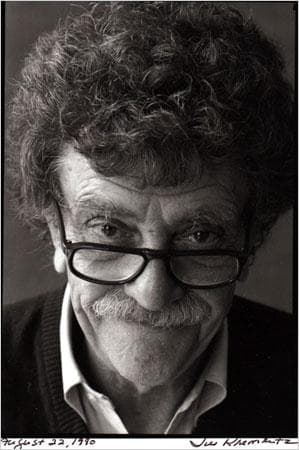
Kurt Vonnegut Jr. (1990)
Genre
Literary Fiction / Science Fiction
Reading Time
480 min
Key Themes
See below
Sign in to track this book
A cynical Vietnam veteran and college professor predicts society's hilarious and horrifying collapse, all while trying to keep his chaotic life and the bizarre events at Tarkington College from spiraling out of control.
The novel begins with Eugene Debs Hartke, age sixty-six, in an isolation cell at Athena, New York's maximum-security prison. He dictates his memoir onto yellow legal pads, which a machine then transcribes. Eugene introduces himself as a former English and Economics professor at Tarkington College, a small liberal arts school, and a decorated Vietnam War veteran. He explains he awaits trial for crimes related to the prison breakout at Athena. He thinks about his past life, his family, and the seemingly harmless events that led him to his current situation, hinting at the bizarre and tragic things to come. His tone is detached, often ironic, and full of his creator's dark humor.
Eugene tells of his life at Tarkington College, where he taught for many years. He describes his wife, Vera, and their four children, all of whom met tragic ends, leaving Eugene scarred. He details his affair with Sarah Powers, the mother of a student named Paul. Sarah, a wealthy socialite, is much younger than Eugene. Their relationship brings him both comfort and complications. Eugene also introduces Dr. Fred T. Lukens, the college president, and his wife, along with other faculty members, showing a seemingly ordinary academic setting with hidden tensions and hypocrisies. He reflects on the superficiality of college life and the faculty's disappointment.
A large part of Eugene's memoir covers his time in the Vietnam War. He describes being captured by the Viet Cong and held as a prisoner of war, enduring torture and seeing terrible acts. He recounts the war's psychological impact, the moral compromises he made, and the lasting trauma that shaped his view of the world. Eugene also reveals a secret: during his captivity, he had to write anti-American propaganda, a fact he kept hidden. His war experiences are a formative period, influencing his cynical view of humanity and his sense of fatalism. He believes the war changed his ability to feel genuine emotion.
Eugene describes the unexpected events at Tarkington College. The college, facing money problems, is bought by a wealthy Japanese businessman, Hiroshi Matsumoto, whose family has a mysterious past connection to Eugene. Matsumoto decides to turn the entire campus into a private, for-profit maximum-security prison called the Athena Correctional Facility. The college faculty, including Eugene, are offered jobs within the prison system, either as teachers for inmates or in administrative roles. This change is jarring, showing education's commodification and the blurring lines between schools and prisons. Eugene, with his professor past, initially teaches the inmates.
With Tarkington College now Athena Prison, Eugene teaches English to a diverse group of inmates. He observes the unique social dynamics within the prison, the hierarchies, and the coping methods prisoners develop. He notes the irony of teaching literature to men who have committed serious crimes, and often questions his role's purpose and effectiveness. Eugene's interactions with the inmates give him a new view on human nature, crime, and punishment. He forms an unusual bond with some prisoners, including a group of African-American inmates known as the Black Muslims. He also continues his affair with Sarah Powers, who now volunteers at the prison.
As Eugene continues teaching, he notices growing unrest among the inmates. A charismatic and intelligent inmate named Dwayne Hoover (a name shared with a character from Vonnegut's 'Breakfast of Champions') becomes a leader, planning a complex mass breakout. Eugene, despite his initial hesitation, becomes involved in the conspiracy, his role growing more important than he expected. The escape plan involves manipulating the prison's security systems and exploiting staff weaknesses. Tension rises as the breakout date nears, with Eugene observing the meticulous planning and the prisoners' desperate hope. He feels conflicted, knowing the potential consequences but also a strange sense of obligation.
The carefully planned prison breakout happens, throwing Athena into chaos. The inmates, led by Dwayne Hoover, overpower the guards and break through the prison's defenses. Eugene is caught in the pandemonium, seeing both brutality and unexpected camaraderie. The escape is not entirely smooth, with casualties on both sides. The outside world learns of the mass escape, leading to a large-scale manhunt. Eugene, though not actively violent, is present during the escape and implicated by his closeness and knowledge. This event is the story's climax, changing everyone's lives and leading directly to Eugene's current imprisonment.
After the breakout, authorities apprehend Eugene. His involvement, though indirect, is enough for his arrest and charges of aiding and abetting the escape. He is put in an isolation cell within the same prison from which the inmates escaped, awaiting trial. Eugene thinks about the absurdity of his situation, a former professor now a prisoner, and the irony of being held where he once taught. He remains largely calm, almost resigned to his fate, continuing to dictate his memoir to process events and reflect on his life's path. He sees his capture as an inevitable result of the world's inherent madness.
As he writes, Eugene explores philosophical ideas about life, death, free will, and the human condition. He often questions personal responsibility, suggesting much human behavior comes from genetics, environment, and chance. He reflects on the deaths of his children, his wife Vera, and the many people he met throughout his life, especially during the war. His thoughts are tinged with deep cynicism and a sense of cosmic indifference. He believes humanity is mostly a collection of biological machines, and grand stories of heroism and purpose are ultimately meaningless. His memoir shows his unique, often bleak, view of the world.
Throughout his memoir, Eugene often comments on the act of writing, memory's unreliability, and truth's subjective nature. He admits his account is his personal interpretation, shaped by his biases and experiences. He often questions his own memories' accuracy and his actions' motivations. This meta-narrative element highlights storytelling's constructed nature and asks the reader to consider reality's fluidity. Eugene's awareness of his narrative choices shows the novel's exploration of perception versus objective fact, and how people find meaning in their chaotic lives.
As his memoir continues, Eugene anticipates his upcoming trial. He expects little hope for a good outcome, believing the legal system is as arbitrary and flawed as any other human institution. He reflects on the absurdity of being judged by others when, in his view, everyone is a product of forces beyond their control. He imagines the arguments against him and the public's view of his guilt. Even facing conviction, Eugene keeps his detached and ironic manner, suggesting the trial is just another act in life's grand, meaningless play. He seems to accept his fate with weary resignation.
In a typical Vonnegut twist, Eugene reveals he is not dictating his memoir to a machine, but to a simple tape recorder that ran out of tape long ago. This revelation emphasizes futility and his narrative's subjective nature. He speaks into the void, his words unheard and unrecorded, yet the act of creation itself holds meaning for him. He ends his memoir with a final thought on the universe, human folly, and art and music's (specifically jazz) enduring power as a way to cope with an indifferent world. His final thoughts mix cynicism with a fragile hope for connection, even if only with himself.
The Protagonist
Eugene's arc is less about transformation and more about a deepening acceptance of his fatalistic worldview, finding a peculiar peace in his final acts of storytelling.
The Supporting
Vera's arc is static, as she is deceased, but her memory evolves from a source of immediate grief to a symbol of Eugene's lost capacity for genuine love.
The Supporting
Sarah's arc is relatively flat, remaining a consistent source of physical and emotional distraction for Eugene, embodying a contrasting idealism.
The Supporting
Dwayne's arc is one of determined agency, culminating in the execution of his grand escape plan, embodying a forceful challenge to his confinement.
The Supporting
Matsumoto's arc is functional, serving as the catalyst for the college's transformation, embodying the impersonal forces of global commerce.
The Supporting
Lukens's arc shows a decline from academic leadership to a diminished role, reflecting the erosion of traditional values.
The Mentioned
Paul's arc is not developed, serving mainly as a narrative device to introduce his mother, Sarah, into Eugene's life.
The Mentioned
Their collective arc is a static representation of profound, arbitrary loss, serving as a foundational element of Eugene's worldview.
Vonnegut explores the idea that human life is meaningless and governed by chance, not free will. Eugene's experiences, especially as a POW and his family's tragic deaths, support his belief that people are just 'biological machines' with little control over their lives. Tarkington College's change into a prison also shows the arbitrary nature of institutions and the decay of traditional values. This theme appears in Eugene's detached narration, dark humor, and acceptance of his imprisonment as an inevitable, if absurd, outcome. The tape recorder revelation further highlights his efforts' futility, yet he continues, finding meaning in the act itself.
“''We are what we pretend to be, so we must be careful about what we pretend to be.''”
The Vietnam War is a central traumatic experience for Eugene, shaping his worldview and emotions. His capture, torture, and forced propaganda writing leave lasting scars, contributing to his cynicism and inability to form deep emotional bonds. The war's senseless violence and moral ambiguities are a small picture of humanity's larger flaws. Eugene often refers to his war experiences, using them to understand later events, including societal breakdown and a college's conversion into a prison. The war's legacy highlights the novel's exploration of human cruelty and resilience.
“''How many more people are going to have to be killed before everybody, every single body, knows that war is a racket?''”
The novel criticizes the decline of traditional institutions and values in modern society. Tarkington College, once a center of liberal arts education, is bought and turned into a for-profit maximum-security prison. This transformation symbolizes knowledge's commodification, capitalism's victory over idealism, and the blurring lines between education and incarceration. The faculty's disappointment and Eugene's observations of the prison system highlight the hypocrisy and moral compromises in these changes. The theme also touches on the breakdown of the family, seen in the tragic fates of Eugene's children and his own detached relationships.
“''I was a prisoner in the hands of the Viet Cong, but I was also a prisoner in the hands of my own country's lies.''”
Eugene's memoir itself comments on memory's subjective nature, narrative, and truth. He often reminds the reader that his account is his biased interpretation, questioning his memories' reliability and his storytelling's motivations. Dictating his life story, even to a non-recording tape recorder, helps him bring order to a chaotic existence and process his experiences. This theme challenges the reader to consider reality's constructed nature and how people find meaning in their personal histories, even when those histories are bleak or absurd. The unreliable narrator is a key tool here.
“''I am a prisoner of my own autobiography.''”
Vonnegut reveals the hypocrisy and arbitrary nature of social class, especially through the contrast between Tarkington College's privileged world and the prison's harsh realities. Sarah Powers, Eugene's wealthy mistress, embodies a detached idealism that sharply contrasts with the inmates' struggles. The wealthy Japanese businessman, Matsumoto, can simply buy and transform an entire institution, showing capital's immense power. Eugene, despite his academic background, finds himself in the same prison as the men he once taught, blurring social distinctions. The novel suggests that beneath societal differences, human nature remains flawed and vulnerable.
“''Rich people are not like you and me. They have more money.''”
Eugene Debs Hartke's subjective and often self-deprecating narration.
Eugene Debs Hartke serves as the quintessential unreliable narrator. He frequently comments on the fallibility of his own memory, the inherent biases in his storytelling, and the subjective nature of truth. This device is heightened by his detached, ironic tone and his philosophical musings on the meaninglessness of existence. The ultimate revelation that he is dictating to a tape recorder that has long run out of tape dramatically underscores the unreliability, suggesting his entire narrative is a soliloquy, a performance for an imagined audience, rather than an objective record. This forces the reader to constantly question the 'facts' presented and to consider the psychological state of the storyteller.
The use of irony and black comedy to critique society and cope with tragedy.
Vonnegut employs satire and dark humor throughout the novel to critique societal institutions, human folly, and the absurdities of life. Eugene's narration is replete with ironic observations, self-deprecating jokes, and a detached, almost flippant attitude towards profound tragedy (like the deaths of his children). This dark humor serves as a coping mechanism for Eugene, allowing him to process immense pain and disillusionment without succumbing to despair. It also highlights the novel's cynical worldview, suggesting that laughter is often the only sane response to an insane world. The transformation of a college into a prison is itself a darkly humorous, satirical scenario.
Eugene's memoir jumps between past and present, war and academic life.
The novel's structure is non-linear, as Eugene's memoir constantly shifts between his present imprisonment, his past life at Tarkington College, his experiences in the Vietnam War, and various philosophical digressions. This fragmented structure mirrors the chaotic nature of memory and Eugene's own disjointed mental state. It allows Vonnegut to draw connections between seemingly disparate events and to gradually reveal the layers of Eugene's trauma and cynicism. The non-linear approach prevents a straightforward plot progression, instead creating a mosaic of experiences that contribute to the protagonist's complex character and the novel's overarching themes of fatalism and the arbitrary nature of life.
The novel comments on its own nature as a created story.
Hocus Pocus utilizes metafiction by having Eugene Debs Hartke, the narrator, directly acknowledge and comment on the act of writing his memoir. He discusses the choices he makes as a storyteller, the limitations of language, and the subjective nature of memory. This device blurs the line between author and character, and between reality and fiction. The ultimate revelation that Eugene is speaking into a non-recording tape recorder is a powerful metafictional twist, drawing attention to the constructed nature of the narrative and the solitary, internal act of creation. It invites the reader to consider the novel not just as a story, but as a commentary on storytelling itself.
“We are what we pretend to be, so we must be careful what we pretend to be.”
— A recurring philosophical reflection by the narrator, Eugene Debs Hartke, on identity and self-creation.
“I've often wondered how much of the history we learn is true, and how much is just a convenient story.”
— Eugene Hartke muses on the nature of historical narratives and their reliability.
“The only difference between a hero and a villain is that the hero is the one who wins.”
— Hartke's cynical take on the arbitrary nature of moral labels, particularly in war.
“It was like the whole world was a stage, and I was just an extra, waiting for my cue.”
— Hartke's feeling of insignificance and detachment while observing the chaos around him.
“All I can say is this: it's a hell of a lot easier to be a soldier than it is to be a human being.”
— Reflecting on the dehumanizing aspects of military life versus the complexities of civilian life.
“The most important things in life are not things, they're moments.”
— A poignant observation on what truly holds value in life, amidst the material obsessions.
“I was a prisoner of war, but I was also a prisoner of my own memories.”
— Hartke struggles with the psychological burden of his past, particularly his wartime experiences.
“Americans are forever searching for love in forms it never takes, in places it can never be.”
— A critical commentary on American cultural tendencies and misdirected desires.
“There are plenty of people who are good at being bad, and plenty of people who are bad at being good.”
— A reflection on the complexities of human nature and the often blurred lines between good and evil.
“The world is full of people who have never been loved, and that's the greatest tragedy of all.”
— Hartke's empathetic view on the fundamental human need for love and its absence.
“I'm not sure what's worse, being forgotten or being remembered for all the wrong reasons.”
— A contemplation on legacy and the fear of being misunderstood or misrepresented after death.
“Sometimes I think the whole world is just a big joke, and we're all the punchline.”
— Hartke's gallows humor and existential despair regarding the absurdity of life.
“All of us are getting ready for something, but we don't know what it is.”
— A sense of impending doom or change, coupled with uncertainty about the future.
“The planet was being run by a bunch of people who were completely out of their minds.”
— Hartke's assessment of the leadership and societal direction, reflecting widespread disillusionment.
Ready to see how well you understood this book? Take our interactive quiz with 10 questions.
Biography coming soon.







