“The past is a foreign country; they do things differently there.”
— A general reflection on the distance and otherness of historical periods.

Sign in to track this book
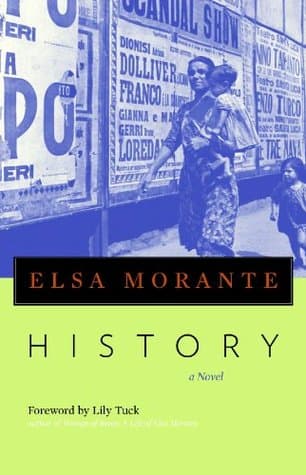
In the unforgiving grip of World War II, a timid Roman schoolteacher's desperate fight to protect her illegitimate son unveils the brutal indifference of history to the lives of ordinary people.
The novel introduces Ida Mancuso, a timid and anxious schoolteacher in Rome. She is always burdened by her Jewish heritage (which she tries to conceal) and the societal pressures of Fascist Italy. She is a widow, having lost her husband, and lives with her adolescent son, Nino. Nino is a rebellious and often irresponsible young man, contrasting sharply with his mother's reserved nature. He is often out with friends, engaged in petty crimes and black market activities, seemingly oblivious to the escalating dangers of World War II. Ida struggles to maintain a semblance of normalcy and provide for them amidst rationing and the constant threat of air raids. Her anxiety is a pervasive undercurrent to her daily existence.
One fateful night, a German soldier, Gunther, on his way to North Africa, billets in Ida's apartment. Despite her desperate attempts to avoid him, he rapes her. The encounter leaves Ida traumatized and pregnant. She hides the pregnancy as long as possible, fearing the shame and the added burden. Eventually, she gives birth to a boy she names Giuseppe, or Useppe. Useppe is a fragile, sensitive, and innocent child whose very existence becomes a source of both immense love and overwhelming fear for Ida, who is terrified of the war's potential to claim him.
As Useppe grows, Nino becomes more deeply entangled in the war's chaos. Initially, he is drawn to Fascist youth movements, enjoying the camaraderie and sense of belonging. However, his allegiances shift with the changing tides of the war. He later joins partisan groups, engaging in dangerous missions and living a life of constant risk. Nino's transformation is marked by a growing detachment from his mother and Useppe. His life becomes a series of fleeting encounters and dangerous escapades. He occasionally returns home, bringing brief moments of joy and fleeting hope, but always leaves again, drawn back to the thrill and danger of his chosen path.
Ida and Useppe continue to live in San Lorenzo, one of Rome's poorer and more heavily bombed districts. Their daily lives are a constant struggle against hunger, fear, and the pervasive destruction of war. Air raids become regular, forcing them to seek shelter in crowded, damp cellars. Ida's anxiety for Useppe's safety intensifies with each new bombing. Useppe, despite his tender age, experiences the harsh realities of war, often witnessing death and destruction, yet maintaining a remarkable innocence and a deep connection to nature and the few moments of simple joy he finds.
As the war intensifies and Rome becomes an increasingly dangerous place, Ida and Useppe are forced to evacuate. They join countless others fleeing the city, enduring a difficult journey to the countryside. They find temporary shelter in a remote village, experiencing the poverty and resilience of the rural population. This period highlights the war's universal impact, as ordinary people from all walks of life are uprooted and forced to adapt to unimaginable hardships. Despite the challenges, Ida's primary focus remains Useppe's survival, and she makes every sacrifice to protect him.
Nino's beloved dog, Blitz, a German Shepherd, is a constant companion during Nino's early years and a source of comfort for Ida and Useppe. Blitz is loyal and protective, a symbol of unwavering affection in a world filled with instability. However, during one of Nino's partisan escapades, Blitz is tragically killed. His death is a profound loss for the family, particularly for Nino, and is a poignant reminder of how the war indiscriminately claims lives, even those of innocent animals, further eroding any remaining sense of normalcy or joy.
Nino's life as a partisan and later as a black marketeer becomes increasingly reckless. He is involved in various illicit activities, often driving stolen vehicles and living on the edge. Despite his mother's constant worry and pleas for caution, Nino remains unyielding in his pursuit of freedom and adventure. His wild lifestyle eventually catches up with him when he dies in a motorcycle accident. His death is a crushing blow to Ida, who had already endured so much. It represents the final, irreversible loss of her first son, leaving her with only Useppe.
Useppe, always a delicate child, begins to suffer from increasingly severe epileptic seizures. His fragile health is a constant source of terror for Ida, who attributes his condition to the traumatic circumstances of his conception and birth. The seizures become more frequent and debilitating, highlighting his inherent vulnerability and the physical toll of his difficult start in life. Ida desperately seeks medical help, but resources are scarce in post-war Italy, and the underlying cause of Useppe's condition remains a mystery, adding to Ida's despair and sense of powerlessness.
Even after the official end of World War II, life for Ida and Useppe remains a struggle. Rome is rebuilding, but poverty and scarcity persist. Ida continues to work as a schoolteacher, but her pay is meager, and she often has to take on additional work. Her already timid nature becomes more pronounced, and she retreats further into herself. Her world narrows to her devotion to Useppe. She witnesses society's superficial return to 'normalcy,' but for her, the scars of war run deep, and her isolation from the burgeoning post-war consumerism and optimism grows.
Throughout his short life, Useppe possesses a remarkable purity and an almost spiritual connection to nature and the simple joys of existence. He communicates largely through his eyes. His words are often simple, yet profound. He finds wonder in everyday things—a flower, an animal, a ray of sunlight. This innocence stands in stark contrast to the brutality of the world around him. His gentle nature and capacity for pure love become a beacon of hope and a source of meaning for Ida, even as his health declines.
Useppe's epileptic seizures become more frequent and severe, eventually leading to a rapid decline in his health. Despite Ida's tireless efforts and desperate prayers, Useppe's small body can no longer sustain itself. He dies, leaving Ida utterly devastated. His death is the final, most unbearable blow, robbing her of the only pure love and reason for living she had left. The narrative emphasizes the immense tragedy of a beautiful, innocent life extinguished by circumstances beyond his control, a direct consequence of the 'History' that shaped his brief existence.
After Useppe's death, Ida's world collapses entirely. She is left with an unbearable grief and a profound sense of emptiness. Her life, once defined by her efforts to protect her sons, is now devoid of purpose. The novel concludes with Ida's desolate existence, highlighting the ultimate powerlessness of individuals against the vast, impersonal forces of 'History.' Her suffering, like that of countless others, is swallowed by the grand narrative of political events, underscoring the novel's central theme of the ordinary individual's struggle against an indifferent, often cruel, world.
The Protagonist
Ida begins as a fearful woman trying to maintain normalcy, evolves into a fiercely protective mother, and ultimately becomes a broken figure consumed by grief and the weight of history's indifference.
The Supporting
Nino transitions from a mischievous youth to a hardened, yet still reckless, wartime survivor, ultimately meeting a tragic end that solidifies his role as a victim of the war's chaos.
The Supporting
Useppe's arc is one of sustained innocence and vulnerability, culminating in his tragic death, which serves as the ultimate indictment of the war's destructive power.
The Supporting
Blitz's arc is brief but impactful, serving as a symbol of loyalty and innocence whose death highlights the war's pervasive destruction.
The Mentioned
Gunther's role is a singular, impactful event that sets in motion Useppe's existence, but he otherwise has no character arc.
The Mentioned
These characters provide episodic glimpses into the broader social impact of the war, rather than individual arcs.
This is the central theme of the novel. Morante argues that 'History,' as written by powerful men and marked by grand political events, is oblivious to the immense suffering it inflicts upon ordinary individuals. Ida's quiet desperation, her struggle to feed and protect her children, the trauma of rape, and the ultimate loss of both sons are presented as insignificant footnotes in the larger, impersonal narrative of war. The narrative frequently interjects with ironic, detached historical summaries, juxtaposing the 'facts' of history with the visceral, personal tragedies experienced by the Mancuso family. For example, the bombing of San Lorenzo is a mere statistic in history books, but for Ida and Useppe, it is a terrifying, life-altering event.
“History, however, is not concerned with the fate of individuals, but with the destiny of nations.”
The novel depicts the erosion of innocence, both literally and figuratively, under the relentless pressure of war. Useppe, with his pure heart and connection to life, embodies ultimate innocence, which is tragically extinguished by his illness. This illness is a direct consequence of his traumatic origins and the war's lingering effects. Nino, while never truly 'innocent' in the conventional sense, loses any remaining naivety as he goes deeper into the violence and moral ambiguities of partisan life and the black market. Even Ida, though an adult, loses her innocence in the face of brutal rape and the constant threat to her children, forcing her to confront humanity's darkest aspects.
“And Useppe, the little child, had to bear the whole weight of History on his tiny shoulders.”
Ida's character is defined by her fierce, unwavering, and often desperate maternal love, particularly for Useppe. Her entire existence becomes centered on protecting her children, providing for them, and shielding them from the horrors of the war. She endures poverty, humiliation, and grief, making countless sacrifices for their well-being. This theme explores a mother's primal instinct to safeguard her offspring, even when faced with insurmountable odds. Ida's love is both a source of her strength and the ultimate cause of her suffering when she loses her sons.
“Her love for Useppe was a wound that would never heal, the only thing that gave meaning to her existence.”
Morante vividly portrays war's multifaceted brutality, not just through direct combat but through its devastating impact on civilian life: starvation, displacement, random violence, and psychological trauma. The novel also highlights war's absurdity, where human lives are squandered for abstract political ideals, and individuals are reduced to pawns in a senseless game. Nino's changing allegiances, the senseless deaths, and the pervasive fear illustrate the arbitrary nature of wartime suffering. The narrative often contrasts leaders' grand pronouncements with the squalid, terrifying realities faced by ordinary people.
“The war, a river in flood, swept away everything, leaving only mud and debris.”
The novel clearly illustrates the deep-seated social injustices and class divides that persist even during wartime. Ida and her family, living in the impoverished San Lorenzo district, are among the most vulnerable to the war's ravages. They suffer from lack of food, inadequate shelter, and limited access to healthcare, while wealthier individuals often find ways to mitigate the hardships. The contrast between the suffering of the urban poor and the indifference or opportunism of some members of the middle and upper classes is a recurring motif, underscoring how war exacerbates existing inequalities.
“For the poor, history was always the same: hunger, fear, and the endless struggle to survive.”
A highly intrusive and opinionated narrator who frequently interjects historical facts and philosophical observations.
The narrator in 'History' is not merely a storyteller but an active, judgmental presence. This omniscient voice frequently breaks the fourth wall, offering direct commentary on the events, the characters' psychology, and, most notably, the nature of 'History' itself. The narrator provides historical context, statistics, and philosophical musings, often with a sarcastic or despairing tone, directly contrasting the grand sweep of historical events with the minute, yet devastating, personal tragedies. This device reinforces the novel's central theme of the indifference of history to individual suffering and shapes the reader's interpretation of the events.
The alternating presentation of intimate character experiences with factual, detached historical accounts.
Morante masterfully employs juxtaposition by alternating between the deeply personal, emotionally charged narrative of Ida and her sons' daily lives and the cold, factual accounts of historical events (dates, battles, political shifts). This technique highlights the chasm between the 'official' record of history and the lived experience of those caught within it. For example, a scene detailing Ida's struggle to find food for Useppe might be followed by a paragraph outlining the strategic importance of a particular battle. This contrast emphasizes the novel's core message: that history often overlooks the individual human cost of its grand narratives.
Useppe represents pure, unadulterated life and innocence, tragically vulnerable to the forces of 'History'.
Useppe, with his ethereal beauty, profound sensitivity, and almost spiritual connection to the world, functions as a powerful symbol of pure innocence. His existence, born from an act of violence amidst war, yet embodying such unblemished goodness, makes him a poignant representation of what 'History' destroys. His recurring illness and eventual death are not just personal tragedies but symbolic acts, signifying the ultimate triumph of the brutal, indifferent forces of the world over pure, innocent life. His vulnerability underscores the novel's indictment of human cruelty and the senselessness of war.
The presence and fate of animals (Blitz, Bella) reflect the humanity or brutality of the characters and the war.
Animals in 'History,' particularly Nino's dog Blitz and Useppe's cat Bella, serve as more than just pets; they act as moral barometers and symbols of uncomplicated affection and loyalty. Blitz's unwavering devotion to Nino and his tragic death underscore the indiscriminate nature of the war's destruction. Bella's presence offers comfort and a connection to the natural world for Useppe. Their fates often mirror the characters' own struggles and losses, highlighting the profound impact of the war on all living beings and emphasizing the contrast between animal innocence and human brutality.
“The past is a foreign country; they do things differently there.”
— A general reflection on the distance and otherness of historical periods.
“The poor are always present, their suffering constant, a testament to the repetitive nature of human misery.”
— A recurring theme highlighting the plight of the common people throughout history.
“Every war is a crime, even when it is called a liberation.”
— A strong anti-war statement, reflecting the author's pacifist views.
“History is a disease. Humanity is a disease. Only the animals are innocent.”
— A cynical and despairing view of humanity's destructive tendencies.
“The true heroes are those who resist, even when resistance seems futile.”
— Praising the quiet acts of defiance against oppression.
“Memory is a fragile thing, easily distorted, easily lost.”
— Reflecting on the unreliability of individual and collective memory.
“The greatest cruelty is not always violent; sometimes it is simply indifference.”
— Highlighting the passive forms of human cruelty.
“Children, in their ignorance, are often the only ones who see clearly.”
— Suggesting that innocence can offer a clearer perspective than adult cynicism.
“Love, even in the darkest times, is the only true act of rebellion.”
— Emphasizing the power of love as a defiant force against despair.
“The silence of God is the loudest sound in a world of suffering.”
— A reflection on the absence of divine intervention in human misery.
“Hope is a dangerous thing, but despair is a deadlier one.”
— Balancing the risks of hope with the ultimate danger of giving up.
“The small gestures of kindness are the only real monuments against oblivion.”
— Highlighting the lasting impact of individual acts of human decency.
“Every life, no matter how humble, carries the weight of all history.”
— Emphasizing the interconnectedness of individual lives with broader historical currents.
“To forget is to participate in the crime.”
— A powerful statement on the moral imperative of remembrance.
Ready to see how well you understood this book? Take our interactive quiz with 10 questions.
Biography coming soon.







