“Data! Data! Data! I can't make bricks without clay.”
— Sherlock Holmes expressing frustration at lack of evidence in 'The Adventure of the Copper Beeches'.

Arthur Conan Doyle (1917)
Genre
Historical Fiction / Mystery
Reading Time
256 min
Key Themes
See below
Sign in to track this book
From outwitting a German spy before WWI to feigning death to catch a murderer, Sherlock Holmes proves that even retirement can't dull his intellect in this collection of his most clever cases.
John Scott Eccles, a bachelor, visits Sherlock Holmes and Dr. Watson with a strange story. He accepted an invitation from Mr. Aloysius Garcia, a Spanish gentleman he barely knew, to stay at Wisteria Lodge in Surrey. Eccles found Garcia and his quiet butler, Henderson, acting oddly. There were no other guests, and the atmosphere was tense. During his stay, Garcia gave him a note with a cryptic message about 'seven o'clock' and a drawing of a man, then took it back, saying it was a joke. The next morning, Eccles awoke to find Garcia gone, leaving a locked room and a feeling of dread. Fearing trouble, he went to London to see Holmes.
Holmes, with Watson and Inspector Gregson, went to Wisteria Lodge. They found Garcia's body in a nearby wood, killed by a blow. The house offered few clues, but Holmes noticed a strange pattern of animal sacrifice in the garden and found a coded message from Garcia. He learned that Garcia was not Spanish but an Englishman named Ferguson, and Henderson was actually Don Murillo, 'The Tiger of San Pedro,' a former dictator from Central America. Murillo, living under a false name, was being hunted by a revolutionary group, and Garcia was part of this group, trying to assassinate him.
Dr. Watson recounts the case of the Bruce-Partington plans, a matter of national importance. Young Arthur Cadogan West, a clerk at the Woolwich Arsenal, was found dead on the Underground tracks, holding top-secret plans for a new submarine, the 'Bruce-Partington.' The plans were incomplete, with seven pages missing. Scotland Yard, led by Inspector Lestrade, was confused, as West was a good man with no clear reason for theft or suicide, and his death was suspicious. The plans were in a locked safe, and West had the key. The Admiralty, in a panic, asked Sherlock Holmes to find the missing pages before they reached enemy hands.
Holmes investigated carefully, finding that West was not the thief. The real culprit was Colonel Valentine Walter, West's brother-in-law, a spy for a foreign power. Walter, using pulleys and a dummy, made it seem like West had taken the plans. He then killed West to hide his tracks and placed the partial plans on him. Holmes, through his deductions, realized Walter's elaborate way of entering and leaving the locked room and identified the true motive: selling the plans for a fortune. Holmes confronted Walter, recovered the missing plans, and ensured Walter's capture, preventing a national disaster and preserving England's naval strength.
Dr. Watson received an urgent message from Mrs. Hudson, asking him to come to Baker Street. When he arrived, Watson was horrified to find Sherlock Holmes in a terrible state, seemingly dying from a rare and contagious tropical disease called 'Tarpeian fever,' caught during a case. Holmes forbade Watson from examining him, refusing medical attention from his friend, insisting on being treated only by a Mr. Culverton Smith, an expert on the disease from Sumatra. Holmes's condition quickly worsened; he seemed delirious, struggled to breathe, and his face was twisted in pain, leaving Watson terrified and helpless.
Holmes, after a long wait, told Watson to hide and watch when Culverton Smith arrived. Smith, a man with a sinister look, revealed he intentionally infected Holmes with the disease using a poisoned ivory box. Believing Holmes was truly dying, Smith bragged about his crime, admitting he murdered his own nephew the same way. At Holmes's signal, Inspector Morton entered and arrested Smith. Holmes then miraculously recovered, revealing his illness was a trick to get Smith to confess. He had carefully staged the entire scene, even using make-up and fasting to appear genuinely ill, much to Watson's great relief and admiration.
Dr. Watson, on holiday, received a letter from Sherlock Holmes asking him to investigate the disappearance of Lady Frances Carfax, a wealthy and independent woman who had vanished. Lady Frances, known for her strong will and somewhat unusual habits, had been traveling abroad. Her last known location was Lausanne, Switzerland, where she fired her maid and withdrew a large sum of money. Holmes, busy with another case, entrusted Watson with the initial work. Watson followed fragmented clues, meeting suspicious people and hitting dead ends, failing to find Lady Frances but confirming the unsettling nature of her disappearance.
Holmes took over the case from Watson, quickly putting together the fragmented information. He identified the criminals as the Reverend Dr. Shlessinger and his wife, con artists who preyed on wealthy, vulnerable women. They had befriended Lady Frances, isolated her, and then abducted her. Their plan was to fake her death, have her body cremated, and then claim her inheritance. Holmes tracked them to a funeral parlor, where he intervened just as Lady Frances, drugged and unconscious, was about to be placed in a coffin for a staged cremation. Holmes rescued her, exposed the criminals, and ensured their capture, saving Lady Frances from a horrifying fate.
The year is 1914, on the eve of World War I. Von Bork, a clever German master spy, had built an intelligence network in England. He operated from a secluded villa on the Kent coast, collecting military secrets and preparing for the coming conflict. He was helped by his Irish-American accomplice, Altamont, and his housekeeper, Martha. Von Bork was confident in his success, believing he had outsmarted British intelligence. He planned a final, meeting with Altamont, who he thought was delivering the ultimate prize: the complete British naval codes, which would ensure England's defeat.
Von Bork waited for Altamont's arrival, expecting to receive the naval codes. When Altamont finally appeared, he was a rough, anti-British American. He gave Von Bork a package, which Von Bork opened to find a book on practical German grammar. Before Von Bork could react, Altamont, who was a disguised Sherlock Holmes, incapacitated him with a chloroform-soaked sponge. Holmes, having spent two years infiltrating German spy circles under the name Altamont, revealed his true identity. He explained his long game, his patience, and how he had finally caught Von Bork and his entire network, gathering all the intelligence they had collected for the British government. Dr. Watson arrived, and together, they secured Von Bork and his documents, neutralizing the German threat on the eve of war.
The Protagonist
Holmes consistently demonstrates his unparalleled deductive abilities, culminating in his patriotic service to England in 'His Last Bow', where he sacrifices personal recognition for national security.
The Supporting
Watson remains Holmes's steadfast companion, his admiration for his friend's genius unwavering, even as he is sometimes used as an unwitting pawn in Holmes's elaborate schemes.
The Antagonist
Initially a confident and successful spy, Von Bork is ultimately outsmarted and captured by Holmes, marking a significant defeat for German intelligence.
The Supporting
Garcia's mysterious and ultimately tragic end reveals a deeper political conspiracy, making him a catalyst for Holmes's investigation into international intrigue.
The Antagonist
Murillo, despite his attempts to hide, is revealed as a brutal dictator, his past catching up to him through Garcia's revolutionary plot.
The Supporting
West's tragic and wrongful implication in espionage is cleared by Holmes, restoring his reputation posthumously.
The Antagonist
Walter's elaborate scheme of espionage and murder is ultimately exposed and thwarted by Holmes, leading to his capture.
The Antagonist
Smith, initially believing he has outsmarted Holmes, is ultimately tricked into confessing his crime and arrested.
The Supporting
Lady Frances, initially independent but vulnerable, is rescued by Holmes from a sinister plot, restoring her safety.
The Antagonist
The Shlessingers' elaborate scheme to murder Lady Frances for her inheritance is thwarted by Holmes, leading to their capture.
This theme is most clear in 'His Last Bow,' where Sherlock Holmes comes out of retirement to serve his country during wartime. He spends two years undercover, enduring hardship and sacrificing personal recognition, all for national security. This contrasts with the self-serving motives of spies like Von Bork and Colonel Valentine Walter. Holmes's dedication to England's safety shows a deep sense of patriotic duty, changing his detective work from a mental exercise to a vital service. The story highlights the silent heroes who protect the nation from unseen threats.
“Good old Watson! You are the one fixed point in a changing age. There's an east wind coming, Watson. Such a wind as never blew on England yet. It will be cold and bitter, Watson, and a good many of us may wither before its blast. But it's an ill wind that blows nobody good. It will sweep the cobwebs out of the attic.”
Deception is a common element, central to both the crimes Holmes investigates and his own methods. In 'His Last Bow,' Holmes himself uses the elaborate disguise of Altamont for two years to infiltrate a German spy ring. In 'The Dying Detective,' he fakes a fatal illness to trick Culverton Smith into confessing. Criminals like Colonel Valentine Walter ('The Bruce-Partington Plans') use clever tricks and misdirection to commit their crimes and frame others. Don Murillo ('Wisteria Lodge') lives under a false identity. This theme shows how easily people can be fooled and how Holmes skillfully handles these layers of falsehood.
“The greatest crimes are not committed by the professional criminal, but by the man who is above suspicion.”
While Holmes often works with the law (represented by Scotland Yard inspectors), there are times when his pursuit of justice operates outside strict legal rules, or when the law itself is not enough. In 'Wisteria Lodge,' the pursuit of Don Murillo by revolutionaries suggests a form of justice outside the law for past wrongs. Holmes's willingness to use deception, as in 'The Dying Detective,' to get a confession, prioritizes revealing the truth and punishing the guilty over strict adherence to legal procedure. This theme explores the moral complexities of crime and punishment, and Holmes's role as an arbiter of a higher form of justice.
“I am a unofficial person... I have no right to intrude where the law is at work.”
Several stories show how innocent people become victims of larger, more sinister plots. John Scott Eccles ('Wisteria Lodge') is an unwitting part of a revolutionary scheme. Arthur Cadogan West ('The Bruce-Partington Plans') is murdered and framed by his own brother-in-law. Lady Frances Carfax ('The Disappearance of Lady Frances Carfax') is targeted for her wealth and independence, almost falling victim to a gruesome plot. These cases highlight how easily malevolent forces can exploit trust and circumstance, showing the need for Holmes's protection.
“Data! Data! Data! I can't make bricks without clay.”
Misleading clues or characters designed to divert the reader's and detective's attention.
Red herrings are frequently employed to complicate Holmes's cases. In 'The Bruce-Partington Plans', Arthur Cadogan West appears to be the thief, but he is actually a victim. In 'The Dying Detective', Holmes's own seemingly fatal illness is a major red herring designed to mislead Watson and, more importantly, Culverton Smith. These diversions serve to heighten suspense and demonstrate Holmes's ability to see through superficial appearances to the underlying truth, often by focusing on seemingly insignificant details that others overlook.
Watson's narration, while detailed, often lacks Holmes's full understanding until the reveal.
Dr. Watson serves as the primary narrator, offering a detailed but often limited perspective. He records events faithfully, but his understanding of the deeper implications or Holmes's grand design is usually incomplete until Holmes's final explanation. This device allows for dramatic reveals, as the reader experiences the mystery alongside Watson, sharing his confusion and eventual enlightenment. It also highlights Holmes's superior intellect by contrasting his comprehensive grasp of the situation with Watson's more conventional, step-by-step understanding, making Holmes's deductions seem even more brilliant.
Holmes's use of complex, staged scenarios to trap criminals.
Holmes frequently employs elaborate deceptions not just to solve crimes, but to actively ensnare criminals. The most prominent example is in 'The Dying Detective', where he convincingly feigns a deadly illness to lure Culverton Smith into confessing. In 'His Last Bow', his two-year undercover operation as Altamont is the ultimate elaborate deception, demonstrating his willingness to commit fully to a role to achieve justice. This device showcases Holmes's theatrical flair and his understanding of human psychology, using the criminal's own arrogance or greed against them in a carefully orchestrated trap.
A seemingly impossible crime committed in a sealed environment.
While not always a literal locked room, this device refers to situations where a crime appears to have been committed under impossible circumstances, defying conventional explanation. In 'Wisteria Lodge', Garcia's disappearance from a seemingly secure room initially presents as an impossible event. In 'The Bruce-Partington Plans', the theft of documents from a locked safe and West's death under perplexing circumstances create a similar sense of impossibility. Holmes specializes in unraveling these seemingly impenetrable puzzles, exposing the hidden mechanisms or overlooked details that make the 'impossible' possible.
“Data! Data! Data! I can't make bricks without clay.”
— Sherlock Holmes expressing frustration at lack of evidence in 'The Adventure of the Copper Beeches'.
“What object is served by this circle of misery and violence and fear? It must tend to some end, or else our universe is ruled by chance, which, so far as I believe, is an unthinkable thought.”
— Holmes pondering the nature of evil and its purpose in 'The Adventure of the Wisteria Lodge'.
“The lowest and vilest alleys in London do not present a more dreadful record of sin than does the smiling and beautiful countryside.”
— Holmes observing the hidden darkness beneath a peaceful facade in 'The Adventure of theer Beeches'.
“It is a fact that in the larger cities the greater proportion of crime is social, as opposed to professional.”
— Holmes discussing the nature of crime in 'The Adventure of the Cardboard Box'.
“I am a brain, Watson. The rest of me is a mere appendix.”
— Holmes explaining his self-perception to Watson in 'The Adventure of the Red Circle'.
“There are grave doubts as to whether the world is not making a gigantic blunder in overpopulating itself.”
— Holmes's Malthusian observation in 'The Adventure of the Red Circle'.
“The world is full of obvious things which nobody by any chance ever observes.”
— Holmes highlighting the blindness of ordinary observation in 'The Bascombe Valley Mystery'.
“Every problem becomes a platitude when once it is explained.”
— Holmes reflecting on the simplicity of solutions once revealed in 'The Adventure of the Red Circle'.
“It is not my business to think, but to see.”
— Holmes emphasizing the importance of pure observation in 'The Adventure of the Cardboard Box'.
“The game is afoot!”
— Holmes's excited declaration at the beginning of an investigation, though this specific phrase is more famously from other stories, its spirit is present throughout.
“There is nothing more deceptive than an obvious fact.”
— Holmes warning against superficial interpretations in 'The Boscombe Valley Mystery'.
“He has a brain, a good working brain, but he has not that supreme gift of the imagination.”
— Holmes's assessment of an antagonist in 'The Adventure of the Red Circle'.
“The last and most important of the cases which I have to recount.”
— Watson's introduction to 'His Last Bow', setting the stage for Holmes's final wartime service.
“Good old Watson! You are the one fixed point in a changing age.”
— Holmes expressing affection and reliance on Watson in 'His Last Bow'.
Ready to see how well you understood this book? Take our interactive quiz with 10 questions.
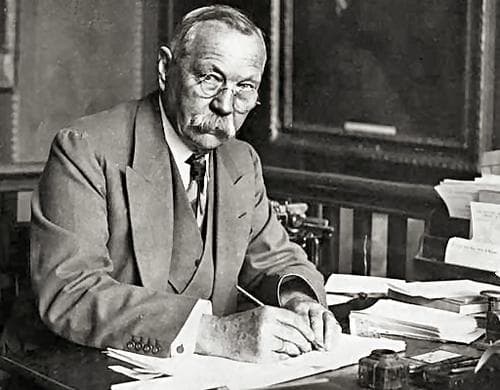
Sir Arthur Ignatius Conan Doyle was a British writer and physician. He created the character Sherlock Holmes in 1887 for A Study in Scarlet, the first of four novels and fifty-six short stories about Holmes and Dr. Watson. The Sherlock Holmes stories are milestones in the field of crime fiction.







