“The magic tree house was still there, perched high in the tallest oak.”
— Jack and Annie's return to the tree house.

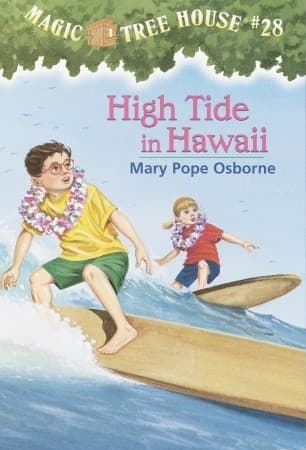
Mary Pope Osborne (2003)
Genre
Fantasy / Children's / Historical Fiction / Young Adult
Reading Time
90-120 min
Key Themes
See below
Sign in to track this book
Jack and Annie ride the ultimate wave back in time to ancient Hawaii, where surfing lessons turn into a race against a looming tidal wave to save their new island friends.
Jack and Annie are transported by the Magic Tree House to a beautiful beach in ancient Hawaii. Their mission from Merlin is to find a special gift that will help solve a riddle. As they explore the sandy shore, they notice a group of Hawaiian children playing in the waves. They are immediately struck by the warmth and friendliness of the islanders. They meet a young girl named Kama and her older brother, Boka, who are skilled surfers. Jack and Annie are a bit overwhelmed by the new environment but are excited to learn to surf and discover what gift they are meant to find on this tropical island.
Kama and Boka, seeing Jack and Annie's curiosity, kindly offer to teach them how to surf. Jack is initially hesitant, worrying about rules and safety, but Annie is eager to try. They watch the Hawaiian children expertly ride the waves on their wooden boards. Kama patiently shows Annie how to position herself on the board and paddle, while Boka guides Jack. Despite some initial tumbles, both Jack and Annie begin to get the hang of it, experiencing the thrill of riding the ocean's power. They quickly bond with Kama and Boka over their shared activity, enjoying the simple pleasure of the beach and the waves.
While enjoying their surfing lesson, Jack notices several unusual things. The tide seems to be going out much farther than normal, revealing parts of the reef that are usually submerged. He also observes that the birds are flying inland, and the local animals seem agitated. Jack, ever the logical and observant one, consults his research book, which explains that these are often signs of an approaching tsunami. He tries to warn Kama and Boka, but they are initially dismissive, attributing the receding tide to a normal low tide, as they haven't experienced such a large wave before.
Jack and Annie, armed with knowledge from Jack's book, become increasingly frantic as the signs of a tsunami become more pronounced. They try to explain the danger to Kama and Boka, describing the immense wave that will soon crash upon the island. Kama and Boka, while kind, are rooted in their traditional understanding of the ocean and have never witnessed such a catastrophic event. Jack points out the truly unusual behavior of the ocean and animals. Eventually, their growing alarm and the undeniable visual evidence of the rapidly receding water convince Kama and Boka that something is truly wrong, and they need to warn their village.
Realizing the seriousness of the situation, Kama and Boka join Jack and Annie in a desperate race to warn their village. They run through the palm groves, shouting warnings to anyone they encounter. The villagers are initially skeptical, but the children's urgency and the strange behavior of the ocean begin to sway some. Kama and Boka, being respected members of the community, help convince their elders. They explain what Jack and Annie have told them about the receding tide and the signs of a huge wave approaching, urging everyone to seek higher ground immediately.
Thanks to the children's warnings, many villagers begin to evacuate, heading towards the higher ground of the nearby mountain. There is a sense of urgency and fear as they leave their homes and belongings behind. Jack and Annie, along with Kama and Boka, help guide the villagers, ensuring that everyone, especially the elderly and young children, are moving quickly and safely. As they ascend the slopes, they can feel the ground tremble and hear a distant, ominous roar from the ocean, confirming Jack's predictions and solidifying the villagers' belief in the impending disaster. The sight of the vast, empty ocean where the waves once crashed is terrifying.
From their vantage point high on the mountain, Jack, Annie, Kama, Boka, and the rest of the villagers witness the terrifying sight of the tsunami. A massive wall of water, unlike anything they could have imagined, crashes onto the shore, engulfing the village and the lower parts of the island. The sound is deafening, and the sheer power of the wave is awe-inspiring and destructive. They watch in horror as their homes and the familiar landscape are swallowed by the ocean. Despite the devastation, there is also a sense of relief that they are safe, thanks to the timely warning and their escape to higher ground.
After the wave recedes, leaving behind a scene of destruction, the villagers slowly descend the mountain. Their homes are damaged or destroyed, and the landscape is dramatically altered. Despite the immense loss, there is a strong sense of community and gratitude for their lives. Kama and Boka express their deep thanks to Jack and Annie for their knowledge and courage. The experience is a powerful lesson for everyone, highlighting the unpredictable power of nature and the importance of heeding warnings. They begin to assess the damage and plan for rebuilding, united in their resilience and spirit.
Amidst the aftermath, Jack and Annie realize that the 'special gift' Merlin sent them to find wasn't a tangible object, but rather the gift of knowledge and the ability to help others. Their quick thinking and Jack's reliance on his research book allowed them to save an entire village from a natural disaster. The experience of sharing their knowledge and seeing its life-saving impact is the true treasure. They reflect on how their understanding of the world, combined with the islanders' trust, created a powerful force for good, fulfilling their mission in a way they hadn't initially anticipated.
Having completed their mission and knowing the villagers are safe and beginning the process of rebuilding, Jack and Annie prepare to return to the Magic Tree House. They share a heartfelt goodbye with Kama and Boka, who are now not just new friends but also understand the importance of scientific observation. The children exchange promises to remember each other. Jack and Annie step back into the tree house, reflecting on the adventure and the impact they had. With a whisper of 'I wish we could go home,' the tree house spins, whisking them away from ancient Hawaii, leaving behind a community forever grateful for their intervention.
The Protagonist
Jack learns to trust his knowledge and assert himself, moving from cautious observer to confident leader in a crisis.
The Protagonist
Annie further develops her courage and empathy, learning the importance of quick action and trust in others during a crisis.
The Supporting
Kama learns to trust outside knowledge and adapt her understanding of nature in the face of unprecedented danger.
The Supporting
Boka expands his understanding of nature's power and learns the importance of heeding unusual signs, even if they contradict familiar knowledge.
The Mentioned
Not applicable, as he is not present in the story.
The Supporting
The villagers learn the importance of heeding unusual warnings and the value of external knowledge in the face of unprecedented natural phenomena.
This theme is central to the story, highlighting how Jack's scientific knowledge and observation skills are crucial for survival. Jack's ability to read and understand the signs of a tsunami (receding tide, agitated animals, birds flying inland) directly leads to saving the Hawaiian village. The narrative shows that knowledge, even from books, can be a powerful tool, especially when combined with careful observation of the natural world. This is clear when Jack uses his research book to identify the danger, which ultimately convinces the skeptical islanders to evacuate.
“Jack checked his book. 'It says here that sometimes, before a tsunami, the ocean pulls way back.'”
The story shows the immense and unpredictable power of nature. The tsunami is a stark reminder that humans are at the mercy of natural forces. The Hawaiian villagers, though deeply connected to the ocean, had never witnessed such a catastrophic event, leading to their initial disbelief. Jack and Annie's warnings, born from understanding these forces, ultimately save lives. The theme encourages both awe and caution towards the environment, showing that while nature can be beautiful (like the surfing waves), it can also be devastating.
“Then they saw it. A wall of water, huge and dark, rose from the ocean.”
The interaction between Jack and Annie and the Hawaiian children, Kama and Boka, explores the theme of cultural exchange and the development of trust. Despite their different backgrounds and initial skepticism from the islanders, the children form a bond through shared experiences like surfing. More importantly, the Hawaiian children eventually trust Jack and Annie's warnings, even though they come from an unfamiliar perspective and contradict their traditional understanding. This trust, built on shared humanity and the urgency of the situation, is vital for the survival of the village, showing the importance of listening and understanding across cultures.
“'We must warn our village!' cried Kama. 'They'll believe us if we tell them!'”
Jack and Annie are heroes by taking on the responsibility to warn and save the Hawaiian villagers. Despite being children in a foreign land, they act when they realize the danger. Jack's intellectual courage to voice his scientific findings and Annie's empathetic drive to help others lead them to become unlikely heroes. Their actions show that heroism is not just about grand gestures, but about having the courage to speak up, share knowledge, and take responsibility for the well-being of others, even when faced with disbelief.
“'We have to tell them, Jack! We have to save them!'”
A magical vehicle for time and space travel.
The Magic Tree House is the primary plot device that transports Jack and Annie to different historical periods and geographical locations. It serves as the catalyst for all their adventures, enabling the narrative to explore various settings and challenges. In 'High Tide in Hawaii,' it brings them to ancient Hawaii, setting the stage for their encounter with the tsunami. It also provides a safe return mechanism once their mission is complete, allowing for self-contained adventures in each book.
A source of factual information and a key to solving problems.
Jack's research book is a crucial plot device. It acts as an external source of knowledge and a tool for problem-solving. In this story, the book contains vital information about tsunamis and their warning signs. Without this specific knowledge, Jack would not have been able to identify the impending danger, and the villagers would not have been warned. The book reinforces the theme of the power of knowledge and allows Jack to act as the logical, informed hero.
Subtle hints that build suspense and warn of impending danger.
The story effectively uses omens and foreshadowing to build suspense and signal the approaching tsunami. The unusually receding tide, the agitated animals, and the birds flying inland are all subtle but clear signs of an impending natural disaster. These details are observed by Jack and noted in his research book, creating a growing sense of dread and urgency for the reader. This device allows the plot to slowly reveal the danger before the actual event, making the climax more impactful.
A specific goal given by Merlin that drives the narrative.
Merlin's instruction to find a 'special gift' serves as the initial quest that propels Jack and Annie into their Hawaiian adventure. While they initially search for a tangible object, the 'gift' turns out to be their knowledge and ability to help others. This device provides a clear purpose for their journey, even if the true nature of the quest is revealed to be metaphorical. It gives structure to the narrative and a sense of accomplishment upon its resolution.
“The magic tree house was still there, perched high in the tallest oak.”
— Jack and Annie's return to the tree house.
“The air was warm and smelled of salt and flowers.”
— First impressions upon arriving in ancient Hawaii.
“A huge wave, like a mountain of water, was coming right at them!”
— The children's first encounter with a giant surf wave.
“They had to find the 'Eye of the Dolphin' before the full moon.”
— The quest given to Jack and Annie.
“The ancient Hawaiians treated the ocean with great respect.”
— Jack's observation about local customs.
“If you listen carefully, the ocean will tell you its secrets.”
— A wise elder's advice to Annie.
“He felt a thrill of fear, mixed with a strange excitement.”
— Jack's internal reaction to facing a challenge.
“The surfing was like dancing on water.”
— Annie's joyful description of learning to surf.
“They were learning so much more than just about history.”
— Jack's realization about their magical adventures.
“Sometimes the bravest thing you can do is ask for help.”
— A lesson learned during a difficult moment.
“The 'Eye of the Dolphin' wasn't a thing you could hold in your hand.”
— The revelation about the true nature of their quest item.
“It was the feeling of being connected to everything around them.”
— The ultimate meaning of the 'Eye of the Dolphin'.
“They had brought back more than just a story; they had brought back a feeling.”
— Reflecting on the impact of their Hawaiian adventure.
“The magic tree house always knew just where they needed to go next.”
— Concluding thought about the tree house's guidance.
Ready to see how well you understood this book? Take our interactive quiz with 10 questions.

Biography coming soon.







