“The worst part about being invisible isn't that people can't see you. It's that they can't hear you either.”
— Martin, the main character, reflecting on his invisibility talent.

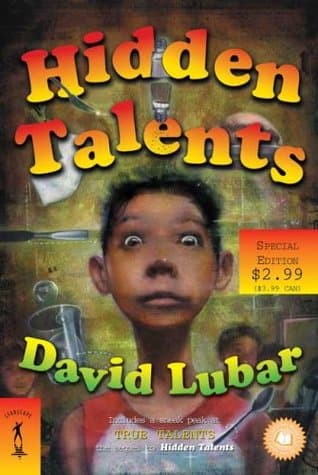
David Lubar (1999)
Genre
Fantasy / Children's / Science Fiction / Young Adult
Reading Time
240 min
Key Themes
See below
Sign in to track this book
At a school for 'losers,' Martin and his friends uncover hidden superpowers, turning their perceived failures into strengths.
Martin Anderson is dropped off at Edgeview Alternative School, a place for boys deemed unmanageable by regular schools. His parents, frustrated by his poor grades, see it as a last resort. Upon arrival, Martin notices the school's run-down look and the students' defeated air. He meets the stern headmaster, Mr. Llewellyn, and the indifferent staff. Martin quickly realizes Edgeview is not just a school; it is a holding pen for society's cast-offs, and he feels immediate dread and isolation, believing his life is over.
Martin begins to get used to Edgeview, watching the other students. He joins a group of boys who, like him, are considered outcasts. These include Torchie, who can start fires with his mind; Flinch, a nervous boy who can turn invisible; Cheater, who has telekinetic abilities, letting him manipulate objects; and Lucky, who seems to have an uncanny knack for making improbable events happen in his favor. They mostly keep to themselves, wary of the school's bullies and strict rules, but Martin feels a strange connection with them.
During a hostile encounter with some older bullies in the recreation room, Martin sees Torchie's hidden talent for the first time. As the bullies corner them, Torchie, under stress, accidentally causes a small flame to erupt from his fingertips, singeing a bully's shirt. The bullies are startled and leave, leaving Martin and his friends shaken but safe. This incident makes Martin wonder if Torchie's 'accident' was more than a coincidence and if there is something unusual about his new friends.
Martin continues to think about Torchie's unusual power. Soon after, while the group plays hide-and-seek in the overgrown school grounds, Flinch, overwhelmed by anxiety, vanishes. Martin and the others search frantically until Flinch slowly reappears, looking terrified. This second inexplicable event confirms Martin's suspicion: his friends have genuine, extraordinary abilities. He begins to realize that their 'problems' are not just behavioral issues but manifestations of unique, powerful talents.
Martin watches Cheater and Lucky, confirming his theory. He sees Cheater effortlessly manipulating small objects, like dice or pencils, to his advantage during games, confirming his telekinetic ability. He also observes Lucky's remarkable streak of good fortune: dropped objects always land perfectly, difficult shots always go in, and dangerous situations consistently resolve in his favor. Martin realizes that each of his friends, deemed failures by the world, possesses a distinct and powerful 'hidden talent.' He feels a growing sense of wonder and responsibility to help them understand and control their gifts.
Frustrated by Edgeview's oppressive atmosphere and the staff's constant belittling, Martin suggests a daring plan: they will use their combined hidden talents to escape the school. He argues that staying at Edgeview will only lead to them being suppressed, and that their powers could be used for something greater. The others are hesitant at first, fearing consequences and unsure of their abilities, but Martin's conviction and the allure of freedom persuade them. They begin to secretly practice and refine their talents, preparing for their breakout.
Under Martin's guidance, the group practices their powers in secret, often after lights out or in secluded areas of the school grounds. Torchie learns to control his flames with more precision, Flinch practices his invisibility, Cheater hones his telekinesis, and Lucky tries to consciously influence his luck. This training strengthens their individual abilities and creates a strong bond of trust among them, turning them from misfits into a cohesive unit.
The night of the escape arrives. The boys put their plan into action. Torchie creates diversions with small fires, Flinch uses his invisibility to scout and bypass guards, Cheater telekinetically manipulates locks and security systems, and Lucky's luck smooths over unforeseen obstacles, like a falling branch distracting a patrolling teacher. They navigate the school's corridors and grounds, facing close calls. The escape is tense, but their combined efforts and confidence propel them forward, showing their growing control over their 'hidden talents.'
Just as the boys think they are free, Mr. Llewellyn and several staff members corner them. The headmaster, however, does not seem surprised by their abilities. He reveals that he has known about their unique gifts all along, and that Edgeview is not just a school for troubled boys, but a facility designed to identify and, in some cases, study such 'talents.' The boys are shocked and disheartened, realizing their escape was perhaps anticipated, and their future at Edgeview, or elsewhere, is more complicated than they imagined.
Mr. Llewellyn explains that Edgeview was established to help children like them, whose undeveloped powers often show as behavioral problems. He reveals that he himself has a similar, though different, hidden talent: the ability to sense and understand the talents of others. He explains that their powers are gifts, not curses, and that the school's strict regimen was meant to help them gain control, though his methods were perhaps too harsh. He regrets his approach but emphasizes the dangers of uncontrolled abilities, hinting at a larger world of individuals with similar powers.
With the truth revealed, the boys, initially defiant, begin to see Edgeview differently. They realize that Mr. Llewellyn, despite his stern demeanor, genuinely wants to help them. They are offered the choice to leave, but they choose to stay, understanding that Edgeview can provide the guidance they need to master their powers safely. They no longer see themselves as outcasts but as individuals with extraordinary potential. The school changes from a prison into a sanctuary and a training ground, and the boys, united by their shared gifts and new understanding, embrace their future.
The story ends with Martin and his friends, now confident in their abilities and their place at Edgeview, starting a new chapter. They are no longer defined by past failures but by their extraordinary hidden talents. They begin more focused training under Mr. Llewellyn's guidance, learning to control their powers and understand their implications. The initial despair of Edgeview has given way to hope and excitement, as they realize they are part of something bigger, ready to face the challenges and opportunities that come with their unique gifts, and perhaps even help others like them.
The Protagonist
From a disillusioned outcast, Martin transforms into a confident leader who empowers others and finds his own purpose in helping his friends.
The Supporting
Torchie learns to control his dangerous power, transitioning from a fearful pyromaniac to a more confident individual.
The Supporting
Flinch gains control over his invisibility and, in turn, his anxiety, becoming more confident.
The Supporting
Cheater learns to use his telekinesis for cooperative and constructive purposes rather than just personal gain.
The Supporting
Lucky gains awareness and some control over his probabilistic manipulation, understanding it as a true power.
The Antagonist/Mentor
From a seemingly cold antagonist, Mr. Llewellyn is revealed as a complex mentor who genuinely cares for the students' development.
The main theme is finding acceptance, both from others and within oneself. The boys at Edgeview are called 'losers' and outcasts, leading to feelings of isolation. Martin's discovery of their 'hidden talents' changes their self-perception, turning their perceived flaws into unique strengths. This new understanding creates a strong sense of belonging within their group, where they are finally understood and valued. This is clear when they choose to stay at Edgeview, now seeing it as a place of growth.
“Maybe we weren't losers after all. Maybe we were just... different.”
The book explores the idea that everyone has untapped potential, often hidden by societal labels or personal insecurities. The boys' 'hidden talents' are literal examples of this theme. What first appear as behavioral problems (Torchie's fires, Flinch's withdrawal, Cheater's dishonesty) are revealed to be uncontrolled superpowers. Through Martin's observation and encouragement, the boys go on a journey of self-discovery, learning to identify, understand, and master their unique abilities. This journey empowers them to redefine themselves beyond negative perceptions.
“Sometimes the things that make you different are the very things that make you special.”
The story questions common definitions of 'normal' and 'deviant.' The boys are sent to Edgeview because they do not fit into standard societal molds. Their powers make them 'deviant' in a world that values conformity. However, the story suggests that what is called 'normal' is often limited, and true strength can come from embracing one's unique qualities. Edgeview initially tries to 'fix' deviance, but it ultimately becomes a place for cultivating it, showing that difference is a gift, not a flaw. This theme is strong in Mr. Llewellyn's final explanation of the school's true purpose.
“What society calls a problem, we call a gift waiting to be understood.”
A core theme is the power of friendship and collaboration. Martin and his friends are initially isolated, each struggling with unique challenges. However, as they discover and understand their powers, they form a strong bond. They learn to trust each other, combine their distinct abilities, and work together towards a common goal (the escape, and later, mastering their powers). Their individual talents are strong, but their collective strength and mutual support truly make them powerful, showing that together, they are more than the sum of their parts.
“Alone we were just a bunch of weirdos. Together, we were something else entirely.”
A literal manifestation of unique, extraordinary abilities.
The 'hidden talent' is the central plot device, giving the book its title and driving the entire narrative. Each main character possesses a distinct superpower (pyrokinesis, invisibility, telekinesis, probability manipulation) that initially manifests as a behavioral problem, leading them to Edgeview. This device serves to both categorize the characters as 'misfits' and provide the means for their eventual empowerment and transformation. It allows for fantastical elements within a realistic setting and is the source of both their initial struggles and their ultimate triumph, embodying the theme of hidden potential.
A seemingly punitive institution that hides a deeper purpose.
Edgeview Alternative School functions as a classic 'special school' trope but with a twist. Initially presented as a desolate, oppressive facility for 'troubled' boys, it serves as a crucible where the protagonists are brought together. The school's isolated setting and strict rules create the perfect environment for their powers to be both suppressed and, eventually, discovered. This device creates initial conflict and confinement, only to be subverted when its true purpose—identifying and nurturing hidden talents—is revealed, transforming it from a prison into a sanctuary and training ground.
A character without overt powers who acts as the catalyst for discovery.
Martin Anderson serves as the 'ordinary' protagonist in an extraordinary situation. Unlike his friends, he doesn't possess an obvious hidden talent, making him relatable to the reader. His role is to observe, deduce, and ultimately unite his superpowered friends. This device allows for the gradual reveal of each talent through his perspective, building suspense and ensuring that the reader discovers the powers alongside him. Martin's lack of a physical power highlights his leadership, empathy, and intelligence as his own unique and crucial 'talent' within the group.
The audience and characters are initially unaware of the true nature of the 'problems'.
Dramatic irony is employed throughout the first half of the book. The characters (and initially the reader) believe the boys' issues are purely behavioral—Torchie is a pyromaniac, Flinch is just extremely shy, Cheater is a habitual cheat, and Lucky is merely fortunate. The 'problems' are presented at face value. However, the true nature of these issues as hidden talents is gradually revealed, creating a sense of surprise and recontextualizing all previous events. This device builds tension and ultimately leads to the satisfying revelation of their powers and Mr. Llewellyn's true intentions.
“The worst part about being invisible isn't that people can't see you. It's that they can't hear you either.”
— Martin, the main character, reflecting on his invisibility talent.
“Sometimes the greatest power is the one you don't even know you have.”
— A general theme throughout the book as students discover their 'hidden talents'.
“Being normal is highly overrated.”
— One of the students expressing their disdain for conformity.
“It's hard to be a hero when no one believes you exist.”
— Martin struggling with his role in the group due to his invisibility.
“Fear can be a powerful motivator, but it can also be a paralyzing force.”
— The students facing challenges and their own fears at the school.
“You don't need a cape to be a superhero. Sometimes all you need is a really good plan.”
— The group devising a strategy using their unique abilities.
“The problem with secrets is that they always find a way out, eventually.”
— The students uncovering truths about the school and themselves.
“Even the most ordinary person can do extraordinary things.”
— Emphasizing the potential within every student, regardless of their perceived 'talent'.
“It's not about what you can do, but what you choose to do with it.”
— A lesson learned about responsibility and using their talents for good.
“The greatest prison isn't made of bars, but of your own mind.”
— Students overcoming their self-doubt and mental limitations.
“Sometimes the best way to hide something is to put it right out in the open.”
— A clever tactic used by one of the characters.
“True friendship isn't about being alike, it's about accepting differences.”
— The diverse group of students forming strong bonds despite their unique quirks.
“The world needs all kinds of talents, not just the ones that shine the brightest.”
— A commentary on the value of every individual's unique contribution.
“You can't change the past, but you can definitely mess up the future if you're not careful.”
— A warning about the consequences of their actions.
Ready to see how well you understood this book? Take our interactive quiz with 10 questions.

David Lubar is a prolific author of young adult fiction, celebrated for his engaging and often humorous stories. His notable works include "Hidden Talents" and "Sleeping Freshmen Never Lie," which explore themes of adolescence, friendship, and the extraordinary found in everyday life. Lubar's accessible writing style and relatable characters have earned him a dedicated readership among young adults.







