“I was Hetty Feather, and I was going to find my mother.”
— Hetty's determined declaration as she sets out on her quest.

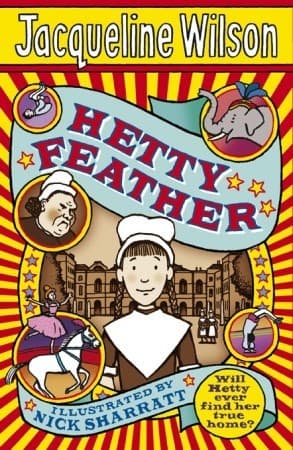
Jacqueline Wilson (2009)
Genre
Children's / Historical Fiction / Young Adult
Reading Time
240 min
Key Themes
See below
Sign in to track this book
In Victorian London, an orphan named Hetty escapes the Foundling Hospital to find her mother, all while dreaming of the circus.
The story starts with baby Hetty Feather left at the London Foundling Hospital in 1876. She is sent to a foster family, the Feathers, in rural Suffolk. There, she grows up with foster siblings: Martha, Jem, and Gideon. Hetty, with her red hair and independent nature, quickly bonds with Jem, who becomes her confidante. Country life is simple but hard, with chores and farm work, but also with freedom to play and explore.
One day, a traveling circus comes to their village. Despite Mrs. Feather's warnings to stay away, Hetty and Jem, curious, sneak off to see it. Hetty is captivated by the performers, especially the beautiful equestrian, Madame Adeline, who rides white horses. The experience deeply affects Hetty, sparking a fantasy that Madame Adeline might be her mother and fueling dreams of a life beyond the foster home.
As Hetty nears her sixth birthday, she and Jem must return to the Foundling Hospital, as per the rules for children old enough to start school. The change is a shock for Hetty. She is taken from the Feathers' loving, though strict, care and put into the impersonal, regimented hospital. Children wear drab uniforms, eat bland food, and follow a strict schedule. Hetty struggles with the loss of freedom and the cold atmosphere, often clashing with matrons and teachers.
Inside the Foundling Hospital, Hetty quickly learns the rules and forms new relationships. She becomes friends with Ida, a quiet girl, and later with Sheila, a more boisterous orphan. Hetty also deals with bullies, like Matron Bottomly, and develops a rivalry with the favored Polly. Despite hardships, Hetty's resilient spirit shows. Her outspoken nature often gets her into trouble, leading to punishments but also solidifying her reputation among peers.
Driven by her wish for a family and the fantasy of Madame Adeline, Hetty becomes intent on finding her birth mother. She watches hospital staff for clues and tries to piece together information. Her imagination runs wild, fueled by the idea of a glamorous mother. This search becomes a main focus in her hospital life, giving her purpose and secret hope amid daily routines. She confides in Jem, who visits her, and they speculate about her origins.
As Hetty gets older in the Foundling Hospital, she notices hushed conversations and clues that suggest deeper secrets. She learns about 'Foundling Tokens'—small items left with babies by their mothers—and wonders about her own. She also sees differences in how children are treated and the visits from wealthy patrons, which makes her aware of social class and injustice. These observations strengthen her resolve to find the truth about her past and the institution.
Hetty sometimes sees the world outside the hospital, like when she goes on a special outing or sneaks out with Jem during his visits. These brief tastes of freedom and London life only increase her longing for a life beyond the institution. She sees street performers, busy markets, and various people, which contrasts sharply with the monotonous hospital life. These experiences confirm her belief that her place is outside, pursuing her dreams.
A key moment occurs when Hetty uncovers a secret about her foster brother, Gideon. She learns that Gideon is her full biological brother, and they share the same mother. This revelation shatters her understanding of her family and adds complexity to her search. It also suggests her mother might be someone different from the circus performer she imagined, forcing Hetty to face a more grounded, perhaps painful, reality about her origins.
Driven by her discoveries, Hetty eventually confronts Matron Bottomly, demanding to know the truth about her mother. The matron, initially resistant, is pressured by Hetty's persistence and the growing evidence. It is revealed that Hetty's mother, Sissy, was a young housemaid at the Foundling Hospital who had a secret affair with a wealthy gentleman, Mr. Moshie, resulting in Hetty's birth. Sissy was forced to leave Hetty and later Gideon at the hospital, unable to care for them. This revelation is both a relief and a disappointment for Hetty, as it is far from her romantic fantasy.
With the truth known, Hetty begins to process her parentage. While her fantasy of Madame Adeline is gone, she finds a new connection to her biological brother, Gideon, and a deeper understanding of her mother's difficult situation. The story ends with Hetty, still at the Foundling Hospital but now with knowledge and a stronger sense of self, looking to the future. She remains spirited and determined, understanding her journey is not over, but now with a clearer, though more complex, understanding of who she is and where she comes from. She holds onto the hope of one day finding her mother, Sissy.
The Protagonist
Hetty transforms from an innocent, imaginative child clinging to a romantic fantasy into a more grounded and mature young woman who accepts the complexities of her past while retaining her hopeful spirit.
The Supporting
Jem remains a constant source of support for Hetty, his loyalty deepening as they face the challenges of separation and the revelations about their family.
The Supporting
Gideon's arc is less about personal transformation and more about his evolving relationship with Hetty as their shared parentage is revealed, solidifying their bond.
The Supporting
Mrs. Feather remains a consistent figure of maternal care, representing the warmth Hetty later longs for.
The Antagonist
Matron Bottomly's arc is static in her role as a disciplinarian, but she serves as a catalyst for Hetty's discoveries.
The Supporting
Ida remains a steadfast friend, her character arc focusing on her supportive role in Hetty's journey.
The Mentioned
Madame Adeline's 'arc' is entirely within Hetty's imagination, shifting from a powerful fantasy figure to a symbol of Hetty's lost innocence and romanticized view of her origins.
The Mentioned
Sissy's story is revealed retrospectively, her 'arc' showing the tragic circumstances that led to her abandoning her children.
Hetty's journey is driven by her need to understand who she is and where she comes from. As a foundling, she lacks a clear origin, which fuels her imaginative idea of a glamorous mother and her search for the truth. Her longing for a 'real' family is constant, shown in her bond with Jem, her idealization of Madame Adeline, and her eventual acceptance of her true parents. The contrast between the loving Feather home and the impersonal Foundling Hospital highlights her search for a place where she belongs, outside the institutional walls.
“I was Hetty Feather, and I was going to find my mother, no matter what.”
This theme is shown through Hetty's experiences in two different places. The fields and woods of the Suffolk countryside with the Feathers represent freedom, adventure, and childhood wildness. Hetty thrives here, often breaking rules to explore or visit the circus. In contrast, the Foundling Hospital means confinement, strict rules, and a loss of personal freedom. The drab uniforms, schedules, and punishments crush the children's spirits. Hetty's constant defiance and her desire for the outside world show her innate wish for freedom, making her a symbol of resistance against oppressive systems.
“The hospital walls were like a cage, and I was a wild bird longing to fly.”
Hetty's imagination is a key coping mechanism and driving force. Faced with her abandonment and the bleakness of the Foundling Hospital, she creates fantasies, especially her belief that Madame Adeline, the circus performer, is her mother. These stories give her hope, purpose, and a sense of self beyond her circumstances. Even when these fantasies are broken by the truth, her ability to imagine a different future and find beauty in the everyday remains a core part of her character, showing how imagination sustains the human spirit.
“I made up stories in my head all the time, stories where I was brave and beautiful, and my mother was the most wonderful woman in the world.”
The novel shows the realities of Victorian society, especially for abandoned children and working-class women. The Foundling Hospital, while providing care, operates with a cold efficiency that takes away children's individuality. The revelation of Hetty's mother, Sissy, as a housemaid forced to abandon her children due to an affair with a wealthy man, shows the social consequences for women who broke moral codes, especially across class lines. Hetty's experiences with poverty, strict rules, and lack of choice highlight social inequality and the vulnerability of marginalized people in 19th-century London.
“We were Foundlings. We didn't have names, not real ones. We had numbers, and a few scraps of cloth left by our mothers.”
A small, symbolic item left with a baby at the Foundling Hospital.
The Foundling Token is a recurring motif and a significant plot device. It is a small, unique item (a coin, a ribbon, a piece of jewelry) left by a mother with her child upon admission to the Foundling Hospital. These tokens are meant to be a potential means of identification should the mother ever return. For Hetty, the absence of her own token becomes a source of mystery and longing, fueling her quest for her mother. The tokens represent the desperate hope of the mothers and the fragile connection between parent and child in a system designed to sever ties, adding emotional weight to the narrative.
A vibrant, fleeting spectacle representing freedom, glamour, and Hetty's idealized dreams.
The circus serves as a powerful symbol throughout the novel, particularly the image of Madame Adeline and her performing horses. For Hetty, the circus represents everything she longs for: freedom, beauty, excitement, and a life far removed from the drudgery of her reality. It is the catalyst for her fantasy about her mother, embodying the romanticized version of her origins. The circus's fleeting nature underscores the transient happiness and elusive dreams Hetty experiences, contrasting sharply with the permanence of her institutional life. It represents the escapism and imaginative power that sustains her.
The strict, impersonal rules of the institution that govern the children's lives.
The elaborate system of rules, uniforms, and daily routines at the Foundling Hospital acts as a plot device to create conflict and highlight Hetty's rebellious nature. These rules are designed to strip the children of their individuality and enforce conformity, directly clashing with Hetty's fiery spirit. Her frequent defiance of these regulations leads to punishments, but also demonstrates her resilience and determination to maintain her sense of self. The rules also serve to illustrate the harsh realities of institutional life in Victorian times and the dehumanizing aspects of charity, pushing Hetty to seek an alternative life.
Hidden documents that reveal crucial information about Hetty's past.
While not a physical journal, the 'hidden' information about Hetty's past, particularly the details surrounding her and Gideon's birth and their mother's identity, functions like a secret journal or set of letters. The slow drip-feed of this information, pieced together by Hetty through overheard conversations, subtle clues, and eventually direct confrontation with Matron Bottomly, drives the central mystery of the plot. These 'secrets' build suspense and propel Hetty's personal quest, ultimately leading to the painful but necessary revelation of her true origins and disrupting her idealized fantasies. It represents the buried truths that Hetty must unearth to find her identity.
“I was Hetty Feather, and I was going to find my mother.”
— Hetty's determined declaration as she sets out on her quest.
“There are some things you can't learn from a book. You have to experience them.”
— A reflection on the importance of real-life experience over mere knowledge.
“Sometimes, when you least expect it, something wonderful happens.”
— Hetty's optimistic outlook despite her challenging circumstances.
“The world was a big, confusing place, and I was just a little girl trying to make sense of it.”
— Hetty's feeling of being overwhelmed by the world outside the Foundling Hospital.
“You can always find a way if you try hard enough.”
— A testament to resilience and problem-solving.
“A secret is like a heavy stone. The longer you carry it, the heavier it gets.”
— Hetty's understanding of the burden of keeping secrets.
“I might have been a foundling, but I wasn't nobody.”
— Hetty asserting her self-worth and individuality.
“Life isn't fair, but you've got to keep going anyway.”
— A pragmatic acceptance of life's injustices and the need to endure.
“The circus was a place of magic and wonder, where anything seemed possible.”
— Hetty's awe and fascination with the freedom and excitement of the circus.
“It's funny how a little bit of kindness can make such a difference.”
— Hetty reflecting on the impact of small acts of compassion.
“I knew what it was like to be an outsider, to feel like you didn't belong.”
— Hetty's empathy stemming from her own experiences as a foundling.
“Sometimes the bravest thing you can do is ask for help.”
— A realization about the strength in vulnerability.
“Home isn't always a place. Sometimes it's a feeling, or the people you're with.”
— Hetty's evolving understanding of what 'home' truly means.
“Even though I was small, I had a big heart and a fiery spirit.”
— Hetty's self-description, highlighting her inner strength.
Ready to see how well you understood this book? Take our interactive quiz with 10 questions.

Biography coming soon.

Dan Gemeinhart
4.5

Kate O'Hearn
4.4

Jeanne Birdsall
4.4

Jen Wang
4.4

Wendelin Van Draanen
4.3

John Marsden
4.3

Chris Van Allsburg
4.3
Jennifer A. Nielsen
4.2