“The gods are not what they were, but they are still gods.”
— A recurring theme about the diminished but still potent power of the old gods.

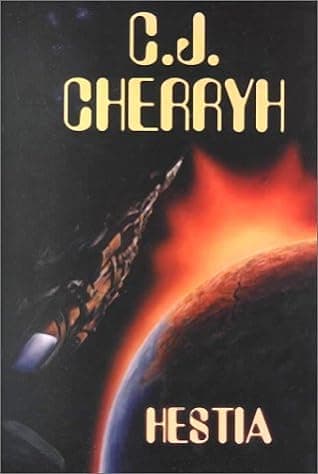
C.J. Cherryh (1979)
Genre
Fantasy / Science Fiction / Romance
Reading Time
246 min
Key Themes
See below
Sign in to track this book
An unwilling engineer, marooned on a failing, isolated colony, must confront hostile alien life and the truths desperate pioneers have hidden, all while building their last hope for survival.
Sam Merrit, a skilled but jaded engineer, arrives on Hestia after the colony requests help. He meets a small, isolated community led by Administrator Mabon and Foreman Skeen. Sam is quickly disappointed by the colony's primitive state and the many problems, including hostile wildlife and a lack of technology. He wants to leave, seeing the colony as a lost cause. However, Mabon explains that a shuttle cannot leave without major repairs and resources, trapping Sam on the planet. He is assigned to the dam project, the colony's last hope for expansion and survival.
Sam reluctantly begins surveying the dam site, a project meant to expand the colony's land and provide more resources. He works with colonists who are suspicious of him and his critical attitude. During his initial explorations, Sam encounters 'haunts,' large, aggressive creatures that threaten the colony. He is unnerved by their silent movement and apparent intelligence. His attempts to use more efficient engineering methods are met with skepticism and tradition from Mabon and Skeen, who are set in their ways after a century of isolation.
Driven by engineering curiosity and a growing unease, Sam studies the 'haunts' and their behavior. He observes their hunting, territorial markings, and organized attacks. He notices differences in the colonists' accounts of the creatures, realizing they have hidden or forgotten details about the 'haunts' to maintain a sense of normalcy. Sam's investigations lead him to believe the 'haunts' are more intelligent and coordinated than the colonists admit, posing a systemic threat. He tries to warn Mabon and Skeen, but they dismiss his concerns as an outsider's overreaction.
Sam's insistence on understanding the 'haunts' creates conflict with Mabon and other elders, who see his questions as a challenge to their authority. During a patrol, Sam's group is ambushed by 'haunts.' His quick thinking saves lives, but the incident only increases the colonists' fear and their reluctance to face the true nature of the threat. Sam becomes isolated, his expertise questioned and his warnings ignored. He realizes the colony's survival depends not just on building a dam, but on changing their approach to the planet and its dangers, a truth the leadership will not accept.
Despite the friction, Sam's engineering skills prove useful. He introduces more efficient methods for excavation and construction, slowly making progress on the dam project. He begins to earn the respect of some younger, more open-minded colonists, especially those tired of the stagnant, fear-driven existence. He finds an ally in Elene, a capable colonist who shares his curiosity about the 'haunts.' Their collaboration marks a turning point, as Sam builds a small support network within the colony, challenging the established order.
Working together, Sam and Elene venture further into the wilderness, discovering ancient structures and unusual geological formations that suggest a deeper history to Hestia. They find evidence that the 'haunts' are not just animals, but perhaps sentient beings integrated into the planet's ecosystem, possibly its guardians. They uncover signs of intelligence and purpose in the 'haunts'' actions, challenging the simple 'monster' story the colonists have held for generations. This discovery hints at a symbiotic relationship between the 'haunts' and the planet, a relationship the colonists have unknowingly disrupted.
Based on their discoveries, Sam theorizes the 'haunts' might communicate, though not verbally. He experiments with light and sound patterns, trying to create a basic dialogue. To the shock of Elene and a few other allies, his efforts work. The 'haunts' respond, showing a sophisticated understanding and clear territorial imperative. This breakthrough confirms Sam's suspicions: the 'haunts' are intelligent, and their attacks are not random aggression but a defense of their territory and the planet's ecological balance. The dam, representing human encroachment, is a direct threat to the 'haunts'.
With clear evidence, Sam and Elene confront Mabon and the colony elders with their findings about the 'haunts.' The truth is hard for the leadership to accept, but the increasing attacks and Sam's proof force them to acknowledge the creatures' intelligence. This revelation shatters the colonists' long-held beliefs and their sense of superiority. They realize their hundred years on Hestia have been spent in ignorance and conflict, misunderstanding the world they sought to conquer. The colony faces a crisis: continue their destructive path or find a way to coexist with the planet's true inhabitants.
Sam, now recognized for his foresight, proposes a new approach: instead of fighting the 'haunts' and imposing their will on Hestia, the colonists must learn to coexist. He suggests abandoning the dam project as planned and focusing on understanding and adapting to the planet's natural systems. This means establishing new boundaries, learning the 'haunts'' patterns, and potentially forming a truce. Many meet this proposal with fear, as it requires abandoning a century of tradition and admitting profound error. However, the alternative is extinction, forcing Mabon and the others to consider Sam's ideas.
Under Sam's guidance, the colony slowly changes its strategy. The dam project is repurposed or its scope altered to minimize impact on the 'haunts'' territory. Efforts are made to understand and respect the alien ecosystem. Communication attempts with the 'haunts' continue cautiously, as the colonists try to establish a fragile peace. This new direction has many challenges, but it represents a fundamental change in the colonists' relationship with Hestia. Sam, once an unwanted outsider, becomes the reluctant leader of this new path, guiding them toward coexistence rather than conquest, with Elene as his steadfast partner.
The Protagonist
Sam evolves from a cynical, detached engineer into a reluctant leader, embracing the challenge of coexistence and finding purpose in Hestia's survival.
The Antagonist/Supporting
Mabon slowly and reluctantly comes to accept Sam's revolutionary ideas, forced by evidence to question a century of colonial beliefs, ultimately prioritizing the colony's survival over tradition.
The Supporting
Elene grows from a skeptical but open-minded colonist into a courageous leader, actively advocating for and implementing the new path of coexistence.
The Supporting
Skeen transitions from a loyal, skeptical foreman to a key supporter of Sam's new vision, valuing practical solutions over entrenched tradition.
The Antagonists
The 'haunts' are recontextualized from simple antagonists to complex, sentient beings, forcing the colonists to re-evaluate their relationship with the planet.
The Supporting/Antagonist
The colony transitions from a state of fearful ignorance and resistance to a cautious acceptance of coexistence, driven by the threat of extinction and Sam's leadership.
The novel explores the dangers of colonizing an alien world without understanding its life and ecosystem. The Hestia colonists, for a century, saw the 'haunts' as beasts to be overcome, not as intelligent beings with their own place in the ecosystem. This misunderstanding leads to constant conflict and prevents the colony's growth. Sam's arrival forces them to confront this ignorance, showing how human-centric views can lead to destructive outcomes when encountering alien life. The dam project itself symbolizes this colonial mindset – an attempt to impose human will on the environment without considering its natural inhabitants.
““They had been a hundred years on Hestia, and they knew nothing. Nothing that mattered.””
A main theme is the need for adaptation over conquest when faced with a truly alien environment. The colonists' initial strategy is to dominate Hestia, clear land, build dams, and fight the 'haunts.' This approach proves unsustainable. Sam Merrit's engineering mind, initially focused on conquering the environment, slowly shifts to understanding and adapting to it. The realization that the 'haunts' are intelligent and deeply connected to the planet forces the colony to abandon its conquest mentality and embrace coexistence, learning to live within Hestia's natural order.
““You can't fight a planet, Mabon. You have to live with it, or it will kill you.””
The colony's old traditions and denial hinder their ability to survive and adapt. Administrator Mabon and the elders cling to methods and beliefs passed down through generations, even when they fail. Their refusal to acknowledge the 'haunts'' intelligence is a form of denial, born of fear and the desire to maintain a familiar, though precarious, existence. Sam's arrival challenges these traditions, forcing the colonists to confront uncomfortable truths about their past and future. This theme shows how fear of the unknown can lead to self-destructive adherence to outdated practices.
““They had built a wall of ignorance around themselves, a century thick, against the things they feared.””
The novel explores different forms of intelligence and the challenges of interspecies communication. The 'haunts' are first seen as animals, but Sam's investigation reveals a complex, non-human intelligence. Their communication is not verbal; it involves patterns, territorial markings, and coordinated actions the colonists initially fail to interpret. The story challenges human-centered views of intelligence, suggesting that alien life forms may have sophisticated cognitive abilities that appear in ways humans do not immediately recognize. Sam's efforts to establish a basic form of communication with the 'haunts' is a turning point, bridging a vast evolutionary and cognitive gap.
““They spoke not with words, but with a language of pattern and presence, a language the humans had been deaf to for a hundred years.””
A central symbol of the colony's aspirations for growth and their initial approach to conquering Hestia.
The dam project is the ostensible reason for Sam Merrit's arrival and serves as a major plot driver. Initially, it symbolizes the colonists' desperate hope for expansion and their desire to impose human order on the alien wilderness. As the story progresses, it transforms into a symbol of their destructive colonial mindset, directly conflicting with the 'haunts'' territory and the planet's ecological balance. Ultimately, the dam's repurposing or abandonment signifies the colony's shift from conquest to coexistence, making it a powerful symbol of their evolving relationship with Hestia.
The indigenous creatures that reflect the colonists' fears, ignorance, and ultimately, their potential for understanding.
The 'haunts' are more than just antagonists; they act as a mirror reflecting the colonists' own flaws and potential. Their perceived 'savagery' initially highlights the colonists' fear and their anthropocentric view of intelligence. As Sam uncovers their true nature, the 'haunts' force the colonists to confront their own ignorance and the destructive consequences of their actions. They become the catalyst for the colony's self-reflection and the imperative for change, showing humanity a different, more integrated way of existing on Hestia.
Sam's perspective as an off-worlder allows him to see the colony's problems and the planet's truths objectively.
Sam Merrit's status as an outsider is a crucial plot device. Having just arrived from off-world, he is not burdened by the colony's hundred years of tradition, fear, and denial. This allows him to observe the 'haunts' and the colony's situation with an objective, scientific eye, free from the ingrained biases of the colonists. His detached perspective enables him to ask the uncomfortable questions and make the radical observations that the entrenched leadership cannot, ultimately leading to the breakthroughs necessary for the colony's survival. His cynicism, initially a flaw, ironically provides the emotional distance needed for rational analysis.
The colony's long period of isolation from Earth that fostered their unique culture, traditions, and ignorance.
The fact that the Hestia colony has been isolated for a hundred years is a significant plot device. This prolonged isolation has allowed a unique, insular culture to develop, characterized by strong traditions, self-reliance, and a deep-seated fear of the unknown. Crucially, it has also led to a collective amnesia or denial regarding the true nature of Hestia and its 'haunts,' as outside knowledge and perspectives were cut off. This isolation makes the colonists resistant to change and Sam's ideas, but also highlights their resilience and the depth of the challenge he faces in trying to enlighten them.
“The gods are not what they were, but they are still gods.”
— A recurring theme about the diminished but still potent power of the old gods.
“You cannot outrun your fate, but you can choose how you meet it.”
— A character's reflection on destiny versus free will.
“Love is a choice, not a curse.”
— A realization by a protagonist burdened by an unwanted affection.
“The oldest magic is the magic of the land itself.”
— Discussion about the inherent power of the natural world, separate from deities.
“Sometimes, the greatest strength is found in yielding.”
— A lesson learned about adaptability and surrender in a difficult situation.
“Memory is a double-edged sword; it can heal or it can wound.”
— A character grappling with past events and their emotional impact.
“Fear makes monsters of us all, whether they are real or imagined.”
— Exploration of the psychological effects of fear on individuals.
“To truly belong, one must first be willing to be vulnerable.”
— A character's journey towards acceptance and finding a place.
“The future is not written, but it is shaped by every breath we take.”
— A philosophical musing on the impact of individual actions on the future.
“Even a god can be lonely.”
— Highlighting the isolation and emotional needs of powerful, divine beings.
“There are truths that lie beyond human understanding, and some are best left undisturbed.”
— A warning about the dangers of seeking forbidden knowledge.
“Trust is a fragile thing, easily broken and rarely mended whole.”
— A character reflecting on betrayal and the difficulty of rebuilding relationships.
“Home is not a place, but a feeling of peace.”
— A character's evolving definition of home as they travel and face challenges.
“The greatest battles are often fought within one's own heart.”
— An internal conflict faced by a protagonist wrestling with difficult choices.
Ready to see how well you understood this book? Take our interactive quiz with 10 questions.

C. J. Cherryh is a Hugo Award-winning author celebrated for her intricate and meticulously researched science fiction. Her works, including the critically acclaimed novel "Cyteen" and the "Foreigner" series, are known for their complex political intrigue, alien cultures, and realistic portrayals of interstellar societies. Cherryh's dedication to world-building and character development has earned her a significant following among science fiction enthusiasts.







