“The gods have no names, and the dead no tales. We are born, we live, we die. What else is there?”
— Halli's grandmother reflecting on the nature of their world.

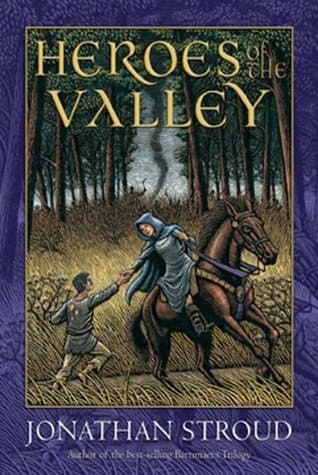
Jonathan Stroud (2009)
Genre
Fantasy / Children's / Historical Fiction / Young Adult
Reading Time
966 min
Key Themes
See below
Sign in to track this book
In a valley where ancient heroics are honored but modern violence is forbidden, young Halli Sveinsson struggles with echoes of legendary bloodlust and the draw of forbidden adventure.
Halli Sveinsson, a restless and small boy from the House of Svein, is bored with the Valley's peaceful life. Wanting adventure and to prove himself, he impulsively throws a rock at the window of the House of Hakon during a feast, hitting Hakon Thorkellson. This act, a serious break of the Valley's strict laws against violence, leads to a hearing before the Council. Halli receives a reprimand, and his mother, Aud, feels deep shame. At the hearing, the Old Mother, a seer, warns Halli that he will face a 'Nine-Day Night,' 'kill a hero,' and 'become one himself,' a prophecy that unsettles everyone.
Soon after Halli's incident, two strangers, Ragnar and Pipa, arrive in the Valley. They claim to be traders from beyond the mountains, a place the Valley folk rarely visit. Ragnar, a large man, brags about his fighting skills and knowledge of the Trows, monsters from old legends. Pipa, quieter, is observant and carries a carved wooden bird. Their arrival causes curiosity and fear among the Valley houses, as the Trows are believed to be long gone, just children's stories. Ragnar's tales of the Trows' return outside the Valley begin to create doubt and worry about the Valley's long peace.
One morning, Halli's mother, Aud, disappears without a trace. The House of Svein and the other houses search the Valley, but Aud is nowhere. The Council is confused, unable to explain her sudden absence. Halli, filled with grief and guilt over his recent behavior, is set on finding her. His cousin, Groa, a practical and clever girl, secretly agrees to help him. Together, they decide to go beyond the Valley's known borders, believing Aud must have gone into the forbidden lands outside, despite the dangers they've heard about.
As Halli and Groa venture into the wilderness, they quickly find that the Trow legends are real. They encounter a group of these monstrous, shadowy creatures, barely escaping. During their escape, Ragnar and Pipa unexpectedly help them, revealing they are experienced Trow hunters. Ragnar shows his combat skills against the creatures, confirming his image as a strong warrior. Pipa, meanwhile, shows surprising knowledge of the land and the Trows' weaknesses. They explain that the Trows have indeed returned and pose a threat to all human settlements.
Ragnar and Pipa reveal that Aud was taken on purpose by the Trows. They explain that the Trows are not just mindless beasts but are organized and led by a powerful Trow-Lord. The Trows plan to use Aud, who knows about the Valley's defenses and hero burial sites, to break the Valley's protective wards and attack its people. Halli is devastated by this news, understanding the true seriousness of his mother's abduction. He becomes even more determined to rescue her and protect his home, realizing the Valley's peace is in danger.
Halli, Groa, Ragnar, and Pipa return to the Valley to warn the Council and the people of the coming Trow invasion. Halli, despite his youth and past mistakes, passionately tells of their encounters with the Trows and the danger ahead. However, the Valley elders, used to generations of peace and skeptical of outside threats, struggle to believe the warnings' severity. They view Ragnar and Pipa with suspicion, questioning their reasons and origins. Fear and denial stop the Council from acting, showing the Valley's unreadiness for true conflict after centuries of calm.
As the Old Mother predicted, the 'Nine-Day Night' begins. The Trows launch a large, coordinated attack, overwhelming the Valley's outer defenses. The peaceful people, unprepared for such brutality, fall into chaos. Many are captured or killed. The House of Svein and other houses barricade themselves, trying to fight off the relentless attacks. Ragnar and Pipa, with a few brave Valley warriors, lead the defense, but the Trows' numbers and ferocity are too much. Halli, seeing the destruction, feels the weight of his earlier actions and the prophecy, understanding the true cost of violence.
During the Trow siege, a shocking betrayal comes to light. Ragnar, who had presented himself as a savior, is working with the Trows. He tries to deliver Aud to the Trow-Lord, planning to use her knowledge to dismantle the Valley's ancient protections. His real goal is to gain power by helping the Trows conquer. Pipa, who had been an unwitting helper, is horrified by Ragnar's treachery and sides with Halli. This reveal shatters Halli's view of heroism and trust, forcing him to face the complex nature of good and evil.
With Ragnar's betrayal and the Valley nearing collapse, Halli realizes that normal fighting won't work. Remembering the legends of ancient heroes and their powerful items, he plans a desperate move. He believes that the relics buried with the heroes in their tombs might hold the key to defeating the Trows. With Groa and Pipa's help, Halli goes into the forbidden burial mounds, a place of reverence and fear for the Valley folk. He confronts the spirits of the dead heroes, seeking their help and the weapons that once defeated the Trows, hoping to honor their legacy.
Halli, now armed with an ancient hero's sword, confronts Ragnar in a final battle. Ragnar, a strong warrior, represents the 'hero' the prophecy spoke of—a hero of the old, violent ways, though a traitor. Halli, despite his inexperience, fights with courage and resolve, driven by his wish to protect his family and home. In a brutal struggle, Halli defeats and kills Ragnar, fulfilling the Old Mother's prophecy. This act is a turning point for Halli, making him accept the violence he once avoided, but doing so for a greater good.
After Ragnar's death, Halli, Pipa, and Groa confront the Trow-Lord. Halli uses the ancient hero's sword and his understanding of the Trows' weaknesses, learned from Pipa and the legends, to battle the powerful creature. He shows not just physical bravery but also strategic thinking, outmaneuvering the Trow-Lord. The Trow-Lord is a strong enemy, but Halli's mix of ancient power and growing courage leads to its defeat. The Trow-Lord's fall breaks the remaining Trow forces, ending the Nine-Day Night and saving the Valley from total destruction.
With the Trows defeated and Aud rescued, the Valley slowly recovers from the destruction. Many lives are lost, and the land is scarred, but the people are safe. Halli, though marked by the experience, is no longer the reckless boy he once was. He has fulfilled the prophecy, becoming a hero, but not as he first imagined. He understands that heroism is not just about glory and violence, but about responsibility, sacrifice, and protecting one's home. The Valley now faces rebuilding, and Halli, with Groa and Pipa, will help shape its future, using the lessons from the Nine-Day Night.
The Protagonist
Halli transforms from a naive, glory-seeking boy into a responsible, thoughtful hero who understands the true cost of violence and leadership.
The Supporting
Groa develops from a cautious companion into a courageous and indispensable ally, solidifying her own strength and resourcefulness.
The Supporting
Aud endures captivity with courage, her hidden knowledge proving vital to the Valley's survival, and she serves as a symbol of the Valley's resilience.
The Antagonist
Ragnar's true nature as a treacherous opportunist is revealed, culminating in his defeat and the exposure of false heroism.
The Supporting
Pipa shifts from a mysterious outsider to a trusted ally, choosing morality over convenience and proving her loyalty to Halli and the Valley.
The Supporting
The Old Mother's role is primarily to foreshadow events and provide a sense of destiny, remaining a consistent source of ancient wisdom.
The Antagonist
The Trow-Lord rises as the primary threat, is ultimately defeated by Halli, signifying the triumph of new heroism over ancient evil.
The Supporting
Hakon's role is largely static, representing the established order challenged by Halli's actions and the subsequent Trow invasion.
The novel explores how heroism is redefined beyond old ideas of violence and glory. Halli first admires ancient heroes for their fighting skill, but his journey teaches him that true heroism involves sacrifice, responsibility, and protecting his community, often requiring tough moral choices. Ragnar shows the old, flawed idea of a hero—strong and charming, but ultimately selfish and deceitful. Halli, in contrast, becomes a hero not by seeking fame, but by facing his fears and making choices for the greater good, even if it means using the violence he first romanticized, as seen when he defeats Ragnar and the Trow-Lord.
“'A hero is not just a man who kills Trows, boy. A hero is a man who saves his people, no matter the cost to himself.'”
The Valley's long peace has made its society unable to handle outside threats. Their strict non-violence and dismissal of old legends as mere stories leave them open to the Trows. This theme shows that while peace is good, a complete refusal to defend oneself can lead to ruin. The Valley's initial disbelief and unreadiness for the Trow invasion, despite Halli and Pipa's warnings, illustrate this danger. The 'Nine-Day Night' forces the Valley to face the harsh truth that some threats cannot be solved peacefully, requiring a new look at their pacifist ideals.
“'We have forgotten the old ways, the ways of fighting. We have forgotten what lies beyond the mountains.'”
Halli's journey is a classic coming-of-age story. He starts as a restless, impulsive boy seeking adventure and praise, but by facing great danger, betrayal, and loss, he grows significantly. His quest to find his mother and protect his home makes him confront his own fears, make hard choices, and understand the results of his actions. He learns that true strength comes not just from physical ability but from courage, loyalty, and wisdom. His change from a mischievous child to a leader who understands his world's complexities is central to the story, ending with his acceptance of his role as a new kind of hero for the Valley.
“'He was no longer just Halli Sveinsson, the boy who threw a rock. He was Halli, who had seen the Trows, who had faced a betrayer, and who had chosen to stand for his people.'”
The Valley is full of legends about its ancient heroes, but over time, these stories have been cleaned up and their true, violent context forgotten. The novel explores how history can be misunderstood or ignored, leading to a false sense of security. Halli's initial romantic view of the heroes clashes with the grim reality of the past. The Trows' return forces the Valley to reconnect with its history, not as comforting tales but as warnings and sources of forgotten knowledge. The heroes' tombs and relics become important, representing the power and wisdom of the past that must be understood and used now.
“'The heroes were not gentle men, boy. They were killers. And sometimes, killers are needed.'”
A cryptic prediction that foreshadows Halli's journey and destiny.
The Old Mother's prophecy—that Halli will face a 'Nine-Day Night,' 'kill a hero,' and 'become one himself'—serves as a powerful narrative device. It creates suspense and provides a framework for Halli's character arc. Each element of the prophecy is eventually fulfilled, but often in unexpected ways, challenging Halli's and the reader's initial interpretations of what a 'hero' truly means. It adds a layer of destiny and ancient wisdom to the story, tying Halli's personal journey into the larger, mythical history of the Valley.
Burial mounds containing the weapons and spirits of the Valley's legendary figures.
The barrows of the ancient heroes are central to the plot, representing both a revered past and a source of forgotten power. They are initially forbidden places, symbolizing the Valley's deliberate detachment from its violent history. Halli's decision to enter them signifies his embrace of the past's harsher realities and his willingness to use the tools of violence for defense. The relics, particularly the hero's sword, are not merely magical items but symbols of the legacy Halli must contend with and ultimately adapt for a new kind of heroism.
A prolonged period of darkness and siege by the Trows, fulfilling a prophecy.
The 'Nine-Day Night' is both a literal event—a sustained Trow invasion—and a symbolic period of intense trial and transformation for Halli and the Valley. It marks the complete breakdown of the Valley's peaceful existence and forces its inhabitants to confront the brutal realities of the outside world. The extended duration of the siege emphasizes the Valley's vulnerability and the depth of the challenge they face, serving as the crucible in which Halli's heroism is forged and the Valley's future is determined.
Strict rules against violence that shape the Valley's society and its vulnerabilities.
The Valley's laws prohibiting violence and settling all disputes by the Council are a foundational plot device. They define the society Halli grows up in, explaining his initial boredom and the severe consequences of his rock-throwing incident. These laws highlight the Valley's isolation and its unpreparedness for external threats, making the Trow invasion even more devastating. The gradual erosion and eventual necessity of breaking these laws during the 'Nine-Day Night' underscore the theme of naive pacifism and the difficult choices required for survival.
“The gods have no names, and the dead no tales. We are born, we live, we die. What else is there?”
— Halli's grandmother reflecting on the nature of their world.
“A hero is someone who does what's right, even when it's hard, even when it's unpopular, even when no one else is watching.”
— Halli's internal musings about what makes a true hero, contrasting with the legendary tales.
“Stories are powerful things, boy. They can build a reputation, or they can tear one down. They can make a man a hero, or a villain.”
— An elder explaining the impact of storytelling on Halli.
“It’s easy to be brave when everyone is cheering for you. The real test is when they’re not.”
— Halli's thoughts on courage during a difficult moment.
“Sometimes the greatest victories are not won with a sword, but with a word.”
— Halli learning that cunning and diplomacy can be more effective than brute force.
“The past is a heavy cloak, boy. Don’t let it smother you.”
— A character advising Halli not to be overly burdened by ancestral legends.
“Fear is a useful thing, if you know how to use it. It tells you what to avoid, and it tells you what to fight.”
— Halli reflecting on his own fear during a perilous journey.
“There are always other ways, if you’re brave enough to look for them.”
— Halli contemplating alternative solutions to seemingly impossible problems.
“The world doesn't care about your legends, boy. It cares about what you do.”
— A blunt reminder to Halli that actions speak louder than inherited fame.
“Even the greatest heroes start somewhere small. It’s the journey that makes them great, not the beginning.”
— Halli considering his own humble origins and aspirations.
“Sometimes the monsters are not in the wild places, but in the hearts of men.”
— Halli's realization about human nature and betrayal.
“The truth is rarely as simple as the stories make it out to be.”
— Halli's growing understanding of the complexities behind the heroic sagas.
“It’s one thing to hear the old tales, another thing entirely to live your own.”
— Halli distinguishing between inherited legend and personal experience.
“You don't always have to be the strongest, or the fastest. Sometimes, you just have to be the smartest.”
— Halli's strategic thinking proving more valuable than brute strength.
Ready to see how well you understood this book? Take our interactive quiz with 10 questions.

Biography coming soon.







