“Henry Brown wasn't sure how old he was. Henry was a slave. And slaves weren't allowed to know their birthdays.”
— Opening lines introducing Henry's life as an enslaved person.

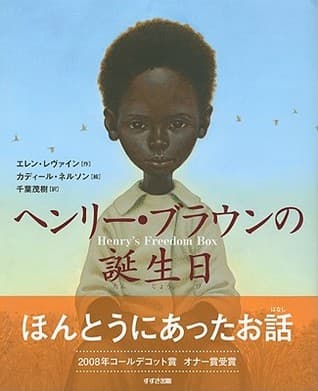
Genre
Children's / Historical Fiction
Reading Time
10 min
Key Themes
See below
Sign in to track this book
With courage and a wooden crate, Henry 'Box' Brown begins a dangerous journey to freedom, a story of a man escaping slavery.
Henry Brown is born into slavery, a condition he does not understand as a young boy. He lives with his mother, father, and siblings, enjoying simple moments like watching birds. His life changes when he is still a child. His master dies, and Henry is sent to work for the master's son, Mr. John, in Richmond, Virginia. This separation is hard for Henry. He must leave his family, which is his first experience of loss and the harshness of being enslaved. He remembers his family as he starts his new life in Richmond.
In Richmond, Henry works long hours in a tobacco factory. It is a demanding and repetitive job. Despite the difficulties of his daily life, he finds happiness when he meets Nancy, another enslaved person. They fall in love and are allowed to marry. Henry and Nancy make a home together, creating a sense of family that had been missing since Henry's childhood. Their marriage brings joy and hope to Henry's life, giving him a needed break from the constant oppression of slavery.
Henry and Nancy's family grows with three children. Henry loves his children, teaching them the alphabet by drawing letters in the dirt, dreaming of a better future for them. Their small cabin becomes a safe place, full of love and the simple joys of family life. However, this happiness is fragile. The threat of being sold and separated always hangs over them, a reminder that they are not free. Henry fears his family could be torn apart at any moment, reliving the pain of his own childhood separation.
Henry's worst fears come true when Nancy and their three children are sold to a different master. He cannot stop it. He watches his family taken away, just as he had been taken from his own parents years before. The pain is huge. He cries for days, overcome by grief. This loss shatters his world, leaving him alone and without hope. The experience makes him determined to find a way to escape slavery, for himself and in memory of his lost family.
After losing his family, Henry wants freedom. He longs for a place where he can be truly free, where families cannot be torn apart. One day, while working, he hears a song about the North, a place where people are free. This gives him an idea. He decides to mail himself to freedom. Henry finds a white shoemaker and a carpenter, both abolitionists, who agree to help him. Together, they plan to build a custom wooden box large enough for Henry to fit inside, strong enough for a long journey.
The shoemaker and carpenter build a wooden box just for Henry. On the day of his escape, Henry arrives at their shop, feeling both fear and determination. He says goodbye to his few remaining friends in Richmond and climbs into the small, cramped box. Inside, he has only a small amount of water and a few biscuits. The lid is nailed shut, and the box is addressed to abolitionists in Philadelphia, Pennsylvania. The journey begins with the box loaded onto a wagon, then a train, and finally a steamship. Each part of the trip is dangerous.
Inside the box, Henry faces many challenges. He is often upside down or on his side, his body aching and cramped. The air becomes stale, and he struggles to breathe. He hears the sounds of the journey — the rumble of the train, the creak of the wagon, the sloshing of the ship, and the voices of people around him, none of whom know his secret. At one point, the box is left upside down for a long time, causing him extreme discomfort. He fears discovery at every turn, but his desire for freedom and the memory of his family help him endure the 27-hour ordeal.
After what feels like forever, Henry hears voices and the box being handled again. He is finally at the Anti-Slavery Office in Philadelphia. He hears quiet voices and then the sound of tools prying open the lid. As the lid is removed, Henry slowly sits up, gasping for fresh air. He is greeted by four men, prominent abolitionists, who look at him with amazement and relief. Henry's first words are, "How do you do, gentlemen?" He has made it. He is free. The men celebrate his courage and cleverness, welcoming him to his new life of freedom.
The Protagonist
Henry transforms from a heartbroken and enslaved man into a symbol of hope and freedom through his extraordinary act of self-emancipation.
The Supporting
Her brief appearance highlights the transient nature of happiness for enslaved people and the constant threat of separation.
The Supporting
Their innocent presence emphasizes the cruelty of slavery and motivates Henry's quest for freedom.
The Supporting
He provides instrumental aid, demonstrating the courage of those who defied slavery.
The Supporting
He provides instrumental aid, demonstrating the courage of those who defied slavery.
The Mentioned
His role is static, representing the oppressive system from which Henry escapes.
The Supporting
They facilitate Henry's final step into freedom, representing the abolitionist network.
The most prominent theme is the inhumane nature of slavery, especially its impact on family bonds. Henry's story begins with his separation from his parents and ends with the heartbreaking sale of his wife and children. These events motivate his escape, showing how slavery destroyed the emotional and social fabric of enslaved people's lives. The book shows that freedom from physical bondage also meant the freedom to keep one's family intact.
“A slave could have a family, but they were not safe. They could be taken away at any time.”
Despite suffering, loss, and constant oppression, Henry's spirit remains strong. His decision to mail himself to freedom, and his ability to endure the 27-hour journey in the box, show great resilience. His determination to find freedom, even with huge obstacles, shows the strength of the human spirit when facing extreme hardship. His actions show the natural desire for liberty.
“He would not give up. He would be free.”
Hope is a strong current throughout Henry's story. Even after devastating loss, the idea of freedom, sparked by a song about the North, creates new hope within him. This hope fuels his plan and sustains him through the terrifying journey. The pursuit of freedom is not just physical escape but a quest for a life where he can truly belong and be safe from the arbitrary cruelty of slavery. His arrival in Philadelphia symbolizes the realization of this hope.
“He closed his eyes and prayed that his next sight would be of a free land.”
Henry's escape is a remarkable act of cleverness and courage. Mailing oneself in a box was new and very risky. It needed a clever plan and the bravery to endure the physical and psychological pain of confinement for hours, not knowing what would happen. His resourcefulness in finding allies and his will to survive against all odds show the extraordinary measures enslaved individuals took to get their liberty.
“He knew it would be dangerous, but he had to try.”
A literal wooden box symbolizing escape, confinement, and transformation.
The wooden box is the central plot device and a powerful symbol. Literally, it is the vessel for Henry's escape, enabling him to travel from slavery to freedom. Symbolically, it represents extreme confinement and the dehumanization of slavery, as Henry is reduced to a package. Yet, it also signifies transformation and hope, as it becomes the means by which he reclaims his humanity and liberty. The box encapsulates the paradox of his journey: an object of oppression becomes an instrument of liberation.
Henry's past losses inform his present actions and motivations.
While not a direct flashback sequence, the narrative frequently refers back to Henry's past traumas, particularly the separation from his parents and later his wife and children. These memories are not just recounted but are shown to actively drive Henry's decisions and fuel his determination. The pain of past losses makes the prospect of freedom even more urgent and gives depth to his courage, constantly reminding the reader of the profound emotional cost of slavery and the personal stakes involved in his escape.
The North represents freedom and a safe haven.
The 'North' functions as a powerful symbol of freedom and hope for Henry. Initially, it's an abstract concept, a place mentioned in a song. As his plan solidifies, it becomes a concrete destination – Philadelphia – representing not just an escape from physical bondage but a place where families might remain together and where his humanity would be recognized. The journey to the North is Henry's journey towards self-determination and a life free from the fear of separation.
The story is told from Henry's perspective, focusing on his thoughts and feelings.
The narrative largely adopts a limited omniscient point of view, primarily focusing on Henry's internal experiences, fears, and hopes. While the narrator is external, they delve into Henry's emotional state, allowing the reader to intimately understand his pain, his courage, and his motivations. This narrative choice builds empathy and makes Henry's struggle and eventual triumph deeply personal and impactful, rather than a mere historical account.
“Henry Brown wasn't sure how old he was. Henry was a slave. And slaves weren't allowed to know their birthdays.”
— Opening lines introducing Henry's life as an enslaved person.
“If you please, sir, I heard them say my master is dead. I must go with the rest of his property.”
— Henry learns he is being sold away from his family after his master's death.
“Henry worked in a tobacco factory. He rolled tobacco leaves into cigars. His fingers bled.”
— Description of Henry's harsh labor conditions after being sold.
“Henry married Nancy, a slave from another plantation. They had three children.”
— Henry builds a family despite the constraints of slavery.
“One day, Nancy and the children were sold at the slave market. Henry watched as they were taken away.”
— The traumatic moment Henry's family is forcibly separated from him.
“Henry was heartbroken. His family was gone. What could he do?”
— Henry's despair after losing his family, leading to his decision to escape.
“I will mail myself to a place where there are no slaves!”
— Henry's bold idea to escape by shipping himself in a box to freedom.
“Dr. Smith helped Henry. He was a white man who believed slavery was wrong.”
— Introduction of an ally who assists Henry in his escape plan.
“Henry climbed into the box. It was three feet long, two feet wide, and two and a half feet deep.”
— Henry enters the cramped box for his journey to freedom.
“The box was nailed shut. Henry could not move. He could hardly breathe.”
— Description of the extreme conditions Henry endured during the shipment.
“The box was tossed and turned. Henry was upside down. His head pounded.”
— Henry experiences the physical hardships of the journey in the box.
“After twenty-seven hours, the box arrived in Philadelphia. Henry was free!”
— The triumphant moment Henry reaches freedom after his ordeal.
“Henry Brown had a birthday. March 30, 1849. His first day of freedom.”
— The closing lines, symbolizing Henry's rebirth into a free life.
“Henry's freedom box was a small wooden crate, but it carried a big hope.”
— Reflective note on the significance of Henry's escape method.
Ready to see how well you understood this book? Take our interactive quiz with 10 questions.

Dan Gemeinhart
4.5

Kate O'Hearn
4.4

Jeanne Birdsall
4.4

Jen Wang
4.4
Wendelin Van Draanen
4.3

John Marsden
4.3

Chris Van Allsburg
4.3
Jennifer A. Nielsen
4.2