“Heckedy Peg, Heckedy Peg, what have you done with my children?”
— The mother's desperate plea to the witch after finding her children transformed.

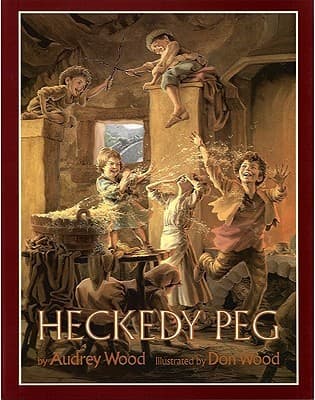
Audrey Wood (1987)
Genre
Fantasy / Children's
Reading Time
5 min
Key Themes
See below
Sign in to track this book
When an evil witch transforms her seven sweet children into a feast of food, a mother's love and a clever riddle become the only hope for breaking the spell.
A loving mother prepares to leave her seven sweet children at home alone while she goes to market. Before she departs, she gathers them and gives a firm warning: they are not to open the door to anyone, especially strangers. She stresses the importance of their safety and obedience, reminding them to stay inside until she returns. The children, eager to please, promise to be good and follow her instructions. They do not fully understand the danger outside their cozy home. With a final kiss and a wave, the mother sets off for the market, leaving her seven children to themselves.
Soon after their mother leaves, a strange figure approaches the children's house. It is Heckedy Peg, an old, hunched woman with a long, pointy nose and a mischievous look in her eyes. She wears tattered clothes and carries a large, empty sack. She hobbles up to the front door, watching the house. The children, peeking through the window, are curious about the visitor, forgetting their mother's warning for a moment. Heckedy Peg's arrival immediately creates a sense of mystery and a hint of trouble, suggesting the problems she is about to cause.
Heckedy Peg knocks on the door and, in a high, sweet voice, pretends to be the children's grandmother. She claims she has come to visit. The children remember their mother's warning but are tempted by the idea of a visitor, so they hesitate. She continues her act, describing a delicious treat she supposedly brought, appealing to their innocent desires. One child, unable to resist the treat, peeks through a crack in the door. Heckedy Peg, seeing her chance, quickly pushes the door open further, revealing her true, less-than-grandmotherly appearance as she steps inside the house with a wicked smile.
Once inside, Heckedy Peg quickly shows her magical powers and bad intentions. With a flick of her wrist and a strange chant, she transforms each of the seven children into a different type of food. One child becomes a loaf of bread, another a potato, a third a slice of bacon. A fourth turns into a cabbage, a fifth into a glass of milk, a sixth into a piece of cheese, and the seventh into a pat of butter. The children, now food items, are helpless. Heckedy Peg then happily gathers her edible bounty into her sack, getting ready to take them away.
The mother returns from the market, her arms full of groceries, humming a happy tune. As she approaches her house, she notices an unsettling quiet. Entering, she calls for her children but gets no answer. A feeling of dread washes over her as she sees the empty rooms. On the table, she finds a cryptic note from Heckedy Peg. It describes the transformation of her children into food and challenges the mother to guess what each child became if she wants to see them again. The mother's heart sinks, realizing her worst fears have come true and her children are in great danger from the wicked witch.
Filled with despair but also strong resolve, the mother quickly realizes Heckedy Peg is responsible. She grabs a sharp knife, a sign of her determination to fight for her family, and leaves her house. She follows the faint trail left by Heckedy Peg, determined to find the witch and reverse the terrible spell. Her journey is urgent and driven by a mother's unwavering love, pushing her forward despite fear and uncertainty. She knows she must use her wits and courage to outsmart the witch and bring her children home safely.
The mother eventually finds Heckedy Peg's isolated, crooked cottage, deep in a dark part of the woods. Without hesitation, she bursts through the door, knife in hand, confronting the surprised witch. Heckedy Peg, who was preparing a meal with the transformed children, tries to act calm, but her surprise is clear. The mother, her voice firm, demands her children back immediately. Heckedy Peg, however, simply cackles, reminding the mother of the challenge in the note: to guess what each child was turned into.
Heckedy Peg presents the mother with the seven food items, daring her to identify which child became which food. The mother observes each item carefully, using her deep knowledge and intuition about her children. She sees the bread and remembers her eldest's love for warm crusts, declaring, "That's my child, Bread!" She sees the potato and recalls her second child's round cheeks, saying, "That's my child, Potato!" With each guess, she identifies a food item, connecting it to a specific memory or trait of one of her children. This shows her strong maternal bond and cleverness against the witch's challenge.
As the mother correctly identifies each food item, a magical transformation occurs. With every declaration, "That's my child, [Food Name]!" the food item shimmers and then, in a flash, turns back into one of her children, safe and sound. Heckedy Peg, visibly frustrated and astonished by the mother's accuracy, watches her plan fail. The cottage fills with the joyful cries of the children as they return to their human forms, running into their mother's open arms, relieved to be free from the witch's spell and reunited with their loving parent. The mother's cleverness has won against the witch's dark magic.
With all seven children successfully identified and transformed back, Heckedy Peg's magic is broken, and her power over the family is gone. The witch, defeated and shamed, shrinks away, her schemes stopped by a mother's love and quick thinking. The mother, with all her children gathered, leads them out of Heckedy Peg's cottage and back towards their home. The children, having learned a valuable and terrifying lesson about obeying their mother's warnings, cling to her side. They return home, safe and sound, forever grateful for their mother's courage and love, and much wiser about the dangers of strangers.
The Protagonist
She transforms from a protective parent to a courageous rescuer, demonstrating her unwavering love and cleverness.
The Antagonist
She begins as a powerful, deceptive antagonist but is ultimately defeated and humiliated by the mother's wit.
The Supporting
They learn a profound lesson about obedience and the dangers of strangers through their terrifying experience.
This theme is central to 'Heckedy Peg,' showing how a mother's strong love can overcome difficult problems. The mother's journey to rescue her children comes from her deep affection and commitment. Her ability to identify each child by connecting them to specific food items—a loaf of bread for her eldest, a potato for her second—highlights her close knowledge and bond with each child. This powerful love gives her the courage to confront the wicked witch and the intelligence to solve the riddle, which saves the children. It shows that maternal love is a strong force against evil.
“"That's my child, Bread!" "That's my child, Potato!" "That's my child, Bacon!"”
The story strongly emphasizes the importance of obeying parental warnings and the bad results of not doing so. The mother clearly warns her children not to open the door to strangers. Their failure to listen directly leads to Heckedy Peg transforming them. This theme serves as a cautionary tale for young readers, showing how ignoring rules for their safety can lead to dangerous situations. The children's fear and helplessness as food items highlight the seriousness of their mistake, making the lesson memorable. Their eventual rescue reinforces the value of listening to and trusting their parents.
“"Do not open the door to anyone, especially not strangers!"”
Heckedy Peg captures the children mainly through deception. She pretends to be their grandmother and promises treats, using their innocence and desire for sweets. This shows the danger of trusting strangers, especially those who use kind words or tempting offers. The children's initial hesitation versus their eventual giving in highlights the conflict between caution and curiosity. The story teaches children to be careful of those who seem friendly but have bad intentions. It reinforces the idea that appearances can be misleading and that true trust should be saved for known, reliable figures like their mother.
“"It's your old granny come to visit, with a pocket full of treats!"”
While magic is in the story, it is the mother's wit and intelligence, rather than magic, that defeats Heckedy Peg. The witch's challenge is a riddle, a test of knowledge and deduction, not a physical fight. The mother's ability to cleverly identify each child's transformed food item shows her intelligence and deep understanding of her children's unique traits. This theme suggests that cleverness and sharp thinking can outsmart brute force or even dark magic. The mother's triumph emphasizes that intelligence and insight are strong tools for overcoming problems, even against a magical opponent.
“Heckedy Peg cackled. 'You may have them back, if you can guess what each child became.'”
A magical spell that turns the children into specific food items.
The transformation spell is the central magical plot device. Heckedy Peg uses it to turn the seven children into various food items (bread, potato, bacon, cabbage, milk, cheese, butter). This spell creates the core conflict, making the children helpless and setting up the mother's quest. The specific choice of food items is crucial, as it later allows the mother to use her intimate knowledge of her children to reverse the spell. It highlights the witch's power and cruelty, while also providing the mechanism for the mother's clever solution.
Heckedy Peg's verbal challenge to the mother to identify her children.
The riddle is a crucial plot device that drives the climax. Instead of simply keeping the children, Heckedy Peg challenges the mother to guess what each child became. This elevates the conflict from a simple rescue mission to a battle of wits. It allows the mother to demonstrate her intelligence and deep connection to her children, making her active participation essential for the children's rescue. The riddle transforms the mother into a detective, using her maternal intuition as her primary weapon against the witch's magic.
A symbolic object representing the mother's resolve and readiness to fight.
The mother's knife is a symbolic plot device. When the mother discovers her children are gone, she grabs a knife before setting out. It is not used for violence against Heckedy Peg, but rather serves as a visual representation of her fierce determination, courage, and readiness to protect her family at all costs. It signifies her transformation from a gentle mother to a formidable rescuer, embodying her unwavering resolve and the protective instinct of a parent. It adds a touch of grounded realism to her magical quest.
“Heckedy Peg, Heckedy Peg, what have you done with my children?”
— The mother's desperate plea to the witch after finding her children transformed.
“Seven children, seven dishes, seven hungry mouths to feed.”
— Describing the mother's daily routine and the number of children she has.
“Each child turned into a different food: bread, milk, cheese, butter, meat, potatoes, and soup.”
— The witch's magical act of transforming the children into dinner ingredients.
“The mother was a good cook, but never had she cooked her own children!”
— The mother's horrified realization of what the witch has done.
“If you can guess what food each child became, I will give them back to you.”
— Heckedy Peg's challenge to the mother, offering a chance to reverse the spell.
“She remembered what each child loved to eat, and what they looked like when they were little.”
— The mother's method for deducing which child became which food.
“My little John, with his round, rosy cheeks, always loved bread!”
— The mother guessing the first child's transformation.
“And little Jane, so sweet and pure, always wanted milk!”
— The mother guessing another child's transformation.
“With each correct guess, a child reappeared, small and whole.”
— The immediate consequence of the mother's successful guesses.
“The witch's face grew longer and longer, like a noodle.”
— Heckedy Peg's reaction as the mother successfully identifies her children.
“Finally, all seven children were back, safe and sound.”
— The triumphant conclusion of the mother's efforts.
“And the witch, Heckedy Peg, flew away on her broom, never to be seen again.”
— The ultimate fate of the antagonist.
“A mother's love is stronger than any spell.”
— The underlying theme demonstrated by the mother's actions.
Ready to see how well you understood this book? Take our interactive quiz with 10 questions.

Audrey Wood is a celebrated children's author, renowned for her imaginative and rhythmic picture books. Her most beloved works include 'The Napping House,' 'Quick as a Cricket,' and 'Heckedy Peg.' Wood's distinctive storytelling and engaging illustrations have earned her a place as a beloved figure in children's literature.







