“The horror! The horror!”
— Kurtz's dying words, echoing his realization of the moral abyss he has fallen into.


Joseph Conrad (2022)
Genre
Historical Fiction
Reading Time
127 min
Key Themes
See below
Sign in to track this book
A journey up the Congo River shows how a brilliant ivory agent goes mad, revealing the harshness of European colonialism and human darkness.
The story begins on the deck of the Nellie, a boat on the River Thames. Charles Marlow, an experienced sailor, is with four other men. As evening comes, Marlow starts to tell about a past journey. He talks about England's history as a place once dark before the Romans. He then moves to his own story, driven by his interest in maps and the Congo River. This led him to a job as a steamboat captain for a Belgian trading company in Africa. His aunt, who had connections in European charity groups, helped him get the job. She thought he would be an 'emissary of light.'
Marlow goes to the Company's offices in Brussels, a 'whited sepulchre' of a city. He has a quick medical exam and signs contracts. He then takes a French steamer. He sees the empty African coast and a warship senselessly shelling the jungle. When he arrives at the Company's Outer Station, he immediately sees the harsh reality of colonialism: broken machines, exploited native workers dying from overwork, and a general feeling of inefficiency and cruelty. He sees a 'grove of death' where sick natives are left to die. This scene disturbs him and hints at the darkness he will soon encounter.
At the Central Station, Marlow finds his steamboat is wrecked and needs many repairs. He meets the Company Manager, an average man who keeps his job because he is healthy and makes people feel uneasy. The Manager worries about delays in getting ivory from the interior, especially from the very successful agent, Mr. Kurtz. Marlow watches the 'pilgrims' – other Company agents – who only care about ivory and show no empathy or purpose beyond getting rich. He hears talk about Kurtz's great success and the Manager's quiet dislike of him.
While waiting for parts to fix his steamboat, Marlow meets the 'brickmaker,' a Company agent who makes no bricks but spies for the Manager. The brickmaker tries to get information from Marlow, thinking Marlow has influence in Europe because of his aunt. Marlow learns that Kurtz collects a lot of ivory and is a talented man. The Company sent him to civilize the natives. He is an important person, seen as an 'emissary of pity and science and progress,' who wrote a report for the International Society for the Suppression of Savage Customs. Marlow becomes more interested in this mysterious person.
After three months, the parts arrive, and the steamboat is fixed. Marlow, the Manager, and a group of 'pilgrims' start the journey upriver to Kurtz's Inner Station. The river is dangerous, and the jungle is stifling. This creates a feeling of dread and isolation. Marlow feels a connection to the wild, sensing its ancient power. The journey is slow and full of danger. The pilgrims' greed and incompetence become more obvious. Marlow focuses on navigating the river, finding comfort in his work amid the surrounding chaos.
Fifty miles from the Inner Station, unseen natives ambush the steamboat with arrows. The helmsman dies, and Marlow is affected by the loss, especially because the helmsman was a good pilot. After the attack, they find a hut with firewood and a note: 'Wood for you. Hurry up. Approach cautiously.' When they reach the Inner Station, they are met by a young, unusual Russian trader, a former sailor who admires Kurtz. The Russian explains he cared for Kurtz when he was sick and learned much from him. This shows Kurtz's strong influence over the natives and his decline into savagery.
The Russian, called the 'harlequin' because of his patched clothes, says Kurtz has gone 'mad' by Company standards but is worshipped by the local tribes. He explains that the heads on the fence posts around the station are warnings. Marlow also sees a beautiful, decorated native woman, who is Kurtz's lover and shows his full involvement in the local culture. The Manager and the pilgrims mainly want the ivory and dislike Kurtz's methods. Marlow, however, is more drawn to Kurtz himself and the terrifying extent of his change.
Marlow finds Kurtz on a stretcher, very sick and thin, but still having a strong, captivating voice. Despite his physical weakness, Kurtz has a commanding presence. His native followers, who do not want him to go, carry him out of the station. Marlow understands how deep Kurtz's influence is and how much he has left behind European rules. Kurtz's first report for the International Society, which Marlow now has, ends with a chilling handwritten note: 'Exterminate all the brutes!' This command shows how corrupt his idealistic mission became.
The Manager and the pilgrims try to take Kurtz, but his native followers resist. They are scattered by a blast from the steamboat's whistle. Kurtz is brought aboard, and the journey downriver begins. During the return trip, Kurtz gets sicker quickly. He talks constantly, often confused, showing his extreme self-importance and the terrible things he has seen and done. Just before he dies, with Marlow nearby, Kurtz says his famous last words: 'The horror! The horror!' Marlow is deeply affected by this, seeing it as a moment of self-awareness.
Marlow himself gets sick after Kurtz's death and almost dies. When he returns to Europe, he finds the civilized world jarring and fake after his experiences in the Congo. Various Company representatives visit him, looking for Kurtz's papers and information, but Marlow gives them nothing important. Finally, he visits Kurtz's 'Intended' (fiancée), a grieving woman who still sees Kurtz as a brilliant, kind man. Marlow cannot tell her the terrible truth of Kurtz's last words. He lies, telling her that Kurtz's last word was her name. This keeps her comforting illusion and protects her from the 'horror' he saw.
The Protagonist/Narrator
Marlow transforms from an adventurous seaman into a man profoundly disillusioned by the realities of colonialism and the darkness within the human soul, carrying the burden of Kurtz's truth.
The Antagonist/Central Figure
Kurtz transforms from a man of high ideals into a megalomaniacal tyrant, utterly consumed by the 'heart of darkness' within himself and the jungle.
The Supporting/Antagonist
The Manager remains static, a symbol of bureaucratic mediocrity and self-serving ambition, never understanding the profound darkness he is a part of.
The Supporting
The Russian's unwavering devotion to Kurtz remains steadfast, even as he faces danger, showcasing the seductive power of Kurtz's personality.
The Supporting
Her character remains static, representing the untouched innocence of Europe, which Marlow chooses to preserve through a lie.
The Supporting
His character remains static, a brief but memorable depiction of colonial administrative detachment.
The Supporting
His death is a pivotal moment for Marlow, underscoring the arbitrary nature of life and death in the Congo.
The Mentioned
Remains static, a listener representing the conventional world.
The Supporting
Her character is a static symbol of untamed nature and Kurtz's complete immersion in the 'savage' world.
The novel criticizes European colonialism, showing its harsh realities beneath the idea of 'civilizing' missions. Marlow sees the exploitation, enslavement, and death of native people by the Company, which only wants ivory. The 'whited sepulchre' of Brussels and the broken machines at the Outer Station show the hypocrisy and inefficiency of colonialism. The story removes the romantic view of imperialism, showing it as a destructive force that corrupts both the colonizer and the colonized, as seen in Kurtz's decline into savagery.
“The word 'ivory' rang in the air, was whispered, was sighed. You would think they were praying to it. A taint of imbecile rapacity blew through it all, like a whiff from some corpse.”
Marlow's journey into the Congo is a journey into himself. It makes him face the darker parts of human nature. As he goes deeper into the wilderness, European society's artificial rules fall apart, challenging his ideas about civilization and savagery. Kurtz acts as a distorted mirror for Marlow, showing him the potential for corruption in everyone when there are no outside controls. Marlow's survival and his moral choices, especially his lie to Kurtz's Intended, define his understanding of himself when faced with great darkness.
“The horror! The horror!”
The 'heart of darkness' refers to the geographical center of Africa and the savagery and primitive instincts within the human soul. The jungle removes the thin layer of civilization, exposing raw, uncontrolled desires and brutality. Kurtz's complete change into a self-important tyrant, worshipped by natives and surrounded by severed heads, shows this theme fully. Marlow himself feels drawn to the wilderness, seeing the basic connection that exists in all people, which suggests that civilization is a fragile idea.
“He had kicked himself loose of the earth. Confound the man! he had kicked the very earth to pieces. He was alone, and so he had looked into himself, and that was the horror.”
The novel looks at the relationship between truth and the comforting ideas people create. The European public has a romantic view of colonialism, believing it is a noble mission. Marlow refuses to break this illusion when he returns. Kurtz's Intended shows this theme, holding onto an idealized image of her fiancé. Marlow's lie to her, saying Kurtz's last word was her name instead of 'The horror!', is an act to preserve her illusion. It suggests that some truths are too painful to be told and that illusions can protect people from unbearable reality.
“It would have been too dark—too dark altogether...”
Marlow often sees irrational and meaningless events in the Congo. From the French warship pointlessly shelling the jungle to the broken machines at the Outer Station and the 'pilgrims' who care about small things while surrounded by death, colonialism is shown as absurd. This absurdity highlights the lack of meaning in the colonizers' actions, who cause great suffering for no clear, rational benefit beyond personal gain. The chaotic and often strange events create a strong feeling of meaninglessness.
“It was like a weary pilgrimage amongst hints for nightmares.”
A story within a story, told by Marlow to an audience on the Thames.
The novel employs a frame narrative, where an unnamed narrator introduces Marlow, who then recounts his journey into the Congo to a group of men on the Nellie. This device creates distance, allowing the reader to experience Marlow's story through a filter. It also establishes a contemplative tone, as Marlow reflects on his past experiences from a removed perspective. The frame allows for a contrast between the 'civilized' setting of the Thames and the 'darkness' of the Congo, emphasizing the universality of the themes explored.
The pervasive use of light and dark imagery to represent moral and psychological states.
Conrad heavily uses light and darkness as central symbols. 'Darkness' represents not only the literal African jungle but also the moral corruption of colonialism, the primitive instincts within humanity, and the unknown depths of the psyche. 'Light' is often associated with the superficiality of European civilization, the 'whited sepulchre' of Brussels, or the fleeting moments of clarity amidst the chaos. The contrast between these elements underscores the novel's thematic concerns about good and evil, civilization and savagery, and the hidden truths of the human condition.
Marlow's internal exploration of his own psyche and the human condition.
Beyond the physical journey up the Congo River, the narrative is fundamentally a psychological journey for Marlow. The external landscape mirrors his internal state, as he descends into a deeper understanding of human depravity and the fragility of civilization. The encounters with characters like Kurtz and the 'pilgrims' force Marlow to confront uncomfortable truths about himself and humanity, making the novel an exploration of the unconscious and the moral complexities of the human mind.
Hints of future events and contrasts between expectation and reality.
Conrad frequently uses foreshadowing, such as the doctor in Brussels warning Marlow about changes in personality, to build suspense and hint at Kurtz's eventual madness. Irony is also pervasive, particularly in the contrast between the stated 'civilizing mission' of the Company and the brutal reality of its operations. Kurtz's initial idealism versus his final 'Exterminate all the brutes!' is a prime example of tragic irony, highlighting the gap between noble intentions and corrupt outcomes.
A narrative style that emphasizes subjective experience and sensory details.
Conrad's prose is highly impressionistic, focusing on Marlow's subjective perceptions, feelings, and the ambiguities of his experiences rather than objective descriptions. This style creates a dreamlike, often unsettling atmosphere, reflecting the disorienting nature of Marlow's journey. Sensory details, particularly those related to the jungle's sounds and smells, contribute to the immersive and often claustrophobic feeling, drawing the reader into Marlow's psychological state and the 'heart of darkness' itself.
“The horror! The horror!”
— Kurtz's dying words, echoing his realization of the moral abyss he has fallen into.
“I was within a hair's-breadth of calling out, and I remember my mouth was full of some bitter dust.”
— Marlow's internal struggle with the truth he has witnessed and the lie he is about to tell Kurtz's Intended.
“It was like a weary pilgrimage amongst hints for nightmares.”
— Marlow's description of his journey up the Congo River, highlighting the unsettling atmosphere.
“All Europe contributed to the making of Kurtz.”
— Marlow reflecting on Kurtz's background and the societal forces that shaped his character and actions.
“He was a prodigy of labour—and what is more, of inspirations!”
— Marlow's initial, somewhat ironic, description of Kurtz based on others' perceptions before he meets him.
“The mind of man is capable of anything—because everything is in it, all the past as well as all the future.”
— Marlow musing on the depths of human potential for both good and evil, and the influence of history.
“The air was thick with malaria and the smell of decaying elephant tusks.”
— A vivid sensory detail from Marlow's journey, emphasizing the harsh and unhealthy environment.
“He had kicked himself loose of the earth. Confound the man! He had kicked the very earth to pieces.”
— Marlow's frustration and awe at Kurtz's complete abandonment of societal norms and sanity.
“The reaches opened before us and closed behind, as if the forest had stepped leisurely across the water to bar the way for our return.”
— Marlow's description of the river's winding path, conveying a sense of being trapped and isolated.
“His was an impenetrable darkness. I looked at him as you would look at a thing that can't be helped, a disaster, a deluge, a visitation of wrath upon the earth.”
— Marlow's perception of the Manager, highlighting his sinister and unreadable nature.
“I was not prepared for a madhouse.”
— Marlow's initial reaction to the chaotic and disturbing scene at the Outer Station.
“He inspired fear, of course, but it was a moral fear, a fear of the wilderness that had swallowed him whole.”
— Marlow reflecting on Kurtz's power and the source of his influence over the native people.
“We live as we dream—alone.”
— Marlow's philosophical observation on the fundamental solitude of human existence, even amidst others.
“And the river was there—fascinating—deadly—like a snake.”
— Marlow's vivid description of the Congo River, personifying its dangerous and alluring nature.
“The last word he pronounced was—your name.”
— Marlow's lie to Kurtz's Intended, protecting her from the true horror of his final utterance.
Ready to see how well you understood this book? Take our interactive quiz with 10 questions.
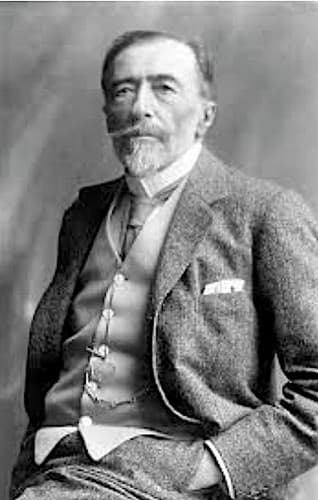
Joseph Conrad was a Polish-British novelist and short story writer. He is regarded as one of the greatest writers in the English language; though he did not speak English fluently until his twenties, he came to be regarded a master prose stylist who brought a non-English sensibility into English literature. He wrote novels and stories, many in nautical settings, that depict crises of human individuality in the midst of what he saw as an indifferent, inscrutable and amoral world.







