“When you don't know what to do, just do what you can. You'll be surprised at what you're able to accomplish.”
— Manjiro reflects on his journey and how he's navigated uncertainty.

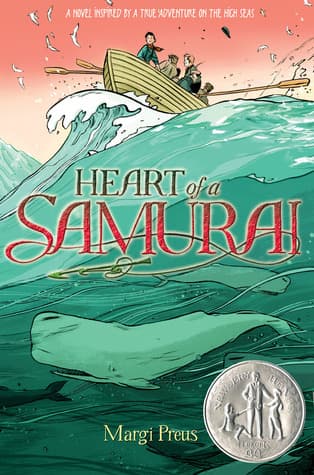
Margi Preus (2010)
Genre
Children's / Historical Fiction / Young Adult
Reading Time
300 min
Key Themes
See below
Sign in to track this book
Stranded in 1841, a curious Japanese boy's accidental journey to America and back turns him into a bridge between two worlds, challenging old borders and chasing a samurai's dream.
In 1841, fourteen-year-old Manjiro, a poor fisherman's son, goes on his first fishing trip with four other men: the experienced captain, Denzo, and three older fishermen, Goemon, Toraemon, and Jusuke. A sudden, violent storm capsizes their boat far from shore. After days adrift, clinging to the wreckage, they wash ashore on a tiny, barren volcanic island, which they later learn is Torishima. Without fresh water and little food, the men face starvation and despair. Manjiro, though the youngest, shows resilience and an observant nature. He finds ways to catch birds and collect rainwater, which helps keep the group alive as they hope for rescue that seems unlikely.
After 143 days of survival on Torishima, the five Japanese fishermen see a ship on the horizon. It is the American whaling ship *John Howland*, captained by William Whitfield. Despite initial fear and suspicion due to Japan's strict isolationist policies, the Americans rescue the men. Captain Whitfield, a kind man, takes them aboard, giving them food, water, and medical care. The language barrier is huge, but Manjiro, with his curiosity and quick mind, begins to observe and copy the English words and phrases he hears. This sets the stage for his future in American culture, much to the worry of his older companions.
The *John Howland* sails to Honolulu, Hawaii, where Captain Whitfield offers the Japanese men a choice: stay in Hawaii or continue to America with him. Japan's sakoku laws mean returning home is impossible without severe punishment. Goemon, Toraemon, and Jusuke, deeply connected to their Japanese identity and afraid of the unknown, decide to stay in Hawaii. Denzo, the captain, also chooses Hawaii, hoping to find a way back to Japan from there. Manjiro, however, driven by curiosity and a desire for knowledge, bravely decides to go with Captain Whitfield to Fairhaven, Massachusetts. He embraces the chance to learn about the mysterious Western world, a decision that puzzles his former shipmates.
In Fairhaven, Massachusetts, Manjiro is welcomed into Captain Whitfield's home and family. He is given the name John Mung and starts a new life. He attends school, learning English, mathematics, and navigation, proving to be a bright and diligent student. He faces challenges, including prejudice and cultural misunderstandings, but also finds friendship, especially with the Captain's son, William, and overcomes them with resilience. Manjiro is fascinated by American customs, technology, and democratic ideas, often comparing them to Japan's rigid class structure. He develops a deep bond with Captain Whitfield, who becomes a father figure, nurturing Manjiro's intellectual growth and independent spirit.
After several years in Fairhaven, Manjiro, now a young man, feels the call of the sea and adventure. He decides to join a whaling voyage, following Captain Whitfield's path. He ships out on the *Franklin*, first as a steward, but quickly proves his skill, rising through the ranks. The whaling life is harsh and dangerous, filled with the thrill of the chase and the constant threat of the ocean. Manjiro shows courage, competence, and leadership, earning the respect of his fellow crewmen. His experiences on the *Franklin* further broaden his understanding of the world and prepare him for future challenges.
Returning from a whaling voyage, Manjiro learns about the California Gold Rush. Wanting to earn enough money to fund his return to Japan, he decides to try his luck in the gold fields. He travels to San Francisco, a chaotic and booming town, and then to the Sierra Nevada mountains. The experience is difficult and often fruitless, as he faces the harsh realities of prospecting, including tough living conditions, competition, and the constant threat of theft. Despite the setbacks, Manjiro's determination remains strong. He eventually gathers a small amount of gold, enough to start planning his long-desired journey back to his homeland.
With his gold, Manjiro begins to plan his return to Japan. He gets help from several American friends and buys a small boat, the *Adventure*. He and two of the original shipwrecked Japanese men, Denzo and Goemon, whom he found in Honolulu, embark on a perilous voyage across the Pacific. Their goal is to reach the Ryukyu Islands (modern-day Okinawa), then controlled by the Satsuma domain, as a secret entry point to avoid direct conflict with the Shogunate's strict anti-foreign laws. The journey is full of danger, including storms and the constant fear of discovery by Japanese authorities, but Manjiro's navigational skills and resolve guide them.
Manjiro, Denzo, and Goemon successfully reach the Ryukyu Islands and land. However, local officials quickly detect their arrival. They are immediately arrested and subjected to a long and strict series of interrogations. The Japanese authorities, suspicious of their foreign clothes, English knowledge, and tales of America, question them extensively about their time abroad, their intentions, and any potential threat they pose to Japan's isolationist policy. Manjiro, despite the harsh conditions and the constant threat of execution, stays calm, carefully recounting his experiences and emphasizing his loyalty to Japan, while subtly sharing the knowledge he has gained.
Manjiro's detailed accounts of America, its technology, and its culture eventually reach higher-ranking officials within the Shogunate. He is brought to various lords and scholars, including the powerful Shimazu Nariakira, Lord of Satsuma. Manjiro describes American democracy, industry, and military power, especially the steamship, a technology far superior to anything in Japan. His unique perspective and accurate information are invaluable at a time when Western powers, particularly the Americans under Commodore Perry, are increasingly pressuring Japan to open its borders. He becomes an unofficial advisor, translating documents and explaining Western concepts, showing the potential benefits of engaging with the outside world.
Recognizing the immense value of his knowledge, Manjiro is eventually granted samurai status, a remarkable achievement for a man of his humble birth. He is appointed a hatamoto, a direct retainer of the Shogun, and given the name Nakahama Manjiro. He is an essential interpreter and advisor, especially during the arrival of Commodore Perry's Black Ships. Manjiro's understanding of both Japanese and American cultures allows him to bridge the communication gap, helping Japan navigate the complex diplomatic challenges of opening its borders. He translates treaties, teaches navigation, and contributes to Japan's modernization, fulfilling his unlikely dream and leaving a lasting legacy.
The Protagonist
From a poor, uneducated fisherman's son, Manjiro transforms into a highly educated and globally aware individual, ultimately becoming a respected samurai and crucial advisor who helps Japan navigate its opening to the West.
The Supporting
He remains a steadfast and benevolent figure, providing the foundation for Manjiro's transformation and embodying the positive aspects of cross-cultural connection.
The Supporting
He grapples with his identity and fear of the unknown, eventually choosing to return to Japan with Manjiro, reaffirming his loyalty to his homeland.
The Supporting
He evolves from a fearful traditionalist to someone willing to risk everything to return home, showing a quiet courage.
The Supporting
He remains a consistent force for modernization, using Manjiro's knowledge to strengthen Japan's position.
The Supporting
She provides a steady, loving presence, helping Manjiro adjust to his new life in America.
The Mentioned
They choose to remain in Hawaii, representing the path not taken by Manjiro and the majority's fear of the unknown.
The Supporting
He offers Manjiro early friendship and acceptance, easing his transition into American life.
The novel explores cultural exchange, showing how Manjiro connects isolationist Japan and the rapidly modernizing West. His journey highlights the challenges and rewards of cross-cultural understanding. Manjiro's ability to adapt to American customs, learn English, and eventually translate between the two nations shows the power of open-mindedness. This theme is clear when Manjiro, though initially viewed with suspicion in Japan, uses his knowledge of Western technology and diplomacy to help his country understand and respond to Commodore Perry's demands, preventing potential conflict and fostering a reluctant but necessary dialogue between civilizations.
““There are two kinds of people in this world,” Captain Whitfield had told him. “Those who are afraid of what’s different, and those who are curious.””
Manjiro's journey is a constant negotiation of his identity. He starts as a Japanese fisherman, becomes 'John Mung' in America, and then struggles to reclaim his Japanese identity upon his return, even being imprisoned as an outsider. The theme explores the feeling of being caught between two worlds, not fully belonging to either, yet finding strength in this unique position. His longing for Japan is a constant undercurrent, even as he thrives in America. Ultimately, he creates a new, hybrid identity, becoming a 'samurai' who embodies both Japanese tradition and Western knowledge, proving that belonging can be redefined and earned through one's contributions.
“He was a samurai now, a hatamoto. And yet, he would always be Manjiro, the fisherman’s son, the boy who had sailed to America and back.”
Manjiro's main trait is his curiosity and his pursuit of knowledge. His curiosity drives him to leave Hawaii for America, to attend school, to learn navigation, and to absorb every detail of Western culture and technology. This theme emphasizes the power of learning and how an open mind can lead to extraordinary opportunities. His detailed observations of American democracy, industry, and military strength become invaluable to the Shogunate, showing that knowledge, even from 'forbidden' sources, can be a nation's greatest asset, especially in times of crisis.
“He wanted to know everything. He wanted to understand the world beyond the narrow confines of his village and his country.”
Manjiro faces many life-threatening challenges: a shipwreck, starvation on a desolate island, cultural alienation in a foreign land, and the risk of execution upon returning home. His journey shows extraordinary courage and resilience. He consistently adapts, perseveres, and maintains hope in the face of adversity. From learning a new language and customs to surviving harsh whaling expeditions and the gold rush, Manjiro's unwavering spirit allows him to overcome obstacles that would defeat most others, ultimately enabling him to achieve his goals and serve his nation.
“Fear was a cold, wet blanket, but curiosity was a fire.”
The narrative implicitly critiques Japan's policy of sakoku (isolation), highlighting its stifling effect on progress and understanding. Manjiro's experiences expose the technological and ideological gap that has grown between Japan and the West. His return forces Japan to confront the reality of a changing world, showing that isolation, while intended to preserve culture, ultimately leaves a nation vulnerable. The theme explores the difficult balance between preserving tradition and embracing necessary change for survival and advancement, as Japan must ultimately open its borders to avoid being forcibly subjugated by Western powers.
“Japan had closed its doors to the world. But the world, Manjiro knew, was not waiting politely outside.”
Manjiro's transformation through a series of challenges and discoveries.
Manjiro's story closely follows the structure of a hero's journey. He is called to adventure by the shipwreck, leaves his known world, faces trials and temptations (surviving on the island, adapting to America, whaling, gold rush), receives guidance (from Captain Whitfield), and ultimately returns to his homeland with a 'boon'—his invaluable knowledge of the West. This framework emphasizes his personal growth and the epic scope of his experiences, transforming him from an ordinary boy into a national hero who bridges two worlds.
Highlighting differences between Japanese and American customs and values.
The novel frequently uses cultural contrast to illuminate Manjiro's experiences and the broader themes. It juxtaposes the rigid class structure and isolationist policies of feudal Japan with the democratic ideals, technological advancements, and individual freedoms of 19th-century America. This device is seen in Manjiro's observations of American schools, political discourse, and family life compared to his memories of Japan. It helps readers understand the profound cultural shock Manjiro experiences and the challenges of bridging such disparate worlds, while also showcasing the unique strengths and weaknesses of each society.
Narrative told primarily from Manjiro's viewpoint, granting intimate access to his thoughts.
While written in third person, the narrative maintains a very close focus on Manjiro's internal thoughts, feelings, and perceptions. This allows readers to intimately experience his wonder, fear, curiosity, and struggles as he navigates new cultures and challenges. This perspective makes his cultural clashes and moments of understanding particularly impactful, fostering empathy and allowing the reader to grow alongside him. It is crucial for understanding his emotional journey and the development of his dual identity, as we see the world through his evolving eyes.
Incorporating real historical events and figures to ground the fictional narrative.
The novel is based on the true story of Manjiro, and it meticulously weaves in historical facts, such as the *John Howland*'s voyage, the California Gold Rush, and Commodore Perry's arrival in Japan. This device lends authenticity and educational value to the narrative. By grounding the fictionalized account in real events, it not only makes the story more compelling but also provides readers with a vivid and accessible entry point into a significant period of Japanese and American history, demonstrating the profound impact of individual lives on historical turning points.
“When you don't know what to do, just do what you can. You'll be surprised at what you're able to accomplish.”
— Manjiro reflects on his journey and how he's navigated uncertainty.
“The sea is a cruel master, but a good teacher.”
— Manjiro's initial thoughts on the harshness and lessons learned from the ocean.
“It is not the sword that makes a samurai, but the heart.”
— Manjiro's internal struggle with the definition of a samurai and his own identity.
“A man's worth is not in his possessions, but in his character.”
— Manjiro observes the different values between his Japanese upbringing and American culture.
“To be truly free, one must be able to choose his own path.”
— Manjiro longs for the freedom to explore the world, a contrast to Japan's isolation.
“Sometimes, the biggest courage is to admit you don't know.”
— Manjiro learns humility and the importance of asking questions in a new culture.
“The world is bigger than you can imagine, and full of wonders.”
— Manjiro's initial awe and excitement upon seeing new lands and experiencing new cultures.
“Even in the darkest times, there is always a glimmer of hope.”
— Manjiro and his companions face starvation and despair while adrift at sea.
“Language is a bridge between worlds.”
— Manjiro's struggle and eventual success in learning English, opening new possibilities.
“Fear can be a powerful motivator, or a paralyzing force. It's up to you which it becomes.”
— Manjiro confronts his fears about returning to Japan and facing the consequences.
“Home is not just a place, but a feeling of belonging.”
— Manjiro feels a sense of belonging with Captain Whitfield and his family, despite being far from Japan.
“To truly understand someone, you must walk in their shoes.”
— Manjiro's growing empathy for different people and cultures he encounters.
“The greatest journeys are not always to distant lands, but within oneself.”
— Manjiro's internal growth and self-discovery throughout his adventures.
Ready to see how well you understood this book? Take our interactive quiz with 10 questions.

Dan Gemeinhart
4.5

Kate O'Hearn
4.4

Jeanne Birdsall
4.4

Jen Wang
4.4

Wendelin Van Draanen
4.3

John Marsden
4.3

Chris Van Allsburg
4.3

Jennifer A. Nielsen
4.2