“The past is never dead. It's not even past.”
— A recurring theme about the lingering effects of past events on the present.

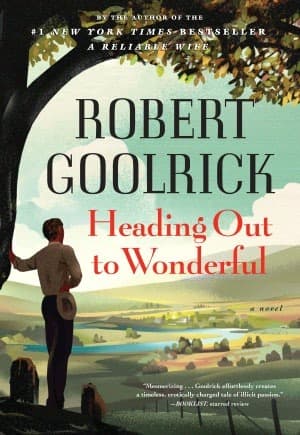
Robert Goolrick (2012)
Genre
Literary Fiction / Thriller / Historical Fiction / Mystery / Romance
Reading Time
600 min
Key Themes
See below
Sign in to track this book
In the sweltering summer of 1948, a charming war veteran with a suitcase full of cash and a set of butcher knives carves a path of doomed romance and chilling mystery through a sleepy Virginia town.
In the summer of 1948, Charlie Beale, a handsome and mysterious veteran, arrives in the small, isolated town of Brownsburg, Virginia. He carries two suitcases: one with his few belongings, including professional butcher knives, and the other with a large sum of money, implied to be stolen. Charlie quickly gets a job as a butcher in Mr. Miller's grocery store. He charms the townspeople with his good looks and politeness, despite their curiosity and suspicion about his sudden wealth and unknown past. He buys a small house and starts to settle into the community, though his past remains a complete mystery.
Charlie is immediately drawn to Sylvan Glass, the beautiful and lively daughter of the town's wealthy and influential Mr. Glass. Sylvan is engaged to Robert, a respectable local man, but Charlie is not deterred. He begins to pursue her with an intense, almost predatory focus, often visiting the Glass family's store and finding chances to be near her. Sylvan, at first resistant and wary of Charlie's intensity, gradually finds herself attracted to his charm, his dark appeal, and the unsettling passion he shows, which contrasts with her predictable life and fiancé.
Despite the risk to Sylvan's reputation and her upcoming marriage, she gives in to Charlie's relentless pursuit, and they begin a passionate, secret affair. Their meetings are furtive, often late at night, in isolated places around Brownsburg. The affair is intense and all-consuming, marked by strong physical attraction and a sense of forbidden excitement. Sylvan finds herself increasingly caught in Charlie's world, drawn to his mysterious nature and the raw, untamed passion he offers, a sharp contrast to the quiet, expected life she had planned with Robert. The secrecy of their relationship only increases its intensity and danger.
As Charlie and Sylvan's affair continues, their secrecy becomes harder to maintain. Sylvan's increasingly erratic behavior, her late-night absences, and her general distraction do not go unnoticed by her family and her fiancé, Robert. Whispers and suspicions begin to spread among the close-knit townspeople. Mr. Glass, Sylvan's protective father, grows increasingly wary of Charlie Beale, sensing the trouble he brings to his daughter's life and the potential scandal for his family. Tension in Brownsburg rises, creating an atmosphere of coming confrontation and discovery.
The affair is eventually exposed, destroying Sylvan's engagement and her family's reputation. This leads to a violent confrontation arranged by Mr. Glass and the town's men, including Robert, who want to drive Charlie out of Brownsburg and protect Sylvan's honor. Charlie, however, is not easily scared. He fights back fiercely, showing a dangerous and brutal side that had been hidden beneath his charming exterior. The confrontation is bloody and public, leaving Charlie injured but unyielding, and further solidifying his status as an outsider and a threat in the town's eyes.
After the confrontation, Charlie, still recovering from his injuries, shows Sylvan a darker part of his personality. He hints at a violent and traumatic past, possibly involving his time in the war or events before it, suggesting a capacity for brutality that chills Sylvan. This revelation unnerves Sylvan, making her question the true nature of the man she has fallen for. She begins to see beyond the charm to a dangerous, disturbed individual, yet she remains inexplicably tied to him, caught between fear and a powerful, destructive love.
Against her family's wishes and the town's judgment, Sylvan chooses Charlie. They marry in a quiet, somber ceremony, effectively isolating Sylvan from her family and Brownsburg society. Their married life, however, is far from perfect. Charlie becomes increasingly possessive and controlling, his dark moods and violent tendencies escalating. The initial passion that drew them together begins to sour into a suffocating, fearful existence for Sylvan, as she realizes the true cost of her choice and the depth of Charlie's disturbed mind.
A young boy named Earl becomes Charlie's apprentice at the butcher shop. Earl, a quiet and observant child, directly witnesses the strange dynamics of Charlie and Sylvan's relationship, the tension in their home, and Charlie's increasingly erratic behavior. He also observes Charlie's peculiar and meticulous methods as a butcher, which take on a sinister tone given Charlie's unraveling personality. Earl becomes an innocent bystander, aware of the dark secrets unfolding in Brownsburg, his perspective offering a view into the community's quiet horror.
One day, Sylvan disappears. Her absence shocks Brownsburg, bringing back old suspicions about Charlie. Charlie's explanations are vague and unconvincing, and his behavior becomes increasingly erratic and isolated. The townspeople, who already distrusted him, now openly suspect him of foul play. The authorities are involved, but without a body or concrete evidence, they cannot formally charge Charlie, despite the overwhelming circumstantial evidence and the town's strong belief in his guilt. The mystery of Sylvan's fate hangs heavily over the town.
Tormented by his actions and haunted by Sylvan, Charlie Beale begins to fully unravel. The pressure from the town, his own guilt, and the slow, inevitable return of his past finally break him. He eventually confesses to Sylvan's murder, revealing the horrific details of her death and what he did with her body. His confession confirms the town's darkest fears and exposes the full extent of his depravity, bringing a tragic end to Sylvan's story and a chilling resolution to the mystery that had gripped Brownsburg. Charlie is arrested, and the town tries to come to terms with the horror that had lived among them.
After Charlie's confession and arrest, Brownsburg is left to deal with the deep trauma and loss. The community is forever changed by the events, the small town's innocence shattered. Sylvan's family is devastated, left with the agonizing truth of their daughter's fate. The story of Charlie Beale and Sylvan Glass becomes a haunting legend, a cautionary tale of love gone terribly wrong and the darkness that can hide beneath a charming facade. The town tries to heal, but the memory of the summer of 1948 and its tragic consequences lasts for generations.
The Protagonist/Antagonist
Charlie transforms from a charming stranger to a possessive, violent husband, ultimately revealing his true monstrous nature and facing his downfall.
The Protagonist/Victim
Sylvan transitions from an engaged young woman to a woman consumed by a destructive love, ultimately becoming the tragic victim of Charlie's pathology.
The Supporting
Mr. Glass struggles to protect his daughter and family honor, ultimately experiencing profound grief and the shattering of his world.
The Supporting
Earl's innocence is exposed to the dark realities of human nature, leaving him with lasting, traumatic memories.
The Supporting
Robert is initially a symbol of normalcy, then becomes a victim of Sylvan's betrayal and Charlie's disruption.
The Supporting
Mr. Miller experiences the disruption Charlie brings to his business and community.
The novel shows how Charlie Beale's initial attraction to Sylvan Glass grows into a dangerous, all-consuming obsession. This theme appears in Charlie's relentless pursuit of Sylvan, his disregard for her engagement, and his increasing possessiveness after their marriage. His obsession blinds him to any moral limits, leading to violence and murder. Sylvan also becomes obsessed with Charlie, pulled into a destructive cycle she cannot escape. The story demonstrates how such intense, unbalanced desire can destroy individuals and lives.
“He wanted her with a ferocity that was frightening, a hunger that devoured everything else.”
Brownsburg first appears as an idyllic, peaceful post-war American town, but Charlie Beale's arrival removes this facade to show underlying tensions, judgments, and a capacity for collective suspicion and fear. The town's initial acceptance of Charlie quickly turns to isolation and then hostility. The novel examines how a close-knit community can be both a source of comfort and a breeding ground for gossip and judgment, and how easily its perceived innocence can be broken by outside evil or internal moral decay. The town's inability to truly protect Sylvan, despite its good intentions, highlights this theme.
“Brownsburg was a town that believed in order, in the way things had always been, and Charlie Beale was a fly in the ointment of their quiet certainty.”
Charlie Beale's character is deeply shaped by his World War II experiences, though these are never explicitly detailed. His violence, detachment, and disturbed mind are strongly implied to be results of the horrors he saw or committed during the war. The novel suggests that the war took away his humanity, leaving him with a capacity for brutality that he brings back to civilian life. This theme explores how trauma can warp a person, making them a danger to themselves and others, and how the scars of conflict can appear in unexpected and devastating ways in peacetime.
“He carried the war inside him, a dark and restless thing that would not be still.”
The passionate affair between Charlie and Sylvan, an outsider and a woman engaged to another, is a classic theme of forbidden love. Their relationship is thrilling and intense precisely because it goes against societal norms and expectations. However, the novel quickly shows the devastating consequences of this transgression. Their love, born from illicit passion, leads to Sylvan's isolation, her separation from her family, and ultimately, her tragic death. It highlights how breaking societal rules, especially in a strict community, can lead to severe personal and social problems.
“Their love was a secret, dangerous flame, burning through the propriety of Brownsburg.”
Charlie Beale's enigmatic past and unknown origins create initial intrigue and foreshadowing.
Charlie Beale's arrival in Brownsburg as a handsome, charming stranger with a suitcase full of money and an unspoken past serves as a classic literary device. His mysterious nature immediately creates intrigue and curiosity among the townspeople and the reader. This device allows the author to gradually reveal Charlie's true character and dark history, building suspense and foreshadowing the tragedy to come. The mystery surrounding him is integral to both Sylvan's attraction and the town's suspicion.
The butcher knives, the dark woods, and Charlie's unsettling intensity hint at future violence.
The novel uses various symbols to foreshadow the impending doom. Charlie's profession as a butcher and his fine set of knives subtly hint at his capacity for violence and precision. The dark, isolated woods where Charlie and Sylvan often meet symbolize the forbidden nature of their affair and the dangerous path they are treading. Charlie's intense gaze and unsettling passion, often described with animalistic imagery, consistently foreshadow his predatory nature and the destructive potential of his desires, building a sense of dread throughout the narrative.
The young apprentice provides an objective, albeit traumatized, perspective on the unfolding events.
Earl, the young boy who becomes Charlie's apprentice, functions as an innocent bystander, a narrative device that offers an unvarnished perspective on the escalating horror. His observations of Charlie and Sylvan's relationship, Charlie's strange behavior, and the aftermath of Sylvan's disappearance provide crucial insights without explicit judgment. This device heightens the sense of tragedy, as the reader experiences the events through the eyes of someone whose innocence is irrevocably lost due to the depravity he witnesses, making the horror more poignant.
Brownsburg's insularity amplifies the impact of Charlie's arrival and the subsequent scandal.
The setting of Brownsburg, a quiet, insular village in post-war Virginia, is a crucial plot device. Its isolation and close-knit nature mean that the arrival of an outsider like Charlie Beale has a magnified impact. Gossip spreads quickly, and secrets are hard to keep. This setting amplifies the scandal of Sylvan and Charlie's affair and the subsequent horror of Sylvan's disappearance, making it a central event that shakes the entire community to its core. The town's rigid social structure and moral code also highlight the 'forbidden' aspect of the romance.
“The past is never dead. It's not even past.”
— A recurring theme about the lingering effects of past events on the present.
“He knew, with the certainty of a man who has lost everything, that he had to get it back, whatever 'it' was.”
— After the protagonist, Sam, experiences a significant loss.
“Love, he realized, was not a gentle current but a powerful river, capable of both creation and destruction.”
— Sam reflecting on the nature of his intense feelings for Sylvan Glass.
“There are some things you can't outrun, no matter how fast you go or how far you travel.”
— A character's realization about the inescapability of their past actions.
“The quiet desperation of small towns was a thing he understood intimately.”
— Sam's observation of the hidden lives and struggles in the rural setting.
“Every man has a secret, and every secret has its price.”
— A general statement about the hidden lives of people and the cost of their secrets.
“He learned that the most dangerous lies were the ones you told yourself.”
— Sam's internal reflection on self-deception.
“The world was a beautiful, terrible place, and he was just a small part of its intricate, brutal dance.”
— A moment of existential reflection on the protagonist's place in the larger scheme of things.
“Sometimes, the only way to move forward was to burn the bridges behind you.”
— A character making a difficult decision to sever ties with their past.
“He carried the weight of his choices like stones in his pockets.”
— Sam feeling the burden of his past decisions.
“There was a kind of beauty in the wreckage, if you knew where to look.”
— A character finding unexpected solace or understanding amidst chaos and destruction.
“The silence in her absence was louder than any scream.”
— Sam experiencing the profound emptiness after Sylvan's departure or loss.
“He understood then that true freedom wasn't about going anywhere, but about being free from something.”
— A realization about the nature of freedom, possibly after escaping a difficult situation.
“The truth, like a river, always finds its way to the sea, no matter how many dams you build.”
— A metaphor for the inevitability of truth being revealed.
Ready to see how well you understood this book? Take our interactive quiz with 10 questions.

Biography coming soon.







