“I used to hate that cat. I used to hate that cat more than anything.”
— Jack reflecting on his initial feelings towards the black cat, before he understood its significance.

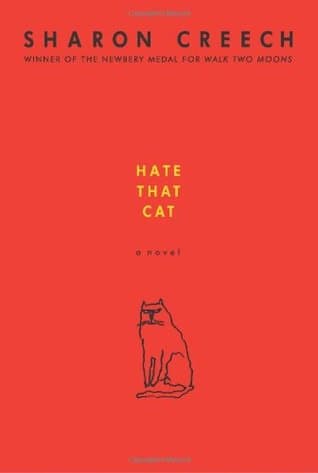
Sharon Creech (2008)
Genre
Children's / Young Adult
Reading Time
90 min
Key Themes
See below
Sign in to track this book
A young boy named Jack navigates his grief and developing poetic voice, finding an unexpected muse and antagonist in a sassy, nut-dropping black cat.
The story begins with Jack, a young boy in Miss Stretchberry's class (Room 204), writing a series of free verse poems during the school year. His first entries in February immediately show his dislike for a 'fat black cat' that drops a nut on his head, making a 'nasty, spiteful' meow. He dislikes cats in general, often mentioning his discomfort around them. At the same time, Jack does not want to write poetry, often saying he 'can't' or 'doesn't want to.' Miss Stretchberry, his teacher, patiently encourages him, suggesting different forms and topics, gently pushing him to explore his thoughts and feelings through verse, often referencing classic poems and poets.
As the school year goes into March and April, Miss Stretchberry introduces Jack to different poetic forms and famous poets. She reads poems about animals, nature, and everyday life, trying to find something Jack can connect with. He slowly starts to respond, at first copying the structures or themes of the poems she shares. For instance, after hearing William Carlos Williams's 'The Red Wheelbarrow,' Jack tries his own version, focusing on a 'yellow school bus.' He also works with haikus and concrete poems, showing a growing, though still hesitant, interest in writing.
A moment happens when Miss Stretchberry introduces the class to the poetry of Walter Dean Myers. Jack is immediately interested, especially by Myers's poem 'Love That Boy.' This poem deeply connects with Jack, who repeatedly asks Miss Stretchberry to read it aloud. He begins to understand how words can capture strong emotions and experiences. The rhythm and imagery of Myers's work inspire Jack, and for the first time, he shows real enthusiasm for a poem, even asking if he can try to write a poem 'like that.' This shows a change in his attitude towards poetry.
After discovering Walter Dean Myers, Jack's poetry becomes more personal and heartfelt. He starts writing about things that truly matter to him, going beyond simple observations. He writes about sounds, silence, and writing itself. He even begins to show a tentative appreciation for the 'cat' in Myers's poem 'Love That Boy,' understanding it as a symbol of comfort and companionship, rather than just the nuisance he associates with his own 'fat black cat.' His entries become longer, more descriptive, and show a developing confidence in his poetic voice, often directly telling Miss Stretchberry his thoughts.
In a personal entry, Jack finally shares why he has complicated feelings about cats and his initial reluctance to write about them. He had a beloved cat named Sky, who was blind and deaf. Sky was hit by a car and died, a traumatic event that left Jack heartbroken. This explains his strong dislike for the 'fat black cat' and his difficulty expressing himself through poetry; the pain of Sky's loss was too fresh. He describes Sky's unique qualities, how she moved through the world, and the deep bond they shared, making it clear that his 'hate' for the other cat was displaced grief.
With the truth about Sky's death now known, Jack begins to use his poems to process his grief. He writes poignant verses recalling Sky's blindness, her gentle nature, and the sorrow he feels over her absence. He describes the silence in his house after she's gone and the lasting pain of her loss. His poems show his love for Sky, changing his initial 'hate' into an outlet for sadness and remembrance. Miss Stretchberry provides quiet support, allowing him the space to mourn and heal through his writing, acknowledging his deep feelings.
Jack makes a connection between his own beloved Sky and the 'cat' in Walter Dean Myers's 'Love That Boy.' He realizes that Myers's poem is not just about a literal cat, but about deep affection, companionship, and perhaps even loss. He sees similarities between the comfort and love described in the poem and the bond he shared with Sky. This realization helps him to further accept the power of poetry to express complex emotions and to find comfort. He now 'loves' the cat in Myers's poem because it reminds him of his own cherished pet.
As the school year ends, Jack's confidence in his poetic voice grows. He continues to write about Sky, about words, and about the world around him, but with new ease and depth. He even begins to appreciate the 'fat black cat' that first bothered him, seeing it as just another creature in the world, no longer weighed down by his grief. Miss Stretchberry invites Walter Dean Myers to visit the school, and Jack volunteers to read his poems about Sky at the assembly, showing his transformation and healing.
The school assembly arrives, and Walter Dean Myers is present. Jack, at first nervous, bravely stands before the audience and reads his poems about Sky. This public act of sharing his personal grief and love is the result of his journey throughout the book. He receives encouragement and validation from Myers, who acknowledges the power of Jack's words. This experience gives Jack a sense of closure and affirmation, solidifying his new identity as a poet who can express his deepest feelings and experiences, turning his sorrow into art.
The Protagonist
Jack transforms from a reluctant, closed-off student into a confident poet who uses words to process grief and express profound love.
The Supporting
She consistently provides a nurturing environment, facilitating Jack's journey from reluctance to poetic confidence.
The Mentioned/Symbolic
Sky's memory serves as the catalyst for Jack's emotional and poetic development, allowing him to process grief.
The Supporting/Inspirational
Myers acts as a distant mentor, then a direct encourager, validating Jack's poetic talent.
The Symbolic
Initially a symbol of Jack's aversion, it becomes a marker of his emotional healing as his feelings towards it change.
The main theme is Jack's unspoken grief over the death of his blind cat, Sky. His initial resistance to writing and his dislike for other cats show this loss. By writing poetry, Jack slowly processes his sorrow, moving from denial and displacement to remembrance and acceptance. The book shows how art can be a tool for healing and mourning, allowing him to honor Sky's memory and express the pain of her absence. This theme is clear in his poems describing Sky's unique qualities and the silence after she is gone.
“And Sky who was blind / and deaf / was hit by a car / and died. / And now / there is no sound / in our house / at all.”
This theme explores how poetry changes Jack from a reluctant, emotionally quiet child into a confident young writer. Miss Stretchberry's patient guidance and the inspiration from Walter Dean Myers help Jack discover that poetry is not just about rhymes or specific forms, but a way to express deep feelings, observe the world, and process difficult experiences. Through his poems, Jack finds his voice, shares his vulnerability, and heals. The book supports the idea that everyone has a story to tell and that words can be a source of power and connection.
“I like the way / words / can be / a cat / or a boy / or a feeling / all at once.”
Miss Stretchberry's role as a patient, empathetic, and inspiring teacher is important to Jack's development. Her teaching style, which emphasizes encouragement over force, active listening, and exposing students to diverse literary voices, allows Jack to grow at his own pace. She recognizes his hidden struggles and provides the tools and space he needs to overcome them. This theme shows the impact a dedicated educator can have on a child's emotional and intellectual growth, encouraging creativity and self-discovery.
“Miss Stretchberry, / you are a good teacher. / You always make me / think.”
At first, Jack struggles with empathy, projecting his grief onto the 'fat black cat.' However, as he explores his own emotions through poetry, he begins to understand others and the world better. His connection to Walter Dean Myers's poem 'Love That Boy' allows him to see a cat not just as a nuisance, but as a symbol of love and companionship, mirroring his own bond with Sky. This journey helps him develop empathy, moving beyond his immediate pain to appreciate the broader spectrum of life and feeling.
“And the cat / in the poem / is a good cat / and I love that cat / because it reminds me / of Sky.”
The entire narrative is presented as a collection of Jack's free verse poems.
The entire novel is structured as a series of free verse poems written by Jack throughout his school year. This device allows for an intimate first-person perspective, directly conveying Jack's thoughts, feelings, and observations without the constraints of traditional narrative prose. The evolving style and content of his poems directly reflect his emotional and intellectual growth, from short, resistant entries to longer, more expressive verses. It immerses the reader in Jack's internal world and makes his journey of self-discovery highly personal and impactful.
The story unfolds through Jack's poetic entries, addressed primarily to his teacher.
The book uses an epistolary format, as Jack's poems are essentially journal entries or letters addressed to his teacher, Miss Stretchberry. This device creates a direct, conversational tone, allowing Jack to share his thoughts and feelings as they develop. Miss Stretchberry's presence is implied through Jack's responses and questions, making the reader privy to a dynamic, evolving dialogue. This format emphasizes the personal journey of the protagonist and highlights the supportive relationship between student and teacher, making the reader feel like an observer of Jack's private reflections.
Cats symbolize grief, love, and the process of healing for Jack.
Cats serve as a powerful symbolic motif throughout the book. The 'fat black cat' initially symbolizes Jack's displaced anger and unresolved grief, acting as an innocent target for his negative emotions. Conversely, Jack's beloved blind cat, Sky, symbolizes unconditional love, loss, and the unique beauty found in vulnerability. The 'cat' in Walter Dean Myers's poem 'Love That Boy' then becomes a symbol of comfort, companionship, and the universal experience of deep affection. The evolution of Jack's feelings towards these different cats directly mirrors his emotional journey and healing process.
References to famous poets and their works guide Jack's poetic development.
Miss Stretchberry frequently introduces Jack and the class to various poets like William Carlos Williams, Robert Frost, and Walter Dean Myers. These allusions serve as pedagogical tools, providing models and inspiration for Jack's own writing. By engaging with these established works, Jack learns about different poetic forms, themes, and the power of language. The most significant allusion is to Walter Dean Myers's 'Love That Boy,' which acts as a profound catalyst for Jack, helping him connect with his own emotions and understand the deeper purpose of poetry, moving beyond mere imitation to genuine self-expression.
“I used to hate that cat. I used to hate that cat more than anything.”
— Jack reflecting on his initial feelings towards the black cat, before he understood its significance.
“It's hard to write about things you don't understand.”
— Jack's early struggles with poetry assignments and his teacher's encouragement.
“Sometimes you have to look at the same thing in a different way to see it truly.”
— His teacher, Miss Stretchberry, offering advice on perspective, especially regarding his feelings about the cat.
“The world is full of sounds, if you just listen.”
— Jack's growing awareness of his surroundings as he starts to pay more attention to the cat and nature.
“You can't always choose what happens to you, but you can choose how you react.”
— A lesson Jack slowly learns about dealing with loss and unexpected events.
“Poetry is just noticing things.”
— Jack's evolving definition of poetry, moving beyond strict rules to simple observation.
“And sometimes the things you hate the most are the things you need the most.”
— Jack realizing the unexpected comfort and companionship the cat brought into his life.
“It's okay to miss someone, even if they're still here.”
— Jack's feelings about his grandmother and the changes in her life.
“A good poem can make you feel things you didn't even know you had inside.”
— Jack's reflection on the power of poetry after experiencing its impact.
“Sometimes the quietest things make the loudest noise in your heart.”
— Jack's internal thoughts about the subtle yet profound impact of the cat.
“It's not about being perfect, it's about being true.”
— Miss Stretchberry's guidance on writing and expressing oneself authentically.
“And now I love that cat. I love that cat more than anything.”
— Jack's ultimate realization and transformation of feelings towards the black cat.
“You can't always understand everything, but you can always keep looking.”
— A message about continuous learning and acceptance of ambiguity.
“Even a small thing can make a big difference.”
— Jack observing how the presence of the cat, a seemingly small detail, profoundly affected his life.
Ready to see how well you understood this book? Take our interactive quiz with 10 questions.

Biography coming soon.
Dan Gemeinhart
4.5
Kate O'Hearn
4.4

Jeanne Birdsall
4.4

Jen Wang
4.4
Wendelin Van Draanen
4.3

John Marsden
4.3

Chris Van Allsburg
4.3
Jennifer A. Nielsen
4.2