“Harriet had a theory that you should always know a lot about things.”
— Harriet's general philosophy on life and observation.

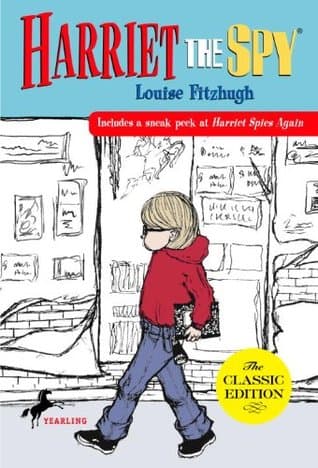
Louise Fitzhugh (1960)
Genre
Children's / Mystery / Young Adult
Reading Time
300 min
Key Themes
See below
Sign in to track this book
Armed with a trusty notebook and an unsparing wit, Harriet M. Welsch chronicles the hilariously harsh truths of her world, only to discover the explosive consequences when her candid observations fall into the wrong hands.
Harriet M. Welsch, an observant ten-year-old, lives a structured life in New York City with her wealthy parents, who are often busy. Her main confidante is her nanny, Ole Golly, a practical woman who supports Harriet's curiosity and independent spirit. Every day after school, Harriet follows her 'spy route' through her neighborhood. She observes neighbors, including Harrison Withers who collects cats, the wealthy Robinsons, and the troubled Dei Santis, writing her honest and often critical thoughts in her secret notebook. These notes help her understand the world and its people.
At school, Harriet has a complex relationship with her two best friends, Sport and Janie Gibbs. Sport Rocque, a sensitive and responsible boy, lives with his struggling writer father and often acts like a parent. Janie Gibbs is an intelligent and somewhat unstable girl interested in science experiments, especially those with explosions. Harriet's observations influence her interactions with them; she notes Sport's home life and Janie's scientific passion. Despite their close bond, Harriet's private thoughts in her notebook reveal her critical opinions of them, as well as her own worries about fitting in and the future, often feeling like an outsider even among friends.
A major event happens when Ole Golly announces her engagement to Mr. Waldenstein and her upcoming departure. Harriet is crushed. Ole Golly has been the most consistent and understanding adult in Harriet's life, offering guidance and accepting her quirks. Her leaving creates a deep emptiness. Before she goes, Ole Golly gives Harriet final advice about life and truth, which Harriet initially struggles to understand. Harriet's parents hire a new nanny, Miss Agatha K. Plummer, who is strict and distant, further isolating Harriet and increasing her feelings of loss and unhappiness.
During a game of tag in the schoolyard, Harriet accidentally leaves her secret notebook. Her classmates find it, including Marion Hawthorne, a popular but manipulative girl, and Rachel Hennessey, her friend. They gather students and begin reading Harriet's entries aloud. The children are shocked and hurt by Harriet's honest, often harsh, and unflattering opinions. Entries describe Marion as a future 'Lady Hitler,' Pinky Whitehead as repulsive, and even her friends Sport and Janie are not spared. The discovery breaks the class's fragile social peace.
The notebook's discovery brings a wave of anger and resentment from Harriet's classmates. They form a 'Spy Catcher Club' to torment Harriet. They refuse to play with her, whisper about her, trip her, and even steal her lunch. Sport and Janie, though conflicted at first, eventually join in the exclusion, feeling betrayed by Harriet's private thoughts. Harriet is completely alone, unable to understand how deeply she hurt them or how to fix the broken relationships. Her attempts to interact are met with hostility, leaving her isolated and confused by the results of her actions.
As the exclusion continues, Harriet's emotional state worsens. She becomes withdrawn, irritable, and defiant. At home, she refuses to eat, acts out against Miss Plummer, and makes life difficult for her parents. At school, her grades drop, and she becomes disruptive, unable to focus. Her parents, initially dismissing her problems, worry about her alarming change in behavior. Harriet herself is confused and overwhelmed, unable to explain her pain or her classmates' anger, leading to a downward spiral.
Harriet's parents, Mr. and Mrs. Welsch, are at a loss. Their attempts to understand and discipline Harriet fail. After talking with the school and seeing Harriet's continued decline, they decide to send her to a child psychiatrist. Harriet resists the idea, seeing it as another punishment or an invasion of her privacy. The sessions are largely unhelpful, as Harriet remains guarded and unwilling to share her true feelings or the cause of her problems. The psychiatrist offers general advice, showing the parents' lack of connection to Harriet's inner life and their superficial understanding.
In desperation, Harriet's parents contact Ole Golly, explaining Harriet's situation. Ole Golly, now in another city, writes a letter to Harriet. In it, Ole Golly acknowledges Harriet's pain and validates her unique way of seeing the world. She advises Harriet that 'lying is the most fun a girl can have without taking her clothes off, but you can't lie to yourself.' She also says, 'sometimes you have to lie. But to yourself you must always tell the truth.' She tells Harriet to apologize and to consider that 'sometimes you have to make up your mind to be a little bit wrong.' This letter offers Harriet the guidance she needs.
Inspired by Ole Golly's letter, Harriet begins to think about the advice. She realizes the impact of her words and the need to take responsibility. Her parents, finally understanding the problem, arrange for her to become the editor of the class newspaper. This position lets her use her writing skills constructively. As editor, Harriet writes a public apology to her classmates, admitting her mistakes and expressing regret for the hurt she caused. While not all her classmates immediately forgive her, the apology marks a start, allowing the slow process of reconciliation to begin.
The class newspaper gives Harriet a new outlet for her observational talents, now used with more empathy and responsibility. While she does not stop her spy route entirely, her approach changes; she learns to balance her observations with consideration for others' feelings. Some friendships slowly begin to heal, especially with Sport and Janie, who, though still cautious, start to interact with her again. Harriet understands that truth and honesty are important but must be balanced with kindness and social awareness. She learns to accept herself, not just as a spy, but as a complex person capable of both sharp observation and genuine connection, ultimately finding her place in the world.
The Protagonist
Harriet learns to temper her absolute honesty with empathy and social awareness, finding a way to use her observational talents constructively without causing undue pain.
The Supporting
Ole Golly provides foundational support and a final, critical piece of advice that enables Harriet's personal growth, even from a distance.
The Supporting
Sport grapples with betrayal but eventually begins to mend his friendship with Harriet, demonstrating his compassionate nature.
The Supporting
Janie, though deeply hurt, eventually softens her stance towards Harriet, hinting at the resilience of their friendship.
The Antagonist
Marion remains largely unchanged, serving as a catalyst for Harriet's isolation and a representation of the social consequences of Harriet's actions.
The Supporting
They slowly begin to understand the depth of Harriet's distress and seek more effective solutions, showing a slight growth in parental awareness.
The Mentioned
Harrison Withers serves as a static observational subject for Harriet.
The Supporting
Miss Plummer's character remains static, serving primarily to highlight Harriet's increasing isolation and unhappiness.
The novel explores the complexities of truth, especially the difference between objective truth and personal view, and what happens when honesty is unfiltered. Harriet's notebook holds her 'truth' about people, but this truth is often harsh and lacks empathy. When the notebook is found, Harriet faces the idea that truth, without kindness, can be damaging. Ole Golly's advice about lying to others but never to oneself highlights the internal honesty of truth versus its use in social settings. Harriet learns that while honesty is important for self-understanding, it must be balanced with consideration for others' feelings in social interactions, as shown when she apologizes to her classmates.
“Sometimes you have to lie. But to yourself you must always tell the truth.”
Harriet's journey is one of self-discovery. Her spying and notebook are her attempts to understand the world and her place in it. She grapples with who she is—a spy, a writer, a friend—and how these roles conflict or combine. Her isolation after the notebook's discovery forces her to re-evaluate her identity and the impact of her actions. By the end, she does not abandon her core identity as an observer but learns to combine it with a more empathetic understanding of human relationships. Her growth is about finding a more mature and complete sense of self that can navigate both her inner world and the external social world.
“She was Harriet M. Welsch. She was a spy. She had a notebook. It was her duty to write down everything she saw.”
Harriet experiences deep isolation, both self-imposed and caused by others. Her secretive nature and critical observations set her apart from her peers, even her best friends. The discovery of her notebook leads to her complete exclusion, making her feel utterly alone and misunderstood. This period of isolation is painful for Harriet and is made worse by Ole Golly's departure, her only true confidante. The theme explores the universal childhood need to belong and the pain of being an outsider. Harriet's eventual reconciliation, however uncertain, shows her slow return to a sense of community, teaching her the value of connection.
“The world was a lonely place when you were ten and had no friends.”
Ole Golly is Harriet's main mentor, providing the intellectual and emotional guidance that Harriet's parents often do not. Ole Golly encourages Harriet's unique talents while subtly teaching life lessons about truth, perception, and human nature. Her departure leaves a significant gap, and Harriet struggles without her direct influence. However, Ole Golly's final letter, sent at a crucial time, gives Harriet the wisdom she needs to handle her crisis and begin to understand and reconcile. This shows the deep impact a wise mentor can have on a child's development, even when not physically present.
“You just keep on writing. But try to remember that people are sensitive.”
A physical manifestation of Harriet's inner world and a catalyst for conflict.
Harriet's secret notebook is the central plot device. It serves as an extension of her mind, a private repository for her unfiltered thoughts, observations, and judgments. It is through these entries that the reader gains insight into Harriet's intelligence, wit, and often brutal honesty. The notebook's accidental discovery by her classmates is the inciting incident that propels the main conflict of the story, leading to Harriet's ostracization. Its contents drive the plot, revealing character motivations and forcing Harriet to confront the consequences of her actions and words.
A turning point providing crucial advice and a path to resolution.
Ole Golly's letter is a pivotal plot device that arrives at Harriet's lowest point. It functions as a deus ex machina of sorts, providing the wisdom and guidance Harriet desperately needs after her parents' attempts at intervention fail. The letter's advice about truth, lying, and the necessity of sometimes being 'a little bit wrong' is the catalyst for Harriet's change in perspective and her eventual apology. It allows Harriet to process her experiences and move towards reconciliation, demonstrating the lasting impact of a mentor's words even in absence.
A structural element that frames Harriet's observations and exploration of her world.
Harriet's daily 'spy route' is a recurring structural device that establishes her routine and her primary method of engaging with the world. It provides a consistent framework for her observations of various eccentric neighbors and allows the narrative to introduce a diverse cast of characters through Harriet's unique lens. The route itself symbolizes Harriet's quest for understanding and her detached, analytical approach to life. It emphasizes her identity as an observer and writer, setting the stage for the later conflict when her private observations become public.
“Harriet had a theory that you should always know a lot about things.”
— Harriet's general philosophy on life and observation.
“She was a spy. She had been a spy for as long as she could remember.”
— Introducing Harriet's core identity and passion.
“There were a lot of things she didn't know, and she intended to find them out.”
— Harriet's motivation for her spying activities.
“She wrote down everything. Not just facts, but opinions.”
— Describing Harriet's meticulous and personal note-taking style.
“The world was full of secrets, and she was going to find them all.”
— Harriet's grand ambition as a spy.
“Sometimes she felt like a cat, watching everything, but not being part of it.”
— Harriet's sense of detachment while observing others.
“You just have to write it down. Everything. No matter what.”
— Harriet's commitment to her notebook and her spy work.
“If you don't write it down, you forget it. And if you forget it, it's gone forever.”
— Harriet's belief in the importance of documentation.
“She wasn't mean. She just wrote down what she saw.”
— Harriet's justification for her sometimes harsh observations.
“Ole Golly said that life was an adventure, and you should live it to the fullest.”
— Ole Golly's influence on Harriet's adventurous spirit.
“She felt a great loneliness, a loneliness that was peculiar to her, and she hugged it to herself.”
— Harriet grappling with her feelings of isolation.
“It was impossible to be a spy without a notebook.”
— Emphasizing the essential tool of Harriet's trade.
“She wanted to know what made people tick.”
— Harriet's fundamental curiosity about human nature.
“Sometimes, for no reason at all, she would feel like crying.”
— Showing Harriet's vulnerability and complex emotions.
Ready to see how well you understood this book? Take our interactive quiz with 10 questions.

Biography coming soon.

Dan Gemeinhart
4.5

Kate O'Hearn
4.4

Jeanne Birdsall
4.4

Jen Wang
4.4
Wendelin Van Draanen
4.3

John Marsden
4.3

Chris Van Allsburg
4.3
Jennifer A. Nielsen
4.2