“One evening, Harold wanted to go for a walk in the moonlight.”
— The very beginning, setting the scene for Harold's adventure.

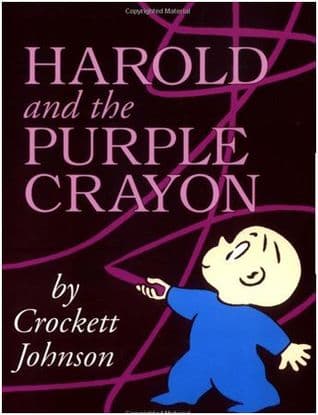
Crockett Johnson (1955)
Genre
Fantasy / Children's / Creativity / Young Adult
Reading Time
10 min
Key Themes
See below
Sign in to track this book
With a single purple crayon, a young boy sketches an entire world of adventure, showing how imagination helps with life's unexpected turns.
One evening, Harold decides to go for a walk. Finding no moon to light his way, he takes out his purple crayon and draws a large moon in the sky. He then draws a long, straight path for himself to walk on. His journey begins with purpose and the immediate use of his creative power, showing that his drawings become real, letting him control his environment and adventure.
As Harold walks, he decides the path is too straight and draws a thick forest around it. The forest, however, quickly becomes too big and dark, causing Harold to get lost. To escape, he draws a single, tall mountain and climbs it. From the top of the mountain, he can see over the forest, but then realizes he needs a way down. This part shows Harold's problem-solving skills and his ability to fix his own creative mistakes, mixing imagination and practicality.
Harold tries to draw a path down the other side of the mountain but accidentally slips and falls into a large sea he hadn't meant to draw. Resourceful, he quickly draws a small boat and sails away from the mountain. This moment shows the surprising nature of his creative world, where even accidental drawings can become real. His quick response to danger, by drawing a solution, shows his calm and quick thinking.
After sailing for a while, Harold draws an island to land on. On the island, he sees a scary dragon. To distract the dragon, he draws an apple tree with nine apples. The dragon, interested in the apples, becomes less threatening. Harold, now hungry, picks an apple for himself, showing his ability to handle threats and meet his own needs through drawing.
Harold, still hungry after the apple, draws a big picnic with nine kinds of pie. After eating, he realizes he is getting sleepy and decides it is time to go home. He draws a house, but realizes it is not his own house. This moment shows a bit of feeling lost and wanting familiar things, as his creations, while useful, do not always provide the comfort of home.
Determined to find his own house, Harold draws a big city with many windows, hoping to see his own. He walks through the busy city, drawing streets and lampposts, but none of the windows he sees belong to him. This part of his journey shows a change from creating new adventures to actively looking for something specific and already existing, meaning he wants the familiar comforts of home more.
Lost and a little annoyed, Harold draws a friendly policeman to ask for directions home. The policeman, however, only points in the direction Harold is already going. Continuing his search, Harold then remembers that his window always has the moon outside it. He draws a window with the moon perfectly framed. This moment of remembering is a breakthrough, connecting his memory with his creative power to finally find his way.
Having found his window, Harold quickly draws his bed right under it. He climbs into bed, places his purple crayon on the nightstand, and goes to sleep. His adventure ends with a return to the safety and comfort of his own room, showing that even imaginative journeys can end with a peaceful homecoming. The purple crayon, his tool for creation, is put away until his next adventure.
The Protagonist
Harold begins by creating an adventure and successfully navigates it, ultimately learning to use his imagination to find his way back to comfort and security.
The main idea of the book is the great power of imagination. Harold literally creates his entire world and solves every problem he meets using his purple crayon. From drawing a moon to light his path, to creating a boat to sail, or a picnic to eat, his creativity drives the story. The story celebrates the idea that with imagination, one can overcome any problem and make their own reality, for both adventure and comfort.
“He wanted to go for a walk in the moonlight. But there wasn't any moon.”
Harold often shows good problem-solving skills. When he gets lost in the forest he drew, he draws a mountain to see over it. When he falls into the sea, he draws a boat. When he is hungry, he draws a picnic. This idea shows how cleverness and quick thinking, combined with creative tools, can handle challenges. Harold's calm way when facing problems he created shows that difficulties are chances for creative solutions.
“He didn't want to get lost. So he drew a very straight path.”
Harold controls his own experiences throughout the story. He decides where to go, what to create, and how to fix problems. The purple crayon shows his full control over his surroundings and experiences. Even when his drawings lead to unexpected things, like falling into the sea, he immediately takes control again by drawing a solution. This idea gives the reader the thought that people can shape their own experiences and worlds.
“He put all his things in a boat and sailed off.”
Despite the exciting adventures Harold creates, an important idea is his eventual wish for home. After drawing a house that is not his own, he actively looks for his specific window, which he remembers always has the moon outside it. This means that even with endless creative power, there is a human need for the familiar, safe, and comfortable space of home. The journey ends not just with adventure, but with a return to safety.
“He realized that it wasn't his window. It wasn't his house.”
The magical tool that brings Harold's drawings to life.
The purple crayon is the central and most significant plot device. It is Harold's instrument of creation, allowing him to materialize anything he draws, from moons and paths to forests, boats, and houses. It functions as a literal representation of imagination and creativity, enabling the entire fantastical narrative. Without the crayon, Harold's adventures would not exist, and all his problem-solving would be impossible. It embodies the theme that creativity has the power to shape reality.
The story begins and ends with Harold in his room.
The narrative begins with Harold in his room, deciding to go for a walk, and concludes with him back in his bed, having found his way home. This circular structure provides a sense of completeness and safety. It reinforces the idea that even the wildest imaginative journeys can have a comforting return to familiarity, grounding the fantastical adventure within a secure framework. It also suggests that imagination is a journey that can be undertaken from anywhere, even one's own bedroom.
Simple line drawings that emphasize the act of creation.
The book's art style, characterized by simple purple lines on a blank background, directly reflects Harold's act of drawing. It makes the reader feel as if they are watching Harold create his world in real-time. This minimalist approach focuses attention on the lines themselves, reinforcing the power of the crayon and Harold's imagination. The blank spaces emphasize that Harold is literally filling an empty canvas with his thoughts and ideas, making the creative process highly visible and central to the storytelling.
“One evening, Harold wanted to go for a walk in the moonlight.”
— The very beginning, setting the scene for Harold's adventure.
“He didn't want to get lost, so he drew a very straight path.”
— Harold's initial act of creation and planning.
“And he didn't want to get lost, so he drew a very straight path.”
— Harold's initial act of creation and planning.
“But he didn't have any place to put them.”
— Harold realizing a problem with his drawing.
“He made a house, with a window and one door.”
— Harold creating a new setting for his adventure.
“And he drew a tree, because he liked trees.”
— Harold's simple, unadulterated act of creation based on preference.
“He was surprised to see a very tiny mouse.”
— An unexpected element appearing in Harold's world.
“He was getting sleepy, and he wanted to be in his bed.”
— Harold's growing desire for comfort and the end of his journey.
“The moon was a good guide.”
— Harold relying on a consistent element in his drawn world.
“He drew a big, purple blanket and a pillow.”
— Harold creating the means to finally rest.
“And the purple crayon dropped to the floor.”
— The final action, indicating the end of the adventure.
“He was very tired, and he was very happy.”
— Harold's emotional state at the end of his journey.
“With a purple crayon, Harold can draw his own world.”
— The underlying premise of the entire book, though not a direct quote.
Ready to see how well you understood this book? Take our interactive quiz with 10 questions.

Crockett Johnson was an American cartoonist and children's book author best known for the "Harold" series, beginning with Harold and the Purple Crayon. His minimalist, imaginative style and focus on a child's creative power resonated with readers, making the series a classic of children's literature.







