“How can you be a god when you can't even punish evil?”
— Don Rumata (Anton) grappling with the limitations of his non-interventionist role.

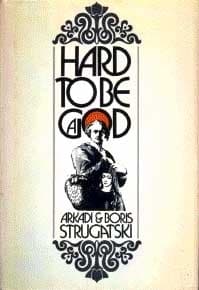
Arkady Strugatsky (2015)
Genre
Fantasy / Science Fiction
Reading Time
240 min
Key Themes
See below
Sign in to track this book
An undercover agent from a utopian future struggles with the moral dilemma of observing a brutal medieval society on an alien planet, where he's forbidden to directly intervene and accelerate their bloody path to enlightenment.
Anton, an operative from a highly advanced, peaceful Earth, is deep undercover on the planet Arkanar, which is stuck in a brutal medieval period. He operates as Don Rumata of Estor, a seemingly arrogant nobleman, duelist, and brawler. His mission is to observe societal development without direct interference, especially in preventing the emergence of a Renaissance. Rumata is housed in a lavish estate in the capital city, surrounded by the squalor and violence of Arkanar. He witnesses the widespread illiteracy, superstition, and the casual cruelty inflicted by the ruling class, particularly the 'grays' (monks and bureaucrats) and 'blacks' (soldiers and thugs) upon the common people and nascent intellectuals. He feels a deep internal conflict between his non-interference directive and his desire to alleviate suffering.
Don Rumata attends court, interacting with King Pitz and his cunning first minister, Don Reba. Reba, a former priest, is a shrewd and ruthless politician who holds significant sway over the king and the kingdom. Rumata's advanced knowledge and subtle interventions, such as his seemingly miraculous medical treatments, cause suspicion among the Arkanarian elite, particularly Reba, who views any form of independent thought or scientific inquiry as a threat to his power. Rumata maintains his persona as a hedonistic, eccentric noble, using his reputation for invincibility in duels to deter direct challenges, though he is forbidden from killing. He observes Reba systematically dismantling any emerging intellectual or artistic movements, labeling them as 'bookmen' and persecuting them.
The persecution of the 'bookmen' intensifies under Don Reba's command. Scholars, poets, doctors, and anyone associated with knowledge or independent thought are rounded up, imprisoned, tortured, and executed. Rumata is deeply pained by his inability to intervene directly, as his mission dictates non-interference in the natural course of societal development. He secretly tries to save some individuals, offering them refuge or helping them escape, but the scale of the purge is overwhelming. This period highlights the inherent conflict in Rumata's mission: he represents a future where knowledge is valued, yet he must stand by as its embryonic forms are crushed in Arkanar. He grapples with the moral implications of his observational role, feeling the weight of their suffering.
Amidst the grim reality of Arkanar, Rumata develops a deep and tender relationship with Kira, a local girl. She is intelligent, compassionate, and represents the purity and potential of Arkanarian humanity. Their relationship offers Rumata a brief respite from his internal torment and the ugliness of his surroundings. He confides in her, to a limited extent, about his true nature and his despair over the world they live in. Kira, in turn, loves him deeply and trusts him implicitly. Their bond highlights Rumata's humanity and his deep emotional connection to the people he is meant only to observe, further complicating his mission and intensifying his internal struggle.
As Don Reba's influence grows unchecked, the political situation in Arkanar deteriorates rapidly. The city becomes a hotbed of fear and suspicion. Reba consolidates power, using the 'grays' and 'blacks' to enforce his will and eliminate all opposition. The common people are increasingly oppressed, and the few remaining intellectuals and free thinkers are driven underground or executed. Rumata observes the escalating brutality with growing horror, his Earthly sensibilities clashing violently with the medieval reality. He sees the regression of society, the triumph of ignorance and cruelty, and feels an overwhelming sense of helplessness, his mission's constraints becoming an unbearable burden.
Rumata's internal conflict reaches a breaking point. He frequently communicates with his Earthly superiors, expressing his despair and frustration with the non-interference directive. He argues that the 'natural course' of history is being violently derailed by figures like Don Reba, and that intervention is necessary to save the nascent Renaissance. However, his superiors reiterate the prime directive: no direct intervention that would fundamentally alter the planet's development, as it could lead to unforeseen and potentially worse outcomes. Rumata feels increasingly isolated and impotent, a god-like figure with immense power, yet forbidden from using it to save those he cares about. His compassion battles constantly with his duty.
Don Reba orchestrates a coup, eliminating King Pitz and seizing absolute power. He declares himself the new ruler, further solidifying his tyrannical grip on Arkanar. The last vestiges of the old order are swept away, replaced by Reba's regime of fear and oppression. This event is a critical turning point, showing the complete triumph of the 'grays' and 'blacks' over any potential for enlightenment. Rumata witnesses this power grab, his inability to prevent it deepening his sense of failure and intensifying his inner turmoil. He sees the kingdom descend into an even darker age, with no hope of a swift recovery.
In a devastating turn of events, Kira is tragically killed, caught in the escalating violence and paranoia of Arkanar. Her death is a direct consequence of the regime's brutality, likely a random act or an indirect result of Rumata's association with her. This loss shatters Rumata. Kira represented his last anchor to hope and humanity within Arkanar, and her death pushes him past his breaking point. The strictures of his mission, which prevented him from protecting her, become unbearable. His grief is immense, transforming his long-suppressed rage and frustration into an overwhelming desire for vengeance, overriding all previous directives.
Driven by grief and incandescent rage over Kira's death, Don Rumata abandons his non-interference directive. He unleashes his true power and advanced capabilities, using his superior strength, speed, and knowledge to exact brutal retribution. He systematically hunts down and kills Don Reba and many of his most brutal 'grays' and 'blacks.' This scene contrasts sharply with his earlier restraint, showing the raw power he had held back for so long. He acts not as an observer, but as an avenging angel, a 'god' delivering justice, albeit a bloody and violent one. This act marks a deep personal and moral transgression for Rumata, but one he feels compelled to make.
After his rampage, Rumata is retrieved by his Earthly colleagues. The mission is a failure in terms of its primary objective, as the societal development of Arkanar has been severely disrupted, and the 'natural' course of its history irrevocably altered by Rumata's actions and the prior brutality of Reba. Rumata is a broken man, haunted by Kira's death and the violence he perpetrated. He is brought back to Earth, but the experience has deeply changed him, leaving him with deep psychological scars. The novel concludes with the somber understanding that even with the best intentions, it is 'hard to be a god' – to wield immense power without causing harm, or to stand by while suffering unfolds.
The Protagonist
Rumata's arc is a tragic descent from detached observer to emotionally shattered avenger, forced to confront the limits of his 'god-like' power and the unbearable cost of non-intervention.
The Supporting
Kira's arc is tragically cut short, serving as the ultimate catalyst for Rumata's transformation from observer to avenger.
The Antagonist
Reba's arc is one of escalating tyranny and consolidation of power, culminating in his violent demise at Rumata's hands.
The Supporting
King Pitz's arc sees him lose his already nominal power, eventually overthrown by Don Reba.
The Supporting
Their role remains largely static, serving as a moral and operational compass for Rumata, upholding the prime directive.
The Supporting
Vaga's arc is one of threatened potential, representing the 'bookmen' who are systematically crushed.
The Mentioned
These groups serve as the instruments of oppression, their presence escalating as Reba consolidates power.
This is the central theme, exploring the moral dilemma of observing profound suffering without intervening. Rumata, with his advanced capabilities, is forbidden from directly altering Arkanar's 'natural' historical development. This creates immense psychological torment for him as he witnesses the systematic persecution of intellectuals and the general brutality of medieval life. The theme questions whether non-intervention is truly ethical when it allows tyranny and ignorance to flourish, particularly when the 'natural' course is heavily influenced by destructive forces like Don Reba. Rumata's ultimate breakdown and violent intervention highlight the unbearable cost of this ethical stance, suggesting that sometimes, 'gods' must act.
“It's hard to be a god.”
The novel critically examines the concept of societal progress, particularly the idea that it is inherently cruel and bloody. Arkanar's medieval society is characterized by superstition, violence, and the suppression of knowledge. The 'bookmen' represent the fragile beginnings of a Renaissance, which Don Reba brutally crushes. The Strugatskys suggest that enlightenment is not an inevitable, smooth process, but a hard-won battle against ignorance and oppression. Rumata's despair stems from witnessing the regression of society, questioning whether humanity is destined to repeat cycles of violence and whether true progress can ever be achieved without overcoming inherent destructive tendencies.
“Where is the great highway of history, if it must pass through such swamps?”
Rumata possesses god-like power and knowledge compared to the Arkanarians, yet this power is a source of immense suffering due to the non-interference directive. He can heal, fight flawlessly, and understand advanced concepts, but he cannot fundamentally change the course of history for the better. This theme explores the paradox of having immense capability but being constrained by ethical limitations. The burden of knowing what could be, and having the means to achieve it, yet being forbidden, is a central source of Rumata's tragic internal conflict. His eventual violent outburst is a manifestation of this unbearable burden.
“I am a god, but I am an unhappy god.”
The novel explores how noble ideals can be corrupted or rendered impotent in the face of brutal reality. Earth's ideal of non-interference, meant to preserve the natural development of civilizations, clashes violently with the reality of Arkanar's suffering. Rumata's own ideals of compassion and justice are slowly eroded by the constant exposure to cruelty, eventually leading him to abandon his principles in a fit of rage. This theme suggests that even the most well-intentioned principles can break under extreme pressure, and that the path to a utopian future is fraught with difficult, often tragic, compromises.
“I will never be able to forget this. I don't want to forget it. Let it burn in me.”
An advanced operative embedded in a primitive society.
The core plot device is Anton's role as Don Rumata, an undercover observer from a utopian future Earth. This allows the narrative to present a stark contrast between a highly evolved, peaceful society and a brutal, medieval one. It provides a unique perspective through which to examine the social, political, and ethical dynamics of Arkanar. The 'undercover' aspect creates dramatic tension, as Rumata must constantly maintain his persona while suppressing his true capabilities and emotions, making his eventual breakdown all the more impactful.
A prime directive forbidding direct intervention in a developing civilization.
This is the central conflict-generating device. The Earth's strict non-interference policy prevents Rumata from using his advanced knowledge and power to alleviate suffering or accelerate Arkanar's development. This constraint forces Rumata to witness atrocities passively, creating immense internal conflict and driving much of the novel's philosophical inquiry into the ethics of observation versus intervention. It also highlights the tragic irony of having 'god-like' power but being forbidden from using it, ultimately leading to Rumata's catastrophic breach of the directive.
The systematic elimination of intellectuals and artists.
This device serves as a concrete manifestation of Arkanar's societal regression and Don Reba's tyranny. The persecution of 'bookmen' (scholars, doctors, artists) directly threatens the potential for Arkanar's Renaissance. It provides Rumata with specific, agonizing examples of the suffering he is forbidden to prevent, intensifying his internal struggle. This device also emphasizes the novel's theme about the fragility of enlightenment and the destructive power of ignorance and oppression, making the stakes of Rumata's mission deeply personal and poignant.
The protagonist's superhuman fighting prowess.
Rumata's apparent invincibility in duels and brawls, a result of his advanced Earthly training, serves multiple functions. It helps him maintain his noble persona and deter direct challenges without resorting to lethal force (initially). This device also underscores his 'god-like' nature among the Arkanarians, highlighting the vast technological and physical gap between him and the locals. Crucially, it makes his eventual, unrestrained violence all the more shocking and devastating, demonstrating the immense power he had been holding back and the extent of his emotional breakdown.
“How can you be a god when you can't even punish evil?”
— Don Rumata (Anton) grappling with the limitations of his non-interventionist role.
“There are no absolutely good people. There are no absolutely bad people. There are only people.”
— Rumata reflecting on the complexities of human nature in Arkanar.
“One cannot teach a man who doesn't want to learn, and one cannot help a man who doesn't want to be helped.”
— Rumata's frustration with the stagnant society of Arkanar.
“The past is always a lesson. The future is always a mystery.”
— A general observation on time and human understanding.
“When you have the power to do good, but are forbidden to use it, that is the greatest torment.”
— Rumata's internal struggle with the Prime Directive.
“It's hard to be a god when you're just a man.”
— A concise summary of Rumata's predicament and the book's central theme.
“Ignorance is not bliss when it leads to suffering.”
— Rumata's thoughts on the consequences of the Arkanar people's lack of knowledge.
“Violence begets violence, and hatred begets hatred. There is no end to it.”
— Rumata observing the cycle of brutality in Arkanar.
“The greatest tragedy is not death, but life without meaning.”
— A profound philosophical statement on the human condition.
“He who saves a life saves the entire world.”
— Rumata's internal justification for small acts of kindness despite the larger non-intervention rule.
“Better to be a living dog than a dead lion.”
— A cynical but pragmatic view expressed by one of the locals, highlighting their survival instincts.
“Progress is not inevitable, it must be fought for.”
— Rumata's realization about the struggle for societal advancement.
“The more you know, the more you realize how little you know.”
— A classic epistemological reflection applicable to the advanced Earthlings observing Arkanar.
“Sometimes, doing nothing is the hardest thing of all.”
— Rumata's constant battle with the non-intervention principle.
Ready to see how well you understood this book? Take our interactive quiz with 10 questions.

Arkady Strugatsky was a prominent Soviet science fiction author, best known for his collaboration with his brother Boris. Together, they penned seminal works like 'Hard to Be a God' and 'Roadside Picnic,' which explored complex philosophical and social themes. Their writing, characterized by its depth and prescient insights, earned them international acclaim within the science fiction community.







