“The old mansion loomed at the top of the hill, its windows like dark, empty eyes staring out into the night.”
— Describing the setting of the party and the general atmosphere.

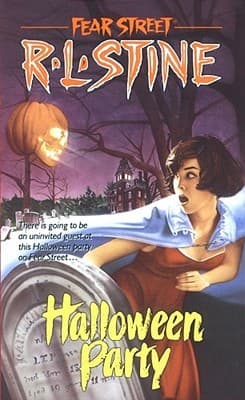
R.L. Stine (1990)
Genre
Thriller / Fantasy / Children's / Mystery / Young Adult
Reading Time
120 min
Key Themes
See below
Sign in to track this book
An exclusive Halloween party on Fear Street turns deadly when a costumed killer crashes the fun, forcing two high schoolers to unmask the murderer before they become the next victims.
Terry, a senior at Shadyside High, and his girlfriend Niki get strange, black-bordered invitations to a Halloween party. The invitations, which show a coffin with 'Reserved For You' written on it, are from Justine Cameron, a beautiful and mysterious transfer student they barely know. Terry and Niki talk about not wanting to go. Justine is new, and her reasons for inviting them are unclear. Despite their worries and the scary invitation, their curiosity and the idea of a party on Fear Street convince them to go, setting up the night.
Terry and Niki arrive at Justine's large, old mansion on Fear Street, decorated for Halloween. The house feels unsettling. Other guests, many in costumes, are already there, making a lively but tense atmosphere. Terry sees familiar faces from school, like Deena and Jade. He also watches Justine, dressed as a witch, moving through the crowd with quiet control. The party is busy with music and dancing, but a feeling of unease fills the mansion.
As the party goes on, the lights suddenly go out. The mansion goes dark. Guests gasp and laugh nervously, thinking it's a Halloween prank. When the lights come back on, they see Michael, a partygoer, lying still on the floor with a knife in his back. At first, many guests, including Terry and Niki, think it's a morbid part of Justine's Halloween fun. But Justine's lack of immediate reaction and the growing silence suggest something worse.
Confusion and disbelief spread through the party. Some guests insist it's a prank, while others, especially Terry and Niki, feel a growing fear. Justine, quiet at first, finally speaks to the crowd. She stays mysterious, neither saying if Michael's death is real nor fake. This uncertainty increases the tension. Terry tries to go to Michael, but the crowd and general chaos stop him. The line between a detailed performance and a real horror blurs, leaving everyone uneasy and unsure what to do.
Justine finally breaks the silence, saying Michael's death is part of a game. She announces that one of them is the killer, and they must find them before dawn. She locks the doors, stopping anyone from leaving. This announcement sends fear and panic through the party. Terry and Niki realize they are trapped with a possible murderer. The 'game' turns the party into a place of suspicion and terror, as guests start to look at each other with distrust, wondering who could do such a thing.
As the night continues, paranoia takes hold of the partygoers. Accusations fly as guests turn on each other, driven by fear. Terry and Niki try to understand the situation, watching Justine's strange behavior and others' reactions. Michael's girlfriend, Deena, is especially upset and becomes a suspect for some, while others suspect Justine. The costumes now seem threatening, turning familiar faces into possible dangers. The group's unity breaks, replaced by a desperate every-person-for-themselves attitude.
The horror of the situation becomes clear when another guest, Jade, is found dead. This second murder removes any doubt that Michael's death was a prank. Panic grows, and the guests' fear becomes outright terror. Terry and Niki realize their lives are in danger. They try to find a way out, but the doors are locked, and the windows are sealed. The killer is still among them, and the stakes are high, forcing Terry and Niki to act fast to survive.
Realizing they cannot rely on Justine or the other panicked guests, Terry and Niki decide to investigate on their own. They search the mansion carefully, looking for clues about the killer or a way to escape. They explore rooms like the library and kitchen, finding nothing clear but feeling the chilling presence of danger. Their investigation is tense, as they know the killer could be anywhere. They also try to understand Justine's reasons and her connection to the victims, but her mysterious nature gives few answers.
As the night peaks, Justine gathers the remaining guests. She finally tells her dark past: her brother died in a hit-and-run, and she thinks Michael, Jade, and other specific guests were responsible, either directly or by covering it up. The Halloween party was a planned act of revenge, a twisted 'game' to make them pay for their perceived crimes. This revelation shocks Terry and Niki. They see the depth of Justine's pain and her planned actions. The 'game' was not about finding a killer, but about Justine carrying out her own justice.
Terry and Niki, horrified by Justine's confession and realizing she plans to kill more people, confront her. They try to talk her out of it, pointing out that her actions are wrong and her revenge is unfair. But Justine, full of grief and a desire for revenge, is firm. She believes her actions are right. A tense confrontation happens, with Terry and Niki trying to stop her before she can kill again. The physical and mental struggle ends in a desperate fight for survival.
In a final struggle, Terry and Niki manage to overpower Justine, or at least distract her enough to find an unlocked door or break a window. They escape the mansion, leaving the horror of the party behind. They run as fast as they can, away from Fear Street and the madness in Justine's house. The experience leaves them deeply shaken and changed by the night. They understand the real terror of Fear Street and its dark secrets.
After their escape, Terry and Niki deal with the mental effects of the Halloween party. They are safe, but the memory of the murders, Justine's chilling revenge, and their own near-death experience will stay with them. The police are likely involved, but the immediate focus is on their survival and emotional recovery. They think about how a seemingly innocent party became a deadly trap, and how Fear Street's charm hid darkness. Their relationship is tested but made stronger by what they went through.
The Protagonist
From a somewhat naive partygoer, Terry transforms into a survivor, forced to confront the dark reality of murder and revenge.
The Protagonist
Niki evolves from a hesitant attendee to a courageous survivor, hardened by the horrors of the night.
The Antagonist
Justine's character is revealed to be a vengeful orchestrator, her seemingly innocent persona unraveling to expose a cold-blooded killer.
The Supporting/Victim
Michael's arc is brief, serving as the initial victim whose death sets the entire plot in motion.
The Supporting
Deena's character remains largely static, primarily serving to illustrate the human cost of Justine's actions.
The Supporting/Victim
Jade's arc is brief, serving as the second victim, confirming the deadly reality of the party.
The main theme is Justine's search for revenge, which she calls justice for her brother's death. The story shows how destructive revenge is, consuming Justine and leading her to do terrible things. It makes characters and readers question the line between justice and personal payback, and if revenge ever truly brings peace. This is clear in Justine's careful planning and her chilling confession later in the book, where she explains her brother's hit-and-run and her targets.
“''Reserved For You.' It was perfectly fitting for an all-night Halloween party on Fear Street. But Terry and his girlfriend Niki wondered why they had been invited.”
The novel often plays with the difference between how things look and how they really are. The Halloween party, first presented as fun and spooky, quickly becomes a deadly trap. Michael's death is first thought to be a prank, showing the guests' difficulty in accepting the truth. Justine herself shows this theme, appearing as a mysterious but charming new student, only to be revealed as a killer. The spooky decorations and costumes add to this blurring of lines, making it hard for characters to tell real threats from playful scares.
“The party was well under way when the lights went out. That’s to be expected at a spooky Halloween party. But when the lights come back on, there was that boy on the floor with the knife in his back. Just a Halloween prank? Maybe. Maybe not.”
Once the party's true nature is known, paranoia quickly spreads among the guests. They turn on each other, driven by fear, as everyone becomes a possible suspect or victim. The locked doors and the killer's hidden identity create a tense atmosphere of distrust, where friendships and alliances break down. This is clear in the accusations that fly after Michael's death and how guests look at each other with suspicion, wondering who is dangerous. The theme shows how fear can destroy social bonds.
“For Terry and Niki the trick-or-treating has turned to terror. To their horror, they realize that someone at the costume party is dressed to kill!”
Fear Street itself represents this theme. Terry and Niki, despite their worries about Justine and the scary invitations, are drawn to the party because it is mysterious and on the famous Fear Street. The unknown, while exciting, turns out to be deadly. The novel explores how people are drawn to the forbidden or unexplained, even when it is risky. This curiosity traps them in a life-threatening situation, showing that some mysteries are best left alone.
“Don’t listen to the stories they tell you about Fear Street. Wouldn’t you rather explore it yourself…and see if its dark terror and unexplained mysteries are true? You’re not afraid, are you?”
Misleading clues or suspects designed to divert attention.
Throughout the story, various characters or circumstances are presented in a way that makes them seem suspicious, diverting the reader's attention from the true killer. For instance, the initial belief that Michael's death is a prank serves as a red herring, delaying the realization of the actual danger. Later, the accusations among guests, particularly towards Deena, also function as red herrings, leading both characters and readers to suspect innocent individuals, thereby heightening the mystery and suspense before Justine's true identity is revealed.
A crime committed in a seemingly impossible or inescapable setting.
The Halloween party mansion becomes a classic locked-room scenario once Justine seals all exits. The guests are trapped inside with a killer, and there's no obvious way in or out, intensifying the feeling of claustrophobia and inescapable danger. This device forces the characters to confront the threat directly and prevents external intervention, ensuring that the resolution must come from within the confined space. It heightens the stakes, as escape is not an option until the killer is dealt with or an unlikely opportunity arises.
The audience knows more about the situation than the characters.
While not overtly present throughout, dramatic irony is subtly used, particularly in the initial scenes. The reader is aware of the ominous nature of Fear Street and the 'invitation to terror' from the book's description, which hints at the danger before Terry and Niki fully grasp it. This creates a sense of dread and anticipation for the reader, as they watch the characters unknowingly walk into a trap. It builds suspense by allowing the audience to anticipate the impending horror that the characters are still oblivious to.
An object or plot element that motivates the characters.
While not a physical object, the 'game' announced by Justine serves as an implicit MacGuffin. It's the central element around which the characters' actions revolve – they are told to find the killer. This 'game' drives their investigation, their suspicions, and their attempts to survive, even though its true purpose is to serve Justine's revenge. The focus on 'finding the killer' motivates their immediate actions, even as the real motive lies in Justine's past grievances, which are revealed later.
“The old mansion loomed at the top of the hill, its windows like dark, empty eyes staring out into the night.”
— Describing the setting of the party and the general atmosphere.
“It was just a harmless Halloween party, or so they thought.”
— Narrator's early thoughts, hinting at the danger to come.
“The air grew colder, and a strange, sweet smell, like rotten candy, filled the room.”
— As the party takes a turn, a sensory detail that signals something is wrong.
“Someone was watching them from the shadows, a silent, unseen presence.”
— The characters begin to feel uneasy and realize they are not alone.
“The mask slipped, and for a terrifying instant, I saw what was underneath.”
— A moment of reveal or near-reveal, creating a jump scare.
“There was a reason the old stories said no one ever left the mansion after midnight.”
— Recalling local legends as the characters find themselves trapped.
“Every creak of the floorboards, every whisper of the wind, sounded like a monster closing in.”
— The heightened senses and fear of the characters.
“It wasn't a game anymore. This was real.”
— The realization that the fun party has turned into a life-threatening situation.
“The shadows seemed to stretch and writhe, taking on monstrous shapes.”
— Describing the terrifying effects of the dark and the characters' fear.
“We had to find a way out, before it was too late.”
— The urgency of the characters' situation as they seek an escape.
“The laughter turned to screams, and the music died.”
— A pivotal moment where the party atmosphere collapses into terror.
“No one believed us when we told them what happened that night.”
— Aftermath, showing the disbelief of others and the lasting impact on the characters.
“Some secrets are better left buried.”
— A concluding thought, reflecting on the dark past of the mansion or the events.
“The party was just beginning.”
— A chilling line, often used at the start of the true horror.
Ready to see how well you understood this book? Take our interactive quiz with 10 questions.
Biography coming soon.







