“It began one day when Jane was sitting in the front yard, waiting for something to happen.”
— Opening line of the book, setting the stage for the adventure.

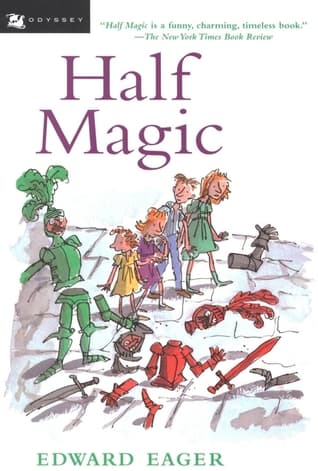
Edward Eager (1954)
Genre
Fantasy / Children's / Young Adult
Reading Time
190 min
Key Themes
See below
Sign in to track this book
Four adventurous siblings discover a magical coin that grants only half their wishes, leading to hilarious, topsy-turvy escapades from desert islands with chattering cats to medieval jousts and downtown riots, all while trying to bring their mother home.
The four children, Jane, Mark, Katharine, and Martha, are having a dull summer at home. Their mother, Alison, is visiting their grandmother, leaving them bored. One hot afternoon, Jane finds an old, tarnished silver coin on the sidewalk while reading. Curious, she casually wishes for something exciting to happen. A large, black dog immediately appears out of nowhere. The children are surprised but soon see the dog is only half there—transparent from the middle back. This strange event makes them curious, and they soon discover the coin's unique power: it grants wishes, but only 'half.' Any wish made is partly fulfilled, leading to funny and often difficult results.
Excited by their find, the children decide to test the coin's power more. They wish for their mother, Alison, to come home. As expected, their mother appears only halfway home—specifically, she is found on the train tracks, halfway to their house, confused. Mr. Smith, a kind professor passing by, rescues her. Mr. Smith brings Alison back to the children, and he and the family start to become friends. The children understand what the 'half' magic means and decide they need to be much more exact with their future wishes to get what they fully want.
Mark, the only boy, is tired of being at home and wants a real adventure. He wishes for them to go to a desert island. The coin, however, makes this a 'desert without an island,' and the children, along with their cat, Carrie, are instantly sent to a vast, sandy desert. Carrie, affected by the half-magic, can only speak in half-words and jumbled sentences. They meet a philosophical camel who understands Carrie's fragmented speech. The children struggle to find water and food in the harsh place, realizing the danger of vague wishes. They eventually wish themselves back home, having learned a lesson about the coin's literal interpretations.
Katharine, the romantic of the family, dreams of knights. She wishes to go to King Arthur's time and meet Sir Launcelot. The coin does this, but again, only 'half' of her wish is fulfilled. She meets Sir Launcelot, but he is only half in love with her, showing polite but distant admiration. The court itself is also only 'half' as grand as she imagined. She tries to have a proper knightly romance, but the half-magic makes every interaction slightly wrong or unfinished. Frustrated by the lack of full passion, Katharine eventually wishes herself back home, realizing that reality, even half-magical, does not always match storybook ideals.
Jane, feeling overlooked and perhaps tired of her siblings, wishes to belong to a different family. The half-magic takes her to a household where she is welcomed as their daughter. This new family seems perfect: they are wealthy, polite, and have a well-behaved dog. However, Jane soon discovers that this perfection is also 'half' complete. The family is incredibly boring; their conversations are dull, their activities unexciting, and they lack the lively chaos and affection she is used to with her own siblings. She misses the spontaneity and warmth of her real family, realizing that her own family, despite its flaws, is where she truly belongs.
Martha, the youngest and most stubborn, is often annoyed by city noise and her siblings. She wishes for 'peace and quiet' downtown. The half-magic coin interprets this literally and partly: it causes a widespread riot and chaos in the city center, as the absence of 'half' the usual noise and order leads to an uproar. Martha finds herself in the middle of a frightening scene of public disorder, with people running and shouting. A policeman chases her, mistaking her for causing the disturbance. The experience is terrifying for Martha, making her face the unintended results of her simple, yet powerful, wish and how 'half' magic can go wrong.
After several individual, problematic wishes, the children decide to use the coin more carefully and together. They invite Mr. Smith, who has become a good friend to their mother, Alison, on a picnic. During the picnic, they decide to try a wish together. They wish for some delicious food to appear, specifically 'half a picnic.' This results in a strange spread of food where some items are missing, and others are only partly formed or cooked. Mr. Smith sees this strange event and learns about the coin's unusual properties. The children, realizing they can no longer hide their secret, tell him about the 'half magic,' and he, being a scholar, is fascinated.
Mr. Smith, interested in the coin, suggests they wish for a book on magic to better understand how it works and how to control it. They wish for 'half a book on magic.' They are taken to a library, where they find a very old, partly complete book on magic. The book itself is only half-written or has missing pages, but it contains useful information about magical objects and how to make wishes work. This leads them on a hunt through the library, looking for the missing half of the book or clues within its incomplete pages. They learn about the importance of precise wording and how human cleverness can complete half-magic.
During one cold evening, the children, with Mr. Smith's help, try to use the coin to wish for a comforting fire in the fireplace. They wish for 'half a fire.' The result is chaotic and dangerous: the fireplace produces smoke and heat, but only from one side, and the flames are erratic and poorly contained. It threatens to set the house on fire. This incident shows the dangerous nature of the half-magic and the need for extreme caution. Mr. Smith quickly steps in, helping them put out the unruly, half-formed blaze. This reinforces the idea that some wishes are too dangerous to be left to the coin's literal interpretation, even with careful planning.
After many tries and near-disasters, Mr. Smith, using his academic mind, finally figures out how to overcome the 'half' limitation. He realizes that if they wish for something, and then immediately wish for the 'other half' of that same thing, or for the item 'to be whole,' the magic will complete the wish. They test this with a simple wish for a glass of water, followed by a wish for the other half, and it works perfectly. The children are very happy, finally having a reliable way to use the coin's power effectively and safely. This discovery changes their view from frustration to empowerment, as they can now control the magic.
With their new understanding, the children decide to make a big, good wish. They wish for something that would truly make their summer perfect, perhaps for their mother to be happy or for a wonderful family vacation. The book does not say the exact final wish, but it suggests a successful and joyful outcome because of their clever 'two-part' wishing method. After this final, fulfilling wish, the children, having learned much about responsibility and desire, decide what to do with the magical coin. They choose to get rid of it, perhaps by throwing it into a river or burying it, understanding that while magic can be fun, a life lived without constant reliance on it is more meaningful. Mr. Smith and Alison's relationship also grows, suggesting a happy future for their mother.
The Protagonist
Jane learns the importance of her own family and the responsibility that comes with power, moving from mild discontent to appreciation.
The Protagonist
Mark learns to temper his impulsiveness with foresight and responsibility, becoming more thoughtful in his desires.
The Protagonist
Katharine's romantic ideals are challenged by reality, leading her to a more grounded understanding of love and adventure.
The Protagonist
Martha learns about the unintended consequences of her desires and the power of her words, gaining a degree of caution.
The Supporting
Alison's life is unexpectedly brightened by the arrival of Mr. Smith, leading to potential romance and happiness.
The Supporting
Mr. Smith uses his intellect to solve the puzzle of the half-magic, becoming a trusted friend and potential partner to Alison.
The Supporting
Carrie gains and loses the ability to speak in half-words, adding a whimsical element to the magical adventures.
The Mentioned
The Camel provides temporary assistance to the children in the desert, serving as a plot device to facilitate communication.
The Mentioned
Sir Launcelot remains a static character, serving to illustrate the 'half' nature of Katharine's wish and disillusionment.
The main theme looks at the nature of getting what one wishes for. While the magic coin offers exciting things, its 'half' nature always leads to funny, frustrating, or even dangerous outcomes. Mark's wish for a 'desert island' resulting in a 'desert without an island,' and Martha's wish for 'peace and quiet' causing a riot, show how unclear desires or literal interpretations of wishes can go wrong. The children learn that true satisfaction comes not just from having a wish granted, but from the careful thought and responsibility that comes with power, eventually leading them to master the coin's magic through cleverness.
“It was a wonderful thing, this half magic, but it certainly took a lot of thinking.”
Despite their disagreements and individual desires, family unity and appreciation is a strong theme. Jane's wish for a different family, which at first seems ideal, quickly shows how dull and unconnected it is compared to her own lively, if sometimes chaotic, household. The shared adventures, challenges, and eventual success over the coin's limits strengthen the siblings' bond. The children's decision to use the magic for a shared good, and their mother's growing relationship with Mr. Smith, further show the importance of family and belonging over individual, short-lived desires.
“She had wished for a new family, and now she knew that her own was the best, after all.”
The book often compares the children's strong imaginations and storybook ideals with the often-messy reality of the half-magic. Katharine's romantic idea of Camelot and Sir Launcelot is lessened by the 'half' version she meets. This shows the difference between fantasy and real experience. The children learn that while imagination can inspire, reality, even a magical one, needs adapting and problem-solving. Mr. Smith's intellectual way of understanding the magic further bridges this gap, suggesting that a mix of creativity and logic is needed to get through the world effectively.
“It seemed that magic, even half magic, was not as simple as it sounded in books.”
A main theme is the children's, and especially Mr. Smith's, journey from being affected by the half-magic to mastering it through cleverness and logic. Instead of just wishing, they have to think critically about how they word their desires and what 'half' fulfillment means. Mr. Smith's solution—wishing for the 'other half'—shows human cleverness in overcoming seemingly impossible magical limits. This theme empowers the characters, showing that intelligence and working together can outsmart even the most whimsical magical forces, making them active people in their own enchanted world.
“The great thing about the coin, Mr. Smith said, was that it made you think.”
The central magical artifact that grants wishes only partially.
The tarnished silver coin is the primary plot device, initiating all conflicts and adventures. Its unique property of granting wishes only 'halfway' drives the narrative, creating immediate complications and forcing the characters to think creatively. It acts as a catalyst for both humor and peril, as its literal interpretations lead to unexpected and often absurd situations, from a transparent dog to a desert without an island. The coin's power is initially a source of frustration, but ultimately becomes a puzzle to be solved, leading to the children's growth and Mr. Smith's intellectual contribution to the story.
The magic's tendency to fulfill wishes exactly as worded, often with unintended consequences.
This device is crucial to the humor and conflict of the story. The half-magic doesn't understand intent, only literal words. Mark wishes for a 'desert island' and gets a 'desert without an island.' Martha wishes for 'peace and quiet downtown' and gets a riot. This literalism forces the children to learn precision and foresight, transforming them from naive wishers into strategic problem-solvers. It highlights the importance of clear communication and the dangers of ambiguity, not just in magic, but in everyday life, making the children more thoughtful about their desires.
An intellectual adult who provides guidance and a solution to the magical problem.
Mr. Smith serves as a wise and logical mentor figure who brings an adult perspective to the children's magical dilemmas. Unlike the children who approach magic with wonder and impulsiveness, Mr. Smith approaches it with scientific curiosity and deduction. His calm reasoning and intellectual prowess are essential in understanding the coin's mechanism and, ultimately, in devising the two-part wishing method. He acts as a bridge between the whimsical world of magic and the practical world of problem-solving, guiding the children towards a responsible use of power and providing a stable adult influence.
Animals that gain human-like qualities due to the magic, adding whimsy and plot points.
The half-magic coin's influence extends beyond humans, affecting the family cat, Carrie, and a desert camel. Carrie gains the ability to speak, albeit in half-words, adding a layer of whimsical confusion and requiring the intervention of the philosophical Camel. The Camel's ability to understand Carrie and communicate with the children provides a unique solution to their predicament in the desert. These anthropomorphic characters enhance the fantastical element of the story, demonstrating the pervasive and often unpredictable nature of the half-magic, while also serving as charming, if temporary, plot facilitators.
“It began one day when Jane was sitting in the front yard, waiting for something to happen.”
— Opening line of the book, setting the stage for the adventure.
“The charm was half magic, so it only did half of what you wished for.”
— Explanation of the magical coin's peculiar property.
“If you wished to be on a desert island, you'd find yourself halfway there—in the middle of the ocean.”
— Example of how the half-magic charm works.
“We'll have to wish twice as hard, that's all.”
— Jane's pragmatic solution to the charm's limitation.
“It's not the wishing, it's the wanting that counts.”
— Reflection on the importance of genuine desire in magic.
“Half a wish is better than no wish at all.”
— Optimistic view of the charm's partial magic.
“They were having the kind of adventure that happens in books, only it was happening to them.”
— The children's realization that their magical experiences are real.
“Magic is a serious business, and not to be trifled with.”
— Warning about the responsibilities that come with using magic.
“The best adventures are the ones you share with your family.”
— Emphasizing the bond between the siblings during their journeys.
“You can't just wish for things; you have to wish for the right things.”
— Lesson learned about careful consideration in making wishes.
“Half magic made everything twice as interesting.”
— Observation on how the charm's limitation adds excitement.
“Even half a knight is better than no knight at all.”
— Humorous take on a partially summoned medieval knight.
“The magic was over, but the memory of it would last forever.”
— Reflection at the end of the children's magical summer.
“Sometimes the best magic is the kind you make yourself.”
— Suggestion that imagination and creativity are powerful too.
Ready to see how well you understood this book? Take our interactive quiz with 10 questions.







