“He's not a pet. He's a person.”
— Ben says this about Zan, the chimpanzee, emphasizing his view of Zan as a sentient being rather than an animal.

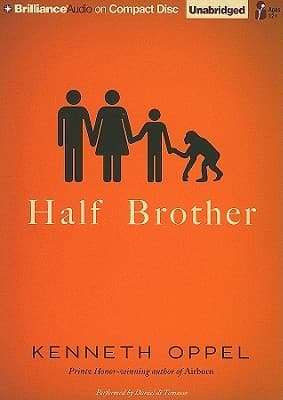
Kenneth Oppel (2010)
Genre
Children's / Historical Fiction / Young Adult
Reading Time
7 hr 30 min
Key Themes
See below
Sign in to track this book
A teenage boy navigates the complex bond with his chimpanzee 'brother,' forcing him to choose between scientific obedience and protecting the primate from a devastating experimental future.
Thirteen-year-old Ben Tomlin lives a normal life in Victoria, British Columbia, until his father, Richard Tomlin, a primatologist, announces a new research project. The family, including Ben's mother, Dr. Eleanor Tomlin, moves to a research facility on a university campus. Richard introduces their new 'family member': Zan, an eight-day-old chimpanzee they will raise as a human child. The goal is to see if Zan can learn American Sign Language (ASL) and communicate, proving chimpanzees have advanced thinking. Ben must treat Zan as a younger brother. He initially dislikes this role, feeling his life and privacy are sacrificed for his father's experiment. He struggles with sharing his home with a chimp.
The first days with Zan are messy. Zan is demanding, untidy, and throws tantrums, making Ben's life hard. Ben's parents, especially his father, keep a scientific distance, carefully recording Zan's actions. Ben, however, feels increasingly connected to Zan. He teaches Zan to play, comforts him, and becomes the chimp's preferred friend. He starts to see Zan not just as a research subject but as a living being capable of affection and understanding. This growing bond creates a split between Ben and his father, who sees Ben's emotional attachment as possibly harming the experiment's objectivity. Ben also learns ASL with Zan, becoming a part of the chimp's language development.
As Zan grows, he shows a strong ability for ASL, quickly learning many signs and combining them to make new phrases. His progress draws media attention, turning the Tomlin home into a constant show. Journalists, photographers, and animal rights activists come to the university. Some call Richard Tomlin a visionary; others call the experiment unethical. Ben, now fluent in ASL, helps interpret Zan's signs, often acting as a link between the chimp and the outside world. He is proud of Zan's achievements, strengthening his belief in Zan's intelligence and personhood. This belief increasingly conflicts with his father's more clinical view.
Two graduate students, Peter and Sylvia, join the Tomlin team to help with the project's demands and media attention. Peter, a handsome and excited young man, quickly bonds with Zan and shows real affection for him. Sylvia is more quiet and academic, initially focusing on collecting data. Ben develops a crush on Sylvia, who seems to understand his unique situation and the emotional toll of the experiment. Their presence adds new layers to the family dynamic, giving Ben allies who also see Zan as more than just a research subject, though they still follow Richard's scientific rules.
As Zan enters adolescence, his physical strength and wild instincts become harder to manage. Even though he was raised in a human home, his chimpanzee nature shows through unpredictable aggression, destructive behavior, and a strong protective instinct, especially towards Ben. An incident where Zan badly injures a neighbor's dog during an escape shows the dangers he poses. These events cause great stress for the Tomlin family and the university, leading to debates about Zan's future. Richard Tomlin, still committed to the experiment, starts to see the challenges of keeping a strong, undomesticated animal in a human home. Questions about Zan's long-term ability to stay in their care begin to appear.
After several incidents, including Zan's aggressive behavior towards a human visitor and property damage, the university administration worries. The initial excitement for the project lessens, replaced by fear and a demand for a solution. Richard Tomlin faces pressure to either control Zan or remove him from campus. Animal rights groups, once supportive, now ask for Zan to be released into a more natural environment, while others argue for euthanasia. Ben is scared of losing Zan and argues strongly with his father, who is torn between his scientific goals and the safety of his family and community. The ethical parts of the experiment become clear.
After much thought and under university pressure, Richard Tomlin decides to send Zan away. He arranges for Zan to go to the Yerkes Primate Center in Atlanta, Georgia, a facility with other research chimpanzees. This decision breaks Ben, who feels betrayed by his father and believes Zan is unfairly punished for his natural instincts. He tries to convince his parents to change their minds, arguing that Zan is his brother and belongs in their family. Zan's departure leaves a hole in Ben's life and creates a deep sense of loss and anger towards his father, widening the emotional gap between them.
Months after Zan left, Ben convinces his parents to take him to visit Zan at the Yerkes Primate Center. The reunion is bittersweet. Ben is sad to see Zan confined in an enclosure, surrounded by other chimps, showing behaviors of institutionalization. Zan recognizes Ben immediately, signing 'brother' and showing joy and confusion. However, Zan also shows a new caution and a deeper connection to his chimpanzee companions, showing the irreversible changes in his life. Ben realizes that while Zan is safe, he is not the same chimp he raised. This visit strengthens Ben's belief that Zan deserves a better, freer life than his current one.
Upset by Zan's conditions at Yerkes, Ben decides to rescue him. He tells Sylvia and Peter, who, despite initial concerns about breaking the law, agree to help. Sylvia, now unhappy with the ethics of primate research, uses her academic contacts to find a more natural, ethical chimpanzee sanctuary in Florida run by Dr. Aris. The plan is a secret operation to 'kidnap' Zan from Yerkes and transport him across state lines. Ben carefully plans the details, driven by his love for Zan and his belief that he is fixing a wrong. The risks are very high, with possible severe legal consequences.
The three carry out their plan at night. Ben, using his knowledge of Zan's habits and the facility's layout, gets Zan from his enclosure. The escape is tense with close calls. With Zan in a prepared crate in their van, they begin their long, dangerous journey to Florida. They face problems, including a flat tire and constant fear of being caught. Zan is disoriented but trusts Ben, relying on his signs and presence. The journey strengthens the bond between Ben, Sylvia, and Peter, as they face the consequences of their actions together, all for Zan's freedom.
Richard and Eleanor Tomlin learn of Zan's disappearance and immediately suspect Ben. They chase the trio, eventually catching them. A dramatic confrontation happens. Ben passionately explains why he freed Zan, accusing his father of abandoning his 'son.' Richard, at first angry, must face the moral parts of his experiment and the depth of Ben's love for Zan. Eleanor, always more understanding, supports Ben. After a tense talk, Richard, seeing the deep bond and the ethical mess he created, makes the hard decision to let Zan go to Dr. Aris's sanctuary. This means sacrificing his career and reputation for Zan's well-being and Ben's beliefs.
The group, now including Ben's parents, arrives at Dr. Aris's sanctuary in Florida. Dr. Aris, a compassionate and experienced primatologist, welcomes Zan. The sanctuary has a large, natural habitat where Zan can live among other chimpanzees, learn to find food, and develop more natural behaviors. Ben shares a final, emotional goodbye with Zan, signing 'I love you, brother.' He watches Zan join his new family, understanding that while their lives will go separate ways, Zan has found a true home where he can thrive as a chimpanzee. The experience changes Ben, solidifying his moral sense and his understanding of love, responsibility, and the complex relationship between humans and animals.
The Protagonist
Ben transforms from a self-absorbed teenager into a compassionate and courageous advocate for animal welfare, sacrificing his own comfort for Zan's freedom.
The Central Character
Zan grows from a dependent infant into a powerful adolescent, ultimately finding a home where he can express his true chimpanzee nature.
The Antagonist/Supporting
Richard evolves from a purely scientific observer to a father who ultimately prioritizes his son's moral convictions and Zan's welfare over his own career.
The Supporting
Eleanor maintains her empathetic nature throughout the ordeal, ultimately siding with Ben in his quest to ensure Zan's well-being.
The Supporting
Sylvia shifts from a detached researcher to an active participant in an ethical cause, demonstrating her own moral courage.
The Supporting
Peter evolves from a dedicated research assistant to a loyal friend and co-conspirator, prioritizing Zan's welfare over scientific protocol.
The Supporting
Dr. Aris provides a resolution and ethical framework for Zan's future, embodying compassionate animal care.
The Mentioned
Dr. Aronson's role is to represent the external pressures and institutional resistance to the project.
The novel explores what it means to be human versus animal, through Zan's development. Zan's ability to learn ASL questions common definitions of intelligence and personhood, blurring species lines. Ben's view often shows Zan's emotional depth and capacity for love, while his father initially focuses on scientific measurements. The story asks if language alone defines humanity and if an animal, by showing human-like traits, deserves human-like rights and consideration, especially when Zan's wild instincts appear.
“He was my brother. He wasn't a science experiment. He wasn't a 'chimp.' He was Zan.”
The story is about the unusual family unit of the Tomlins and Zan. Ben struggles with Zan's presence but accepts him as a brother, creating a strong bond that defines his sense of responsibility. The dynamics between Ben, his parents, and Zan show different ideas of 'family' – whether it is defined by blood, shared experience, or love. Zan's need for a home among his own kind at the sanctuary shows that true belonging might mean finding one's place within their natural community, even if it means separation from an adoptive family.
“How could I explain to him that he wasn't really family, that he was just a visitor? He was more family than anyone.”
The novel looks at the ethical parts of animal experimentation, especially with intelligent and social primates. Richard Tomlin's experiment, while new, raises questions about the subject's welfare, possible harm, and the researchers' moral responsibility. The story explores the conflict between scientific progress and animal rights. It makes characters like Ben, Sylvia, and even Richard face the consequences of treating living beings as just data. Zan's situation at Yerkes and Ben's rescue highlight the argument for more humane and natural environments for research animals.
“We'd taken him out of the jungle, dressed him in clothes, taught him to sign, and now we were putting him in a cage. What kind of scientists were we?”
Ben's journey is a coming-of-age story. Initially a typical teenager, he is put in an unusual situation that makes him grow up quickly. He develops a strong moral sense, learning to trust his own feelings and beliefs even when they conflict with his parents' authority and social norms. His decision to go against his father and plan Zan's rescue shows courage, loyalty, and a deep understanding of justice. This experience shapes his identity, teaching him about love, sacrifice, and standing up for what he believes is right, no matter the personal cost.
“I had to do it. For Zan. For me. For everyone who had ever said he was just an animal.”
Allows readers intimate access to Ben's emotional journey and moral development.
The story is told entirely from Ben Tomlin's point of view, immersing the reader in his emotional and moral struggles. This narrative choice is crucial because it allows us to experience the profound bond with Zan firsthand, understand Ben's internal conflicts, and witness his growing empathy. It ensures that Zan is perceived not as a scientific subject but as a beloved brother through Ben's eyes, making the ethical dilemmas more personal and impactful. This perspective also highlights the generational and moral clash between Ben and his father.
A literal and symbolic bridge between human and chimpanzee worlds.
ASL serves as a central plot device, enabling communication between Zan and the human characters. It is the core of Richard Tomlin's experiment, but it quickly becomes a symbol of Zan's intelligence, his capacity for connection, and his 'personhood.' For Ben, learning ASL is not just a research tool but a way to truly understand and bond with his 'brother.' The signs Zan uses, particularly 'brother' and 'love,' are powerful emotional anchors in the narrative, highlighting the chimp's ability to express complex emotions and fostering the reader's empathy.
A confined, liminal space symbolizing the blurred boundaries of the experiment.
The Tomlin family's home, which doubles as a research facility on a university campus, acts as a significant setting. It represents the artificial environment in which Zan is raised, a space designed to blur the lines between human and animal living. This confinement ultimately highlights the conflict between Zan's innate wildness and the human expectations placed upon him. The security measures and constant surveillance within this 'home' underscore the ethical tensions and the lack of true freedom for Zan, eventually leading to his escape from this restrictive environment.
Foreshadowing and catalysts for escalating conflict and ethical concerns.
The episodes of Zan's aggressive behavior (e.g., injuring the dog, interactions with visitors) function as critical plot devices. They serve as stark reminders of Zan's powerful chimpanzee nature, which cannot be entirely suppressed by human upbringing. These incidents escalate the tension, drive the plot forward by creating conflict with the university and the public, and force the characters, especially Richard, to confront the practical and ethical limits of the experiment. They are catalysts for the decisions to send Zan away and ultimately for Ben's rescue plan.
“He's not a pet. He's a person.”
— Ben says this about Zan, the chimpanzee, emphasizing his view of Zan as a sentient being rather than an animal.
“Sometimes you have to break the rules to do what's right.”
— Ben reflects on his decision to help Zan escape from the research facility.
“We taught him to be human, but we never learned to be chimpanzees.”
— Ben realizes the limitations of the experiment and the cultural gap between humans and chimpanzees.
“Love isn't something you can measure in an experiment.”
— Ben argues with his father about the emotional bond he shares with Zan.
“Just because you can do something, doesn't mean you should.”
— Ben questions the ethics of the scientific experiment involving Zan.
“He was my brother, and I was going to save him.”
— Ben declares his determination to rescue Zan from the research facility.
“Words aren't the only way to communicate.”
— Ben observes Zan's non-verbal ways of expressing emotions and needs.
“Sometimes the right thing feels wrong, and the wrong thing feels right.”
— Ben struggles with the moral ambiguity of his actions to protect Zan.
“We were playing God, and we had no idea what we were doing.”
— Ben criticizes the arrogance of the scientists in the experiment.
“Home isn't a place; it's who you're with.”
— Ben realizes that his bond with Zan defines his sense of home.
“You can't unlearn what you've learned.”
— Ben reflects on the irreversible impact of the experiment on Zan.
“He was more than a project; he was part of our family.”
— Ben asserts the emotional significance of Zan beyond the scientific study.
“Sometimes the hardest thing is to let go.”
— Ben faces the difficult decision about Zan's future.
“We gave him a voice, but we didn't listen to what he was saying.”
— Ben criticizes the scientists for focusing on teaching Zan language while ignoring his needs.
Ready to see how well you understood this book? Take our interactive quiz with 10 questions.

Biography coming soon.
Dan Gemeinhart
4.5

Kate O'Hearn
4.4

Jeanne Birdsall
4.4

Jen Wang
4.4
Wendelin Van Draanen
4.3

John Marsden
4.3

Chris Van Allsburg
4.3
Jennifer A. Nielsen
4.2