“Love is not a dream. Love is a doing. Love is a becoming. Love is a being.”
— Dodola's reflection on the nature of love and its active form.

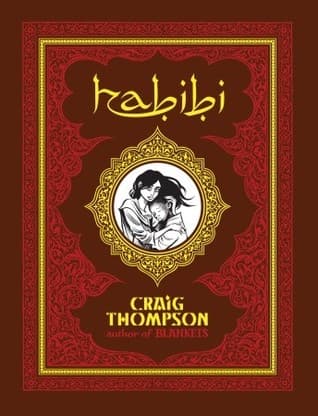
Craig Thompson (2011)
Genre
Children's / Historical Fiction / Young Adult / Romance
Reading Time
1200 min
Key Themes
See below
Sign in to track this book
In an allegorical world, two enslaved children escape their past to find love, freedom, and the meaning of 'habibi' through Quranic tales.
The story begins with young Dodola, married to an older scribe named Abu-Husayn, in a land with no rain. Her husband teaches her to read and write, showing her Arabic calligraphy and Quranic stories. Their village is attacked, and Dodola is sold into slavery. She endures harsh conditions and many owners. She eventually escapes and finds shelter in an old boat, a wreck in a vast desert. There, she discovers an abandoned infant boy, names him Zam, and takes him in, becoming his protector and mother.
Dodola and Zam make a simple life in the decaying boat, their home. Dodola uses what she learned from Abu-Husayn to teach Zam. She teaches him to read and write using charcoal on the boat's hull, telling him stories from the Quran, the Bible, and other old tales. These stories, often mixed with her own experiences, become their shared language and a source of comfort and meaning in their isolated life. Their bond grows stronger through their struggle to survive, finding food, and dealing with the harsh desert. Dodola always protects Zam from the worst of their poverty.
As Zam grows up, their isolated life is suddenly interrupted. Slave traders find and capture Dodola, taking her to be sold into a harem. Devastated and alone, Zam, now a young man, is left behind. He needs to find Dodola, his 'Habibi' (my love). He leaves his only home and goes into the large, modern, and often cruel city of Wanatolia. His journey is dangerous, and he experiences culture shock, seeing the difference between his simple desert life and the city's overwhelming complexity, greed, and industrial decay, all while hoping to reunite with Dodola.
Dodola finds herself in the Sultan's rich but restrictive harem. Her beauty and intelligence get attention, especially from the Eunuch who manages the women. She is forced into servitude and sexual exploitation, but she keeps her spirit and mind. Dodola uses her storytelling skill, learned from Abu-Husayn, to entertain the Sultan and others in the court. She tells detailed tales, often from the Quran and old myths, subtly embedding messages of love, longing, and resistance. These stories help her survive, a way to keep her identity and hope in her captivity, while she longs for Zam.
In the city, Zam faces many challenges. He is naive and vulnerable, often used for his strength and innocence. He takes on hard jobs, from working in a slaughterhouse to cleaning sewers, barely earning enough to live. He sees the big differences in city life, great wealth next to extreme poverty, and the widespread environmental damage from industry. Despite the difficulties, Zam never stops looking for Dodola. His determination is strong, driven by their deep love and connection. He moves through the city's complex streets and corrupt underworld, always asking about a woman who looks like Dodola.
Dodola, through cleverness and a desperate act, escapes the harem. She tricks the Eunuch and takes a chance to flee, driven by her desire for freedom and her lasting love for Zam. Her escape is dangerous as she navigates the city's streets. By chance, and through their deep connection, Dodola and Zam finally find each other in the city's chaos. Their reunion is emotional and sad, marked by the joy of finding each other again but also by the visible scars and changes they both endured during their separation. This solidifies their strong bond.
After reuniting, Dodola and Zam try to build a new life together in the city's poor areas, finding shelter in a shantytown. They struggle to make enough money, facing continued hardship and the realities of their environment, including pollution and scarcity. Despite their situation, their love grows, and they find comfort in each other. Dodola becomes pregnant, a sign of hope and continuation in their difficult lives. The birth of their daughter adds a new layer to their relationship, making them a family and giving them a renewed purpose and future, even in their challenging surroundings.
The Eunuch, still obsessed with Dodola, eventually finds her in the slums. He confronts her, wanting to reclaim her and punish her for escaping. To protect Zam and their child, Dodola makes a heartbreaking sacrifice. She offers herself to the Eunuch, redirecting his attention and keeping her family safe. This echoes her past acts of self-sacrifice for those she loves. This act of love and protection comes at a great personal cost, leaving Zam without Dodola again, but ensuring the survival of their child and continuing their family line in a world of constant threats.
Devastated by Dodola's sacrifice, Zam grieves deeply. He struggles with her loss, but he finds strength and comfort in the stories she taught him. He realizes the power of their shared narratives, seeing them as a way to keep Dodola's memory alive and to pass on their history and wisdom to their daughter. Zam becomes a storyteller, continuing the tradition of weaving tales that mix the sacred with the personal, the ancient with the modern. This act of storytelling helps him honor Dodola, process his pain, and find meaning in a world that has taken so much from him.
Zam focuses on raising his daughter, teaching her the same love for stories and knowledge that Dodola shared with him. He continues to live in the harsh reality of their world, but his view is now shaped by the lasting power of love, connection, and the cycle of life and death. The story ends with a return to the theme of water, a resource important throughout. Zam's daughter learns to navigate the world, carrying on her mother's legacy and the stories that connect them. The story shows life's cyclical nature, the connection of all things, and the enduring human spirit.
The Protagonist
Dodola transforms from a vulnerable child into a fiercely protective mother figure and a master storyteller, making the ultimate sacrifice for her family.
The Protagonist
Zam evolves from a dependent child into a determined seeker of love, a devoted father, and a keeper of stories.
The Supporting
His primary role is to establish Dodola's intellectual foundation and love for stories, which she carries forward.
The Antagonist
The Eunuch remains a static force of oppression and desire, driving conflict throughout Dodola's time in the harem and beyond.
The Mentioned
The Sultan's role is primarily symbolic of the societal power structures.
The Supporting
Her arc symbolizes the cyclical nature of life and the passing of a legacy.
The Mentioned
They function as a force of disruption and oppression, initiating major plot points.
Throughout Habibi, storytelling and the Arabic language are powerful for survival, education, and connection. Dodola's knowledge of the Quran and other old tales, taught by Abu-Husayn, helps her educate Zam, entertain the Sultan, and keep her identity and hope. The beauty of Arabic calligraphy is shown as a sacred art, connecting spiritual and earthly things. Stories give comfort, meaning, and a shared history for Dodola and Zam. Zam continues this tradition to honor Dodola and teach their daughter, ensuring their legacy. Narratives shape understanding and maintain cultural identity.
“And from that time on, the stories were their shelter. Their food. Their water.”
The lasting love between Dodola and Zam is the emotional center of Habibi. Their bond, first motherly and then romantic, overcomes separation, hardship, and outside corruption. Both characters often make sacrifices for the other's well-being and survival, ending with Dodola's sacrifice to protect Zam and their child. This theme explores love's power to transform and redeem, showing its ability to give meaning, strength, and hope even in great suffering and loss. It is a love that lasts beyond physical presence.
“You are my Habibi... You are my life. My everything.”
The story directly discusses environmental damage and the lack of natural resources, especially water. The opening shows a dry land, forcing Dodola's family to sell her. The vast, dry desert around their boat highlights their desperate need for water. Later, the busy city is shown as polluted and wasteful, with overflowing sewers and industrial decay contrasting with nature's beauty. This theme comments on humanity's relationship with the environment, linking resource use to social inequality and suffering. It also emphasizes how precious life-sustaining elements are.
“Water, the breath of God. Life itself. And we waste it so.”
Habibi mixes elements of Islam, Christianity, and Judaism, showing their shared stories and spiritual heritage. Dodola's storytelling often combines tales from the Quran with biblical stories, illustrating common themes of creation, prophets, and divine love. The graphic novel's visuals use Arabic calligraphy and Islamic art, while also drawing parallels to Western religious art. This theme challenges cultural divisions, suggesting a universal spiritual truth and a common human experience that goes beyond specific religious beliefs, promoting understanding and unity.
“All the stories are one story, if you listen closely.”
The characters, especially Dodola, face various forms of exploitation, including slavery, child marriage, and sexual servitude in the harem. The city itself is a place where vulnerable people are often used for labor or pleasure. This theme reveals the harsh realities of power imbalances, greed, and the oppression faced by those at the bottom of society. Despite this exploitation, both Dodola and Zam show great strength, adapting, enduring, and fighting for their freedom and dignity. Their ability to find hope and keep their humanity in such suffering is a main message.
“Our bodies are just vessels, Habibi. Our spirits, they are free.”
Ancient stories from the Quran, Bible, and other texts are used to parallel and comment on the characters' experiences.
Craig Thompson expertly interweaves stories from the Quran, the Bible, and other ancient myths into the main narrative. These stories are not merely decorative but serve as a profound commentary on the characters' plights, their moral dilemmas, and the universal human condition. Dodola often recounts these tales to Zam, using them to teach, to provide comfort, and to make sense of their own challenging lives. Visually, these religious narratives are often depicted in a distinct, ornate style, contrasting with the grittier reality of Dodola and Zam's world, creating a rich tapestry of meaning and demonstrating the timeless relevance of sacred texts.
The art of Arabic calligraphy is used as both a narrative element and a powerful visual motif.
Arabic calligraphy is a central visual and thematic element in Habibi. It is introduced early on as Dodola's first husband teaches her to write, symbolizing knowledge, beauty, and spiritual connection. Throughout the book, specific Arabic words and phrases, often related to the Quran or themes of love ('Habibi'), are integrated into the artwork, sometimes forming intricate patterns or flowing across pages. This device not only grounds the story culturally but also visually reinforces the themes of language, storytelling, and the sacred. The flowing lines and intricate designs convey emotion and meaning beyond literal translation, adding layers of depth to the narrative and characters' inner lives.
Water symbolizes life, purity, spirituality, and scarcity throughout the narrative.
Water is a powerful and recurring motif in Habibi, representing life, purity, spiritual cleansing, and also scarcity and environmental crisis. The story begins in a drought, highlighting its vital importance. Dodola and Zam's refuge in a beached boat, a vessel of water stranded in a desert, underscores their isolation and longing. The polluted rivers and scarce resources in the city further emphasize humanity's destructive impact on this essential element. The narrative frequently juxtaposes the spiritual significance of water (e.g., rivers of paradise) with its physical absence or defilement, creating a poignant commentary on humanity's relationship with the natural world and the sacred.
The narrative frequently employs stark contrasts to highlight thematic tensions.
Thompson uses numerous dualities and contrasts to enrich the narrative and emphasize thematic tensions. These include the contrast between the pristine, spiritual desert and the polluted, industrial city; the innocence of childhood versus the harsh realities of exploitation; sacred love versus carnal lust; and ancient traditions versus modern decay. Visually, this is often represented through stark black-and-white artwork, with detailed, ornate panels juxtaposed against raw, expressionistic ones. These contrasts highlight the complexities of the world and the characters' experiences, forcing readers to confront the moral and environmental dilemmas presented.
Dodola and Zam's separate journeys mirror and reflect each other's experiences.
After their initial separation, Dodola and Zam embark on parallel journeys, each facing their own unique forms of exploitation, hardship, and challenges in different settings. Dodola endures the gilded cage of the harem, while Zam navigates the brutal and chaotic urban landscape. Despite their physical distance, their experiences often mirror each other, reflecting themes of survival, longing, and resilience. This device emphasizes their profound connection, showing how their lives remain intrinsically linked even when apart, and builds anticipation for their eventual reunion, highlighting the strength of their shared love and destiny.
“Love is not a dream. Love is a doing. Love is a becoming. Love is a being.”
— Dodola's reflection on the nature of love and its active form.
“The world is a book, and those who do not travel read only one page.”
— Wisdom shared by Zam, reflecting on the importance of experience.
“Every human is a universe within themselves.”
— Dodola contemplating the complexity and individuality of each person.
“To truly see, you must close your eyes.”
— A paradoxical statement about inner vision and understanding.
“Stories are like rivers, they flow into each other, creating a vast ocean of meaning.”
— Dodola's understanding of interconnected narratives and their power.
“Even in the desert, there is water to be found, if you know where to look.”
— A metaphor for finding hope and resources in difficult situations.
“Silence is not empty, it is full of answers.”
— Dodola's appreciation for quiet contemplation and introspection.
“The greatest prison is a mind without imagination.”
— A comment on the liberating power of creativity and thought.
“Our bodies are just vessels for the stories we carry.”
— Dodola considering the transient nature of the physical and the enduring power of narrative.
“Fear is a thief that robs us of our present and future.”
— A reflection on the destructive nature of fear.
“To truly give, you must give of yourself.”
— Dodola's understanding of genuine generosity and sacrifice.
“The desert teaches you humility, for it cares nothing for your desires.”
— Zam's experience of the harsh but instructive nature of the desert.
“Beauty is in the eye of the beholder, but truth is in the heart of the seeker.”
— A distinction between subjective beauty and objective truth.
“Every scar tells a story, a testament to what we have survived.”
— Dodola viewing physical scars as narratives of endurance.
Ready to see how well you understood this book? Take our interactive quiz with 10 questions.

Craig Thompson is an acclaimed graphic novelist known for his deeply personal and intricately drawn narratives. His seminal works, "Blankets" and "Habibi," explore themes of love, faith, and identity with remarkable emotional depth and visual artistry. Thompson's unique style has earned him significant critical praise and a devoted readership within the literary and comics communities.
Dan Gemeinhart
4.5
Kate O'Hearn
4.4

Jeanne Birdsall
4.4

Jen Wang
4.4
Wendelin Van Draanen
4.3

John Marsden
4.3

Chris Van Allsburg
4.3
Jennifer A. Nielsen
4.2