“I could not forbear thinking that this ought to be the great design of every prince and minister of state in prescribing rules for the government of his people.”
— Gulliver reflecting on the simplicity and virtue of the Brobdingnagian society.

Jonathan Swift (1826)
Genre
Fantasy
Reading Time
10-12 hours
Key Themes
See below
Sign in to track this book
A shipwrecked surgeon travels to strange lands, encountering tiny people, giants, and intelligent horses, eventually returning home with a deep dislike for humanity.
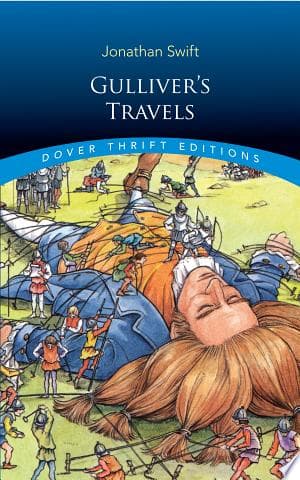
Lemuel Gulliver, a surgeon from England, begins his first voyage as a ship's surgeon on the Antelope. A strong storm near Van Diemen's Land wrecks the ship. Gulliver is the only survivor and swims to an unknown island. Tired, he falls asleep on the shore. When he wakes, he finds himself tied to the ground by many tiny ropes, his arms and legs secured, and his long hair tied down. He sees a human figure, no taller than six inches, climbing onto his body, followed by hundreds more. These are the people of Lilliput. They are at first cautious but eventually lead him to their capital, Mildendo, where he is given an abandoned temple and huge amounts of their small food and drink.
Gulliver quickly learns the Lilliputian language and gains favor with Emperor Golbasto Momarem Evlame Gurdilo Shefin Mully Ully Gue. He observes their unique customs and political system, where high offices are given for skill in rope-dancing and jumping over sticks, not for merit. He learns about the deep rivalry between two political groups, the 'High-Heels' (Tramecksan) and the 'Low-Heels' (Slamecksan), which reflect England's Whig and Tory parties. More importantly, he learns about the long war with the nearby island of Blefuscu, which started from a religious argument over which end of an egg to break first – the 'Big-Endians' versus the 'Little-Endians'.
The Emperor of Lilliput asks for Gulliver's help in the war against Blefuscu. Gulliver uses his huge size and strength to wade across the channel between the islands. He gets fifty strong cables and fifty hooks, fastens them to Blefuscu's warships, and pulls the entire fleet back to Lilliput. This action gives Lilliput a complete victory. The Emperor is very happy and gives Gulliver the title of Nardac. However, Gulliver refuses the Emperor's later demand to destroy Blefuscu entirely and enslave its people. This begins to strain his relationship with the Lilliputian court, especially with the jealous Flimnap and the dishonest Skyresh Bolgolam.
Gulliver learns of a plan against him by his enemies in the Lilliputian court. They accuse him of treason for not destroying Blefuscu, for putting out a fire in the royal palace by urinating on it (an act seen as disrespectful despite saving the Empress), and for secretly talking with the Blefuscudians. Facing the threat of blinding and starvation, Gulliver escapes to Blefuscu, where he is treated better. While there, he finds a large, seemingly abandoned boat and repairs it with the help of the Blefuscudians. He sails away, is picked up by an English merchant ship, and finally returns to England, bringing some small cattle and sheep from Lilliput.
After a short time in England, Gulliver begins his second voyage on the Adventure. During a trip ashore for water, he is separated from his companions and left on an island of giants. A farmer, seventy-two feet tall, finds him and takes him home. There, Gulliver becomes a show, kept in a small box and displayed for money. The farmer's nine-year-old daughter, Glumdalclitch, mostly cares for him. She treats him kindly, dresses him, teaches him their language, and protects him from household dangers like rats and the baby's rough handling. He is eventually sold to the Queen of Brobdingnag.
At the royal court of Brobdingnag, Gulliver gets a special traveling box and Glumdalclitch continues to care for him as his governess. He becomes a favorite of the Queen and often talks with the King. Gulliver tries to impress the King with descriptions of English society, history, politics, and technology. However, the King is unimpressed, seeing England's systems as corrupt and its people as small-minded and violent, comparing humanity to 'hateful vermin.' The King's questions often show the flaws of European civilization from a giant's view, highlighting its moral failures.
Despite his protected status, Gulliver faces constant dangers due to his small size in Brobdingnag. He nearly drowns from hail, is almost eaten by a dog, attacked by wasps, and even carried off by a monkey who mistakes him for a baby. He lives in constant fear. One day, at the seashore with Glumdalclitch, a giant eagle snatches his traveling box and carries it high into the sky. The eagle eventually drops the box into the sea, where English sailors find Gulliver. He is rescued and returns to England, finding it hard to adjust to the normal size of people and things after living among giants.
Gulliver's third voyage takes him to a series of strange lands. He is rescued by the flying island of Laputa, home to absent-minded thinkers and musicians who need 'flappers' to remind them to speak or listen. Laputa rules over Balnibarbi, whose capital, Lagado, houses a Grand Academy where scientists work on odd, useless projects, such as getting sunbeams from cucumbers or softening marble for pillows. Gulliver also visits Glubbdubdrib, an island of sorcerers where he can talk with historical figures, and Luggnagg, where he meets the immortal Struldbrugs, who, to his dismay, are cursed with endless old age and sadness. He eventually travels to Japan and then back to England.
On his fourth and last voyage, Gulliver is left on an unknown shore after his crew revolts. He soon finds two distinct groups: the Yahoos, ugly, hairy, human-like creatures driven by basic urges, and the Houyhnhnms, intelligent, rational horses who govern themselves with perfect reason and goodness. A Houyhnhnm Master takes Gulliver in. Despite his initial confusion about Gulliver's appearance (so like a Yahoo), the Master sees his ability to reason. Gulliver quickly learns their language and is deeply impressed by their calm, logical, and moral society, which operates without lies, war, or greed.
Living among the Houyhnhnms, Gulliver comes to admire their pure logic and goodness. He starts to see the Yahoos as a terrible reflection of human nature, without reason or decency. He tells his Houyhnhnm Master about Europe's history and customs, accidentally showing the corruption, war, injustice, and foolishness of human society. The Houyhnhnms, with their steady logic, find human behavior completely confusing and unpleasant. Gulliver takes on this view, slowly adopting Houyhnhnm ways and developing a deep self-hatred and disgust for humanity, seeing himself as a Yahoo in disguise.
Despite his acceptance and his Houyhnhnm Master's affection, the Houyhnhnm assembly decides that Gulliver, being a Yahoo in form, cannot stay among them. They fear his presence might corrupt their young or encourage the Yahoos. Gulliver is heartbroken by this decision, preferring to live with the good Houyhnhnms than return to his own depraved human species. He reluctantly builds a small canoe and sails away, feeling completely cut off from humanity.
Gulliver is eventually picked up by a Portuguese ship captained by Don Pedro de Mendez, a kind and good man, who treats him with compassion despite Gulliver's increasingly strange behavior and his refusal to admit his humanity. Gulliver is brought back to England, but he cannot stand to be around his own family or other humans, whom he now sees as Yahoos. He buys two horses and spends his days talking to them in his stable, slowly trying to get used to human society again, but always keeping his deep hatred and disgust for his own species. He dislikes their smell, their manners, and their lack of reason, forever preferring the company and principles of the Houyhnhnms.
The Protagonist
Gulliver transforms from a curious, relatively open-minded traveler into a bitter misanthrope who despises humanity after experiencing the rational Houyhnhnms.
The Supporting
Remains largely static, his character serving as a satirical representation of political vanity and shortsightedness.
The Supporting
Her character remains consistent as a figure of innocence and care, providing a moral anchor in a challenging environment.
The Supporting
His character is fixed as a symbol of enlightened reason, serving as a foil to Gulliver's initial pride in his homeland.
The Supporting
Remains a consistent embodiment of pure reason and virtue, serving as a moral compass for Gulliver.
The Antagonists/Symbolic
They are static representations of humanity's lowest common denominator, a catalyst for Gulliver's misanthropy.
The Antagonist
Remains a consistently antagonistic figure, representing the corrupt elements of the Lilliputian court.
The Supporting
A static character who represents genuine human kindness and reason, contrasting with Gulliver's adopted Houyhnhnm perspective.
This is the main theme, shown through Gulliver's increasingly harsh experiences. In Lilliput, Swift mocks the triviality of political ambition and conflict (e.g., rope-dancing for office, the Big-Endian/Little-Endian war). In Brobdingnag, the King's critique reveals the brutality of European history and systems (e.g., gunpowder, legal systems). In Laputa, it's the impracticality of abstract thought. Finally, the Yahoos show humanity's natural flaws, while the Houyhnhnms embody pure reason and goodness, making human faults very clear to Gulliver and the reader. This leads to Gulliver's strong dislike for people.
“I was struck with a horrible dilemma, in the prospect of my fellow-creatures, and myself, as I was a Yahoo. For, I was in hopes to have made a more advantageous comparison between the Houyhnhnms and us, than I found it possible for me to do.”
Swift often uses changes in size and culture to show that truth and morals depend on one's viewpoint. In Lilliput, Gulliver is a giant, making their political squabbles seem unimportant. In Brobdingnag, Gulliver is tiny, and the King sees European society as equally small and morally flawed. The Houyhnhnms' logical view shows the unreasonableness of human customs Gulliver once accepted. This theme asks the reader to question their own beliefs by showing how different situations can greatly change how one sees what is 'normal' or 'right.'
“I remember, upon this occasion, a remark which I had often heard an English gentleman make, that when a creature is to be considered as a whole, the beauty of the parts is of little consequence.”
Swift uses sharp satire to criticize various parts of 18th-century European (especially English) politics, religion, and social customs. The Lilliputian court, with its groups (High-Heels/Low-Heels) and small reasons for war (Big-Endians/Little-Endians), directly mocks the Whig and Tory parties and the religious conflicts of Swift's time. The Grand Academy of Lagado satirizes the Royal Society and its often-impractical scientific work. The King of Brobdingnag's disdain for European history and systems, especially the legal system and gunpowder, directly criticizes the supposed 'advances' of Western civilization. The Yahoos' primitive wildness is a harsh comment on humanity's built-in flaws.
“I told him of an invention, discovered between three and four hundred years ago, to make a certain powder; which, put into a hollow tube of brass or iron, by means of a match, would drive forth a ball of lead with such violence, as nothing was able to resist.”
While the Houyhnhnms represent pure reason, Swift also hints at the limits of a life without feeling and imagination. Their society, though good, can seem cold and strict, leading them to coldly expel Gulliver based on a logical, but harsh, rule. On the other hand, the Laputians, relying too much on abstract reason, are impractical and out of touch with reality, showing the dangers of intellect without common sense. The book explores the balance between reason and emotion, suggesting that too much of either can lead to societal problems or personal isolation, as seen in Gulliver's ultimate hatred of people.
“But, when a creature is to be considered as a whole, the beauty of the parts is of little consequence.”
Gulliver's identity constantly changes because of his experiences. He is a giant, then a dwarf, then an intellectual equal, and finally a Yahoo. Each society he meets makes him question who he is and where he belongs. His attempts to fit into these foreign cultures eventually lead to deep separation from his own. After living with the Houyhnhnms, he can no longer identify with humanity, feeling a deep disgust and disconnection from his family and countrymen. This theme explores the psychological effect of living in another culture and the difficulty of bringing together very different ways of seeing the world.
“I fell into a Swoon for want of Breath, and was not able to recover, till I had discharged my Stomach of the unsavoury Morsels that lay upon it. And, to say the Truth, I was for some Days after so much out of order, that I could not look upon a Yahoo, without a Mixture of Hatred and Contempt, nor endure the Sight of my own Person in a Glass.”
Characters and events symbolize real-world political and social issues.
Swift uses allegory extensively, particularly in the first two voyages. Lilliput is an allegorical representation of England, with the High-Heels and Low-Heels representing the Whig and Tory parties, and the Big-Endians and Little-Endians satirizing the religious conflicts between Catholics and Protestants. Brobdingnag's King, through his judgments, allegorically critiques the moral failings of European governance. This device allows Swift to comment on sensitive political and social issues of his time without directly naming them, providing a layer of protection while still making his criticisms clear to contemporary readers.
Reversing traditional roles or placing contrasting elements side-by-side to highlight absurdity.
Swift's primary satirical technique involves inverting the expected order of things or juxtaposing vastly different scales and moral systems. In Lilliput, a six-inch-tall emperor wields absolute power, making his trivial concerns seem ridiculous. In Brobdingnag, Gulliver, representing 'civilized' Europe, is reduced to a pet, and his boasts about humanity are met with the King's contempt. The most striking example is the juxtaposition of the rational Houyhnhnms with the bestial Yahoos, which forces Gulliver (and the reader) to re-evaluate the very definition of humanity. This device effectively exposes the irrationality and moral corruption of human society.
The story is told as a series of adventures from Gulliver's perspective.
The novel is presented as Gulliver's personal account of his voyages, written in the style of a factual travelogue common in the 18th century. This first-person narration lends credibility to the fantastical events and allows the reader to experience the shock, wonder, and eventual disillusionment alongside Gulliver. It also enables Swift to embed Gulliver's evolving (and often flawed) perspective directly into the narrative, making his transformation into a misanthrope more impactful. The seemingly objective reporting style makes the underlying satire all the more potent, as Gulliver often describes absurdities without fully grasping their satirical implications.
Imitating the style of travel writing to mock its conventions and underlying assumptions.
Swift parodies the popular travel narratives of his era, which often presented exotic lands and peoples with a veneer of factual accuracy, even when describing the highly improbable. By mimicking the detailed descriptions, navigational data, and cultural observations found in real travel accounts, Swift lends a false sense of authenticity to Gulliver's impossible journeys. This parody allows him to subtly mock the credulity of readers and the often-ethnocentric biases found in such travelogues, while simultaneously using the familiar format to deliver his sharp social and political critiques.
“I could not forbear thinking that this ought to be the great design of every prince and minister of state in prescribing rules for the government of his people.”
— Gulliver reflecting on the simplicity and virtue of the Brobdingnagian society.
“And he gave it for his opinion, that whoever could make two ears of corn, or two blades of grass, to grow upon a spot of ground where only one grew before, would deserve better of mankind, and do more essential service to his country, than the whole race of politicians put together.”
— The King of Brobdingnag's pragmatic view on genuine service to humanity.
“Undoubtedly, philosophers are in the right when they tell us that nothing is great or little otherwise than by comparison.”
— Gulliver observing the world from different perspectives, particularly in Lilliput and Brobdingnag.
“But, great as you are, and as much as I admire your wisdom, I am afraid you are not free from the errors of your own education.”
— Gulliver to the King of Brobdingnag, highlighting the limitations of even the wisest rulers.
“I cannot but conclude the bulk of your natives to be the most pernicious race of little odious vermin that nature ever suffered to crawl upon the surface of the earth.”
— The King of Brobdingnag's scathing assessment of humanity after Gulliver describes European society.
“He said, he knew no reason why those who entertain opinions prejudicial to the publick should be obliged to change, or should not be obliged to conceal them.”
— A Laputan philosopher discussing freedom of thought and its limits.
“Reason has no power to determine the will, but is only able to point out the way.”
— A statement reflecting the Houyhnhnms' perspective on reason and emotion.
“I had hitherto conceived a favourable opinion of myself and mankind, but it was now impossible for me to avoid the mortification of seeing myself in the most contemptible point of view.”
— Gulliver's self-realization and disgust after living among the Houyhnhnms and Yahoos.
“My master argued, that the use of speech was to make us understand one another, and to receive information of facts; now if any one said the thing which was not, these ends were defeated.”
— The Houyhnhnm master's view on truth and language, contrasting with human deceit.
“For, as to what we call the secrets of nature, they are more properly the secrets of art, hard to be discovered, but easy when found.”
— A Laputan scholar discussing scientific discovery.
“He was amazed how so impotent and groveling an insect as I (our odious appellation of man) could have the intrepidity to engage in new adventures, or the folly to pretend to govern the world.”
— The King of Brobdingnag's reaction to Gulliver's description of human ambition and warfare.
“I soon observed that, among the Lilliputians, the high heels and low heels represented the two great political factions, and that the monarch was inclined to favour the low heels.”
— Gulliver observing the petty political divisions in Lilliput.
“The learning of this people is very copious and extensive, and their libraries are filled with treatises on all subjects, written in a very elegant and judicious style.”
— Gulliver describing the intellectual pursuits of the Houyhnhnms.
“He thought it beneath him to take any notice of my complaints, or to offer me the least comfort; but, on the contrary, seemed to enjoy my perplexity, and to triumph in my distress.”
— Gulliver's treatment by the Portuguese captain Don Pedro after his return from the Houyhnhnms, highlighting human cruelty.
Ready to see how well you understood this book? Take our interactive quiz with 10 questions.
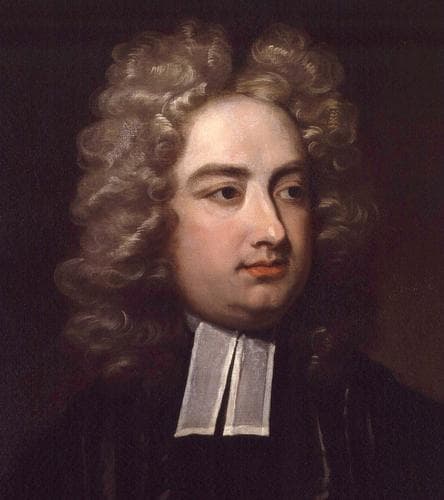
Jonathan Swift was an Anglo-Irish satirist, author, essayist, political pamphleteer, poet, and Anglican cleric who became Dean of St Patrick's Cathedral, Dublin, hence his common sobriquet, "Dean Swift".







