“I can see you, Sabine. I can see you from my window.”
— Griffin's initial letter to Sabine, revealing his inexplicable ability.

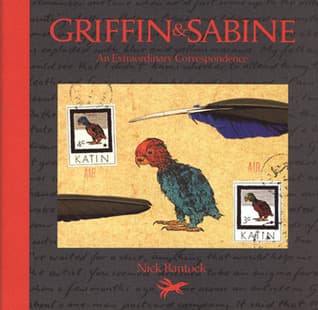
Nick Bantock (1992)
Genre
Fantasy / Creativity / Mystery / Romance
Reading Time
45 min
Key Themes
See below
Sign in to track this book
A solitary artist's ordered life unravels through intimate, illustrated letters with a mysterious woman who can inexplicably see his paintings, blurring the lines between reality, romance, and the supernatural.
Griffin Moss, a London artist, receives an unexpected postcard from Sabine Strohem, an artist on a remote tropical island named Sicmon. The postcard features one of Sabine's illustrations and, more unsettlingly, a message stating she knows what Griffin is painting at that very moment. Griffin, initially dismissive, is disturbed by this claim, as he works alone and has no known connection to anyone so distant. He feels compelled to reply, beginning a strange correspondence that will change his solitary life.
Griffin's first letter expresses his disbelief and asks for an explanation from Sabine. He suspects a prank. However, Sabine's next letters and postcards become even more precise, describing not just the subjects but also the specific colors, textures, and even the emotional states of his current paintings — details no one outside his studio could know. She explains that she sees his work in her mind, a connection she calls a 'gift' or a 'curse.' This deeply unsettles Griffin, forcing him to confront the impossibility of her claims.
As their correspondence continues, Sabine reveals that her connection to Griffin goes beyond his art. She describes seeing glimpses of his daily life, his surroundings, and even his dreams. She mentions specific details about his London flat and his routine, further eroding Griffin's logical defenses. Griffin, though still doubtful, begins to feel a strange pull towards Sabine. He starts to wonder if this connection is a unique form of clairvoyance, a shared psychic link, or something more, challenging his view of reality.
Griffin and Sabine discuss theories about their connection. Sabine believes they are 'twin souls' or part of a larger, mystical network of artists. Griffin, while still looking for a logical explanation, starts to acknowledge Sabine's impact on his life and art. He finds inspiration from her fantastical world, and his own art begins to change, becoming less solitary and more infused with the exotic imagery Sabine describes. Their letters become a joint exploration of a shared, unseen dimension.
As their correspondence deepens, a strong emotional bond forms between Griffin and Sabine. They share personal thoughts, fears, and artistic goals. The initial shock and mystery give way to a deep sense of connection and longing. Both express a desire to meet, to bridge the vast distance and understand the physical form of their psychic link. Griffin, once a recluse, finds himself increasingly open to the idea of meeting the woman who sees into his soul.
The practicalities of a meeting begin to surface. Sabine's island, Sicmon, is remote and hard to reach, adding another layer of mystery to her life. There are subtle hints that her life might not be as straightforward as Griffin's, or that their meeting could have unforeseen results. Despite the growing intimacy, a sense of apprehension remains. Griffin is torn between wanting to meet Sabine and fearing what such a meeting might reveal or, conversely, destroy about their unique, ethereal connection.
Sabine's letters begin to sound more uneasy. She hints that their connection might be more than just a beautiful synchronicity; perhaps it is a spiritual entanglement that could be dangerous if physically realized. She mentions dreams of 'giants' and 'shadows' that seem to be entering her world, suggesting an external force or consequence related to their bond. She warns Griffin, urging him to consider the implications of their link beyond mere romance or curiosity.
Despite Sabine's subtle warnings and growing apprehension, Griffin's determination to meet her solidifies. He is captivated by her, and the mystery surrounding her only fuels his resolve. He begins to plan his trip to Sicmon, researching routes and preparing for the long journey. He believes that only by meeting Sabine in person can they truly understand their bond and perhaps find answers to the questions that trouble them both. His initial skepticism has been replaced by a firm belief in their connection.
Griffin sends his last postcard to Sabine before starting his journey to Sicmon. His message mixes excitement, hope, and a hint of worry about what awaits him. He expresses his deep gratitude for how she has changed his life and art. The book ends with Griffin presumably traveling, leaving the reader to consider the outcome of his quest and the truth behind the connection between these two artists. The resolution of their story is left open, inviting continued thought.
The Protagonist
Griffin transforms from a skeptical recluse into an open-minded, romantically inclined adventurer, willing to cross continents for an inexplicable connection.
The Protagonist/Mysterious Figure
Sabine remains somewhat enigmatic, revealing the depths of her unique perception and hinting at the complex, perhaps dangerous, implications of their shared connection.
This theme explores how human connection can exist beyond the physical. Griffin and Sabine's bond challenges common understanding, suggesting a spiritual or psychic link that goes beyond distance and logic. Their letters discuss the idea that two souls can be deeply connected, sharing thoughts, creations, and even dreams, without ever having met. This is clear from Sabine's first postcard, where she describes Griffin's painting, and their later letters, where they discuss the profound, unexplainable synchronicity of their minds.
“How can you know what I am painting? There is no one here.”
Art is the main way Griffin and Sabine's connection is first made and then strengthened. Their shared artistic sensibilities and Sabine's ability to 'see' Griffin's creations highlight art's power to reveal hidden truths and create paths between minds. Their individual styles, Griffin's more grounded and Sabine's fantastical, merge and influence each other, suggesting that artistic expression can be a way for spiritual or psychic communication, letting them communicate on a deeper, non-verbal level. Their paintings become literal windows into each other's souls.
“I see your paintings, Griffin. They are beautiful, but you are not alone.”
The entire story plays with the reader's, and Griffin's, view of reality. Is Sabine real? Is their connection a genuine psychic event, a shared delusion, or something else? The format of letters and postcards, often with fantastical images, blurs the line between what is real and what is imagined. Griffin's shift from doubt to belief mirrors the reader's own wrestling with the extraordinary claims. The book constantly asks what is 'real' when faced with such profound and unexplainable experiences, leaving the final answer unclear.
“Are you a clairvoyant? A long-lost twin? Or a malevolent angel?”
Despite the unsettling nature of Sabine's first messages, Griffin is drawn into the mystery rather than put off by it. The unknown, represented by Sabine's remote island, her psychic abilities, and the sheer impossibility of their connection, becomes a strong magnet. This theme explores human curiosity and the desire to explore the limits of what is understood. Griffin's decision to travel across the world to meet Sabine, despite her subtle warnings, shows how the unknown can inspire deep change and adventure.
“I must come. I must see you. I must know.”
The story is told entirely through letters and postcards.
The entire narrative unfolds through the exchange of physical letters and postcards between Griffin and Sabine. This format is crucial for building suspense and intimacy, as the reader directly experiences their evolving relationship. The physical act of opening envelopes and reading their private correspondence creates a unique, voyeuristic engagement, making the reader feel like a privileged participant in their mystery. It also visually reinforces the distance between them and the gradual bridging of that gap through their words and art.
The reader must interpret the truth of the events through subjective accounts.
While not a single unreliable narrator, the epistolary format inherently creates a sense of subjective reality. Both Griffin and Sabine's accounts are filtered through their individual perceptions and emotions. The reader never gets an objective third-person view of their connection, forcing them to question whether Sabine's psychic abilities are real, a shared delusion, or a metaphor. This ambiguity enhances the mystery and allows for multiple interpretations of the story's fantastical elements, contributing to the 'fantasy, mystery' genre aspects.
The narrative is heavily integrated with the characters' artwork.
Each letter and postcard is not just text, but also features the characters' unique illustrations. Griffin's art tends to be more grounded, while Sabine's is vibrant and fantastical, depicting bizarre creatures and lush landscapes. These visuals are integral to the plot, as Sabine's ability to 'see' Griffin's paintings is a central mystery. The artwork also enriches the characterization, provides clues about their inner worlds, and immerses the reader in the fantastical elements of the story, making the book a unique artistic experience in itself.
A psychic or spiritual link that transcends physical distance.
The central plot device is the inexplicable, non-physical connection between Griffin and Sabine. This allows Sabine to 'see' Griffin's art and even aspects of his life from thousands of miles away. It serves as the catalyst for the entire story, driving Griffin's initial disbelief, then his profound curiosity, and ultimately his decision to travel. This device establishes the fantastical element of the story and challenges the characters (and the reader) to consider possibilities beyond conventional understanding of reality and human interaction.
“I can see you, Sabine. I can see you from my window.”
— Griffin's initial letter to Sabine, revealing his inexplicable ability.
“Are you a figment of my imagination? Am I a figment of yours?”
— Sabine's early response to Griffin, questioning the nature of their shared vision.
“We are two antennae, picking up the same frequency.”
— Griffin's metaphor for their unique connection, explaining their shared sight.
“The world is a much smaller place than we imagine, and much larger.”
— A reflection on the paradox of their connection across distances.
“Perhaps we are merely dreaming each other.”
— Sabine's philosophical musing on the nature of their existence and interaction.
“It's like finding a secret door in a familiar house.”
— Griffin's description of the wonder and surprise of discovering Sabine.
“I feel as if I've been waiting for you all my life, without knowing it.”
— A heartfelt expression of the deep, pre-destined connection felt by Griffin.
“Our art is the key, isn't it? The way we see things.”
— Sabine realizing their shared artistic vision is fundamental to their connection.
“The truth is often stranger than fiction, especially when it's personal.”
— A general observation on the bizarre reality of their situation.
“Don't ever stop writing. Don't ever stop seeing.”
— An urgent plea from one to the other, emphasizing the importance of their communication and shared vision.
“We are creating our own map, aren't we? Of a place no one else can see.”
— Sabine's reflection on their unique journey and shared reality.
“To be seen, truly seen, is a rare and wonderful thing.”
— A poignant statement about the profound intimacy of their connection.
“Perhaps the greatest mysteries are the ones we live inside.”
— A philosophical thought on the inherent mystery of life and personal experience.
Ready to see how well you understood this book? Take our interactive quiz with 10 questions.







