“War is a grenade. It doesn't care who it kills.”
— Reflection on the indiscriminate nature of war, central to the book's theme.

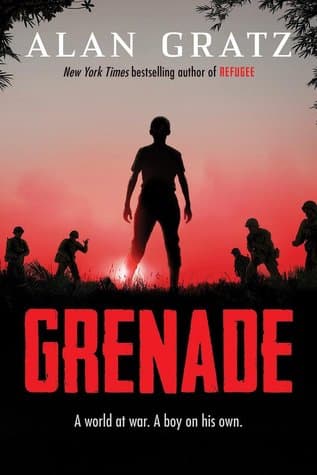
Alan Gratz (2018)
Genre
Children's / Historical Fiction / Young Adult
Reading Time
270 min
Key Themes
See below
Sign in to track this book
On the war-torn island of Okinawa in 1945, a Japanese boy conscripted with a grenade and an American Marine fighting for survival are set on a collision course that will force them to confront the true cost of war and the unexpected paths to humanity.
In April 1945, twelve-year-old Hideki Kaneshiro lives a simple life in Okinawa, tending to his family's farm and caring for his younger sister, Kimiko. Life is relatively peaceful despite the distant rumble of war. This peace ends when American ships appear offshore, signaling an imminent invasion. The Japanese Imperial Army, already on the island, begins conscripting local Okinawan boys, including Hideki, into the 'Blood and Iron Student Corps.' He is given a uniform, a basic rifle, and two grenades, with strict orders to fight to the death and never surrender. His family, including his father and pregnant mother, are forced into a cave for shelter, leaving Hideki with a heavy heart and the terrifying burden of defending his homeland.
Across the island, eighteen-year-old Private Ray Miller, an American Marine from Nebraska, lands on Okinawa with his unit. The initial landing is quiet, making Ray believe the Japanese have retreated. This illusion is quickly shattered by intense shelling and sniper fire. Ray sees the immediate, horrifying reality of war as his comrades are killed and wounded around him. He struggles with fear and the overwhelming chaos, trying to follow orders amidst the constant threat of death. His unit's objective is to push inland, clearing out Japanese resistance, but the terrain is difficult, and the enemy, though unseen, is everywhere.
Hideki, along with other conscripted Okinawan boys, is sent on a mission to find water for the Japanese soldiers. They are constantly threatened by American patrols and air raids. During this mission, Hideki has his first terrifying encounter with American soldiers. He is ordered to use one of his grenades to kill an enemy, but his fear and inexperience prevent him from acting. He sees his friend, Yoshio, bravely sacrifice himself with a grenade. This traumatizes Hideki and reinforces the Japanese military's brutal 'no surrender' ideology. The weight of his orders and the expectation to die for the Emperor press heavily on him, making him question his ability to fulfill his duty.
Ray's Marine unit pushes deeper into Okinawa, encountering increasingly fierce resistance. They face well-fortified Japanese positions, including hidden bunkers and caves. The fighting is brutal and hand-to-hand at times, with the Japanese soldiers often launching desperate Banzai charges and suicide attacks. Ray sees the psychological toll of the war on his fellow Marines, as exhaustion, fear, and trauma begin to wear them down. He struggles with seeing the enemy as less than human, trying to reconcile the orders to kill with the glimpses of humanity he sometimes sees in the Okinawan civilians caught in the crossfire.
Overwhelmed by the horrors of war and the Japanese army's disregard for Okinawan lives, Hideki decides to abandon his assigned post and search for his family. He believes they are still sheltering in the cave where he left them. His journey across the island is dangerous, as he dodges both American and Japanese soldiers, who view him with suspicion or as unimportant. He sees the widespread devastation of his home island, with villages destroyed and civilians suffering greatly. This journey is a desperate race against time and the advancing American forces, as he tries to reunite with his loved ones, particularly his pregnant mother and young sister, Kimiko.
Ray's unit is pinned down by heavy Japanese fire, running critically low on water. The heat and constant combat take a severe toll, and dehydration is as dangerous as enemy bullets. Ray, along with his squad leader, is sent on a desperate mission to find a water source. During this search, they encounter a group of Okinawan civilians, including women and children, hiding in a cave. The encounter is tense, as both sides are wary, but the immediate need for water temporarily overrides the combat. Ray struggles with the moral ambiguity of the situation, recognizing the civilians' suffering even as they are caught between two warring armies.
After a dangerous journey, Hideki finally reaches the cave where he had left his family. His hope turns to despair when he finds the cave has been shelled. Inside, he discovers the bodies of his family members, including his father and his mother, who died during childbirth, holding her stillborn baby. His younger sister, Kimiko, is missing. Overcome with grief and a deep sense of loss, Hideki's resolve to fight for Japan shatters. His only remaining purpose is to find Kimiko, believing she might still be alive, and to somehow get revenge for his family, though the path to revenge is unclear.
Driven by grief and a desperate need for revenge after discovering his family's fate, Hideki, armed with his last grenade, stalks American soldiers. He sees Ray and his squad near a cave, believing them responsible for his family's death. Hideki ambushes them, throwing his grenade. The explosion injures Ray and kills some of his comrades. In the ensuing chaos, Ray, wounded and disoriented, manages to fire back, hitting Hideki. The two boys, one an American Marine and the other an Okinawan boy soldier, find themselves face-to-face, locked in a deadly struggle born of war and misunderstanding. The encounter is brutal and personal, a culmination of their separate journeys.
Wounded and disoriented from the grenade blast and subsequent gunfire, Ray and Hideki lie near each other. As Ray prepares to deliver a final, fatal blow, he notices a small, familiar object clutched in Hideki's hand: a hand-carved wooden horse, identical to one Ray had seen given to a child by an Okinawan woman earlier. This small detail, a symbol of childhood innocence and shared humanity, breaks through Ray's combat-hardened mindset. He sees Hideki not just as an enemy soldier, but as a boy, a victim of the same war. This realization forces Ray to hesitate, questioning the very nature of his mission and the enemy he has been trained to kill.
In a moment of deep moral conflict, Ray chooses not to kill Hideki. He leaves Hideki wounded but alive, retreating as other Marines approach. Hideki, though gravely injured, manages to crawl away, his life spared. The war eventually ends, and both boys survive the Battle of Okinawa, though deeply scarred by their experiences. Ray returns home, haunted by the atrocities he witnessed and the choices he made. Hideki, having lost everything, rebuilds his life on a devastated Okinawa. Their brief, brutal encounter leaves an indelible mark on both. It shows the personal cost of war and the fragile thread of humanity that can persist even in the darkest of times.
The Protagonist
Hideki transforms from an innocent farm boy into a survivor hardened by loss, but ultimately chooses to live rather than die for a cause he no longer believes in.
The Protagonist
Ray evolves from a naive soldier into a war-weary veteran who learns the profound cost of conflict and the importance of recognizing humanity in the 'enemy'.
The Supporting
Serves as a catalyst for Hideki's actions and a symbol of humanity's enduring spirit amidst destruction.
The Supporting
His death signifies the destruction of Hideki's family and the loss of his childhood home.
The Supporting
Her death marks a tragic turning point for Hideki, symbolizing the complete destruction of his family unit.
The Supporting
His sacrifice serves as a grim example of the Japanese military's indoctrination and the tragic fate of young Okinawan soldiers.
The Supporting
Remains a consistent figure of authority and combat experience, guiding Ray through the war.
The Supporting
He remains a symbol of the ruthless military ideology that compels Hideki to fight.
The novel clearly shows how war strips away individuality and creates hatred between combatants. Both Hideki and Ray are taught to see the 'other' as an enemy to be killed, not as fellow human beings. Hideki is called 'devil' by the Japanese soldiers for being Okinawan, and Ray is told the Japanese are 'animals.' This theme is strongly shown in the initial encounters, where both boys are ready to kill without knowing anything about each other, driven solely by propaganda and survival instinct. The climax, where Ray recognizes Hideki's humanity through the wooden horse, directly challenges this dehumanization.
“'Kill the devils!' the Japanese soldiers would shout, meaning the Americans. 'Kill the animals!' the Americans would shout back, meaning the Japanese. But Hideki knew, deep down, that they were all just people.”
Both Hideki and Ray, despite their age difference, are forced to grow up too quickly due to the war. Hideki, a twelve-year-old farm boy, is thrust into combat with a grenade and orders to die. His childhood is stolen by the harsh realities of fighting, seeing death, and losing his entire family. Ray, an eighteen-year-old, quickly loses his naive idealism about serving his country as he experiences the horrors of combat, the death of comrades, and the moral compromises required for survival. The novel shows how war robs children and young adults of their formative years and leaves them with deep psychological scars.
“Hideki was twelve, but he felt like he was a hundred. He'd seen things no one should ever see, done things no one should ever do.”
For Hideki, the quest to find his family, particularly his younger sister Kimiko, becomes his central driving force after the initial conscription. His love for his family goes beyond his forced loyalty to the Japanese army. This theme highlights the universal human need for connection and the devastating impact of war on familial bonds. Even for Ray, a sense of belonging to his unit and the desire to return to his family in Nebraska provides motivation amidst the chaos. The wooden horse, a gift from Hideki to Kimiko, symbolizes these deep familial ties and ultimately creates a moment of connection between the two protagonists.
“He wasn't fighting for the Emperor anymore. He was fighting for Kimiko. He was fighting to find his family.”
The novel consistently presents characters, particularly Ray, with morally complex situations where there are no easy answers. Ray struggles with the orders to kill an unseen enemy while encountering Okinawan civilians, including children. The climax, where Ray chooses not to kill a wounded Hideki, is the main example of this theme. Similarly, Hideki grapples with the Japanese army's 'no surrender' policy versus his innate desire to live and protect his family. The book avoids clear-cut heroes and villains, instead focusing on the difficult choices individuals make under extreme pressure.
“He had to kill this boy. It was his job. It was what he was here for. But as he looked at Hideki's face, he saw not an enemy, but just... a boy.”
Despite the overwhelming odds and the constant threat of death, both Hideki and Ray show great resilience. Hideki endures starvation, fear, and the deep grief of losing his family, yet he continues to push forward in his search for Kimiko and ultimately chooses to survive. Ray, facing constant combat, dehydration, and the psychological toll of war, also perseveres. This theme shows the human will to live and adapt even in the most brutal circumstances, displaying the strength of the human spirit to endure and rebuild after devastation.
“He was just a boy, but he was still alive. And as long as he was alive, there was hope.”
Alternating chapters between Hideki and Ray to offer contrasting viewpoints.
The novel employs a dual perspective, alternating chapters between Hideki, a twelve-year-old Okinawan boy conscripted into the Japanese army, and Ray, an eighteen-year-old American Marine. This device allows readers to experience the Battle of Okinawa from two opposing sides, fostering empathy for both protagonists. It highlights the shared fear, suffering, and dehumanization inherent in war, while also showcasing the cultural and personal motivations driving each character. This narrative structure builds tension towards their inevitable confrontation and provides a holistic view of the conflict's impact.
A small, hand-carved toy symbolizing innocence and shared humanity.
The wooden horse is a significant symbolic object in the novel. Carved by Hideki for his younger sister, Kimiko, it represents family, childhood innocence, and the life that war is destroying. Ray first encounters a similar wooden horse given to an Okinawan child by a local woman, momentarily connecting him to the civilian population. When Ray later sees the identical horse clutched in a wounded Hideki's hand during their final confrontation, it acts as a powerful catalyst, allowing Ray to see Hideki not as an 'enemy' but as a boy, a brother, and a fellow human being, leading to his pivotal decision not to kill him.
A literal and symbolic object representing destruction, duty, and moral choice.
The grenade is central to the novel's title and its thematic core. For Hideki, it represents the brutal orders of the Japanese army – a tool for suicide attacks and a symbol of his forced duty to die for the Emperor. He carries two, one for the enemy, one for himself, embodying the 'no surrender' policy. For Ray, grenades are a weapon of the enemy, a constant threat. The final grenade thrown by Hideki, which wounds Ray, leads to their face-to-face confrontation. Ultimately, the grenade symbolizes the destructive power of war, but also the moral weight of using such power and the choices made in its presence.
A pervasive Japanese military ideology driving Okinawan soldiers to fight to the death.
The 'no surrender' doctrine is a crucial plot device that shapes Hideki's actions and the overall brutality of the Battle of Okinawa. Imposed by the Japanese Imperial Army, it forces Okinawan conscripts and civilians to fight to the last man, commit suicide rather than be captured, and view surrender as a profound dishonor. This ideology leads to immense suffering for the Okinawan people and creates an intractable enemy for the American forces. It directly influences Hideki's initial reluctance to use his grenade and his eventual desertion when he realizes the futility and cruelty of this command, forcing him to choose survival over blind obedience.
“War is a grenade. It doesn't care who it kills.”
— Reflection on the indiscriminate nature of war, central to the book's theme.
“I am not a soldier. I am a boy with a gun.”
— Hideki's internal conflict about his role in the Battle of Okinawa.
“Two grenades. One for the Americans, one for myself.”
— Hideki's initial mission as a Japanese student soldier.
“Sometimes the bravest thing you can do is not fight.”
— A moment of realization about alternative forms of courage.
“We are all just trying to survive.”
— Observation about shared human experience during the battle.
“The world had gone mad, and I was just a boy caught in the middle.”
— Hideki's perspective on the chaos of war.
“Every life has weight. Every death has meaning.”
— Reflection on the value of individual lives in wartime.
“I didn't want to kill anyone. I just wanted to go home.”
— Ray's thoughts as an American soldier in Okinawa.
“War makes monsters of us all.”
— Comment on how conflict dehumanizes both sides.
“There are no winners in war. Only survivors.”
— Conclusion about the ultimate cost of conflict.
“My grenade was my shame, and my salvation.”
— Hideki's complex relationship with his assigned weapon.
“In the end, we are all just children of the same earth.”
— Realization of shared humanity beyond nationalities.
“The hardest battles are fought inside.”
— Reference to internal struggles during wartime.
“I carried the weight of Okinawa on my shoulders.”
— Hideki feeling responsible for his homeland's fate.
Ready to see how well you understood this book? Take our interactive quiz with 10 questions.

Alan Gratz is a critically acclaimed author known for his gripping historical fiction for young readers. His notable works, including "Refugee," "Code of Honor," and "Grenade," often explore themes of resilience and survival against the backdrop of significant historical events. Gratz's engaging storytelling and meticulous research have earned him a dedicated readership and numerous accolades within the children's literature community.

Dan Gemeinhart
4.5

Kate O'Hearn
4.4

Jeanne Birdsall
4.4

Jen Wang
4.4

Wendelin Van Draanen
4.3

John Marsden
4.3

Chris Van Allsburg
4.3

Jennifer A. Nielsen
4.2