“I do not like green eggs and ham. I do not like them, Sam-I-am.”
— The protagonist repeatedly refuses to try the unusual dish offered by Sam-I-Am.

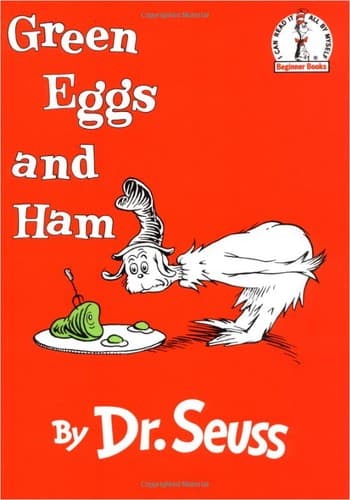
Dr. Seuss (1960)
Genre
Fantasy / Children's / Young Adult
Reading Time
5 min
Key Themes
See below
Sign in to track this book
Sam-I-am tries to convince a skeptical character to eat green eggs and ham, offering them in many places and with many creatures.
The story starts with Sam-I-am approaching an unnamed, grumpy character who is reading a newspaper. Sam-I-am immediately offers a plate of green eggs and ham and asks, 'Do you like green eggs and ham?' The grumpy character, without looking at the food, quickly says, 'I do not like them, Sam-I-am. I do not like green eggs and ham.' This first refusal sets up Sam-I-am's ongoing efforts to get the character to try the unusual meal.
Not discouraged, Sam-I-am starts suggesting different places and companions for eating the green eggs and ham. He first asks, 'Would you like them here or there?' then adds, 'Would you like them in a house? Would you like them with a mouse?' The grumpy character, still refusing to consider the food, repeats his dislike for green eggs and ham. He says he does not like them in a house or with a mouse. His refusal stays firm, even as Sam-I-am lists more scenarios.
Sam-I-am's efforts grow as he suggests more creative and unlikely places to eat the green eggs and ham. He asks if the grumpy character would eat them 'in a box' or 'with a fox,' then suggests 'in a boat' or 'with a goat.' Each time, the grumpy character rejects the idea, repeating his dislike for the green eggs and ham and for all the suggested places and companions. The character's annoyance with Sam-I-am's questions begins to build, but he still has not tasted the food.
Sam-I-am's attempt to convince the grumpy character continues, now moving to different weather conditions. Sam-I-am asks if he would eat them 'in the rain' or 'in the dark.' The grumpy character, becoming more annoyed, sticks to his position. He says he would not eat them in the rain, in the dark, in a box, with a fox, in a house, or with a mouse. His list of rejections gets longer, showing his complete refusal to try the dish under any circumstances Sam-I-am suggests.
Sam-I-am's resolve strengthens as he follows the grumpy character onto a train and even up into a tree, still carrying the plate of green eggs and ham. He asks, 'Would you eat them on a train? In a tree?' The grumpy character, now clearly bothered by Sam-I-am's pursuit, firmly rejects these new ideas. He repeats his dislike for the food and all the places and companions suggested, making it clear he wants Sam-I-am to leave him alone.
As Sam-I-am keeps asking, the grumpy character reaches his limit. He loudly lists all his rejections, saying he would not eat green eggs and ham anywhere with anyone. In his frustration, and while Sam-I-am is still offering the food, the train they are on crashes into a car, which then falls into the water. This event puts the two characters in a new, unexpected place, surrounded by water and wreckage.
After the crash, finding themselves in water, Sam-I-am makes one last request: 'You do not like them. So you say. Try them! Try them! And you may. Try them and you may, I say.' Overwhelmed by the situation and Sam-I-am's persistence, the grumpy character finally gives in, saying, 'Sam! If you will let me be, I will try them. You will see.' He takes a bite of the green eggs and ham, ending his long refusal.
To his surprise, the grumpy character finds he likes the green eggs and ham. His mood changes at once. He happily exclaims, 'Say! I like green eggs and ham! I do! I like them, Sam-I-am!' This sudden change reverses his earlier strong refusal, showing what can happen when you try new things.
After tasting them, the formerly grumpy character enthusiastically lists all the places and companions he would now eat green eggs and ham with. He says he would eat them in a boat, with a goat, in a house, with a mouse, in a box, with a fox, in the dark, in the rain, on a train, and in a tree. His change is complete; he now enjoys the dish he once strongly rejected, and he thanks Sam-I-am for his persistence.
The Protagonist
Sam-I-am remains consistent throughout, a symbol of persistence, ultimately succeeding in his goal.
The Antagonist/Protagonist (of his own journey)
He transforms from a closed-minded, grumpy individual to an open-minded, joyful one who embraces new experiences.
The Mentioned
Does not have an arc; serves as a static element in Sam-I-am's propositions.
The Mentioned
Does not have an arc; serves as a static element in Sam-I-am's propositions.
The Mentioned
Does not have an arc; serves as a static element in Sam-I-am's propositions.
Sam-I-am's steady effort to convince the unnamed character to try green eggs and ham drives the story. Despite constant rejections, Sam-I-am never quits, always suggesting new places and companions. This theme shows that consistent effort can lead to a breakthrough, even when someone strongly opposes it, as seen when the grumpy character finally gives in after many tries.
“I do not like them, Sam-I-am. I do not like green eggs and ham. I do not like them here or there. I do not like them anywhere.”
The book's main point is that you should try new things before deciding if you like them. The grumpy character first rejects the green eggs and ham just because they look strange, without tasting them. His journey from firm refusal to happy acceptance after one bite shows how judging something beforehand can stop you from finding enjoyable experiences. The story encourages readers to be open-minded and willing to try new foods or situations.
“Say! I like green eggs and ham! I do! I like them, Sam-I-am!”
Sam-I-am's repeated suggestions, though first met with resistance, eventually wear down the grumpy character's decision. The many different situations he suggests, from a house to a boat to a train, highlight that sometimes, you only truly know what you like by experiencing it. The story shows that while words can express dislike, only trying something can confirm or change that feeling, leading to a big shift in the grumpy character's view once he tastes the food.
“You do not like them. So you say. Try them! Try them! And you may. Try them and you may, I say.”
The use of repeating phrases and building lists to create rhythm and emphasis.
The story heavily relies on repetition, particularly the phrase 'I do not like green eggs and ham,' and the cumulative listing of places and companions. This device creates a strong rhythm, making the book highly memorable and engaging for young readers. It emphasizes the grumpy character's stubbornness and highlights Sam-I-am's relentless persistence as the list of suggested scenarios grows longer with each page, building anticipation for the eventual taste test and the character's change of heart.
The consistent use of rhyming words to enhance readability and memorability.
Dr. Seuss's signature AABB rhyme scheme is central to 'Green Eggs and Ham.' The simple, predictable rhymes (e.g., 'Sam-I-am' / 'green eggs and ham,' 'house' / 'mouse,' 'boat' / 'goat') make the text highly rhythmic and enjoyable to read aloud. This device not only aids in memorization for children but also propels the narrative forward, creating a lighthearted tone despite the grumpy character's initial resistance, and reinforcing the story's playful nature.
Illustrations that visually extend the absurdity of the situations.
The illustrations in 'Green Eggs and Ham' play a crucial role, often exaggerating the situations described in the text. From Sam-I-am's determined facial expressions to the grumpy character's increasingly frantic attempts to escape, and the final comical crash involving a car and a train, the visuals amplify the humor and absurdity. The sight of green eggs and ham itself is a visual gag, immediately signaling something unusual and challenging the reader's (and character's) expectations.
The green eggs and ham serve as the central object of conflict and resolution.
The peculiar 'green eggs and ham' are not just a meal; they are the central catalyst for the entire plot. Their unusual color immediately sparks the grumpy character's prejudice and sets Sam-I-am's mission in motion. The food serves as a concrete, tangible symbol of 'newness' or 'difference' that must be confronted. The resolution of the story hinges entirely on the character's interaction with and eventual acceptance of this strange dish, making it a powerful symbol for trying new experiences.
“I do not like green eggs and ham. I do not like them, Sam-I-am.”
— The protagonist repeatedly refuses to try the unusual dish offered by Sam-I-Am.
“Would you like them in a house? Would you like them with a mouse?”
— Sam-I-Am suggests various imaginative scenarios to persuade the protagonist to try the dish.
“I would not like them here or there. I would not like them anywhere.”
— The protagonist emphatically rejects the idea of trying green eggs and ham in any location.
“You do not like them. So you say. Try them! Try them! And you may.”
— Sam-I-Am encourages the protagonist to be open-minded and give the dish a chance.
“I do not like them in a box. I do not like them with a fox.”
— The protagonist rejects the dish in another whimsical scenario proposed by Sam-I-Am.
“Say! I like green eggs and ham! I do! I like them, Sam-I-am!”
— After finally trying the dish, the protagonist enthusiastically admits to enjoying it.
“And I would eat them in a boat. And I would eat them with a goat.”
— The protagonist, now converted, lists the absurd places they would happily eat the dish.
“I will eat them here and there. Say! I will eat them anywhere!”
— The protagonist completely reverses their earlier refusal, embracing the dish enthusiastically.
“Would you? Could you? In a car? Eat them! Eat them! Here they are!”
— Sam-I-Am continues to propose increasingly absurd locations to try the dish.
“Not in a tree! You let me be!”
— The protagonist resists trying the dish even in a tree, showing exasperation.
“I do not like them, Sam-I-am. I do not like green eggs and ham.”
— The iconic refrain that establishes the protagonist's initial stubborn refusal.
“Thank you! Thank you, Sam-I-am!”
— The protagonist expresses gratitude to Sam-I-Am after discovering they like the dish.
“You may like them. You will see. You may like them in a tree!”
— Sam-I-Am optimistically suggests the protagonist might enjoy the dish in an unlikely place.
Ready to see how well you understood this book? Take our interactive quiz with 10 questions.

Dr. Seuss, born Theodor Seuss Geisel, was a beloved American children's author and illustrator. He is renowned for his imaginative tales and whimsical rhymes, including iconic works like 'The Cat in the Hat,' 'Green Eggs and Ham,' and 'Oh, the Places You'll Go!'. His unique style and memorable characters have made him a staple in children's literature for generations.







