“The greatest trick the Devil ever pulled was convincing the world he didn't exist.”
— A classic line often referenced, reflecting the hidden nature of evil.

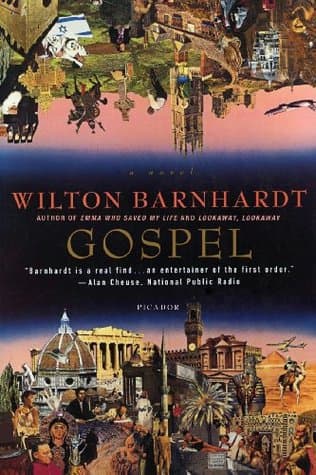
Wilton Barnhardt (1993)
Genre
Thriller / Historical Fiction / Spirituality / Mystery
Reading Time
1360 min
Key Themes
See below
Sign in to track this book
A shy theologian and a cynical ex-Jesuit race across continents, from the Vatican to the ancient Silk Road, in a thrilling, erudite, and often humorous pursuit of a lost first-century gospel that could redefine the essence of Christian faith.
Lucy Dantan, a meticulous and introverted doctoral candidate in theology at the Pontifical Gregorian University in Rome, researches early Christian heresies in the Vatican Secret Archives. Examining a marginal note in an obscure 13th-century manuscript, she deciphers a coded reference to a 'Fifth Gospel' or 'Gospel of Thomas the Twin,' distinct from the Nag Hammadi texts. This discovery, seemingly insignificant to others, sparks her academic curiosity. Her advisor, Monsignor Alvise Loredan, a well-connected and jaded Vatican official, initially dismisses her findings as academic fantasy, unaware of what this lost text could mean for the Church and Christian faith. Lucy, however, feels drawn to pursue this clue, setting her on an unexpected path.
In Cairo, Patrick O'Hanrahan, a once brilliant Jesuit scholar now a disillusioned and hard-drinking archaeologist, gives tours and lectures on ancient history. He left the order years ago after a crisis of faith and personal tragedy, finding solace in cynicism and alcohol. His quiet, self-imposed exile is shattered when Father Michael O'Shea, an old friend and fellow Jesuit, arrives with a proposition. O'Shea, working for a powerful Vatican faction, reveals that a lost gospel, potentially written by Thomas the Apostle, is rumored to exist. He needs Patrick's expertise in ancient languages and archaeological methods to track it down, hinting at its immense theological and political significance. Despite his reluctance and distrust of the Church, Patrick is intrigued by the intellectual challenge and the potential for a genuine historical discovery, agreeing to join the search.
Lucy's research leads her to the ancient Christian communities of Alexandria, Egypt, a historical center of early Christian thought and diverse theological interpretations. She travels there, navigating the bustling city and its historical sites, seeking any mention or hint of the 'Fifth Gospel' in obscure Coptic texts and early church records. Simultaneously, Patrick, guided by Father O'Shea's initial intelligence, also arrives in Alexandria, focusing on archaeological sites and private collections that might house ancient manuscripts. Both independently follow fragmented clues — a reference in a papyrus fragment, a historical anecdote about a suppressed text — that point towards the same elusive document. They remain unaware of each other's presence, yet their separate investigations are slowly drawing them closer to the same target, a sign of the gospel's persistent, if hidden, legacy.
Patrick's investigation takes him to a remote monastery in the Sinai Desert, known for its extensive collection of ancient manuscripts. He believes this isolated community might hold a key piece of the puzzle. While examining the monastery's archives, he encounters unexpected resistance and veiled threats from some of the monks, who seem to guard their secrets fiercely. His suspicions are confirmed when unknown assailants ambush him. He barely escapes with his life. This violent encounter reveals that powerful forces also know about the lost gospel and are actively trying to prevent its discovery, hinting at the immense stakes involved. Patrick realizes this is more than an academic treasure hunt; it is a dangerous race against shadowy adversaries who will stop at nothing to keep the truth buried.
Lucy travels to Jerusalem, a city steeped in religious history, to consult with various scholars and examine ancient Jewish and early Christian texts in specialized libraries. Her meticulous research pays off when she consults with a reclusive expert in ancient Semitic languages. Together, they decipher a complex linguistic code embedded in several early Christian fragments, revealing a consistent, non-canonical theological perspective. This breakthrough allows Lucy to reconstruct fragments of the lost gospel's unique theological framework and even speculate on its potential narrative structure. She realizes that the text, if authentic, would present a radically different understanding of Jesus's teachings and persona, one that challenges centuries of established dogma. Her excitement is tinged with apprehension, as she grasps the magnitude of her findings.
Both Lucy and Patrick's separate trails lead them to a volatile region in Syria, near an ancient Christian community rumored to possess a repository of early manuscripts. Patrick, still recovering from his Sinai ordeal, pursues a lead about a specific family lineage that historically safeguarded ancient texts. Lucy follows a cryptic reference to a hidden library within a monastery. Their paths violently converge when the same shadowy organization that attacked Patrick earlier targets both of them. Forced to flee together, they realize they are after the same thing. Initially wary of each other — Lucy finding Patrick too cynical, Patrick finding Lucy too naive — they reluctantly agree to combine their knowledge and resources, understanding that their survival and the success of their quest depend on their uneasy alliance.
As Lucy and Patrick continue their perilous journey, narrowly escaping their pursuers across various ancient sites in the Middle East, they pool their expertise. Lucy's linguistic and theological insights, combined with Patrick's archaeological and historical acumen, allow them to piece together more fragments of the lost gospel. They discover it is not merely an alternative narrative but a profound philosophical and spiritual text, emphasizing individual spiritual experience, direct access to the divine, and a less institutionalized form of faith. It presents Jesus not as a divine sacrifice but as a wisdom teacher guiding humanity towards self-knowledge and inner enlightenment. This revelation deeply impacts both of them, challenging Lucy's academic framework and forcing Patrick to confront the lingering embers of his own lost faith, making the gospel's recovery even more urgent.
The pursuit intensifies as Lucy and Patrick close in on the gospel's likely hiding place. During a tense confrontation with their pursuers, Father Michael O'Shea reappears, not as an ally but as the orchestrator of the opposition. It is revealed that O'Shea represents a highly secretive and powerful faction within the Vatican, deeply entrenched in preserving the Church's established power structure and theological interpretations. This faction, aware of the lost gospel's existence for centuries, has been actively suppressing it, fearing its potential to destabilize the faith and challenge the authority of the Holy See. O'Shea, believing he is protecting the Church from chaos, intends to seize the gospel and ensure its permanent concealment, even if it means eliminating Lucy and Patrick. This betrayal shatters Patrick's last vestiges of trust in the institution.
Lucy and Patrick, now fully aware of the immense forces arrayed against them, embark on a desperate race to a remote, ancient monastery hidden deep within the mountains of Armenia. Historical clues and linguistic analysis have convinced them that this is the gospel's final, centuries-old resting place, safeguarded by a small, isolated community of monks. O'Shea and his operatives are close behind, determined to intercept them. The chase is fraught with danger, involving treacherous terrain, close calls, and the constant threat of capture or worse. Lucy's academic courage and Patrick's street smarts are pushed to their limits as they navigate this perilous landscape, driven by the conviction that the world deserves to know the truth contained within the lost gospel, regardless of the personal cost.
Lucy and Patrick finally reach the hidden monastery and, after a tense standoff with O'Shea's forces, manage to secure the lost gospel. It is a remarkably preserved codex, confirming their suspicions about its authorship and contents. The text, indeed, presents a radically different understanding of Jesus, emphasizing individual spiritual journey over institutional dogma. The immediate aftermath is chaotic; O'Shea is apprehended, but the news of the gospel's discovery quickly leaks, sending shockwaves through the Vatican and the global Christian community. The world is forced to grapple with a document that challenges centuries of established belief, sparking intense theological debates, media frenzies, and a re-evaluation of faith itself. Lucy and Patrick, having completed their quest, now face the daunting task of ushering this revolutionary truth into the world.
In the wake of the discovery, Lucy and Patrick find themselves at the center of an unprecedented global discussion. They dedicate themselves to the painstaking process of translating, authenticating, and contextualizing the 'Gospel of Thomas the Twin.' Lucy's academic rigor provides the scholarly foundation, while Patrick uses his historical knowledge to frame its significance within early Christian movements. They collaborate with a team of independent scholars and theologians, determined to make the text accessible to a wider audience, free from institutional manipulation. Despite ongoing pressure from conservative factions and the immense responsibility, they believe in the gospel's power to foster a more personal and inclusive understanding of spirituality. Their work is not just about a historical document, but about a paradigm shift in how humanity approaches faith.
The public unveiling and widespread dissemination of the 'Gospel of Thomas the Twin' have a lasting global impact. Millions of people, both within and outside traditional Christian faiths, are captivated by its message of self-discovery and direct spiritual connection. While some embrace it as a liberating truth, others vehemently reject it, leading to schisms within religious institutions and intense public debates. The Vatican, forced to confront the challenge, struggles to adapt, with some factions seeking to incorporate its teachings and others attempting to discredit it. Lucy and Patrick, now respected figures in the intellectual and spiritual world, witness the unfolding transformation, understanding that their discovery has irrevocably altered the landscape of faith, prompting humanity to reconsider the essence of its spiritual journey.
The Protagonist
Lucy transforms from a shy academic into a courageous and determined seeker of truth, finding her voice and conviction in the face of danger.
The Protagonist
Patrick slowly sheds his cynicism and re-engages with the world and a semblance of faith, finding purpose in protecting and revealing the lost gospel.
The Antagonist
O'Shea's unwavering commitment to preserving traditional faith hardens into fanatical opposition, leading to his downfall.
The Supporting
Loredan moves from detached skepticism to a reluctant acknowledgment of the gospel's significance, grappling with its implications for the Church he serves.
The Mentioned
His historical and theological legacy is rediscovered, shaking the foundations of established Christianity.
The Antagonist
Their long-held secret is exposed, leading to a crisis of faith and authority within the Church.
The Supporting
They fulfill their centuries-old duty by finally releasing the gospel to the world.
The novel explores the tension between personal, individual faith and the rigid doctrines and power structures of organized religion. The lost gospel itself embodies a radical, internal approach to spirituality, contrasting sharply with the hierarchical and dogmatic framework of the Catholic Church. Lucy's journey is a quest for genuine spiritual truth, while Patrick's cynicism reflects disillusionment with institutional hypocrisy. Father O'Shea, conversely, exemplifies the belief that institutional stability is paramount, even if it means suppressing truths. This theme questions whether true faith can exist independently of, or even in opposition to, established religious institutions. This is seen in Lucy's initial academic pursuit versus O'Shea's militant protection of dogma.
““The Church, my dear, is not just a building or a book. It is an idea, a vessel. And sometimes, the vessel must be protected, even from those who would fill it with poison, however well-intentioned.””
The discovery of the lost gospel highlights how knowledge, particularly historical and theological knowledge, can be both liberating and destabilizing. The truth contained within the 'Gospel of Thomas the Twin' has the power to redefine centuries of Christian understanding, offering a more personal and less dogmatic path to spirituality. However, this same knowledge is perceived as a dangerous threat by those who benefit from or believe in the necessity of the established order. The novel demonstrates how powerful institutions will go to extreme lengths to suppress information that challenges their authority, illustrating that truth, while inherently valuable, can also be a catalyst for upheaval and even violence. The pursuit of this knowledge puts Lucy and Patrick's lives in constant peril.
““History is not just what happened, but what we choose to remember. And more importantly, what we choose to forget.””
Both Lucy and Patrick undergo significant personal transformations throughout their quest. Lucy, initially shy and academically focused, finds courage and conviction as she confronts danger and embraces the revolutionary implications of her discovery. Patrick, a cynical and broken man, slowly finds a renewed sense of purpose and even a form of spiritual redemption through his pursuit of the gospel. The journey forces them to confront their own beliefs, doubts, and fears, leading to a deeper understanding of themselves and their place in the world. Their individual arcs mirror the larger theme of humanity's potential for self-discovery through confronting challenging truths. Patrick's recovery from alcoholism and his re-engagement with his scholarly past are key to this theme.
““Sometimes, you have to lose everything to find out what you truly believe, and who you truly are.””
At its core, the novel explores the human impulse to seek truth, especially spiritual and historical truth. Lucy's academic rigor and Patrick's archaeological experience drive their relentless pursuit of the lost gospel, motivated by a desire to uncover what truly happened and what Jesus truly taught. This search is depicted as a dangerous and arduous undertaking, fraught with obstacles, deception, and personal sacrifice. The narrative suggests that truth is often hidden, manipulated, or suppressed by powerful forces, but that its eventual revelation, though disruptive, is ultimately essential for growth and understanding. The deciphering of ancient codes and the piecing together of historical fragments embody this relentless search.
““The truth, like a river, will always find its way to the sea, no matter how many dams are built against it.””
The story constantly juxtaposes ancient history and its impact on the contemporary world. The discovery of a first-century document has immediate and dramatic repercussions in the 21st century, demonstrating how historical events and texts continue to shape modern belief systems and power dynamics. The novel highlights the tension between preserving ancient traditions and adapting to new revelations. The lost gospel acts as a bridge, connecting the foundational moments of Christianity with its present-day challenges, forcing a re-evaluation of how the past is understood and interpreted in the present. This is evident in the struggle of the Vatican to cope with a text from antiquity that threatens its modern authority.
““The past is never truly dead. It’s not even past.””
The lost gospel serves as the central object driving the entire plot.
The 'Fifth Gospel,' or 'Gospel of Thomas the Twin,' functions as the primary MacGuffin in the story. Its specific contents are initially unknown, but its rumored existence and potential to destabilize established Christianity are enough to propel Lucy and Patrick on their dangerous quest. The actual theological implications of the gospel are gradually revealed, increasing its significance, but its initial role is to set the plot in motion, unite disparate characters, and provide a tangible goal for both protagonists and antagonists. It represents the ultimate prize, the hidden truth that everyone is seeking or trying to suppress.
The pairing of the timid academic and the cynical ex-Jesuit creates dynamic tension and complementary skills.
The relationship between Lucy Dantan and Patrick O'Hanrahan exemplifies the 'unlikely duo' trope. Lucy is brilliant but naive, grounded in academic theory and ancient languages. Patrick is cynical, worldly, and possesses practical archaeological skills and street smarts. Their contrasting personalities and skill sets are essential for navigating the complex challenges of their quest. Lucy's scholarly insights are complemented by Patrick's ability to navigate dangerous situations and interpret physical clues. Their initial friction evolves into a strong partnership, highlighting how diverse strengths can overcome formidable obstacles.
A shadowy faction within the Vatican actively works to suppress historical truths.
The 'Vatican Conspiracy' serves as a major antagonist force, embodied by Father Michael O'Shea and his operatives. This device creates a powerful, secretive, and institutional adversary that is deeply entrenched and operates with significant resources. It introduces elements of political intrigue, high stakes, and a sense of betrayal, as the very institution meant to safeguard faith is shown to be actively suppressing potentially revolutionary truths. This conspiracy raises questions about authority, control of information, and the lengths to which institutions will go to protect their power and established narratives.
The plot advances through the deciphering of historical documents, codes, and archaeological riddles.
The progression of the plot heavily relies on the deciphering of cryptic clues, ancient manuscripts, and historical puzzles. Lucy's academic expertise in languages and early Christian texts, combined with Patrick's archaeological knowledge, is crucial for unraveling these mysteries. From marginalia in medieval texts to obscure references in Coptic papyri and hidden symbols in ancient sites, each clue leads them closer to the gospel. This device immerses the reader in the intellectual detective work, showcasing the power of scholarship and historical investigation to uncover long-buried secrets and drive the narrative forward.
“The greatest trick the Devil ever pulled was convincing the world he didn't exist.”
— A classic line often referenced, reflecting the hidden nature of evil.
“Faith is not about seeing to believe; it's about believing to see.”
— Exploring the core concept of faith in the face of the unseen.
“History is written by the victors, but truth has a way of finding its own voice.”
— Discussing the manipulation of historical narratives and the persistence of truth.
“Sometimes the most profound mysteries are hidden in plain sight, if only we dare to look.”
— A reflection on overlooked clues and the nature of discovery.
“The past is never truly dead. It's not even past.”
— Highlighting the enduring influence of historical events and their impact on the present.
“What is heresy to one generation is orthodoxy to the next.”
— Examining the shifting nature of religious dogma and societal acceptance.
“The silence of God is often more terrifying than His wrath.”
— Pondering the absence of divine intervention and its psychological impact.
“Every secret has a shelf life, and some are long overdue for exposure.”
— A reflection on the eventual unveiling of hidden truths.
“To question is not to betray; it is to seek a deeper understanding.”
— Encouraging critical thinking and intellectual curiosity within a spiritual context.
“The weight of untold stories can break a man, or make him.”
— Exploring the burden and potential of hidden narratives.
“There are truths that shatter worlds, and then there are truths that build them anew.”
— Differentiating between destructive and constructive revelations.
“Sometimes, the most dangerous path is the one that promises the most certainty.”
— Warning against dogmatism and the allure of simple answers.
“The greatest journey is not across lands, but into the depths of one's own soul.”
— Emphasizing internal exploration and self-discovery.
“Even miracles leave traces, if you know where to look.”
— Suggesting that even the extraordinary has an underlying logic or evidence.
Ready to see how well you understood this book? Take our interactive quiz with 10 questions.







