“The past was a country no one could visit. The future was a country no one could know.”
— Arkady's reflection on time and memory.

Martin Cruz Smith (1981)
Genre
Thriller / Mystery
Reading Time
580 min
Key Themes
See below
Sign in to track this book
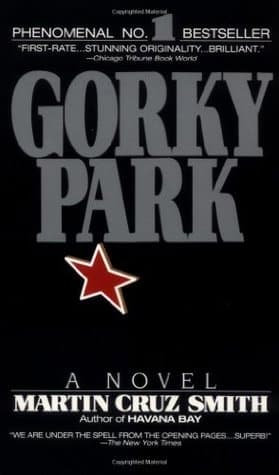
In Moscow, where truth is a luxury, Chief Investigator Arkady Renko investigates a triple murder of unrecognizable victims in Gorky Park, navigating international espionage and Soviet corruption to find a killer before he becomes the next casualty.
In the snowy landscape of Moscow's Gorky Park, three bodies are found, their faces skinned and fingertips removed. Chief Investigator Arkady Renko of the Moscow Militia is called to the scene. The initial investigation is hampered by the KGB, led by Major Pribluda, who tries to take over the case, suggesting the victims are foreign and thus outside Renko's jurisdiction. Renko is determined to identify the victims and uncover the truth. He observes the unique ice-skate marks near the bodies, a detail that hints at a carefully staged crime. Despite pressure from his superiors and the KGB, Renko begins his work, navigating the political challenges of Soviet-era Moscow.
Renko's investigation quickly focuses on identifying the victims. One victim is tentatively identified as an American, a fact that increases the KGB's interest and attempts to control the investigation. Renko learns of a suspicious American fur importer, William Kirwill, who has arrived in Moscow, claiming to be searching for his brother, a dissident. Renko finds a distinctive watch on one of the victims, a vital clue. He also encounters Irina Asanova, a beautiful and mysterious dissident, whose connection to the victims is unclear but immediately intriguing. The KGB's presence becomes more overt, with Major Pribluda constantly shadowing Renko and trying to discredit his findings.
William Kirwill, a New York police detective, confronts Renko, insisting that one of the victims is his brother, a known anti-Soviet activist. Kirwill's aggressive pursuit of answers clashes with Renko's methodical approach, but they find common ground in their desire for justice. Through Kirwill, Renko learns about a planned defection involving a high-ranking Soviet official and an American contact. This information suggests the murders are part of a larger international conspiracy, involving not just the KGB but American intelligence agencies. Renko begins to suspect that the defection plot went wrong, leading to the triple murder.
Irina Asanova, a dissident and a friend of one of the victims, becomes a central figure in Renko's investigation. She is beautiful, intelligent, and suspicious of authority. Renko discovers she was romantically involved with one of the American victims and was part of the defection plan. Her apartment is bugged, and she is under KGB surveillance. As Renko investigates, he realizes Irina is not just a witness but a key player, holding vital information about the defection and the mastermind behind the murders. Their relationship, initially adversarial, slowly develops into a mix of suspicion, attraction, and mutual reliance.
As Renko pieces together clues, he uncovers a sable smuggling operation. This illegal trade, involving valuable Siberian sables, appears to be a front for something larger and more sinister. He learns that the American victims were involved in this smuggling ring, using it to finance their activities. This discovery adds another layer of complexity to the case, suggesting that financial gain, not just political motives, might be a driving force behind the murders. The smuggling operation links back to prominent figures, both Soviet and American, indicating corruption and illicit dealings.
John Osborne, a wealthy American fur dealer, emerges as a key suspect. He is the purported American contact in the defection plot and the primary recipient of the smuggled sables. Renko and Kirwill confront Osborne, who presents himself as a legitimate businessman. However, Renko's instincts tell him otherwise. He suspects Osborne is more than he appears, possibly an intelligence agent or a double-crosser. Osborne's calm demeanor and evasive answers solidify Renko's suspicions. The confrontation reveals Osborne's deep involvement in the defection scheme and his ruthless pursuit of personal gain, regardless of the human cost.
Despite the disfigurement, Renko uses dental records, obtained through ingenious means, to identify the victims. He discovers that the bodies found in Gorky Park are not who they were initially believed to be. This revelation is a major turning point in the investigation, confirming Renko's suspicions of a carefully orchestrated deception. The true identities of the victims, one American and two Soviets, reveal a swap, designed to mislead investigators. This discovery exposes the elaborate nature of the conspiracy and the lengths to which the perpetrators went to conceal their tracks, further complicating the case.
Following the trail of the sable smuggling and the defection plot, Renko travels to New York City, ostensibly to return the furs to Osborne. This journey is dangerous, as Renko is operating outside his jurisdiction and is a target for both the KGB and Osborne's operatives. In New York, Renko finds himself in a deadly game. Osborne, realizing Renko is close to uncovering the full truth, tries to eliminate him. Renko navigates the unfamiliar streets of New York, pursued by Osborne's men, leading to a tense confrontation in a taxidermy shop, where the true nature of Osborne's plan is revealed.
The climax reveals John Osborne as the mastermind, a ruthless double agent who manipulated both American and Soviet intelligence for his own financial gain. He orchestrated the defection, the murders, and the sable smuggling, betraying everyone involved. His plan was to fake the defection of a high-ranking Soviet official, using the bodies in Gorky Park as decoys, while simultaneously profiting from the illegal sable trade. The confrontation with Renko exposes Osborne's ambition. Renko, with the reluctant help of Kirwill, corners Osborne, leading to a violent struggle where Osborne tries to escape justice.
In a final struggle, John Osborne is killed, ending his reign of manipulation and murder. Renko returns to Moscow, having solved the Gorky Park murders, but the victory is bittersweet. He has exposed the corruption and brutality of both Soviet and American intelligence, leaving him cynical. His relationship with Irina Asanova remains complicated; she decides to defect, leaving Renko behind. The case has cost him dearly, professionally and personally. Renko is left to grapple with the moral ambiguities of his world, knowing that while he brought one killer to justice, the larger systems of power and deception remain in place.
The Protagonist
Renko begins as a disillusioned but committed investigator and ends as a more profoundly cynical man, having seen the depths of international corruption, but still holding onto his core sense of justice.
The Supporting
Irina evolves from a guarded and suspicious witness to a trusting ally of Renko, ultimately choosing to defect for her freedom.
The Supporting
Kirwill transitions from an antagonistic outsider to a reluctant but effective partner for Renko, driven by familial loyalty and a sense of justice.
The Antagonist
Osborne's true manipulative nature is gradually exposed, culminating in his demise as the architect of the entire conspiracy.
The Supporting
Pribluda remains largely static, a representation of the unyielding Soviet bureaucracy and its constant threat to individual integrity.
The Supporting
Iamskoy remains a static character, serving as a representation of the suffocating bureaucracy Renko operates within.
The Supporting
Golodkin remains a powerful, shadowy figure, his motivations and actions driving much of the political intrigue.
The Supporting
Levi remains a consistent source of scientific expertise and moral support for Renko.
The novel portrays the corruption and deception in the Soviet totalitarian system. From the KGB's constant interference in Renko's investigation to the politically motivated cover-ups by his superiors, truth is suppressed in favor of party loyalty and maintaining appearances. This theme is clear when Renko discovers the victims' identities have been obscured, highlighting the state's willingness to erase individuals and manipulate facts for political gain. The narrative shows how personal integrity is a dangerous liability, forcing characters like Renko to navigate a labyrinth of lies.
“In Russia, a man was guilty until proven innocent, and even then he was usually guilty.”
A central theme is Renko's pursuit of truth and justice in a world that resists both. Despite facing immense pressure from the KGB and his superiors, Renko refuses to compromise his investigation or accept convenient lies. The disfigured bodies in Gorky Park symbolize the deliberate obscuring of truth, forcing Renko to uncover identity and motive through forensic work and deduction. The novel suggests that while institutional justice may be flawed, individual integrity and the pursuit of factual truth remain vital, even if the personal cost is high.
“He was a detective. That was his job. He didn't care about politics. He cared about the dead.”
The struggle between individual freedom and state control is a recurring motif, particularly through Irina Asanova and the concept of defection. Irina, as a dissident, battles surveillance and the threat of imprisonment, representing the yearning for personal liberty in a restrictive society. The entire plot revolves around a defection scheme, highlighting the extreme measures individuals take to escape state control and the state's equally extreme measures to prevent it. Renko himself, while a state employee, chafes against the limitations imposed on him, embodying the individual's quiet resistance within the system.
“Freedom was a luxury only the dead could afford.”
Gorky Park portrays the moral ambiguity of the Cold War, where neither side is entirely 'good' or 'evil.' While the Soviet system is repressive, the American characters, particularly John Osborne, are shown to be equally ruthless and manipulative, driven by greed and self-interest. The novel blurs the lines between espionage and organized crime, suggesting that both superpowers engage in morally dubious actions. This theme challenges simplistic interpretations of the conflict, revealing a complex web of deceit and betrayal that transcends national loyalties and ideological divides.
“There were no heroes in the Cold War, only survivors.”
Arkady Renko's character embodies a sense of isolation and loneliness. His integrity sets him apart from his corrupt colleagues and superiors, leaving him with few allies and fewer confidants. His failed marriage and the atmosphere of distrust in Soviet society further contribute to his solitude. This theme is clear in his dedication to the dead, finding a form of connection and purpose in uncovering their stories when he struggles to connect with the living. The novel suggests that in a system built on suspicion, genuine human connection is rare and fragile.
“He was a man alone, in a city of millions.”
The central mystery device that drives the plot.
The three bodies found in Gorky Park, with their faces skinned and fingertips removed, serve as the primary inciting incident and a powerful symbol. This meticulous disfigurement is a deliberate act of obfuscation, designed to prevent identification and mislead investigators. It immediately establishes the high stakes and the cunning nature of the perpetrator, forcing Renko to rely on less conventional forensic methods and his own deductive brilliance to uncover the truth. The 'blank' identities of the victims represent the broader theme of truth being suppressed by state power.
A red herring and a parallel criminal enterprise.
The sable smuggling operation functions as both a crucial plot point and a sophisticated red herring. Initially, it appears to be a primary motive for the murders, drawing attention away from the true defection plot. However, it is eventually revealed to be intertwined with the larger conspiracy, used by John Osborne to finance his activities and provide a plausible cover. This device adds layers of complexity to the narrative, showcasing the intricate web of illicit dealings and international intrigue that Renko must unravel, demonstrating how crime can mask espionage.
The underlying international conspiracy driving the murders.
The planned defection of a high-ranking Soviet official is the central mechanism around which the entire plot revolves. It provides the ultimate motive for the murders and links all the key characters: the victims, Irina, Kirwill, and Osborne. The defection plot creates a high-stakes international backdrop, drawing in the KGB, FBI, and various intelligence agencies. It serves as a catalyst for the double-crosses and betrayals that characterize the story, highlighting the moral ambiguities and dangerous games played during the Cold War.
A small but crucial piece of evidence.
A distinct, expensive watch found on one of the victims, initially dismissed by others, becomes a vital clue for Renko. Its specific brand and origin help him narrow down the victims' identities and connect them to the larger smuggling operation and John Osborne. This device emphasizes Renko's meticulous attention to detail and his ability to see significance in seemingly minor clues that others overlook. It's a classic detective story element that allows Renko to make crucial breakthroughs against overwhelming odds.
“The past was a country no one could visit. The future was a country no one could know.”
— Arkady's reflection on time and memory.
“In Russia, there are no accidents. Only incidents.”
— A cynical observation about the nature of events in the Soviet Union.
“Gorky Park was meant to be a place of joy, but death found its way in.”
— The central irony of the murder location.
“The truth was a weapon, and like all weapons, it could be turned against its wielder.”
— Arkady contemplating the dangers of pursuing truth.
“He knew the rules of the game, and the first rule was that there were no rules.”
— Arkady's understanding of the chaotic power dynamics.
“The city itself was a conspirator, its shadows and alleys hiding secrets that no one would ever fully uncover.”
— Description of Moscow as a character in itself.
“Sometimes the best way to hide something was to put it in plain sight.”
— A thought on deception and misdirection.
“Justice was a luxury, and in their world, luxuries were in short supply.”
— A bleak assessment of the legal system.
“He had seen enough death to know it had a thousand faces, and none of them were pretty.”
— Arkady's experience with the grim reality of his profession.
“The wind carried whispers of things unsaid, promises broken, and lives lost.”
— Evocative description of the atmosphere in Gorky Park.
“Every lie created a new truth, a parallel universe where the deception was real.”
— Arkady's thoughts on the pervasive nature of lies.
“Fear was a constant companion, a shadow that never quite left, even in the brightest light.”
— Exploration of the psychological impact of living under a repressive regime.
“He was a detective, not a philosopher, but sometimes the two were difficult to separate.”
— Arkady's internal struggle with the deeper implications of his work.
“The cold was more than just a temperature; it was a state of mind, a way of life.”
— Description of the pervasive cold in Moscow, both literal and metaphorical.
Ready to see how well you understood this book? Take our interactive quiz with 10 questions.
Biography coming soon.







